Film Review: The Death of Stalin (dir by Armando Iannucci)


2017’s The Death of Stalin opens in Moscow in 1953.  Joseph Stalin (Adrian McLoughlin) calls into Radio Moscow and demands that he be sent a recording of the piano concerto that has just been performed live.  The only problem is that no one bothered to record it while it was being performed.  In a panic, the head of Radio Moscow announces that no one — not the musicians, not the exhausted conductor, and certainly not the audience — is allowed to leave until the orchestra has performed again.

Indeed, one of the recurring themes of The Death of Stalin is that everyone is terrified of their beloved dictator.  The orchestra fears being executed for failing to recreate their performance.  The members of the Central Committee fear being the next person to be purged from the ranks of Stalin’s government.  The two guards that are posted outside of Stalin’s bedroom are so terrified of interrupting Stalin and getting on his bad side that they don’t investigate when they hear Stalin collapsing to the floor.  When Stalin is found unconscious, the only doctors available are young and inexperienced because Stalin recently exiled all of the good doctors from Moscow.  Even after Stalin dies from a cerebral hemorrhage, his reign of terror continues as all the members of his household staff are promptly executed to keep anyone from learning either the exact details of Stalin’s death or the way that the members of the Central Committee responded to his passing.

The Death of Stalin is a dark comedy that follows the members of the Central Committee as they scramble to protect their own positions after Stalin’s death.  The humor comes from watching historical figures like Nikita Khrushchev, Vyacheslav Molotov, Lavrenti Beria, and Georgy Malenkov act like panicked junior executives who are desperately trying to save their own jobs during a corporate takeover.  Of course, the stakes are a bit higher.  Whoever succeeds Stalin will undoubtedly want to execute every other contender for the post.  As with so many of Armando Iannucci’s works, the humor comes from watching very powerful people act in very immature and petty ways.  While Malenkov (Jeffrey Tambor) tries to convince people that he actually is in charge, the brutal Beria (Simon Russell Beale) tries to bully his way into power and the wily Khrushchev (Steve Buscemi, giving one of his best performances) waits for his moment to strike.  (Beria, it should be noted, is one of history’s greatest monsters and the film, while a comedy, does not shy away from his depravity.)  Molotov (a hilarious Michael Palin) is so loyal to the Party that he says that Stalin was absolutely correct to have his wife executed just to then have Beria show up and reveal that Molotov’s wife is still alive.  Meanwhile, Stalin’s idiot son (Rupert Friend) claims that it’s all an American plot while the rest of the Central Committee laughs at him behind his back.  Only Georgy Zhukov (Jason Isaacs) seems to have full control of his emotions and his actions and it’s not a surprise to learn that, long after the events depicted in this film, purged from the Party.  In The Death of Stalin, the leaders of Russia are obviously scared of anyone who is too competent at their job.

The Death of Stalin is not only a satiric portrayal of petty bureaucrats.  It’s also a darkly humorous look of life in a dictatorship, where everyone is at the whim of whoever happens to be in charge at any given time.  The film is full of power-hungry narcissists who use their ideology and their nationalism as a shield for their own ambitions.  Everyone wants to control someone else.  Even as mourners pass by Stalin’s coffin, they’re given orders on how to properly grieve and move.  The film ends with a series of pictures of various people either having their faces scratched or, in some cases, just vanishing.  In a free country, failure leads to humiliation.  In a dictatorship,  it leads to non-existence as the formerly prominent are suddenly erased from a history that no longer has a place for them.  Ironically, of all the original leaders of communist Russia, it was Molotov who lived the longest.  He was 96 when he died in 1986.  If not for Stalin’s sudden death, he probably would have been purged and executed at the age of 63.

On this May Day, with so many people currently trying to rehabilitate the reputations of the 20th Century’s worst dictators, The Death of Stalin is must-watch.
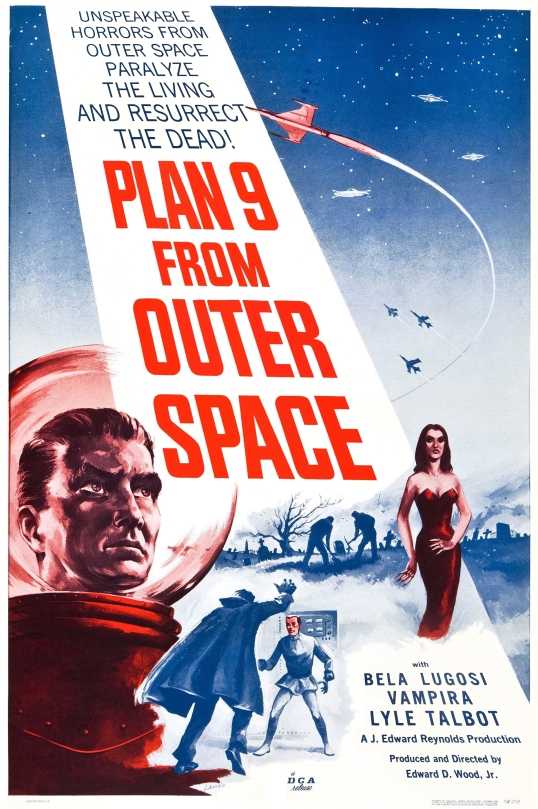
 

Horror on the Lens: Plan 9 From Outer Space (dir by Edward D. Wood, Jr.)


Viewing Plan 9 From Outer Space during October is a bit of a tradition around these parts and here at the Shattered Lens, we’re all about tradition.  And since the 100th anniversary of the birth of Ed Wood, Jr. is just a five days away, it just seems appropriate to watch his best-known film.

Speaking of tradition, this 1959 sci-fi/horror flick is traditionally cited as the worst film ever made but I don’t quite agree.  For one thing, the film is way too low-budget to be fairly judged against other big budget fiascoes.  If I have to watch a bad movie, I’ll always go for the low budget, independent feature as opposed to the big studio production.  To attack Ed Wood for making a bad film is to let every other bad filmmaker off the hook.  Ed Wood had his problems but he also had a lot of ambition and a lot of determination and, eventually, a lot of addictions.  One thing that is often forgotten by those who mock Ed Wood is that he drank himself to death and died living in squalor.  The least we can do is cut the tragic figure some slack.

Plan 9 From Outer Space is a ludicrous film but it’s also a surprisingly ambitious one and it’s got an anti-war, anti-military message so all of you folks who have hopped down the progressive rabbit hole over the past few years should have a new appreciation for this film.  I mean, do you want the government to blow up a Solarnite bomb?  DO YOU!?

Also, Gregory Walcott actually did a pretty good job in the lead role.  He was one of the few members of the cast to have a mainstream film career after Plan 9.

Finally, Plan 9 is a tribute to one man’s determination to bring his vision to life.  Ed Wood tried and refused to surrender and made a film with a message that he believed in and, for that, he deserves to be remembered.

Now, sit back, and enjoy a little Halloween tradition.  Take it away, Criswell!

Can you prove it didn’t happen?

WELL, CAN YOU!?

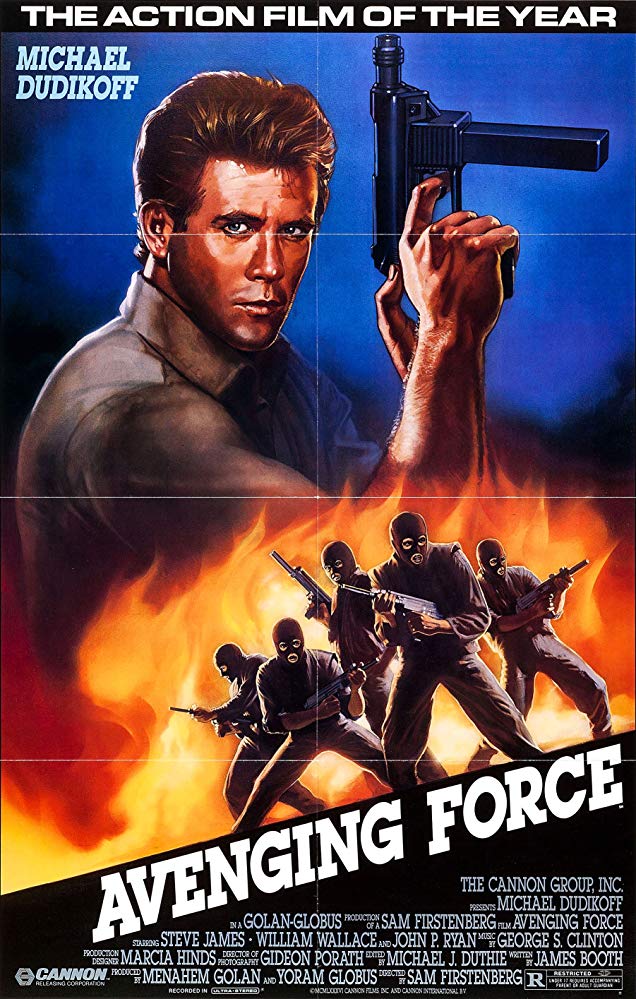
Avenging Force (1986, directed by Sam Firstenberg)


If you think this year’s elections are messed up, just watch Avenging Force and see what happens when two martial artists run against each other for a seat in the U.S. Senate.

Steve James plays Larry Richards, a former military commando who is now running for the Senate in Louisiana.  His opponent is Wade Delaney (Bill Wallace), who is described as being “the South’s youngest senator” and who is also secretly one of the world’s greatest martial artists.  Wade is a member of Pentangle, a Neo-Nazi cult that is made up of wealthy businessmen and other politicians.  When Larry and his family are invited to ride a float in the most sedate Mardi Gras parade of all time, the Pentangle attempts to assassinate him.  While Larry escapes injury, his oldest son does not.

Larry’s best friend, Col. Matt Hunter (Michael Dudikoff), is also in town and Hunter just happens to be another one of the world’s greatest martial artists.  (This film leave you wondering if there’s anyone in Louisiana who isn’t secretly a ninja.)  Matt tries to protect Larry and the remaining members of his family from Pentangle.  Matt fails miserably.  With Larry and the entire Richards family now dead, Matt goes deep into the Louisiana bayou, seeking both to rescue his sister (who has been kidnapped and is set to be sold at some sort of Cajun-run sex auction) and avenge Larry’s death.

As you probably already guessed, Avenging Force is a Cannon Film and it’s crazy even by that company’s fabled standards.  It’s not often that you come across a movie about a U.S. Senator who is also a neo-Nazi ninja who spends his spare time stalking people through the bayous.  What makes this plot point even more memorable is that no one in Avenging Force seems to be shocked by it.  Matt isn’t surprised in the least when an elected official suddenly lunges out of the fog and attempts to drown him in swamp water.  Of course, Senator Delaney isn’t the only villain in the film.  In fact, he’s not even the main bad guy.  That honor goes to Prof. Elliott Glastenbury (John P. Ryan), who lives in a huge mansion and who sees himself as a real-life version of The Most Dangerous Game‘s General Zaroff.  He not only wants to secretly rule the world but he also wants to hunt human prey in the bayou.  When Matt shows up at Glastenbury’s mansion, he is greeted by a butler who complains that Matt hasn’t bothered to wipe the blood off his shirt before showing up.

Avenging Force was originally planned as a sequel to Invasion U.S.A., with Chuck Norris reprising the role of Matt Hunter.  When Norris declined to appear in the film, the connection to Invasion U.S.A. was dropped and Michael Dudikoff of the American Ninja films was cast in the lead role.  (Of course, they didn’t bother to change anyone’s name in the script so the hero of Avenging Force is still named Matt Hunter, even if he’s not meant to be the same Matt Hunter from Invasion U.S.A.)  What Dudikoff lacked in screen presence, he made up for in athleticism and Avenging Force features some Cannon’s best fight scenes.  The plot may be full of holes but the idea of ninjas in the bayou is so inherently cool that it carries the film over any rough patches.

The critics may not have loved Avenging Force when it was first released but it holds up well as a fast-paced and weird action film.  It is perhaps the best Cajun ninja film ever made.