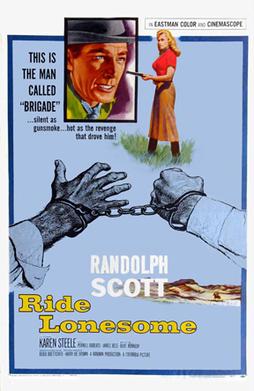
 In the western Ride Lonesome, Randolph Scott plays Ben Brigade. Brigade is a bounty hunter. The only thing that really differentiates him from the outlaws that he captures is that he gets paid for what he does. When Brigade arrests a young outlaw named Billy John (James Best), he gives Billy just enough time to send word to his older brother, Frank (Lee Van Cleef). And when Brigade starts to lead Billy John back to the town of Santa Cruz, he takes his time and fails to cover his tracks, almost as if he is intentionally making time for Frank to eventually catch up to him. Along the way, Brigade meets up with three others, a woman named Carrie (Karen Steele) and two outlaws named Boone (Pernell Roberts) and Whit (James Coburn). Carrie is searching for her husband while Boone and Whit want to arrest Billy John themselves so that they can turn him in and get a pardon for their own crimes.
Ride Lonesome is one of the best of the many films that Randolph Scott made with director Budd Boetticher. Boetticher specialized in making fast-paced westerns that had deceptively simple plots. Nobody in a Boetticher western was totally good or totally bad and that’s certainly the case with Ride Lonesome, which may seem like a typical western but which is actually a character study of 6 very different people. Brigade is often only the hero by default and his actions are often as ruthless as those of the men who are tracking him. It’s only after he meets and gets to know Carrie that he starts to seriously consider that his plans could lead to innocent people getting hurt. Billy John may be a wanted killer but, underneath his bravado, he’s just someone trying to live up to his brother’s example. Meanwhile, Boone and Whit may be outlaws but they turn out to be the most morally upright characters in the film. Ride Lonesome takes a serious look at frontier justice and suggests that maybe black-and-white morality isn’t all that it’s cracked up to be.
Needless to say, the cast is great. Randolph Scott was one of the great western heroes and Karen Steele, Pernell Roberts, Lee Van Cleef, and James Best all turn in memorable performances. Best of all is James Coburn, making his film debut and showing that, even at the start of his career, he was already the epitome of cool. Ride Lonesome is one of the best of of the Boetticher/Scott westerns and a true classic of the genre.


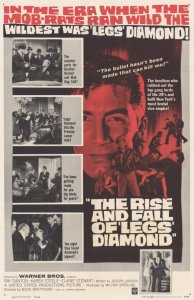 It’s the 1920s. Prohibition is the law of the land and gangsters control the streets of New York City. Jack Diamond (Ray Danton) and his tubercular brother, Eddie (Warren Oates), arrives in town. Jack and Eddie are small-time jewel thieves but Jack has ambitions to be something more. He works with his girlfriend, Alice (Karen Steele), as a dance instructor but he dreams of being the most powerful mobster in the world. His first step is to get a job working as a bodyguard for New York crime lord (and fixer of the 1919 World Series), Arnold Rothstein (Robert Lowery). Though Rothstein never trusts him, Jack works his way into his inner circle and even gets a nickname. Because he is a dancer, he is renamed “Legs” Diamond.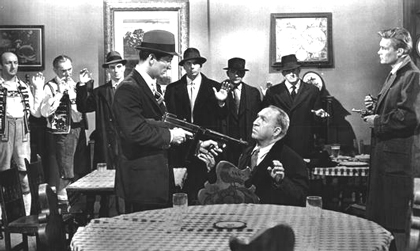
 Through the Shattered Lens