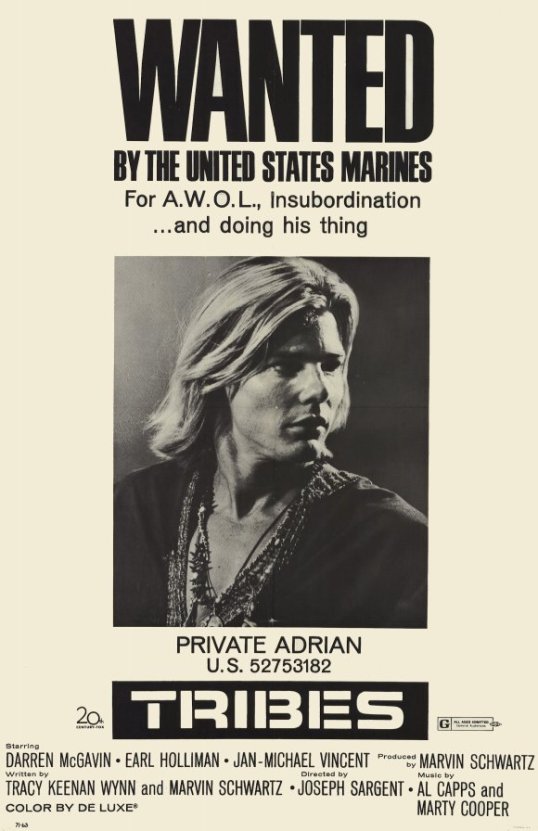
Adrian (Jan-Michael Vincent) is a free-spirited hippie who has just been drafted into the Marine Corps. As soon as he arrives at the boot camp, his long hair get shaved off and he immediately starts to get under the skin of Sgt. DePayster (Earl Holliman). While Adrian scored higher than anyone else in the platoon on his aptitude tests, he is also a pacifist who refuses to shoot a gun and teaches all of the other draftees how to meditate. DePayster wants to put Adrian in the Motivational Platoon, a disciplinary unit where Adrian probably would not survive. Trying to protect Adrian while also trying to turn him into a killing machine is his drill instructor, Sgt. Drake (Darren McGavin).
Tribes has never been released on DVD/Blu-ray but it can be watched on YouTube. Not surprisingly, for a movie that was made for television in 1970, there are some parts of the film that have not aged well. I doubt a real drill instructor, even one who secretly draws pictures and admires Adrian’s rebellious spirit, would have put up with Private Adrian for as long as Drake does in this movie. Again because of its television origins, the language has been cleaned up. You won’t mistake this one for Full Metal Jacket. On the plus side, Earl Holliman gives a good performances as the hardass sergeant and Jan-Michael Vincent shows why he was expected to be such a big star before he ended up becoming one of Hollywood’s greatest cautionary tales. Best of all is Darren McGavin, who is even better as the tough but fair Sgt. Drake than he was in his two best known roles, the father in A Christmas Story and reporter Carl Kolchak.
Tribes was a huge rating success when it aired, leading to it getting a limited theatrical release. In Europe, it was retitled The Soldier Who Declared Peace.
Burt Reynolds labored for years in the Hollywood mines, starring in some ill-fated TV series (his biggest success on the small screen was a three-year run in a supporting role on GUNSMOKE) and movies (nonsense like SHARK! and SKULLDUGGERY) before hitting it big in John Boorman’s DELIVERANCE. Suddenly, the journeyman actor was a hot property (posing butt-naked as a centerfold for COSMOPOLITAN didn’t hurt, either!), and studios were scurrying to sign him on to their projects. WHITE LIGHTNING was geared to the Southern drive-in crowd, but Reynolds’ new-found popularity, along with the film’s anti-authority stance, made it a success across the nation.
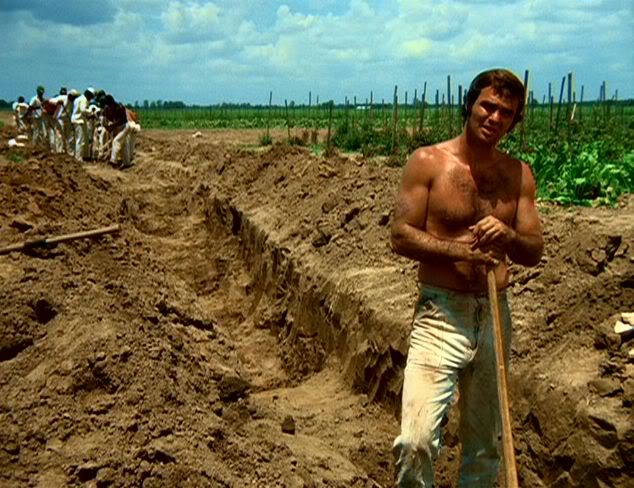
WHITE LIGHTNING takes place in rural Arkansas, and Gator McKluskey (Burt) is doing a stretch in Federal prison for running moonshine. His cousin visits and tells Gator his younger brother Donnie was murdered by Sheriff J.C. Connors, the crooked boss of Bogan County. A raging Gator tries to escape, but is immediately caught, so he…
A year after co-starring in Deliverance, Burt Reynolds and Ned Beatty reunited for another movie about life in the backwoods, White Lightning.
White Lightning starts with two hippies, bound and gagged and floating in a canoe. While a banjo plays in the background, two rednecks use a shotgun to blow the canoe into pieces. They watch as the hippies drown in the swamp. It turns out that one of those hippies was the brother of legendary moonshiner and expert driver, Gator McCluskey (Reynolds). Gator is doing time but when he hears that his brother has been murdered, he immediately realizes that he was probably killed on the orders of corrupt Sheriff J. C. Connors (Ned Beatty). The Feds arrange for Gator to be released from prison, on the condition that he work undercover and bring them enough evidence that they can take Connors down.
Back home, Gator works with a fellow informant, Dude Watson (Matt Clark), teams up with local moonshiner, Roy Boone (Bo Hopkins), and has an affair with Roy’s girl, Lou (Jennifer Billingsley). Connors and his main henchman, Big Bear (R.G. Armstrong) both suspect that Gator and Dude are working for the government. Since this is a Burt Reynolds movie, it all ends with a car chase.
A classic of its kind and a huge box office success, White Lightning set the template for almost every other film that Burt Reynolds made in the 1970s and 80s. There is not much to the movie beyond Burt’s good old boy charm and Ned Beatty’s blustering villainy but if you’re in the mood for car chases and Southern scenery, White Lightning might be the movie for you. Joseph Sargent also directed the New York crime classic, The Taking of Pelham One Two Three, and he gives White Lightning an edginess that would be lacking from many of Burt Reynolds’s later movies.
For tomorrow’s movie a day, it’s the sequel to White Lightning (and Burt Reynolds’s directorial debut), Gator.
I have to admit that I had ulterior motives for reviewing the film Hustle as a part of Embracing the Melodrama. I was already planning on reviewing another 1975 film about prostitutes, one that I had recently watched on Netflix. That name of that film was Hustling and, for whatever reason, it amused me to imagine being alive in 1975 and going to see Hustle at a movie theater and then coming home, turning on TV, and finding myself watching a film called Hustling.
So really, if I was going to review one of those films, I had to review the other, right? It made perfect sense at the time!
Anyway, as for Hustling, it’s a film about prostitutes in New York and the wealthy magazine writer who decides to interview them for an article. Watching the film, what I immediately noticed was that, even though the film had a properly gritty feel to it, none of the characters ever cursed and, for a film about sex workers, there was no nudity. Though the characters continually talked about getting beaten up by their pimps, all of the violence occurred off-screen. Even more importantly, whenever something dramatic happened, the scene would fade to black. It was almost as if the movie was pausing for an unseen commercial.
Which, of course, it was. Hustling was made for television and, as I watched it, it was easy for me to imagine that I was actually watching the latest Lifetime original film. It certainly followed a pattern that should be familiar to anyone who has ever watched a movie on Lifetime. Wanda (Jill Clayburgh, giving an excellent performance) is a veteran prostitute who, after being arrested for the hundredth time, is told that the charges against her will be dropped if she allows herself to be interviewed by magazine writer, Fran Morrison (Lee Remick). At first Wanda refuses but, after her pimp refuses to pay her fine and suggests that she should just accept spending a few months in jail, Wanda reconsiders and accepts Fran’s offer.
The rest of the film charts Fran and Wanda’s unlikely friendship. Wanda tells Fran what it’s like to be prostitute. Fran encourages Wanda and the other prostitutes to stand up for their legal rights. Wanda deals with a society that looks down on her. Fran deals with a boyfriend (Monte Markham) who can’t understand why she’s so concerned about a bunch of prostitutes. Wanda considers going back to her pimp. Fran considers exposing all of the “respectable” men who use prostitutes.
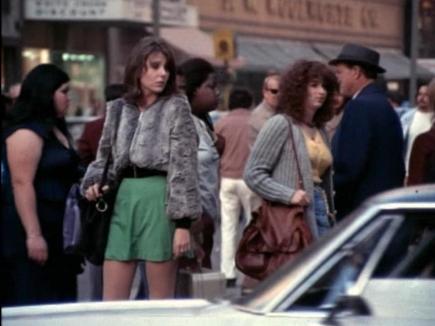
So, Hustling is pretty predictable and, not surprisingly, rather dated but it’s also a fairly effective portrait of life on the margins of society. Lee Remick is stuck playing a one-note character but Jill Clayburgh is great in the role of Wanda. If nothing else, Hustling was filmed on location in some of the sleaziest parts of 1970s New York City and therefore, the film serves as a bit of a historical document.
For those wishing to check it out, the film’s currently available on Netflix.
Way back in January, I was looking for something to have playing on TV in the background while I cleaned the house. I went from station to station until I finally came across a movie that I had never seen before. It featured a young-looking Sally Field wandering through a house that was full of stuffy-looking old people. She stepped out of the house and dived, fully clothed, into a swimming pool. Everyone in the house was shocked. Then, one abrupt jump cut later, a bearded David Carradine was hijacking an ice cream truck…
“What the Hell is this?” I wondered. Checking on the guide, I discovered that I was watching Maybe I’ll Come Home In The Spring, a made-for-television film from 1971. I put off the cleaning for thirty minutes so that I could watch the rest of the film.
(And, if you know how obsessive compulsive I am about keeping the house clean, then you know what a big deal that was for me.)
After watching the rest of the film on television, I rewatched Maybe I’ll Come Home In The Spring on YouTube. And I decided that I so wanted to recommend this film that I ended up launching Embracing the Melodrama Part II specifically so I’d have an excuse to write about Maybe I’ll Come Home In The Spring.
Sally Field, who was 25 when this film was first broadcast but looked and sounded much younger, plays Dennie Miller. After being raised in the oppressively conformist atmosphere of the suburbs, Dennie ran away from home and spent a year with her hippie boyfriend, Flack (David Carradine). As we learn from several flashbacks that are almost randomly spread out across the film, Dennie’s life with Flack largely amounted to panhandling and trying to avoid the police. Finally getting tired of living with the controlling Flack, Dennie waited until Flack was busy panhandling and then hitched a ride with a leering truck driver.
Arriving back home after being gone for a year, Dennie is welcomed back by both her father (Jackie Cooper) and her mother (Eleanor Parker). However, Dennie finds it difficult to readjust to her parent’s conformist life style. Meanwhile, her emotionally distant parents are uncomfortable with talking to Dennie about the previous year and instead, cho0se to act as if she never left. Dennie’s younger sister, Susie (Lane Bradbury), both looks up to and resents Dennie. Susie got used to a life without Dennie and now that Dennie has returned, Susie is forced back into the role of being the kid sister.
Meanwhile, Flack isn’t prepared to let Dennie go. Fully committed to both the idea of living a life separate from conventional society and to his own self-image as being the ultimate counter-cultural alpha male, Flack travels across California, intent on tracking Dennie down and convincing her to once again leave with him.
I loved Maybe I’ll Come Home In The Spring. While it is undeniably dated (as any 1971 film about hippies would be), it also touches on a lot of themes and issues that never go out of date. Whether it was the complicated relationship between Dennie and Susie or Dennie’s discovery that, as a result of her year spent on her own, all of her parent’s friends now view her as being somehow “damaged,” there is so much about Maybe I’ll Come Home In The Spring that rings painfully true.
And while Maybe I’ll Come Home In The Spring does not hesitate to point out the hypocrisy of Dennie’s parents and their friends, it’s equally critical of Flack and his countercultural posturing. In the end, you come to realize that Flack and Dennie’s father are actually two sides of the same coin. They’re both convinced that their way is the only way and that they — and they alone — know what is best for Dennie. In the end, Maybe I’ll Come Home In The Spring is less about mainstream vs. hippie and more about Dennie’s struggle to be an independent woman in a world that doesn’t value or appreciate female independence.
Maybe I’ll Come Home In The Spring is a good film and guess what? You can watch it below!





 Through the Shattered Lens