Film Review: Michael Collins (dir by Neil Jordan)


Released in 1996, Michael Collins tells the story of the early 20th century struggle of Ireland to gain independence from Britain.

Liam Neeson stars as Michael “Mick” Collins, the revolutionary leader who perfected the use of guerilla warfare against the British and then, in the greatest of ironies, found himself fighting some of his former allies during the Irish Civil War.  Aidan Quinn plays Mick’s friend and fellow revolutionary, Harry Boland.  Both Harry and Mick fall in love with Kitty Kiernan (Julia Roberts).  Stephen Rea shows up as Ned Broy, a member of the Dublin police department who is inspired by Mick’s words to become a double agent.  Charles Dance has a cameo as the fearsome Soames, a British intelligence agent who is sent to Ireland to violently put down the Irish insurgency.  Finally, Alan Rickman plays Eamon de Valera, who goes from being one of Mick’s strongest allies to being one of his fiercest rivals.  The film follows Collins from the Easter Rising of 1916 to his eventual assassination in 1922, providing a look at the history of Ireland that is as much directed towards those outside of Ireland as those on the inside.

When watching Michael Collins, it helps to have a working knowledge of Irish history.  Otherwise, it can occasionally be a bit difficult to keep track of who is angry with who at any particular point in time.  Of course, it should be noted that the movie itself is not exactly historically accurate.  In the film, the gentle and likable Ned Broy becomes a victim of British bloodlust.  In real life, Ned Broy outlived Michael Collins by several decades and died peacefully at the age of 84.  For that matter, the film presents Eamon de Valera as being coldly Machiavellian and it suggests that de Valera was jealous of Mick’s popularity.  Though both Rickman and director Neil Jordan later said it wasn’t intentional, the film also seems to suggest that de Valera played a role in Collins’s assassination.  While Eamon de Valera remains a controversial figure for many reasons (including his neutrality during World War II), Jordan has said that he feels de Valera was not necessarily treated fairly in Michael Collins and indeed, de Valera — who plays as big a role in the founding of the Irish republic as anyone — is portrayed as often being ineffectual and unwilling to truly put himself at risk to fight the British.  De Valera’s relationship with Collins was undoubtedly more complex than portrayed in this film but, when one makes a movie for an international audience, nuance is often the first thing that’s abandoned.

Seen today, 29 years after it was released, Michael Collins is an impressively made film that has a few inescapable flaws.  It’s gorgeous to look at, full of moody shots of dark Dublin streets.  The violence is often shocking and Jordan doesn’t shy away from considering the moral implications of Collins’s guerilla warfare.  Michael Collins doesn’t make the mistake of blindly celebrating violence, which would be a valuable lesson for the world’s current crop of self-styled revolutionaries if they were only willing to hear it.  Having gotten used to seeing Liam Neeson cast in one generic action film after another, it was interesting to watch Michael Collins and see what a good actor he truly could be.  Even in 1996, He was perhaps a few years too old to playing a man who was only 31 when he died but Neeson still plays the role with a ferocious charisma that makes him believable as a leader.  His scenes with Aidan Quinn have a joie de vivre that brings out the both in best actors.  Alan Rickman is memorably sinister as Eamon de Valera and Stephen Rea’s gentle style makes Ned Broy into a truly tragic figure.  That said, the very American Julia Roberts feels miscast as Kitty Kiernan.  One gets the feeling that she was cast solely for her box office appeal.  Every film, the feeling goes, needs  a love story and those love stories need to be between people with familiar faces and Roberts is such a familiar face that her every appearance in the film feels like a distraction from the story being told.  That said, the film captures the excitement and danger of being in the middle of history-making events.  It’s a historical epic that’s never boring and manages to hold the viewer’s interest.

Michael Collins is ultimately a flawed but entertaining look at the early days of the Irish republic.
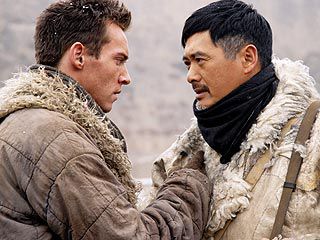

THE CHILDREN OF HUANG SHI (2008, directed by Roger Spottiswoode) – The incredible story of English adventurer George Hogg!


My wife and I love to watch movies based on true stories and real people. I had never heard of English adventurer George Hogg prior to 2008, which was the year that I found out that Chow Yun-Fat would be co-starring in a film based on Hogg’s life. Chow Yun-Fat is my favorite living actor, so I make it a point to watch every film he’s in. I even watched the horrendous DRAGONBALL EVOLUTION, even worse, at the theater!! As I looked into the film a little closer all those years ago, I thought Hogg’s real-life story had major dramatic potential. I thought the cast was interesting as well. At the time, Jonathan Rhys Meyers was starring in a popular series called THE TUDORS, where he played King Henry VIII. He seemed ready for the role of real-life hero George Hogg. Radha Mitchell had somewhat recently starred in the Denzel Washington action film, MAN ON FIRE, which I’m very fond of. And coolest of all, outside of Chow Yun-Fat of course, was the casting of Michelle Yeoh, another favorite of mine from her years in Hong Kong films. She and Chow Yun-Fat were captivating together in CROUCHING TIGER HIDDEN DRAGON. And finally, I saw that Roger Spottiswoode would be directing the film. The veteran filmmaker has had a hand in some of my favorite films, from editing HARD TIMES with Charles Bronson, to writing 48 HRS. with Nick Nolte and Eddie Murphy, and even directing the excellent action film SHOOT TO KILL, with Sidney Poitier and Tom Berenger. I was expecting a good, solid film!

The story opens in 1937 with British reporter George Hogg (Jonathan Rhys Meyers) worming his way into Nanjing, China, to cover the Japanese occupation of the city. While there, he sees and photographs horrific violence against the Chinese people. Discovered by the Japanese authorities with his camera, it appears he’s headed for execution. But luckily for Hogg, just prior to having his head lopped off, he’s saved by Chinese resistance fighter Chen Hansheng (Chow Yun-Fat). Injured while escaping, Hogg awakens under the care of Nurse Lee Pearson (Radha Mitchell), who is also taking care of Chen. Needing time to recover from his wounds, Hogg is sent to a boy’s orphanage in Huang Shi by Chen and Nurse Pearson. Initially reluctant to get involved with the 60 or so orphans, Hogg eventually begins to try to improve their living conditions. He begins teaching the boys, and he comes up with a way to guarantee needed food and supplies in town when he strikes a deal with the local merchant, Mrs. Wang (Michelle Yeoh). Over the next few years, it seems like everything is going pretty well. But when the Chinese nationalist military camps outside of the orphanage, and some of their leaders come to the orphanage and threaten to take some of the boys into their army by force, Hogg makes the decision that they should leave the area. Thus begins an incredible journey over mountains and through deserts to the city of Shandan, which is approximately 700 miles away, but in an area that Hogg believes will be safe. Will they be able to survive the journey and start all over again with a better life in Shandan?

With THE CHILDREN OF HUANG SHI, Director Roger Spottiswoode delivers a solid, but certainly not spectacular, movie. Even if writers James MacManus and Jane Hawksley take some liberties with the actual events for dramatic effect, the basic story about George Hogg working to improve the lives of these orphaned boys and then leading them to safety across hundreds of miles of treacherous terrain and away from war, is good stuff. I’m glad I watched it, and at times it managed to stir up my emotions. With that said, there still seemed to be something missing. I don’t think the movie as executed ever moved me as far emotionally as I hoped it would. Thinking back on the performances, I found Jonathan Rhys Meyers only adequate as George Hogg. He delivers some good moments, but I didn’t leave the film really thinking that much about him. I’d say that Radha Mitchell did better with her role as the nurse who saves Hogg, and who eventually falls in love with him. Her character had some complexity, and I felt myself more drawn to Mitchell’s performance. Chow Yun-Fat and Michelle Yeoh are in true supporting roles. Chow has so much natural charisma, that you can’t help but like his character, and anytime he’s on-screen things pick up. He’s actually quite fun as resistance fighter “Jack” Chen. The problem is that there are large chunks of the film’s 125-minute running time that he’s nowhere to be seen. Much of the same can be said of Michelle Yeoh. She’s very effective when she’s on the screen, but it seems she has even less screen time than Chow. It’s hinted at that her character has hidden layers of depth, but there just isn’t enough time to really develop anything. She is so beautiful, and I did enjoy every time she appeared. Thanks to cinematographer Xiaoding Zhao (THE CURSE OF THE GOLDEN FLOWER), there are many times that the movie itself is just so beautiful to look at. It appears that some of the most beautiful places on earth were captured for this film.

THE CHILDREN OF HUANG SHI has an awesome ace up its sleeve at the very end of the film, and by the end I mean the credits. As the credits begin to roll, some of the actual boys who lived through these harrowing experiences, now older men, appear on screen and provide some of their memories of the journey and of Hogg. That kind of stuff always gets to me and it did here as well. It was a strong ending to a decent film.

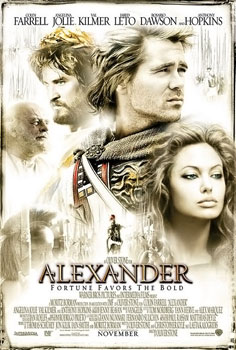
Film Review: Alexander (dir by Oliver Stone)


Before I really get into talking about Oliver Stone’s 2004 film, Alexander, I should acknowledge that there’s about four different version of Alexander floating around.

There’s the widely ridiculed theatrical version, which was released in 2004 and which got terrible reviews in the United States, though it was apparently a bit more popular in Europe.  This version of Alexander was a notorious box office bomb and Oliver Stone’s career has never quite recovered from it.  Though Stone’s still making movies, it’s been a while since he’s really been taken as seriously as you might expect a two-time Oscar winner to be taken.  The box office and critical failure of Alexander is a big reason for that.

There’s also the Director’s Cut of Alexander, which is slightly shorter than the version that was released into theaters and which apparently emphasizes the action scenes more than the original film did.  For an Oscar-winning director to release a director’s cut that’s actually shorter than the version that he originally sent into theaters is rare and it shows that the film’s subject matter was one that Stone was still trying to figure out how to deal with.

There is also the “Final Unrated Cut,” which lasts 3 hours and 45 minutes and which Stone described as being the Cecil B. DeMille-version of the story.  At the time the Final Unrated Cut was released in 2007, Stone announced that he had put everything back into the movie and that we were finally able to see the version of the story that he wanted to tell.

However, Stone apparently still left some stuff out because, in 2009, we got the Final Cut, which goes on for 206 minutes and which, once again, apparently includes everything that Stone wanted to put in the original cut of the film.  The Final Cut has actually received some positive reviews from critic who were not impressed by the previous three versions of Alexander.

For the record, I saw the Director’s Cut.  This is the second of the Alexanders, the one that runs 167 minutes.  Some day, I’ll watch the four hour version and I’ll compare the two films.  But for now, I’m reviewing the 167-minute version of Alexander.

Anyway, Alexander is a biopic of Alexander The Great, the Macedonian ruler who took over a good deal of the known world before mysteriously dying at the age of 32.  The film jumps back and forth in time, from an elderly Ptolemy (Anthony Hopkins, going about as overboard as one can go while playing an ancient Greek historian) narrating the story of Alexander’s life to Alexander (Colin Farrell) conquering his enemies to scenes of Alexander’s mother (Angelina Jolie) and one-eyed father (Val Kilmer) shaping Alexander’s outlook on the world.  Along the way, we discover that Alexander was driven to succeed and forever lived in the shadow of his father.  We also discover that he may have been in love with his general, Hephaistion (Jared Leto), even though he married Roxane (Rosario Dawson, who gets to do an elaborate dance).  We also discover that no battle in the ancient world could begin before Alexander gave a long speech and that all of the Macedonians spoke with thick Irish accents.  Stone has said that the Irish accents were meant to signify that the Macedonians were working-class.  Other people say that, because Colin Farrell’s accent was so thick, the rest of the cast had to imitate him so he wouldn’t sound out-of-place.

And here’s the thing — yes, Alexander is a big, messy film that is often incoherent.  Yes, the cast is full of talented actors, every single one of which has been thoroughly miscast.  Yes, it’s next to impossible to keep track of who is fighting who and yes, it’s distracting as Hell that all of the Macedonians have Irish accents and that Angelina Jolie uses an Eastern European accent that’s so thick that it almost becomes a parody of itself.  All of these things are true and yet, I was never bored with the director’s cut.  The sets were huge, the costumes were beautiful, and the cast was eccentric enough to be interesting.  Val Kilmer, Angelina Jolie, and Anthony Hopkins all go overboard, chewing every piece of scenery that they can get their hands on.  Colin Farrell alternates between being determined and being wild-eyed.  Jared Leto allows his piercing stare to do most of his acting.  Even Christopher Plummer shows up, playing Aristole with a North Atlantic accent.  No one appears to be acting in the same film and strangely, it works.  The ancient world was chaotic and the combination of everyone’s different acting styles with Stone’s frantic direction actually manages to capture some of that chaos.

Oliver Stone apparently spent years trying to bring his vision of Alexander’s life to the big screen.  Watching the film, it’s a classic example of a director becoming so obsessed with a story that they ultimately forgot why they wanted to tell it in the first place.  Stone tosses everything he can at the cinematic wall, just to see what will stick.  Is Alexander a tyrant or a misunderstood humanist?  Is he a murderer or a noble warrior?  Is he in love with Hephaistion or has his borderline incestuous relationship with his mother left him incapable of trusting anyone enough to love them?  The film doesn’t seem to know who Alexander actually was but it’s so desperate to try to find an answer among all of the endless battle scenes and lengthy speeches that it becomes undeniably compelling to watch.  If nothing else, Alexander gives us the rare chance to see an Oliver Stone film in which Stone himself doesn’t seem to quite know what point it is that he’s trying to make.

Alexander is a mess but there’s something fascinating about its chaos.  It’s a beautiful wreck and, as with all wrecks, it’s impossible to look away.