Retro Television Reviews: Acting Sheriff 1.1 “Pilot”


Welcome to Retro Television Reviews, a feature where we review some of our favorite and least favorite shows of the past!  On Thursdays, I will be reviewing Acting Sheriff, which aired on CBS in 1991.  The entire show is currently streaming on YouTube!

Who is Brent McCord?

Why, he’s the acting sheriff!

Episode 1.1 “Pilot”

(Dir by Michael Lembeck, originally aired on August 17th, 1991)

At a small country jail in North Carolina, the staff is waiting the arrival of the new sheriff.

Dispatcher Helen Munson (Ruth Kobart) is grumpy and sarcastic, as all older characters were required to be in 1990s sitcoms.

Deputy Judith Mahoney (Diane Delano) is a blonde badass who can’t wait to enforce the law and lock up every criminal that she sees, despite the fact that there aren’t many criminals to be found in this small, rural county.

Deputy Mike Swanson (John Putch) is the smart, responsible deputy who ran for sheriff in the last election but lost, despite his years of hard work and his likability.

Who is the new sheriff?  Why, he’s Brent McCord (Robert Goulet), a former Hollywood star who went from starring in films like Get Al Capone and A Fistful of Courage to appearing in books with titles like Where Are They Now?  Brent once was a huge star but, after several failed television shows and a handful of divorces, he has returned home and …. run for sheriff, for some reason.

When he does show up at the jail, Brent swaggers around like John Wayne and says things like, “Is the slime infecting the streets waiting for me?”  Brent McCord doesn’t know anything about being a county sheriff but he does know how to act like a character in a movie.  He walks into the station, draws his gun, and accidentally fires it.

Deputy District Attorney Donna Singer (Hilary B. Smith) is not happy about the new sheriff.  She tells him that, “Someone should put a tent over you and charge admission!”  She’s even less happy when a banker robber (Lee Tergesen) escapes from the jail, largely due to the sheriff’s incompetence.  Fortunately, Deputy Mike remembers a scene from Get Al Capone where McCord’s character recaptured a bank robber by leaving more money around for him to steal.  Following the same strategy, Mike recaptures the bank robber but he allows Sheriff McCord to have all the credit.  Mike’s a good guy who doesn’t hold a grudge over a silly thing like losing an election to a B-actor.

This pilot, which was produced by Disney for CBS, aired once and that was it.  It didn’t lead to anymore episodes and, watching the pilot, it’s easy to see why.  The pilot struggles to combine the relatively realistic portrayal of a county jail with the over-the-top performance of Robert Goulet.  Occasionally, Goulet will get a laugh by delivering his pompous lines in the most self-serious manner possible.  But, far too often, the character is so cartoonish that the other actors don’t seem to know how to keep up with Goulet’s hammy performance.  (At times, Goulet seems to be copying William Shatner’s technique without any of Shatner’s charm.)  Probably the biggest problem is that pilot fails to answer the most obvious question that one would have while watching the show.  Why did Brent McCord run for sheriff?  Does he want to do a good job or was he just bored?  Does he care about the county or did he just want to see his name in the newspapers?  Is he well-intentioned or just buffoonish?  The pilot doesn’t seem to know and, as a result, audiences would never find out.


A Horror Blast From The Past: The Wave (dir by Alexander Grasshoff)


First broadcast in 1981, The Wave stars Bruce Davison as Ben Ross, a high school social studies teacher who conducts a social experiment.

Frustrated by the fact that he can’t answer his students questions of how the German people could have allowed the Holocaust to occur, Ben decides to teach his students a lesson.  He starts by introducing a bunch of seemingly arbitrary rules to his classroom, concerning the proper way for students to sit at their desks and to address the teacher.  Ben is somewhat surprised to see how quickly his students adapt to the new rules, even taking pleasure in showing how quickly and efficiently they can follow orders.  The next day, Ben tells his students that they are now members of The Wave, a national youth organization with membership cards and a secret salute.

And that is when all Hell breaks loose.  Ben only meant to show his students what it’s like to be a member of a mass movement but the students take The Wave far more seriously than Ben was expecting.  Soon, other students are joining The Wave.  When the popular football players announce that they are a part of The Wave, others are quick to flock to the organization.  The formerly likable David turns into a fanatic about bringing people into the organization.  Robert, a formerly unpopular student, revels in his new job of reporting anyone who deviates from the rules of The Wave.  When a student reporter writes an article that is critical of the organization, she and the school paper are targeted.  Has Ben’s social experiment spiraled out of control?

42 years after it was originally produced, The Wave remains a powerful and sobering look at how people can be manipulated into doing things as a mob that they would never do as an individual.  If anything, the film feels more relevant today than it probably did in 1981.  The character of Robert, in particular, is a familiar one.  He’s someone with no self-esteem who latches onto a movement and finds his identity by taking down others and accusing them of failing to follow the rules.  One can find people like Robert all over social media, searching through old posts for any example of wrongthink that they can broadcast all through their social world.  It’s tempting to smirk at how quickly the members of The Wave sacrificed their freedom and their ability to think for themselves but it’s no different from what we see happening in the real world every day.  (Indeed, if the film had been made just two or three years ago, The Wave would probably be the people policing whether or not the rest of us were observing quarantine and wearing our facemasks correctly.)  People like to feel that they belong to something, even if that means sacrificing their humanity in the process.

Featuring a good performance from Bruce Davison as the well-meaning teacher who is both fascinated and terrified by the experiment that he’s set in motion, The Wave can be viewed below:

Film Review: Atlas Shrugged, Part II (dir by John Putch)


2012’s Atlas Shrugged: Part II picks up where Part I left off.

The time is still the near future.  (Part I specifically set the story as taking place five years into the future.  Part II declines to use a specific date but it does feature some news personalities playing themselves so it’s still clearly only meant to be a few years from 2012.)  The economy has gotten even worse.  The poor are only getting poorer while the rich are getting richer.  Under the direction of Head of State Thompson (Ray Wise) and his main economic advisor, Wesley Mouch (Paul McCrane), the government has nationalized nearly every business.  Halfway through the film, Thompson declares a national emergency and uses the Fair Share Law to invoke Directive 10-289.  All inventors, businessmen, and other creative people are required to sign their patents over to the government and to stop trying to develop now techniques.  Wages are frozen.  No one can be fired and no one can be hired.  Creative thinking is discouraged.  Asking questions or expressing doubt is forbidden.  People are encouraged to snitch on anyone not following the Directive.  Thompson and Mouch insist that it’s for the “good of the people,” and anyone who disagrees runs the risk of being dragged into court and sent to prison for ten years.  Meanwhile, gas now costs $42.00 a gallon.  One of the funnier moments of the film features someone paying $865.72 to fill up a truck.

Dagny Taggart (Samantha Mathis), the Vice President of Taggart Transcontinental Railways, is still trying to discover who invented an experimental motor that she found hidden away in a mine.  The motor could potentially change the way that goods are transported but it appears to be missing one component.  Unfortunately, all of the great scientists and inventors have been vanishing, with many of them leaving behind notes that ask, “Who is John Galt?”  Meanwhile, Dagny’s lover, Hank Rearden (Jason Beghe), fights to protect Rearden Metal from being taken over by the government and Dagny’s brother, James (Patrick Fabian), sells out to Wesley Mouch with the end result being that there’s no one left at Taggart Transcontinental with the intelligence or the experience necessary to keep two trains from colliding in a tunnel.

Given that Ayn Rand herself was an atheist who wrote very critically of religion, it’s interesting how much of Atlas Shrugged: Part II feels like one of those evangelical films where the Rapture comes and the entire world falls apart because all of the believers have suddenly vanished.  In the case of Atlas Shrugged, the world falls apart because all of the creatives and all of the leaders of industry and all of the innovative thinkers have abandoned it so that they can create a new community with John Galt.  (They’ve “stopped the motor of the world.”)  In many ways, this is the ultimate in wish fulfillment, a way of declaring, “They’ll miss me when I’m gone!”  Indeed, the majority of people who keep a copy of Rand’s novel displayed on their bookcase do so because they believe that they would be one of the lucky ones who was approached by Galt.  No one expects that they’ll be the person left behind to try to run the railroad.  It’s a bit like how like the most strident Marxist activists always assume they’ll be the ones organizing the workers as opposed to being a worker themselves.

Not surprisingly, the same critics who attacked Part I didn’t care much for Atlas Shrugged Part II.  When I first saw it, I thought the film was a bit too long and I was annoyed that, with the exception of a few minutes at the end, the film didn’t really seem to move the story forward.  At the same time, just as with the first film, I appreciated the fact that the second film was proudly contrarian in its portrayal of the government as being inherently incompetent.  After all, this was 2012, back in the “good government” era, when a lot of people still reflexively assumed that the government was staffed only by hyper-competent policy wonks who knew what they were doing and who were only concerned with making sure that “the trains ran on time,” to borrow an old expression.

Rewatching the film this weekend, I have to say that I actually appreciated Atlas Shrugged Part II a bit more than the first time I watched it.  Yes, Part II was still a bit too long and the domestic drama between Hank and his wife fell flat but Part II is still a marked improvement on the first film.  Some of that is because Part II had a higher budget than Part I and, as a result, it didn’t look as cheap as the first film.  The corporate offices looked like actual corporate offices and the factories looked like real factories.  Secondly, the second film had an entirely different cast from the first film.  Samantha Mathis, Jason Beghe, and especially Patrick Fabian were clear improvements on the actors who previously played their roles.  That’s especially important when it comes to Mathis and Beghe because, as opposed to the first film, Part II convinces the viewer that  Dagny and Hank actually are as important as they think they are.  When the trains collide in the tunnel, the viewer never doubts that Mathis’s Dagny could have prevented the disaster if not for the government’s attempts to force her out of her own company.  As well, the viewer never doubts that Beghe’s Hank would fight to the end to protect his business, even if it means prison.  One wouldn’t have necessarily believed that while watching the first film.

Finally, having lived through the COVID era, the film’s portrait of government overreach and incompetence feels a lot more plausible when watched today.  One doesn’t have to be a fan of Rand’s philosophy or agree with her solutions to see the parallels between Directive 10-289 and the policies that led to children being kept out of schools and numerous small business having to shut their doors.  In an era when most people’s faith in governmental institutions has been broken to such an extent that it might never be fixed in our lifetime, Atlas Shrugged Part II resonates.  Whereas the film once felt subversive, now it feels downright prophetic.

Horror Film Review: Jaws 3 (dir by Joe Alves)


So, this is a strange one.

As the title states, this 1983 film is the third sequel to the Jaws.  As I pointed out in my reviews of the first film and Jaws 2, the first two films all starred Roy Scheider and took place on Amity Island.  In fact, it can be argued that Amity Island was almost as important to the success of the first two films as the shark.  When Martin Brody conquered his fears and got out on the water, it wasn’t just to destroy a shark.  It was also to protect a community under siege.

Well, there’s no such community like Amity Island in Jaws 3.  And there’s no Roy Scheider either.  Instead, our hero is Martin Brody’s son, Mike.  Mike is all grown up and working as the senior marine biologist at SeaWorld Orlando.  Mike is now played by a very young and very bearded Dennis Quaid.  This leads to an interesting situation where Mike — who grew up in New England and whose father was a former New York City cop — has a very pronounced Texas accent.  That’s not a complaint, of course.  I’m from Texas so I’m always happy to see (and hear) a fellow Texan in a movie.  Plus, Dennis Quaid’s a likable actor.  Still, it somehow seems appropriate that the third installment of the Jaws franchise would feature a New Yorker growing up to be a Texan.  I mean, if we’re going to accept that the same outlandish event can keep happening to the members of the same family then I guess anything’s possible.

The other Brody son, Sean, is also featured in the film.  Sean is now played by John Putch and, when he first shows up to visit Mike, he’s dressed like he just got off work at the rodeo.  You have to kind of wonder if maybe the trauma of nearly getting killed in Jaws 2 led to both of the Brody boys rejecting their New England roots and embracing the ways of the west.  Say what you will about Texas and all the states in between El Paso and Los Angeles, we’re pretty much shark free.

Anyway, this is a Jaws films so you can guess what happens.  A big shark ends up getting loose in SeaWorld and Mike tries to close the park down, just to be overruled by the park’s manger, Calvin Bouchard (Lou Gossett, Jr.).  Meanwhile, a hunter named Philip Fitzroyce (Simon MacCorkindale) announces that he will personally track down and kill the shark.  As you might guess just from the fact that his last name is Fitzroyce, Philip is arrogant and speaks with a posh accent.  Mike takes an immediate dislike to him but I was happy whenever Philip showed up, mostly because Simon MacCorkindale gave a performance that was so over-the-top that it was fun to watch.  Whenever MacCorkindale and Gossett got together in the same scene, the film stopped being about the shark and instead became a contest to see who could overenunciate their dialogue with the most style.

(In the end, MacCorkindale won, but only narrowly.  A few years after Jaws 3, Gossett would co-star in The Principal and would go on to secure his spot in the Overenunciation Hall Of Fame by pronouncing the word “drugs” in such a way that I first thought he was talking about druids.)

One of the reasons why Jaws 3 seems odd when watched today is because it was originally released in 3-D.  (In fact, the film’s original title was Jaws 3-D.)  As a result, there’s a lot of scenes of people either walking towards or pointing directly at the camera.  Whenever anyone holds up a pole or a harpoon or anything similar, you know that they’re going to end up pointing the end of it straight at the viewer.  At the start of the film, when the shark bites a fish in half, the fish’s head ominously floats closer and closer to the camera.  There’s a lot of scenes that were obviously designed to make audiences says, “Oh my God!  I feel like I could reach out and touch it!” but, in the non-3D version, those scenes are just weirdly paced and slightly out-of-focus.  (At one point during the film, the picture was so blurry that I actually checked to make sure I had my contacts in.)

Add to that, there’s more than few scenes where it’s obvious that the shark has been superimposed into the action.  If the first two Jaws films featured big sharks, Jaws 3 often seems to feature a cartoon shark.  In short, what may have been impressive in a theater in 1983 to an audience wearing special glasses is far less impressive when you’re watching the movie at 3 in the morning on AMC.

The other weird thing about this film is that it was actually filmed at SeaWorld Orlando.  I’m going to guess that the film was supposed to serve as a 99-minute advertisement and a lot of time is devoted to people talking about how much they love SeaWorld.  At the same time, this film also features the park’s manager refusing to shut down the park and basically putting everyone’s life in danger.  If anything, the film’s main message seems to be, “If you go to SeaWorld, you’ll die.”  You have to wonder if some executive lost his job after Jaws 3 came out.

Anyway, Jaws 3 is a silly movie that never quite comes to life in the way that both Jaws and, to a lesser extent, Jaws 2 did.  Yes, the shark’s ruthless and we get to hear the familiar music and there’s some cute dolphins but otherwise, the movie itself is just kind of bland.  Rumor has it that Jaws 3 was originally going to be a comedy called Jaws 3 People 0.  That probably would have made for a more memorable movie but, at the same time, I got some good laughs out of the scene where the tourists in an underwater tunnel realized that a shark was watching them so, in the end, everything worked out for the best.

Val’s Movie Roundup #14: Hallmark Edition


l_love-is-a-4-letter-word-with-dvd-case-hallmark-fd56

Love Is a Four Letter Word (2007) – This was really disappointing. I could say something like shit is also a four letter word, but disappointing is really a better word for this movie. The movie is about three couples. The first are newlyweds. The second are an older couple who are getting divorced. The third are the two divorce attorneys handling each end of the older couples divorce. What’s so disappointing is that the beginning of this movie has some of the sweetest, affectionate, and genuine moments between two lovers I have seen in a Hallmark movie. However, it then just degenerates into a pitiful attempt at a 1940’s screwball comedy while trying to keep the emotions of the beginning of the film alive on top of cutting between the three couples to tell their stories in parallel. It doesn’t work! Why couldn’t the movie have stuck with the couple we met at the beginning and just tell a nice simple love story. Is it a sin to follow the principle of KISS when making a movie? That being Keep It Simple Stupid! There’s no reason to waste your time on this movie.

JacksFamilyAdventures1s2

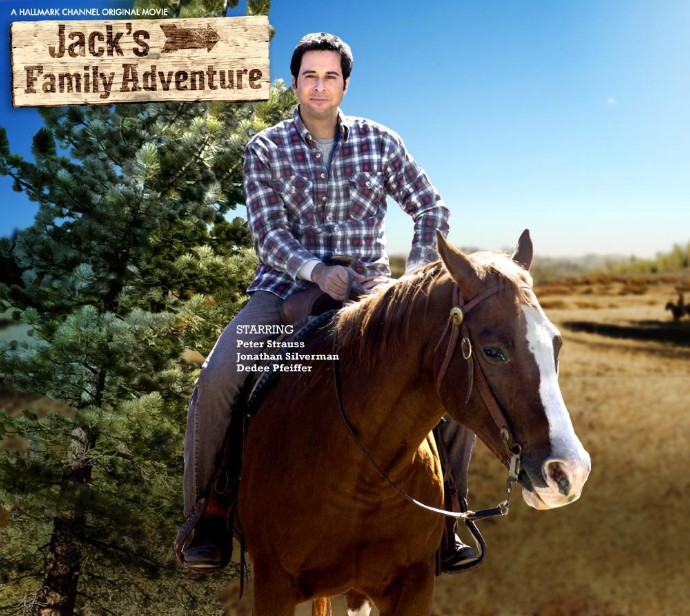
Jack’s Family Adventure (2010) – This movie is okay, but that’s the problem. It’s so okay that it’s not really worth watching. A guy played by Peter Graves dies and leaves a cabin to his son played by Jonathan Silverman. No! I’m not going to make that joke.

Jack decides to take his family to said cabin because we all know that getting away from city life brings families together. While they are adjusting, a guy called Wild Bill (Peter Strauss) shows up. They all have a good time and the family emerges closer than when they arrived. That’s it! Like I said, it’s just so okay that boredom sets in pretty quickly. Not worth seeking out, but you’ll survive if you end up seeing it.

1968647_Dear_Prudence_2008

Dear Prudence (2008) – Was Jane Seymour always this annoying? I think I have only seen her in Live And Let Die (1973). She is like the living embodiment of the wig from Lies Between Friends. Awful! Well, Seymour plays some TV show host who basically shows you life hack type stuff. She gets sent to a special place in Wyoming. It doesn’t take long for her to stumble upon a crime. I didn’t even know this was going to be a murder mystery going into it. I mean it doesn’t have “murder” or “mystery” in the title to tell me. Sadly, that is so common with Hallmark that I was honestly surprised when she came across blood on a carpet. However, I wasn’t surprised to quickly figure out this was actually shot in Canada. Little tip for Canadian productions trying to pretend they are in the U.S.: Don’t have your Canadian actors say the word “about”.

So in between fantasies of Jason showing up to cut off Seymour’s head, a murder mystery unravels. It’s not an interesting mystery by any means, but Seymour and her trusty side kick giving out all these stupid household remedies for everything will suck any fun you might derive from it right out of it. Skip!

murder101_collegecanbemurder2

Murder 101: College Can Be Murder (2007) – This is easily the best entry in the Murder 101 series. Despite “murder” being in the title of the movie, it is actually all about Dick Van Dyke trying to get his bike back after it is stolen. It’s an old bike that has a lot of sentimental value. He of course hires his friend played by his son Barry Van Dyke to help him track it down. It’s so funny! Dick keeps seeing people on campus riding his bike around and tries to chase them down. He never catches them. He goes to the gym to try and get in shape in the futile hope that it will help him catch the thief. Barry keeps going around questioning people all about this bike. Posters are put up all around campus. There’s even a scene where Dick is in class and has what I can only describe as a spidey sense that his bike is nearby. He runs out into the hall to find the thief waiting for him on his bike. A hilarious chase ensues.

I would have totally loved this movie if that was what it was actually about. In reality, the stolen bike is just a subplot. I made up some of that stuff, but he does keep chasing after the bike, goes to the gym to gain speed, and Dick does put up posters. Why couldn’t the movie be one long joke about that bike? Instead, some college professor gets killed by eating an orange. At first it’s natural causes, but after Barry does some dumpster diving to retrieve the orange (how the hell did he do that?) they discover he was poisoned. It all winds up revolving around the saying of “publish or perish”. It’s a decent entry in the Murder 101 series, but I really wanted that bike movie instead.

6 Late Reviews: Atlas Shrugged: Part II, Project X, This Means War, A Thousand Words, Trouble With The Curve, The Vow


2012 is quickly drawing to an end and seriously, where has the time gone?  I’m seriously running behind in reviewing all of the films that I’ve seen in 2012 so, in the interest of getting caught up, here are six quick (and late) reviews of some of the film that I saw earlier this year.

(Fortunately, seeing as how we live in a world of Netflix, DVD, Blu-ray, and On Demand service, it’s never too late to review any film.)

1) Atlas Shrugged: Part II (dir by John Putch)

Picking up where the first Atlas Shrugged ended, Atlas Shrugged: Part II continues to tell the story of how America was ruined by elitist do-gooders and how the smartest people in the world responded by uttering the phrase, “Who Is John Galt?” and then vanishing.

There’s a lot of bad stuff that I could say about Atlas, Shrugged Part II.  I could point out how close to nothing actually happens in the film.  I understand that this is the second part of a proposed film trilogy but, seriously, that’s all that Atlas Shrugged Part II has in common with The Two Towers.  With the exception of the great Patrick Fabian (who has a lot of fun playing a weasel), the cast isn’t memorable and the film is full of slow spots.

Part II was made by a different director and with a far more professional cast than Part I but that proves to be a mistake.  Part of the odd charm of Atlas Shrugged, Part I was that it was such a low-budget, pulpy affair.  Atlas Shrugged, Part II is a lot more slick and, as a result, it feels a lot less sincere.

That said, I couldn’t help but enjoy Atlas Shrugged, Part II because, much like For Greater Glory, the film flew so completely in the face of conventional cinematic political statements.  Atlas Shrugged Part II might not be a great (or even a good) film but it annoyed all of the professional film critics and it’s always amusing to watch the same critical establishment that embraced Avatar whine about how any other film is too heavy-handed.

Am I, therefore, recommending Atlas Shrugged, Part II?  Not really.  I tend to learn towards the Libertarian point of view when it comes to politics and even I found the film to be tedious.  That said, if you ever really want to annoy your wannabe hipster friend (the same one who leaves a hundred comments a day over at the A.V. Club), Atlas Shrugged, Part II might make the perfect holiday present.

2) Project X (dir by Nima Nourizadeh)

In California, two loathsome high school students — Costa (Oliver Cooper) and J.B.(Johnathan Daniel Brown) — throw a birthday party for their friend Thomas (Thomas Mann).  Thomas is a stereotypical nice guy but he’s also friends with Costa and J.B. and that makes him loathsome by association.  The party quickly gets out of control and eventually, houses are destroyed and a SWAT team is called in to restore order.

Oh!  And the entire film is presented as being a bunch of “found footage.”  What that means is that we have to sit through all the usual stuff of people acting awkward in an attempt to convince us that we’re not watching a movie, despite the fact that we clearly are.

Project X fails on so many levels that it’s hard to even know where to begin.

It’s impossible to sympathize with the film’s three main characters and let’s just say that Oliver Cooper is no Jonah Hill.

There’s no real build-up to the party getting out of control and hence, most of the film’s comedy falls flat.  This is the type of film where a midget happens to show up at the party just so he can then be tossed into an oven.  Uwe Boll would probably call that genius but, for the rest of us, it just feels like desperation on the part of the filmgoers.  (You can just here them going, “Midgets are always funny!”)

Finally, worst of all, Project X is the latest film to use the whole found footage gimmick as a way to try to explain away the fact that it’s just not a very good movie.  Seriously, mediocre filmmakers of America — it’s time to move on to a new gimmick!

3) This Means War (dir. by McG)

Two CIA Agents (Chris Pine and Tom Hardy) set aside their friendship and go to war when they realize that they’re both attempting to win the heart of the same woman (played by Reese Witherspoon).   Fortunately for them, they’ve both managed to fall in love with the one woman in the world too stupid to realize that there’s anything strange going on.  Chelsea Handler is also in this film.  She plays Witherspoon’s best friend and delivers all of her lines in this kind of depressed monotone that seems to suggest that she’d rather be co-starring with Whitney Cummings.  Eventually, a lot of things explode and well, anyway … bleh.

Seriously, This Means War has absolutely no right to be as boring as it is.  Outside of this film, Chris Pine and Tom Hardy are both hot, Reese Witherspoon is likable, and even Chelsea Handler still makes me laugh on occasion.  And yet, when all four of these people are put together in the same film, the end result is a mess that just gets more and more annoying with each passing second.

Most of the blame has to be put on the director.  McG never finds a consistent tone for his film and never seems to be sure whether he’s parodying or celebrating the conventions of both action films and romantic comedies.

Myself, I just find it funny that people actually address him as “McG.”

4) A Thousand Words (dir by Brian Robbins)

Jack (Eddie Murphy) is a literary agent who talks too much.  So, one night, a tree with a thousand leaves magically appears in his back yard.  Every time that Jack says a word, a leaf falls off of the tree.  Luckily, Jack happens to know a new age guru (Cliff Curtis) who explains that once every leaf has fallen, Jack will die.  As a result, the formerly glib Jack learns the importance of saying just the right thing and he becomes a better husband, father, and son as a result.

A Thousand Words is just as bad as the above plot synopsis suggests and that’s all that really needs to be said about it.  Wasting a thousand words talking about A Thousand Words would be a mistake indeed.

5)  Trouble With The Curve (dir by Robert Lorenz)

Widower Gus (Clint Eastwood) is an aging baseball scout who is slowly losing his eyesight.  Mickey (Amy Adams) is Gus’s daughter, a driven lawyer who has a strained relationship with her father.

And together … they solve crimes!

No, not really.  Instead, Gus is given one last assignment and Mickey, who is both concerned for her father’s well-being and wants to try to repair their fractured relationship, accompanies him.  At first, Gus doesn’t want Mickey around but she eventually proves her worth to him and gets to flirt with a young scout played by Justin Timberlake as well.  So, it’s a win-win.

 I don’t know much about baseball (beyond the fact that my sister Erin yells at the TV a lot whenever the Rangers are playing) but Trouble With The Curve is such a predictable movie that you really don’t have to know much about the game to be able to follow the plot.  That said, Trouble With The Curve might be predictable but it’s also a genuinely sweet and likable film.  Timberlake and Adams make for a really cute couple and it’s always fun to watch Eastwood growl at a world that never fails to disappoint him.

6) The Vow (dir by Michael Sucsy)

Paige (Rachel McAdams) and her husband Leo (Channing Tatum) are in a horrific car accident.  Paige is sent flying through the windshield and when she recovers consciousness, she no longer remembers being married or anything else about her life after she first met Leo.  While Leo attempts to get Paige to fall in love with him for a second time, Paige’s parents (Sam Neill and Jessica Lange) attempt to convince her to divorce him and return to her previous life as a pampered law student with a rich fiancée (played by Scott Speedman).

The Vow is a lot like Trouble With The Curve in that it’s totally predictable but, at the same time, it’s so sweet and likable that anyone who complains about the film being too predictable probably doesn’t have a heart.  Rachel McAdams and Channing Tatum have a lot of chemistry and anyone who complains that this film is too much like a Lifetime movie has obviously never experienced a really great Lifetime movie.