Lisa Marie Reviews An Oscar Nominee: In The Name Of The Father (dir by Jim Sheridan)


One thing that I’ve come to realize is that Irish-Americans (like myself) have been guilty of idealizing the Irish Republican Army in the past.

We tend to view the IRA as being freedom fighters, battling against the occupation and standing up against religious bigotry.  The truth of the matter is that the IRA was a violent organization whose actions often made things even worse for the Catholics in Northern Ireland.  While the IRA’s American supporters always tended to present the IRA as plotting actions against the British army, the truth of the matter is that many of the IRA’s victims were Irish citizens who were judged to either be collaborators or to not be properly enthused about the IRA in general.  The popular excuse for the IRA’s terrorism is to say that the IRA usually called and gave advanced warning before a bomb went off but really, that’s kind of a weak excuse when you think about it.  Really, the only thing that the IRA had going for it was that the British were often just as bad and even more heavy-handed when it came to dealing with the Irish.

In 1993’s In The Name of the Father, Daniel Day-Lewis plays Gerry Conlon, who is sent to London by his father, Giuseppe (Pete Postlethwaite), specifically to keep him from falling victim to the IRA.  Of course, once Gerry arrives in London, he supports himself through burglaries and spends most of his time in a state of stoned bliss with his friends.  It’s while Gerry is in London that an IRA bomb blows up a pub in Guildford.  When Gerry later returns to Belfast, he is promptly arrested and accused of being one of the four people responsible for the bombing.

Gerry protests that he’s innocent and we know that he’s innocent.  We know that, when the bomb was placed, Gerry was busy getting high with Paul Hill (John Lynch).  Paul has also been arrested and the British police are determined to get a confessions out of both him and Gerry.  The interrogation stretches for hours.  Though exhausted, Gerry refuses to confess.  Suddenly, Inspector Robert Dixon (Corin Redgrave) enters the room.  He walks up to Gerry and whispers in his ear that if Gerry doesn’t confess, “I will kill your Da.”

It’s a shocking moment because the threat is delivered without a moment of hesitation on the part of Dixon.  Dixon’s voice is so cold and so direct that, when I watched this film, I actually gasped at the line.  An exhausted and terrified Gerry confesses.  Soon, Gerry is thrown in prison.  He’s joined by his sickly father, who has been accused of being a co-conspirator.  At first, Gerry resigns himself to never being free again.  He meets Joe (Don Baker), who says that he’s the one who set the bomb and that he confessed after Gerry, Giuseppe, Paul Hill, and the other members of the so-called Guildford Four had been given their life sentences.  With Giuseppe’s health faltering, Gerry finally steps up and, with the help of an attorney (Emma Thompson), fights for his freedom.

In The Name of the Father is a powerful film, one that was based on a true story.  Gerry and his father come to represent every victim of a biased justice system and an authoritarian-minded police force.  Gerry starts the movie trapped between the two sides of the Troubles.  The IRA doesn’t trust him because he’s not a bomb-thrower.  The British distrust him because he’s Irish.  Despite his innocence being obvious, Gerry finds himself sent to prison because letting him go would be viewed as a sign of weakness.  Daniel Day-Lewis gives a passionate and charismatic performance as the impulsive and somewhat immature Gerry but the film’s heart really belongs to the late Pete Postlethwaite, playing a father who refuses to give up on either his freedom or his son.

In The Name of the Father received seven Oscar nominations, including Best Picture, Director, Actor, Supporting Actor, and Supporting Actress (for Emma Thompson).  That was also the year of Schindler’s List, which took the Oscars for both Picture and Director.  Daniel Day-Lewis lost to Philadelphia’s Tom Hanks while Postlethwaite lost to Tommy Lee Jones for The Fugitive and Thompson lost to Anna Paquin for The Piano.  1993 was a good year for movies and the Oscars, though I would have voted for Day-Lewis over Hanks.

The TSL Grindhouse: Killing American Style (dir by Amir Shervan)


Filmed in 1988 but apparently not released until 1990, Killing American Style is a low-budget variation on The Desperate Hours.

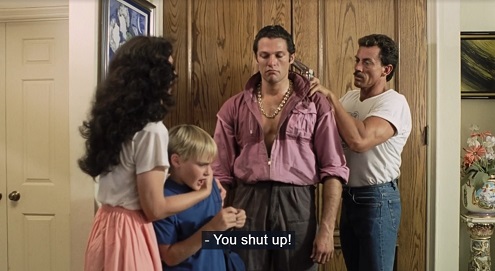
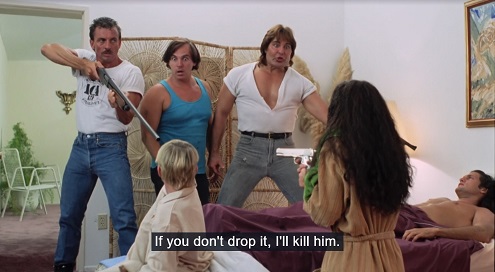
The film opens with a ruthless criminal named Tony Stone (Robert Z’Dar, of Maniac Cop fame) leading a daring robbery of an ice cream truck depot.  All of the ice cream trucks have come back for the day and, when Tony and the boys show up, the money is still being counted.  Tony quickly takes control of the situation, intimidating everyone with both his weaponry and his amazing jawline.

Unfortunately, for Tony, the robbery is not as successful as he thought.  Yes, he gets away with a lot of money but the police quickly track him down to his home, where he’s in the process of having sex with his stepmother.  Tony is arrested and, in record time, sentenced to a maximum security prison.  (Seriously, the arrest, conviction, and sentencing all seem to happen on the same day.)  Tony is put on a prison bus but then the bus itself stops to help out a stranded motorist.  The motorist turns out to be Tony’s brother, Jesse (Bret Johnston).  In the resulting shootout, all of the guards are killed but Jesse is wounded.  Tony and his associate, Lynch (John Lynch …. hey, I wonder if that’s just coincidence?), take Jesse to a nearby ranch house.

The house belongs to John Morgan (Harold Diamond), who is a long-haired kickboxing champion.  When Tony arrives, John is out of the house and beating up the dad of a kid who bulled Morgan’s son, Brandon.  John is not happy to come home and discover Tony holding his entire family hostage.  For that matter, Morgan’s son isn’t amused by it either.

Because they are being pursued by a grim and determined police detective (played by Jim Brown …. yes, the same Jim Brown who starred in countless blaxploitation films in the 70s), Tony and his men do not want to run the risk of leaving the house to retrieve the loot from the robbery themselves.  So, they send Morgan out to pick up the suitcase from Tony’s stepmother.  I guess they assume that Morgan will be able to move around inconspicuously despite the fact that Morgan is a 6’1 kick boxer with long hair.  I mean, there’s no way that Morgan is going to be able to move around without being noticed by the cops.

Of course, before Morgan can get the money, he also has to get a doctor for Jesse.  Dr. Fuji (Joselito Rescober) agrees to help, despite the fact that he never seems to be quite sure what’s actually going on with all the angry men who keep pointing guns at each other.  When Dr. Fuji mentions that he wants to kill Tony “Japanese style,” Morgan promises that he’s going to kill Tony “American style.”  It’s never really made clear what the difference is between the two styles, though the American version does seem to involve a bit more kickboxing.

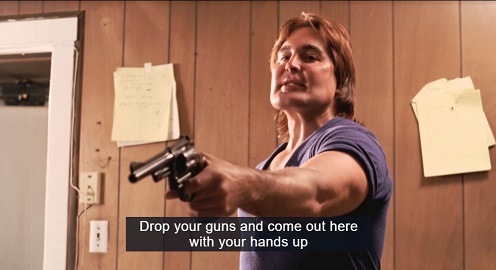
Anyway, this is an incredibly cheap and dumb movie but Robert Z’Dar seems like he’s having fun as Tony and …. well, to be honest, Robert Z’Dar is really the only reason to recommend this film.  He gives an enjoyably over-the-top performance, one that certainly contrasts with the more subdued performance of Harold Diamond.  (For his part, Diamond often seems to be struggling to stay awake.)  Hostage movies usually bore me to tears and this one had a lot of slow spots but it also had shots like the one below:

Eh.  Let’s call it even.

Quickie Review: Black Death (dir. by Christopher Smith)


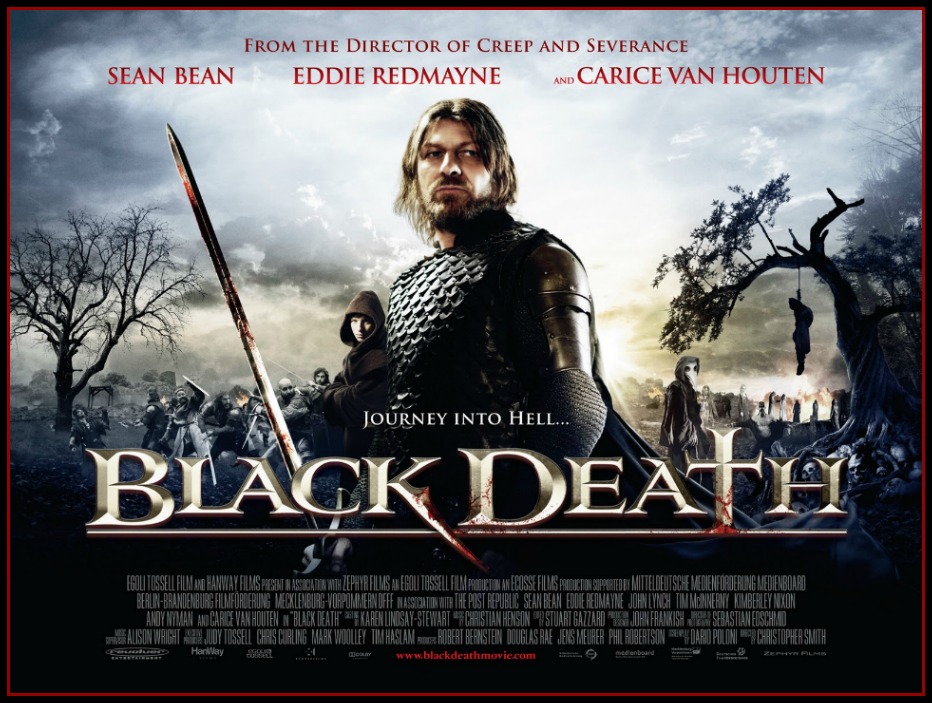
British filmmaker Christopher Smith has been flying under the radar of most of the film-going public. He’s already a filmmaker with five films to his credit of varying quality, but each showing his growth as a director with each successive release. In 2010, Christopher Smith released his sixth film in the UK with some film festival showings in the US soon thereafter. Black Death continues Smith’s work in the horror genre with this latest film a historical horror piece which tries to take a look at the subject matter of the Black Death of medieval Europe in a realistic, gritty light.

The film is set during in 1348 plague-ravaged England where a Osmund, a young monk, has a crisis of faith as he agonizes over his celibate vows to God and his love for Avrill, a young woman in town who also has feelings for Osmund. Avrill gives Osmund a week to find the answer to his dilemma and will wait for him at the marshes in that alloted time. Osmund finds his answer as templar knight Ulric (played by Sean Bean) and a group of his soldiers arrive at the monastery on a mission to find a village said to be untouched by the plague and one which might be providing a safe haven for a necromancer who has brought the dead back to life. Osmund seizes on this chance to leave the monastery and lead Ulric and his men through the marshes and to this village.

During their travel the group loses a couple men to bandit attacks and to the plague itself. They also come across a band of villagers about to burn a young woman for witchcraft. At first, Ulric seems to take pity and show compassion to this young woman, but instead kills her himself for the crime she is accused of. Ulric reminds Osmund and his men that they have no time for such distractions as they a much more important task ahead of them. A task which soon brings them to the very village which seem to be free from the plague many attribute to God punishing the sinners and other’s as the Devil tormenting the faithful.

It’s this ambiguous theme of how the Black Death was seen by villagers, soldiers and faithful which becomes an overriding theme in the film. Smith, using Dario Poloni’s screenplay, goes about exploring how those in power on both sides of the question — of whether God or the Devil was responsible for the plague — hold such a major influence on the minds of the uneducated populace. Ulric, Osmund and the group do find their necromancer, but it’s not all what they’ve expected and, for Osmund, this mission becomes a tragic one which tests his faith in God, his church and all that he’d been taught (indoctrinated some would call it) to believe. Osmund becomes the spiritual battleground from which Ulric and the necromancer fight over his eternal soul and the effect this has on the young monk turns out a surprising fashion which brings to mind Michael Reeves own historical piece and one of the greatest horror films of all-time in Witchfinder General.

Christopher Smith’s direction continues to improve and shows in Black Death as he’s able to make not just the subject of this horrific era in Europe’s medieval past, but at the same time use a deft hand to explore themes of faith, spirituality, role of religion as control and how fundamentalism doesn’t just affect those with religious conviction but also those who follow the secular path. It helps that Smith had a capable ensemble cast led by Sean Bean’s usual strong performance. Eddie Redmayne as Osmund seemed to be a one-note cipher through the first-half of the film, but once he arrives in the village his character begins to open up in complex ways that we’re never sure if he’ll fall on the side of the angels or the demons even right up to the end and even then it’s left ambiguous.

Black Death marks the latest in Christopher Smith’s tour of the horror genre and it’s many varying subjects to hone his growing craft as a filmmaker. The film ended up being entertaining despite having such an oppressive atmosphere and tone to not just the story, but to the very setting. There’s enough blood and gore spilled (using practical effects and not a sign of CGI to be seen) during scenes of fighting and torture to satisfy gorehounds who might come across the film. It also should work the mind of those also looking not just for the grue but also something to stimulate the mind. It’ll be interesting to see what Christopher Smith has next to follow-up this well-done and executed historical horror film.

Black Death: Trailer


There’s a film called Black Death that came out sometime around 2010 that seems to have fallen below the radar of most everyone. It’s a British historical horror film from upcoming genre filmmaker Christopher Smith. The film stars Sean Bean in the role of a knight during the Black Death era of Europe.

From what I’ve seen of the trailer and read about the film it seems to be a horror film that looks at the Black Death era of history with a slightly supernatural bent to it. Even the trailer gives gives the film a certain Wicker Man vibe to it. Holy warriors of the Christian faith coming into a village untouched by the Black Death. A village whose inhabitants might be dabbling with powers from a much older and earthy religion to keep the village safe. It definitely sounds like this film might have been influenced by that classic horror film starring Edward Woodward.

I like the look of the film as seen through the trailer. It almost looks black and white with splashes of vibrant colors here and there. Black Death hasn’t been announced as having a North American theatrical release date so this film looks like it will be a blu-ray release for me to finally see it.