Knute Rockne, All American (1940, directed by Lloyd Bacon)


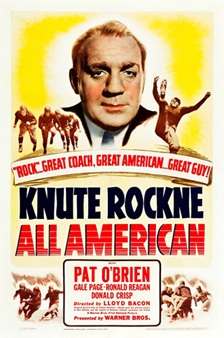
The son of a Norwegian carriage builder who immigrated to the United States in 1892, Knute Rockne (Pat O’Brien) attends Notre Dame, revolutionizes football as both a player and a coach, and leads Notre Dame to upset victory after upset victory.  Other coaches look to Rockne and see how to build and inspire a team and learn the importance of taking chances when the game is on the line.

This rah-rah biopic of real-life coach Knute Rockne elevates the character to near sainthood.  I was surprised that he didn’t heal any sick children or single-handedly end World War I.  Pat O’Brien is just the right age to play Rockne as an aging, veteran coach but the movie also has him playing Rockne as a college student.  It’s strange to see Rockne telling his father that he’s decided to go into coaching and that he hopes he won’t be a disappointment to his family when both the father and the son appear to be the same age.

If there is one thing about this movie that really works, it’s the performance of future President Ronald Reagan as George Gipp, a college baseball player who is recruited to the football team after Rockne sees how far and how high he can kick the ball.  Gipp becomes a surrogate son to Rockne and Ronald Reagan’s innate likability is put to good use.  As an actor in forgettable B-movie, Reagan could seem stiff and uncomfortable but, as George Gipp, he seems surprisingly relaxed and natural.  It’s easy to see why this film temporarily made him a star.  The scene when George Gipp, on his death bed, tells Knute to tell the team to “win one for the Gipper” is a classic tear-jerker moment and Reagan’s image as being the selfless Gipper, the man who was all about inspiring the team at even the worst of moments, served him well when he went into politics.

(It also served the makers of Airplane! well when Leslie Nielsen needed to give Robert Hays an inspiring speech to get Hays back into the cockpit of that plane.  Win one for the Zipper!)

Ronald Reagan’s performance is the only thing about Knute Rockne, All American that has aged well.  The movie made me want to win one for the Gipper.
Lisa Reviews An Oscar Winner: The Life of Emile Zola (dir by William Dieterle)


The Life of Emile Zola, the winner of the 1936 Oscar for Best Picture of the Year, opens with two French artists living in a drafty apartment.

Emile Zola (Paul Muni) is destined to become one of France’s most popular and important writers.  Paul Cezanne (Vladimir Sokoloff) will eventually become one of the most important artists of the post-impressionist movement.  But for now, they’re just two struggling artists who have sworn that they will never sell out their principles.  They are poor but they’re happy.  That changes for Zola after he meets a prostitute named Nana (Erin O’Brien-Moore) and he uses her life story as the inspiration for a novel.  The book is controversial and its frank content scandalizes France.  The public censor comes close to banning it.  But it also becomes a best seller.  It’s the book everyone secretly owns but claims to have never read.

Zola writes several more books, all about the conditions of the working class in France.  Eventually, he becomes what he claimed he would never be, a wealthy man living in a mansion and having little contact with the poor and oppressed.  Cezanne sees Zola one last time, calling him out for having sold his talent for money.  Cezanne explains that, on general principle, he can no longer be Zola’s friend.

Meanwhile, a quiet and rather meek family man named Captain Alfred Dreyfus (Joseph Schildkraut) has been arrested and accused of being a spy for Germany.  There’s little evidence that Dreyfus is a spy.  Indeed, most of the evidence seems to point to a Major Walsin-Esterhazy (Robert Barrat).  But, because Dreyfus is considered to be an outsider, he is convicted in a show trial and exiled to Devil’s Island.

(In real life, it’s generally agreed that Dreyfus was a victim of anti-Semitism.  As the only Jewish member of the army’s General Staff, Dreyfus was viewed with suspicion by his colleagues even before anyone knew that there was a German spy.  The Life of Emile Zola doesn’t specifically state that Dreyfus was a victim of anti-Semitism, with the exception of a brief moment when one of his accusers looks at his personnel file and says, “He’s not one of us,” while pointing at the word “Jew.”  Otherwise, the fact that Dreyfuss was Jewish is never mentioned in the film.  It’s as if the film is going out of its way to avoid offending the very people that the movie is criticizing.)

After speaking to Dreyfus’s wife (played by Gale Sondergaard, who would later become the victim of a show trial herself when she was blacklisted as a suspected communist), Zola decides to take up Dreyfus’s case.  He publishes an open letter — J’Accuse — in which he states that Dreyfus was not given a fair trial and that Dreyfus is innocent of the charges against him.  Zola finds himself in court, accused of libel.  Zola uses his trial to give Dreyfus the hearing that he never received.  While the army boos his every utterance, the people of France rally to his side.

The Life of Emile Zola is an early example of the type of prestige production that today is often referred to as being an “Oscar picture.”  It tells a true story.  As a film that condemns the treatment of Alfred Dreyfus but avoids stating the obvious reason why Dreyfus was targeted in the first place, it’s political without being radical.  And it features a performance from the most acclaimed actor of the era, Paul Muni.  Muni gives a powerful performance as Zola, holding the viewer’s attention even during the lengthy trial scenes that take up most the second half of the film.  That said, the true star of the film is Joseph Schildkraut, who plays Dreyfus as being a kind and trusting soul who finds himself caught up in a Kafkaesque nightmare.  At one point, Dreyfus is given a gun and told that there’s one way that he can avoid being put on trial for treason.  Schildkraut played the scene so well that I wanted to cheer when he refused to surrender.

The Life of Emile Zola is a big and, at times, self-consciously important production.  It was clearly designed to win a bunch of Oscars and it certainly managed to do that.  Compared to some of the other films nominated that year — The Awful Truth, Dead End, A Star is Born, Lost Horizon, Stage Door, In Old Chicago — The Life of Emile Zola can seem a bit stodgy.  However,  the performances of Muni and Schildkraut continue to make the film worth watching.

Horror Film Review: Invisible Agent (dir by Edwin L. Marin)


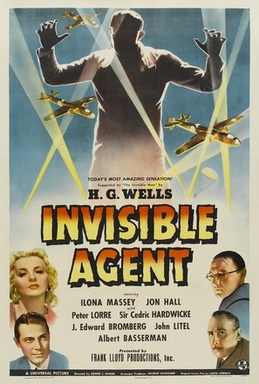
In 1942, the world was at war and everyone, whether a soldier or a civilian, was expected to do their part for the war effort.  That included the best and the brightest of Hollywood.  Stars like Jimmy Stewart, Clark Gable, and Henry Fonda enlisted in army.  Others sold war bonds and narrated patriotic news reels.  Even the Universal monsters did their part for the war effort, with the Invisible Man becoming the Invisible Agent in the 1942 film of the same name.

Invisible Agent opens in 1940, with Frank Griffin, Jr. (Jon Hall), the grandson of the original Invisible Man, being confronted by a Nazi (Sir Cedric Hardwicke) and a Japanese spymaster (Peter Lorre) at his print shop in Manhattan.  They want his grandfather’s invisibility formula.  At first, they offer to pay him for it.  Then, when Frank refuses, they threaten to chop off his fingers.  Frank manages to escape with both his fingers and the formula.  As Frank later tells the Americans, he’s not willing to give the formula to anyone because he knows how dangerous it can be if not used properly.  As far as Frank is concerned, the formula must never be used again.  Frank does say that he might change his mind under extraordinary circumstances.

The film cuts to a series of headlines announcing that the Japanese have bombed Pearl Harbor.  The circumstances are now extraordinary and Frank agrees that it is time to use the formula for the war effort.  But he agrees to do so on the condition that only he be allowed to take the formula.  Frank becomes the Invisible Agent, taking the formula and then parachuting into Nazi Germany.  Unseen, Frank searches for information about Nazi spies in the U.S. and the details of Germany’s plan to bomb New York.  Along the way, he meets Maria Sorenson (Ilona Massey), a wealthy German woman who is lusted after by the members of the German high command but who is actually working for the Resistance.  Frank also finds himself, once again, coming across the two men who previously threatened him in New York.

Here are the positive things about this film.  Invisible Agent has an intriguing premise.  The Nazis are such monsters that even the once fearsome Universal monsters are joining the effort to take them down.  The film also features two intelligent performances from Cedric Hardwicke and Peter Lorre, both of whom bring some unexpected shadings to their villainous roles.  The opening scene in Manhattan plays out like an intense film noir and, once the action moves to Germany, director Edwin L. Marin keeps things moving at a steady pace.

Unfortunately, Invisible Agent has one huge problem that it cannot overcome.  Jon Hall gives a remarkably charmless performance in the title role, flatly delivering his lines and showing very little in the way of personality.  When you’re not seen for the majority of the film, it’s important to have a voice that’s full of personality.  That’s one reason why the previous Invisible Man films benefitted from the casting of actors like Claude Rains and Vincent Prince.  Jon Hall, on the other hand, just comes across as being dull.  He gives a boring performance, whether visible or not and, as a result, Invisible Agent falls flat in a way that the previous Invisible films did not.  There’s no real stakes in his turning invisible because there really wasn’t much to him to begin with.

Still, I thank the Invisible Agent for his service.

Previous Universal Horror Reviews:

  1. Dracula (1931)
  2. Dracula (Spanish Language Version) (1931)
  3. Frankenstein (1931)
  4. Island of Lost Souls (1932)
  5. The Mummy (1932)
  6. The Invisible Man (1933)
  7. The Bride of Frankenstein (1935)
  8. Dracula’s Daughter (1936)
  9. Son of Frankenstein (1939)
  10. The Invisible Man Returns (1940)
  11. The Wolf Man (1941)
  12. Ghost of Frankenstein (1942)
  13. Frankenstein Meets The Wolf Man (1943)
  14. Son of Dracula (1943)
  15. House of Frankenstein (1944)
  16. House of Dracula (1945) 
  17. Creature From The Black Lagoon (1954)

A Movie A Day #222: Secret Service of the Air (1939, directed by Noel M. Smith)


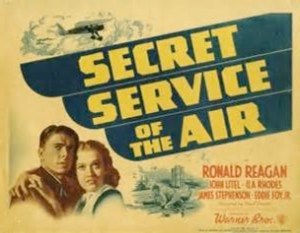
When a secret service agent’s investigation into a supposed counterfeiting ring instead leads to him discovering a plot to smuggle illegal aliens into the United States via airplanes, the agent ends up plummeting several hundred miles to his death.  Realizing that they need someone who can go undercover and infiltrate the smuggling ring, the Secret Service recruits Lt. Brass Bancroft (Ronald Reagan).  Bancroft is a war hero who is now a commercial airline pilot.  He is also good with his fists, has an innate sense of right and wrong, and a sidekick named Gabby (Eddie Foy Jr., giving a very broad performance as the movie’s comic relief).  But before Brass can win the trust of the smugglers, he will have to establish a firm cover story and that means allowing himself to be arrested on fake charges.  In order to save the day, Brass will have to first survive prison.
If Secret Service of the Air is remembered today, it is because it featured future President Ronald Reagan in an early starring role.  In the role of Brass Bancroft, Reagan gives a performance that can be best described as being amiable.  He may not be anyone’s idea of a good actor but he is likable, a trait that served him well when, 26 years later, he ran for governor of California.  As for the rest of the movie, it was obviously cheaply made but it is also only an hour long, which means that there is rarely time for a dull moment.  It plays out like as serial, with a new cliffhanger ever few minutes.  Though Reagan was dismissive in the film in his autobiography, Secret Service of the Air was enough of an unexpected success that he would play Brass Bancroft is two sequels.

Fabulous Forties #32: Outpost in Morocco (dir by Robert Florey)


Otmorpos

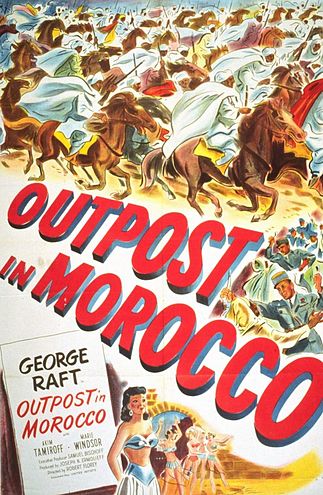
After watching the excellent The Last Chance, I was really hoping that the 32nd film in the Fabulous Forties box set would turn out be a classic as well.  Sadly, that was not the case.  1949’s Outpost in Morocco is a generally forgettable adventure film about the French Foreign Legion.

George Raft plays Capt. Paul Gerard, a captain in the French Foreign Legion.  Now, I happen to like George Raft.  He may not have been the greatest actor of Hollywood’s Golden Age but he did have a roguish charm and he was a great dancer.  Unfortunately, while the role of Paul Gerard did call for a bit of charm, it didn’t call for much dancing.  Instead, Paul Gerard is rather stolid and dependable and a little bit boring.  Needless to say, George Raft was more than a little miscast in the role.

Speaking of miscast, the beautiful but very American Marie Windsor plays Cara, the daughter of the Emir of the Moroccan city of Bel-Rashad.  The French are not allowed to enter the city and there are rumors that the Emir has been using this situation as an opportunity to plot against France.  Since Cara has spent the last few years studying in France, she is willing to go into Bel-Rashad and report on whether or not the rumors are true.  Gerard is assigned to escort her to the city.  Gerard’s superiors suspect that Cara might even fall in love with Gerard and, as a result, will be willing to turn against her father.

And that’s exactly what happens!  It takes exactly 10 days for Cara and Gerard to fall in love.  (We know this because the film is full of excerpts from a journal that Gerard keeps as he escorts Cara across the desert.)  However, once they reach Bel-Rashad, Cara does discover that her father is indeed conspiring against the French.  It is up to Gerard to put down the revolution and defeat the Emir, even if it means potentially sacrificing his love for Cara.

It’s interesting to note that there’s a few scenes where Raft sounds like he’s trying to imitate Humphrey Bogart, which immediately reminded me of how so many of Bogart’s great roles were initially offered to Raft.  I found myself wondering if Raft agreed to do Outpost in Morocco to make up for refusing Bogart’s role in a certain other film that was set in Morocco.

Unfortunately, Outpost in Morocco is no Casablanca.  Whereas Casablanca is a classic that holds up to this day, Outpost in Morocco is best described as being … well, dull.

How boring in Outpost in Morocco?  George Raft looks bored.  Marie Windsor looks bored.  Even the great character actor Akim Tamiroff looks bored!  Portions of the film were shot on location in Morocco so there are a few nice shots of the desert (if that’s your thing) and the ending is a bit darker than you might normally expect for a 1949 adventure film but otherwise, Outpost in Morocco is a fairly forgettable film.

Embracing the Melodrama Part II #12: Jezebel (dir by William Wyler)


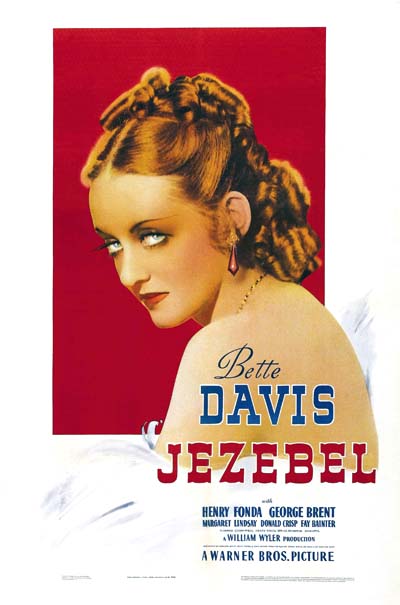
Jesebel_movieposterWe started out this day by taking a look at Bette Davis in Of Human Bondage so it seems only appropriate that today’s final entry in Embracing the Melodrama should be another film in which Bette Davis plays a potentially unlikable character who is redeemed by being the most interesting person in the film.

The 1938 best picture nominee Jezebel stars Bette Davis as Julie Marsden, a strong-willed Southern belle who lives in pre-Civil War New Orleans.  Julie is looking forward to an upcoming ball but is frustrated when her fiancée, boring old Pres (Henry Fonda), says that he has to work and declines to go shopping for a dress with her.  Impulsively, Julie does exactly what I would do.  She buys the most flamboyant red dress that she can find.

Back in the old South, unmarried women were expected to wear white to formal balls, the better to let everyone know that they were pure and innocent and waiting for the right man.  When Julie shows up in her red gown, it’s a scandal and, upon seeing the looks of shock and disdain on everyone’s faces, Julie wants to leave the ball.  However, Pres insists that Julie dance with him and he continues to dance with her, even after the orchestra attempts to stop playing music.

And then he leaves her.  At first, Julie insists to all who will listen that Pres is going to return to her but it soon becomes obvious that Pres has abandoned both Julie and Southern society.  Julie locks herself away in her house and becomes a recluse.

Until, a year later, Pres returns.  At first, Julie is overjoyed to see that Pres is back and she’s prepared to finally humble herself if that means winning back his love.  But then she discovers that the only reason that he’s returned to New Orleans is to warn people about the dangers of Yellow Fever.

Oh, and he’s also married.

To a yankee.

For the most part, Jezebel is a showcase for another fierce and determined Bette Davis performance.  It’s easy to be judgmental of a character like Julie Marsden but honestly, who doesn’t wish that they could be just as outspoken and determined?  It helps, of course, that the film surrounds Julie with a collection of boring and self-righteous characters, the type of people who you love to see scandalized.  Henry Fonda gives one of his more boring performances in the role of Pres while Margaret Lindsay, in the role of Pres’s Northern wife, is so saintly that she reminds you of the extremely religious girl in high school who would get offended whenever you came to school wearing a short skirt.  In a society as rigid, moralistic, and judgmental as the one portrayed in Jezebel, it’s impossible not to cheer for someone like Julie Marsden.

Add to that, I totally would have worn that red dress too!  In a world that insisted that all women had to act a certain way or look a certain way and think a certain way, Julie went her own way and, regardless of what boring old Pres may have thought, there’s a lesson there for us all.

When watching Jezebel, it helps to know a little about film history.  Bette Davis very much wanted to play Scarlett O’Hara in Gone With The Wind and was reportedly very disappointed when the role went to Vivien Leigh.  Depending on the source, Jezebel is often described as either being Davis’s audition for the role of Scarlett or as being a consolation gift for losing out on the role.  Either way, Jezebel is as close as we will ever get to seeing Bette Davis play Scarlett.  Judging from the film, Davis would not have been an ideal Scarlett.  (Whereas Gone With The Wind works because Leigh’s Scarlett grows stronger over the course of the film, Davis would have started the film as strong and had nowhere left to go with the character.)  However, Davis was a perfect Julie Marsden.


Now Showing On The Shattered Lens: Flight to Mars (dir by Lesley Selander)


Flight_to_mars

Are you lucky enough to have an extra 70 minutes free today?  Why not spend them watching an entertaining little B-movie called Flight to Mars?

First released in 1951, Flight to Mars is reportedly the first American film to ever be made about traveling to the red planet.  At the start of the film, a rather phallic spaceship is launched into space.  Aboard the ship are cynical reporter Steve (Cameron Mitchell), brilliant scientist Jim (Arthur Franz), token female scientist Carol (Virginia Huston), and a few other scientists who all kind of blend together.  Steve is attracted to Carol but Carol is more interested in Jim.  However, Jim isn’t interested in anything other than his work.  When the spaceship does reach Mars, it turns out that Mars is a lot like Earth and the Martians are a lot like us.  The main difference between humans and Martians appears to be that Martian women wear miniskirts.  Among those Martian women is Alita (Marguerite Chapman), who falls in love with Jim.  The rest of Mars, however, is not quite as infatuated with their intergalactic visitors…

Flight to Mars is definitely a product of its time.  This is one of those films where the men are all blatantly sexist and the women are usually just happy to be noticed.  Carol, for instance, is overjoyed to discover that they have kitchens on Mars and, while the men spend all of their time making plans, Carol usually just stands in the background, eating Martian snacks and pining for Jim.  Of course, Jim only has eyes for Alita, who, upon meeting the virile males of Earth, has absolutely no problem betraying her entire planet.  Beyond the sexist attitudes, Flight to Mars is also distinguished by presenting space travel as being the equivalent of a long flight on a small airplane.  This is definitely a low-budget B-movie that has absolutely no relation to science fact (or, for that matter, any other type of fact).

And, to be honest, that’s why I like the film.  It truly is such a time capsule that just watching it will make you wonder if Eisenhower is still in the White House.  I’ve always felt that the best way to learn about history is to experience it personally and one of the best ways to do that is to watch a movie that could only have been made during a certain period of time.  And trust me, Flight to Mars is pure 1951.  As for the film’s low budget — well, this film proves that you don’t need CGI to create an alien world.  Sometimes, cardboard and colorful costumes work just as well.  And, as for the film’s science — well, facts are boring.  That’s one reason why good people have often turned to science fiction.

So, if you’ve got 70 minutes to kill, why not experience Flight to Mars?

Enjoy!

http://www.youtube.com/watch?v=N18m1uoA8Ts