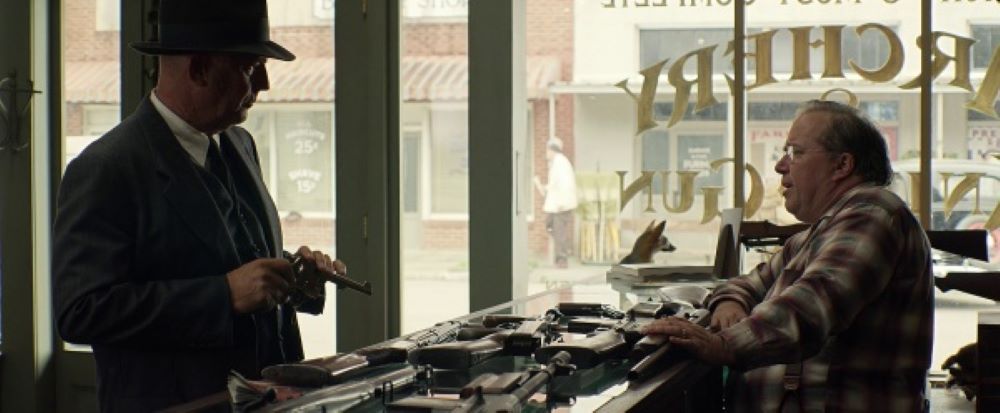
I reviewed the film The Highwaymen (directed by John Lee Hancock) earlier this week and there was always one scene from the entire film that I always go back to rewatching. It’s pretty much a sequence where Texas Ranger Frank Hamer (played by Kevin Costner) stops by a local gun store and begins naming off pistols and rifles that he wants to examine.
It’s a random scene, but it also shows how much has changed from how American treated the purchase and ownership of guns during the Prohibition and gangland era of the late 20’s and early 30’s. This was a time when any adult could go into a store and purchase any type of gun (from pistols, rifles, shotguns and all the way up to machine guns) as long as they had the money. No license required to purchase whatever one desired and no waiting period and background check.
All of this would just a month after the deaths of Bonnie and Clyde as depicted in the film when Congress would pass the National Firearms Act of 1934 when certain firearms would be heavily restricted (such as short-barreled shotguns, machine guns, short-barreled rifles aka submachine guns, etc.) requiring specific licenses and up to restricted for law enforcement use-only.
This scene shows a time that was still holding onto the ways of the frontier and the Old West, but was about to end as the government began to centralize regulation on the federal level and away from the states. It’s a scene that on its own was a small random one that almost borders on the ridiculous as Hamer just names off guns after guns then answering the store owner’s question of which he would buy with a simple answer of “all of them.”
I also love this scene being a gun enthusiast who has his own large collection. What I wouldn’t give to be able to just do what Frank Hamer did in this scene. Though my wallet would cry if I was given the chance.
“People don’t always know who they are… ’til it’s too late.” — Frank Hamer
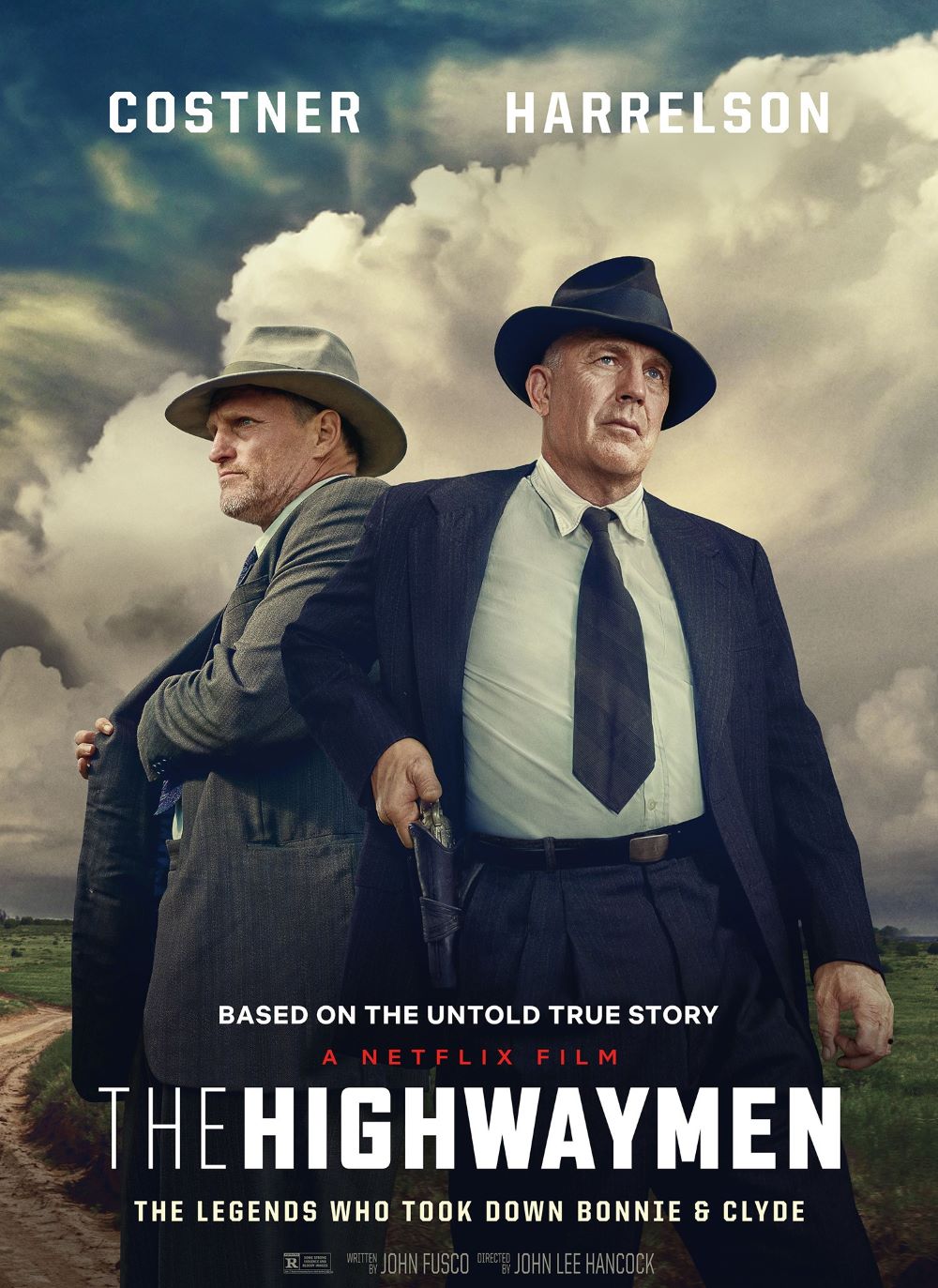
The Highwaymen, as directed by John Lee Hancock, delivers a character-driven, period crime drama that refreshes a story so often mythologized in American pop culture. Instead of glamorizing Bonnie and Clyde, the film spotlights the two former Texas Rangers tasked with ending their crime spree: Frank Hamer (played by Kevin Costner) and Maney Gault (played by Woody Harrelson). Set against the bleak dustbowl landscape of 1934, the film opens with the criminal duo breaking their associates out of Eastham Prison, setting the state of Texas into a panic. In desperation, Governor “Ma” Ferguson authorizes the return of Hamer, a seasoned lawman whose old-school methods have largely been left behind in modern policing.
From the start, The Highwaymen takes its time, inviting viewers into a slower, more contemplative chase rather than the kinetic action often associated with outlaw stories. Hamer, long retired and resistant to rejoining the fight, is persuaded both by the severity of Bonnie and Clyde’s violence and the humiliation his state faces in failing to catch them. Gault, for his part, is recruited despite his own personal struggles, adding a layer of regret and weariness to their partnership. Their pursuit is marked by straightforward detective work—staking out small towns, following trails, and confronting a public that is strangely captivated by the criminals they hunt. The film repeatedly draws attention to the way crowds and the press elevate Bonnie and Clyde, reflecting on an early version of true crime celebrity culture.
The dynamic between Hamer and Gault forms the emotional core of the movie. Their bond is shaped by years of experience, mistakes, and a real sense of being out of place in a society that now doubts their relevance. There’s plenty of banter and friction, but also reflective moments that dig into the costs of life spent in pursuit of justice. Throughout the investigation, the film uses the Texas and Louisiana landscape as a powerful backdrop—the vast, windswept highways underscore the isolation and existential gravity faced by these lawmen. The cinematography favors wide shots and muted colors, giving the chase a feeling of endlessness and melancholy.
Instead of showcasing Bonnie and Clyde as glamorous anti-heroes, the film keeps them at a distance, rarely granting much screen time or dialogue. Violence is handled abruptly and unsentimentally. When it finally arrives, most notably in the climactic ambush, it is portrayed as brutal and inevitable, reminding the viewer that myths are built on blood and public spectacle. The lawmen’s final confrontation results in the infamous shootout, depicted with documentary-like restraint. The aftermath involves a bullet-riddled car towed through throngs of onlookers—an eerie scene that highlights how tragedy becomes spectacle.
One of the film’s greatest strengths is in its portrayal of moral ambiguity. Both Hamer and Gault operate by principles shaped in a different era. Their methods can be rough and unorthodox; they clash with younger law enforcement and the FBI, whose approaches are more bureaucratic, less personal. The film hints at the toll violence and a lifetime in law enforcement has taken on them, including a poignant story from Gault about a tragic accident in his past. These reflections draw out the muted sadness underlying their pursuit, exploring themes of justice, changing times, and what remains after one’s era passes.
Performance-wise, Costner and Harrelson bring authenticity and gravity to their roles. Their chemistry is quiet and real, developed largely through understated scenes—silent drives, awkward motel breakfasts, and occasional arguments broken up by mutual respect. Supporting roles, like Kathy Bates’s steely governor and John Carroll Lynch’s earnest corrections chief, flesh out the historical setting and institutional pressures.
The film doesn’t always dig as deep as it could into the complexities of Depression-era justice, but its restraint and focus on character make up for that. Rather than indulging in nostalgia or sensationalizing violence, it keeps its lens on the human cost—the consequences for the victims, the weariness of the men trying to restore order, and the strange cultural fascination with outlaws. If you’re looking for a grounded historical drama that trades fast action for thoughtful pacing, and puts working-class grit front and center, The Highwaymen is worth the ride.
Since it’s due to leave HBOMax at the end of the day and since HBOMax isn’t exactly cheap, I decided that I should go ahead and watch The Little Things, the serial killer thriller that has been getting some unexpected Oscar buzz due to the performance of Jared Leto.
Taking place in the 90s, The Little Things follows two cops as they investigate a series of murders. Deacon (Denzel Washington) is the former hotshot homicide detective who, back in the day, allowed his obsession with an unsolved murder to destroy his life. He lost not only his wife but also nearly his life. Now, he’s a small town deputy who is still haunted by the cases that he didn’t solve. Jim (Rami Malek) is the detective who has picked up where Deacon left off. Deacon is haunted and unable to move on. Jim is young and cocky and obviously doomed to repeat all of Deacon’s mistakes. At first, Jim doesn’t want to work with Deacon and Deacon seems to be a little bit skeptical of Jim’s abilities. Eventually, though, they bond over their mutual righteousness. Jim is the type of who reminds the crime scene technicians that they’re working for the victim. Deacon is the type who muses about whether or not God has abandoned humanity. On the one hand, we should be thankful that they’re good at their job. On the other hand, you wouldn’t necessarily want to invite either of them to a party.
Deacon and Jim’s investigation leads them to a suspect named Sparma (Jared Leto) and you know that he’s a bad dude as soon as you learn that his name is “Sparma.” It sounds like too much of a mix of sperm and pharma for this guy to be anything other than dangerous. Sparma is an appliance repairman with unwashed hair, a permanent smirk on his face, and a disconcerting history of confessing to crimes that he didn’t actually commit. Jim and Deacon both think that Sparma is guilty but can they prove it? How far will they go to take a possible killer off the streets?
Jared Leto is certainly creepy as Sparma. In fact, I think you could probably argue that he’s a little bit too obviously creepy and unhinged in the role. Most real life serial killers — especially the ones who manage to kill for years without being detected — are able to blend in with society. Consider the cases of killers like Gary Ridgway, the Green River killer who avoided capture for nearly three decades, or Dennis Rader, the infamous BTK killer. While it’s true that everyone in his hometown apparently thought Rader was a dick even before he was revealed to be a serial killer, he also still managed to hold down a respectable job while raising a family and fooling people into thinking that he was just a normal jerk as opposed to a homicidal one. That ability to blend in and disguise their true selves is one of the things that makes real-life serial killers so frightening. Sparma, however, might as well have the words “murderer” tattooed on his forehead. I can understand why Jared Leto is getting Oscar buzz because it’s a showy role and it allows him to act up a storm. But it’s still hard not to feel that the film, which tries to introduce the idea that Deacon and Jim’s obsession with this case has led to them developing a tunnel vision that has left them incapable of suspecting anyone other than Sparma, might have been a bit more effective if it had taken a slightly more ambiguous approach to the character.
That said, The Little Things is a well-made movie. Though it’s bit overlong and occasionally meanders a bit too much for its own good, the film looks great and director John Lee Hancock does a good job of creating an effectively creepy atmosphere, providing the viewer with some wonderfully ominous images as Deacon and Jim search for the truth in the middle of the night. For instance, the scene where Deacon imagines himself talking to the ghosts of the killer’s victims really shouldn’t work but it does because Washington gives such a committed performance and Hancock, as a director and writer, is smart enough to just let the scene develop naturally. Even as he ages, Denzel Washington remains a compelling actor and he helps to carry The Little Things over more than few speed bumps on the way to the end credits. At its best, the film works as an examination of obsession and there is a haunting intensity to the film’s final moments that suggests the movie that The Little Things could have been if the film’s pace had been just a little bit tighter.
In the end, The Little Things is uneven but it has enough effective moments to be watchable.
I know that the regular MLB season being delayed (or even — gasp! — cancelled) is hardly the worst thing that we have to deal with right now but I still really miss watching baseball! I miss the swing of the bat, the sounds of the stadium, and I even miss getting upset over the Rangers having a disappointing season. I’ve been dealing with my grief by watching old games and a lot of baseball movies. It’s not the same as getting to watch a real game but I guess it’s as good as things are going to get right now.
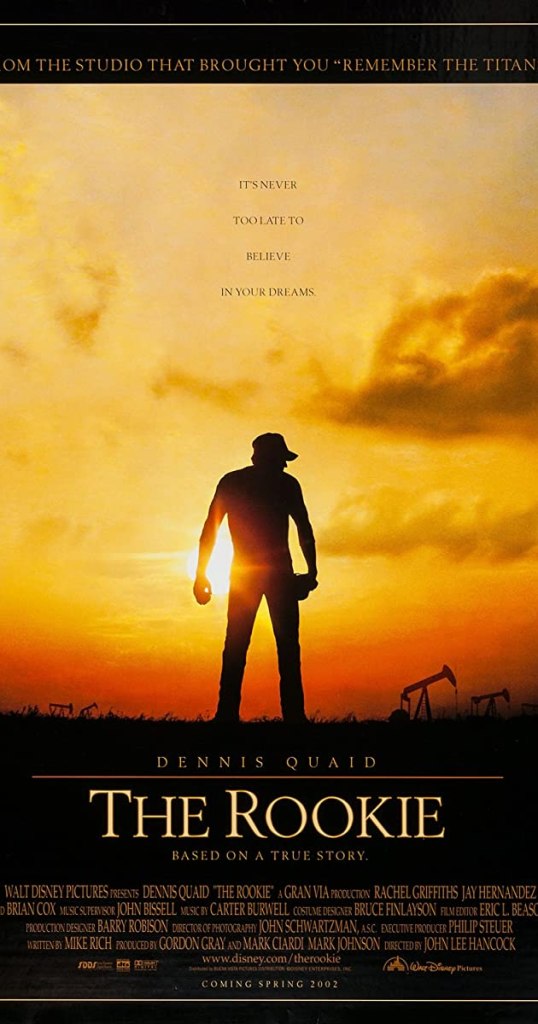
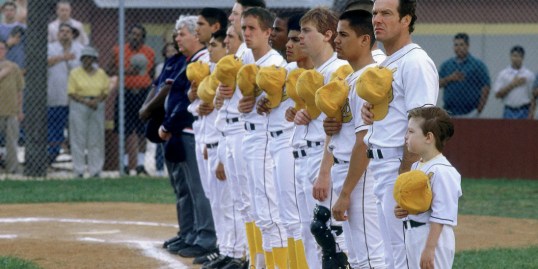
When the quarantine stated, one of the first baseball movies that I watched was The Rookie. Starring Dennis Quaid (who gives a really good performance), The Rookie is based on the true story of Jim Morris, a former minor league pitcher who retired from playing the game after injuring his arm and took a job coaching baseball for Reagan County High School in Big Lake, Texas. In 1999, Morris promised his players that if they managed to win the district championship, he would try out for a major league baseball team. When his team went on to win the championship, Morris honored his side of the bargain by trying out for the Tampa Bay Devil Rays. Even though no one expected Morris to make it onto the team, he was given a chance because it was felt that it would be good publicity. The 35 year-old Morris shocked everyone by throwing a 98 mph fastball. The team started Morris out in the minors and then, when the roster expanded in September, called him up to the majors. At an age when many other players were calling it quits, Morris made his major league debut at the Ballpark in Arlington and struck out Royce Clayton.
Though I’m sure it probably takes a lot of liberties with Morris’s story, I really like The Rookie. It’s a really sweet movie that was filmed on location in Texas. It’s one of my favorite baseball movies because it captures everything that I love about the game. It’s about more than just who wins or who struck who out. It’s about teamwork and healthy competition and fairplay. (Or, at least, that’s what baseball should be about. That’s one reason why the Astros cheating scandal hurts so much. For me, it’s not just that the first Texas team to win the World Series did so dishonestly. It’s that what they did goes against the spirit of baseball.) I liked that the movie is as much about Jim coaching his high school team as it was about him eventually getting to play a few games in the majors. The whole reason that Jim even tried out for the Devil Rays was to keep a promise to his high school team and, in a perfect world, that’s what baseball would be all about.
The Rookie is not just a baseball movie. It’s also a movie about never giving up on your dreams. Jim Morris may be happy coaching high school baseball but he’s never stopped thinking about how he once dreamed of playing in the major leagues. Even he’s surprised when he discovers that he’s still a good pitcher. (My favorite scene is him throwing a baseball at one of those radars that tells how fast you’re driving. He only thinks he’s throwing a 78 mph fastball and it’s only after he drives off that the full sign lights up and reveals that he was throwing 98 mph.) When Jim makes his major league debut, it’s real stand up and cheer moment.
Here’s hoping that we’ll all be back at the ballpark soon!

 Through the Shattered Lens