Made-For-TV Horror: Good Against Evil (dir by Paul Wendkos)


The 1977 made-for-TV movie Good Against Evil opens with a woman giving birth in a hospital.  Her baby daughter is forcefully taken from her and given to her father, the sinister Mr. Rimmin (Richard Lynch).

Two decades later, Jessica Gordon (Elyssa Davalos) has grown up and is working at a boutique in San Francisco.  When her car is rear-ended by a free-spirited, van-driven single guy named Andy Stuart (Dack Rambo), it’s love at first sight.  Jessica and Andy are so caught up in their whirlwind romance that they don’t even notice that there’s a schlubby guy following them everywhere that they go and that strangers are giving them dirty looks.  Someone does not want Jessica and Andy to end up together.

How could anyone object to two young people falling in love, you may ask.  Well, it turns out that Jessica is meant to be a bride of Satan and the plan is for her to eventually give birth to the Antichrist.  Everyone in Jessica’s life works for Mr. Rimmin …. or, at least, everyone but Andy.  Andy suddenly showing up and falling in love with Jessica throws a big old monkey wrench into Rimmin’s carefully crafted scheme.  Mr. Rimmin reacts by sending an army of adorable cats to harass Andy.

This might sound like it has the makings for a good made-for-TV horror film and, in fairness to Good Against Evil, the first 50 minutes or so are pretty well-done.  The movie does a good job of building up and maintaining an atmosphere of paranoia and I enjoyed watching all of the people attempting to discreetly keep an eye on Andy and Jessica whenever they went out.  When Mr. Rimmin finally abducted Jessica and took her back to his mansion, I was prepared to see Andy risk his life to rescue her….

That didn’t happen, though.  Instead, Andy got involved with the case of a little girl who was possessed.  (Again, in all fairness, he got involved because he read a news story about the girl drawing a pentagram while in a coma and he assumed that meant she was a victim of the same cult that abducted Jessica.)  Andy meets the girl’s mother (played by Kim Cattrall) and then helps an exorcist (Dan O’Herlihy) perform an exorcism.  The movie ends with Jessica, still in the clutches of Mr. Rimmin.

Good Against Evil was apparently a pilot for a television series that wasn’t picked up.  I assume the plan was that Andy would have a weekly supernatural adventure while trying to recuse Jessica from Mr. Rimmin.  The idea had some potential.  As always, Richard Lynch is a wonderfully sinister villain.  But the pilot shoots itself in the foot by getting distracted with the whole exorcism storyline.  It’s wonderful to see the great Dan O’Herlihy as a priest but the exorcism storyline really does come out of nowhere and the exorcism scene itself so blatantly copies The Exorcist that they really should have given William Peter Blatty an onscreen credit.  Sadly, because this was a pilot, the movie ends with the main storyline unresolved.  The joke is on us for caring about two people in love.

Good Against Evil is one of those films that can be found in a dozen Mill Creek box sets.  Ultimately, it’s as forgettable as its generic name.
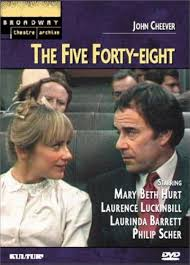
Retro Television Review: 3 By Cheever 1.3 “The Five Forty-Eight”


Welcome to Retro Television Reviews, a feature where we review some of our favorite and least favorite shows of the past!  On Saturdays, I will be reviewing 3 By Cheever, which ran on PBS in 1979.  The entire show can be purchased on Prime and found on YouTube.

This week, we finish up 3 By Cheever with an adaption of one of his best-known short stories.

Episode 1.3 “The Five Forty-Eight”

(Dir by James Ivory, originally aired on James Ivory)

Laurence Luckinbill stars as Blake, a business executive who rides the train into the city for work and then back to the suburbs when it’s time to return to his perfect home.  One day, as Blake heads to his train, he comes to be aware that he’s being followed by his former secretary, Miss Dent (Mary Beth Hurt).  Blake is concerned because Miss Dent made quite a scene when she was fired from her job a little while ago.  Of course, a part of the reason why she was so upset was because Blake had earlier seduced her, something that he has a habit of doing when it comes to his secretaries.  On the train, surrounded by neighbors (including one that Blake can’t stand because of his long hair), Blake finds himself sitting next to Miss Dent.  She explains that she has a gun in her purse.  As the train heads for its destination, Blake’s confident facade crumbles and he is soon as humiliated by his former secretary as she was by him.  And yet, this being a Cheever story, one wonders if Blake is even capable of realizing why any of this is happening to him.

The final episode of 3 By Cheever was an adaptation of one of John Cheever’s best short stories.  As directed by James Ivory, this adaptation can feel a bit overdrawn.  The short story, for instance, opens with Blake on an elevator, already preparing to head home on the train.  Ivory’s adaptation opens with Blake at the start of his day and we see a lot of things — like Blake’s antagonistic relationship with his long-haired neighbor — that Cheever simply mentioned.  It takes a while for Miss Dent to finally sit down next to Blake and Ivory doesn’t do much to build up any sort of suspense while we’re waiting.

On the plus side, the film reveals Ivory’s skill when it comes to working with actors as both Luckinbill and Mary Beth Hurt give excellent performances.  Luckinbill goes from being oily and overconfident to being a neurotic mess by the end of the show while Hurt does the opposite, going from being meek to commanding.  Both the original short story and Ivory’s adaptation succeed in making you wonder what the future could possibly hold for either one of the two characters.  They both seem to reach a point of no return and it’s hard to imagine Blake going back to his suburban home and his train rides and his motel hook-ups but, then again, this is a Cheever story so the implication is that he does just that, untouched by the fact that he nearly lost his life due to his own behavior.  As for Miss Dent, she reclaims her self-respect by going to an extreme.

This was the last episode of 3 By Cheever.  This was an interesting series of adaptations, even if Cheever’s prose does seem to work best on the page than literally translated to film.  Next week, a new series will being in this spot.

Retro Television Review: 3 By Cheever 1.2 “O Youth And Beauty!” (dir by Jeff Bleckner)


Welcome to Retro Television Reviews, a feature where we review some of our favorite and least favorite shows of the past!  On Saturdays, I will be reviewing 3 By Cheever, which ran on PBS in 1979.  The entire show can be purchased on Prime and found on YouTube.

Episode 1.2 “O Youth and Beauty!”

(Dir by Jeff Bleckner, originally aired on October 31st, 1979)

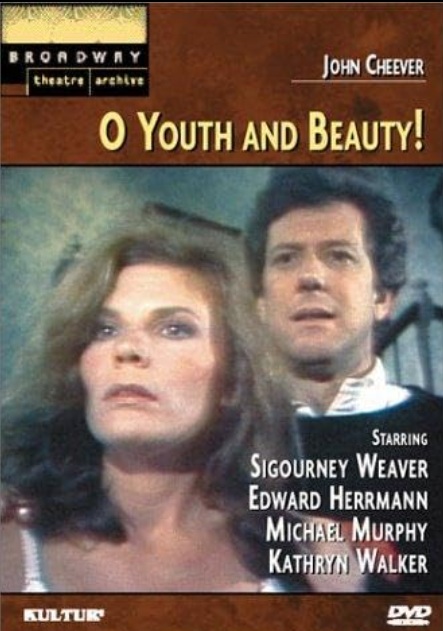
Back in the day, Cash Bentley (Michael Murphy) was an athletic marvel.  He was a track star who could jump the hurdles with ease and who everyone in high school looked up to.  Now, however, he’s 40 years old and he feels lost.  He’s aging and a new generation of young people have come along.  They certainly have no idea who Cash Bentley used to be.

At drunken neighborhood parties, Cash insists on recreating his youth by having his hosts set up their furniture like an obstacle course.  Giving them a starter’s pistol that he insists be fired to signify the start of the race, Cash will run through the house, jumping over chairs and couches and tables while everyone cheers.  Unfortunately, Cash’s luck runs out and he ends up breaking his leg during one of his demonstrations.

Forced to get around on crutches, Cash feels isolated from the rest of the world.  He doesn’t get a promotion because his bosses say they need someone who can start traveling immediately.  When all of his neighbors get on the train that is heading into the city at the usual morning time, a hobbled Cash arrives late and is forced to wait alone for the next one.  His wife, Louise (Kathryn Walker), gets a job working at a boutique to help pay the bills.  She says that maybe she’ll make enough that they’ll be able to take a vacation.  At the neighborhood parties, no one wants to deal with Cash and his broken leg.  His athleticism was all he had left.  It was what he was known for.  It was the source of all his confidence.  Now that he doesn’t have that, he’s lost.

Eventually, his legs comes out of the cast and he insists that Louise set up all the furniture in the house so that he can run another obstacle race.  He gives Louise the starter’s pistol and insists that she fire it when it’s time for him to start.  The scene cuts to the outside of their suburban home.  The sound of one gunshot upsets the calm.  Later, Louise and her children are seen moving out of the house.  Cash is nowhere to be seen.

The episode ends ambiguously.  Those who are familiar with the original John Cheever short story know that Louise shot Cash and that no one was sure whether she meant to do it or not.  The movie cuts away before the gun is actually fired.  For all we know, Cash did the obstacle course and then just never returned home.

O Youth and Beauty is one of John Cheever’s most acclaimed short stories.  The screen adaptation features an excellent performance from Kathryn Walker but the scenes of Cash running the furniture obstacle course are probably something that worked better on the page and in the reader’s imagination than when actually presented on film.  Michael Murphy is almost too confident and handsome as Cash.  The role calls for a former jock slowly going to seed and desperately trying to hold onto his youth whereas Murphy looks like he’s still in peak athletic form.  Murphy does a good job portraying Cash’s depression and his alienation after he breaks his leg but, physically, he still seems miscast in the role.

Edward Herrmann and Sigourney Weaver, who were the center of last week’s episode, make a brief appearance in this one, hovering in the background of the neighborhood’s endless parties.

Next week, we finish up 3 By Cheever.

Retro Television Review: 3 By Cheever 1.1 “The Sorrows of Gin” (dir by John Hofsiss)


Welcome to Retro Television Reviews, a feature where we review some of our favorite and least favorite shows of the past!  On Saturdays, I will be reviewing 3 By Cheever, which ran on PBS in 1979.  The entire show can be purchased on Prime and found on YouTube.

In 1979, PBS aired 3 By Cheever, three short films that were all based on stories by the American author, John Cheever.  The stories all took place in the same suburban milieu and featured characters in common.  The first episode was an adaptation of one of Cheever’s earlier stories, The Sorrows of Gin.

Episode 1.1 “The Sorrows of Gin”

(Dir by Jack Hofsiss, originally aired on October 24th, 1979)

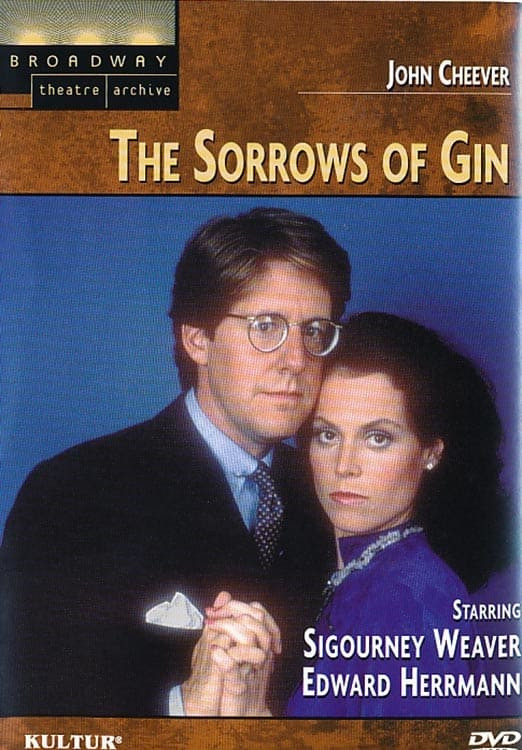
Taking place in the New England suburb of Shady Hill, The Sorrows of Gin deals with the Lawton family.  The Lawtons have got a nice house, lovely neighbors, and enough loyal servants that they don’t ever have to really worry about taking care of their eight year-old daughter, Amy (Mara Hobel).  Kip (Edward Herrmann) and Marcia Lawton (Sigourney Weaver) are youngish, successful, athletic (they play tennis, of course), and they’re also alcoholics.  They don’t realize they’re alcoholics and they’re both far more refined than the stereotypical image of the boozy drunk but they’re alcoholics nonetheless.

They’re also hypocrites.  When Amy’s babysitter, Rosemary (Eileen Heckart), comes to work with booze on her breath, Kip fires her.  Amy, realizing that the alcohol is causing her parents to fight, starts to secretly pour out all of the gin, a little at a time.  Kip and Marcia assume that the servants are sneaking drinks and they go on a firing rampage.  Amy finally decides to run away from home, just to be found by Kip who, at the very least, seems like he’s willing to try to be a better father and husband.

Wow, what a depressing story!  Cheever’s original short story, which was one of the first American stories to really explore suburban alcoholism, was written with a good deal of wit and social satire.  The PBS adaptation takes a far more literal approach.  It captures Cheever’s story but not his voice and, as a result, you kind of find yourself why you should care about any of these people.  Even taking alcohol out of the equation, Kip and Marcia are shallow, self-absorbed, and terrible parents.  Maybe Amy should run away.

On the plus side, the film does feature Edward Herrmann and Sigourney Weaver, both giving excellent performances as the Lawtons.  The same year in which this aired, Weaver also starred as Ripley in Alien and it is a bit odd to see Weaver playing someone who would probably never in a thousand years see that film.  That said, Weaver does a good job and is totally believable as the clueless Marcia.  Meanwhile, Edward Herrmann has just the right WASP-y style to play Kip Lawton.  One of the most effective things about this film is how Kip is just a goofy suburban husband until he thinks someone is drinking his gin.  Then, he becomes outraged.  This film ends with a hint of redemption for Kip, a suggestion that Kip has finally realized how much his drinking is upsetting his daughter.  But, honestly, Kip doesn’t really seem like he has it in him to change.  Hopefully, he’ll just stop firing people.

This was an uneven production.  The story wasn’t quite as shocking as perhaps it was when Cheever first wrote about the Lawtons.  But the performances of Herrmann and Weaver kept me watching.


Film Review: Acapulco Gold (dir by Burt Brinckerhoff)


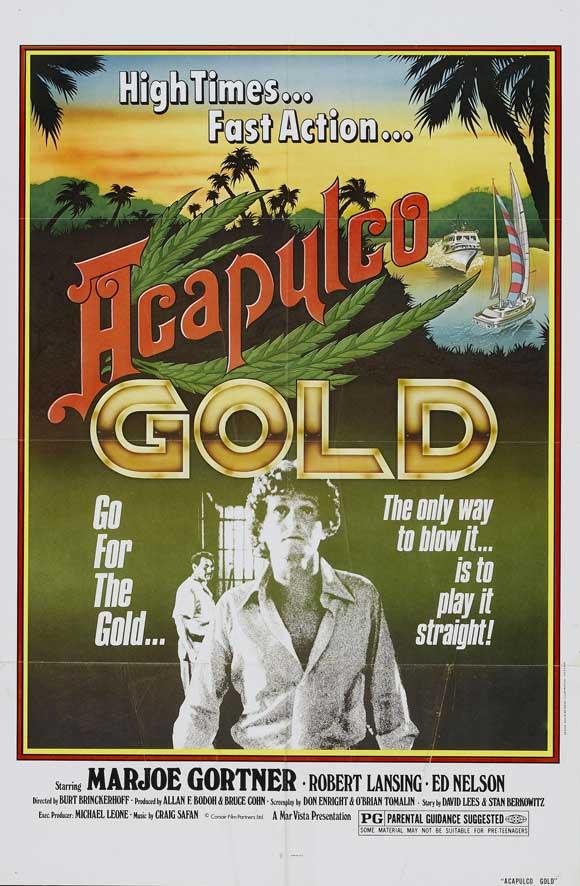
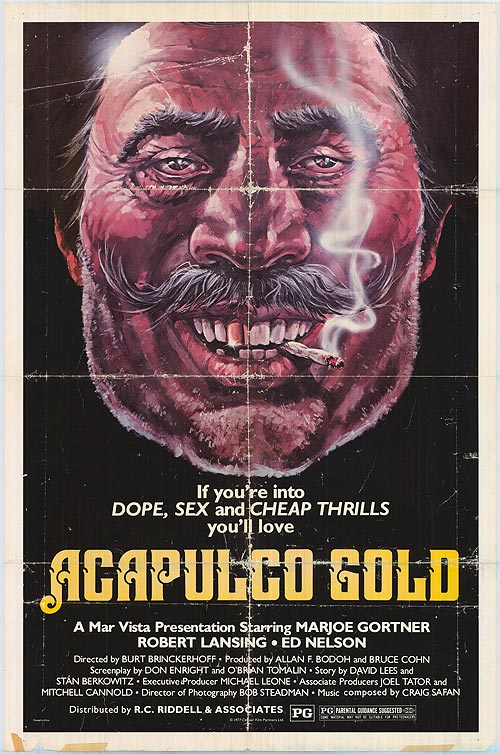
The poster is better than the film.

I just finished watching Acapulco Gold, a rather goofy 1976 film about …. well, who knows?

The film starts with some well-shot footage of marijuana farmers checking out their crop but then it abruptly abandons all of that to follow an American insurance salesman named Ralph Hollio (Marjoe Gortner). Ralph is at an airport in Acapulco, waiting to board a flight back to America. He’s approached by a nun who asks him to carry a piñata for her. Ralph says sure but — oh no! — that piñata is actually full of heroin! Ralph’s an unwitting drug mule and not a very good one because it doesn’t take long for him to get himself arrested and sentenced to 40 years in a Mexican prison.

Despite this run of bad luck, Ralph remains surprisingly cheerful. One is tempted to almost describe him as being a Candide-like figure but that would probably be giving this film too much credit. In prison, he meets another prisoner, a boat captain named Carl Solberg (Robert Lansing). Carl is sprung from jail by local businessman, Morgan Frye (John Harkins). Frye wants Carl to sail a boat from Mexico to Hawaii. Carl agrees but he insists that Morgan also pull some strings so that Ralph can serve as his first mate. Morgan, of course, agrees.

The film’s “action” shifts to Hawaii, where it turns out that Ralph and Carl are being used as a part of a much bigger plot. Or something. To be honest, it’s a bit difficult to figure out just what exactly is going on. Acapulco Gold has a make-it-up as you go along feel to it. Occasionally, it’s amusing. Often, it’s frustrating. As soon as you start to get in any way interested in one storyline, it gets abandoned. The film doesn’t have a plot as much as it has a bunch of scenes that we’re left to assume are meant to be somehow connected.

For instance, there’s an elderly couple who keep showing up at inopportune times, providing what I guess is meant to be comedic relief. At one point, it appears that the couple is surely doomed but, several scenes later, they show up at a golf course and they look none the worse for wear. There are lengthy sailing scenes, mixed in with lengthy helicopter scenes. None of them add much to the plot but the Hawaiian scenery is frequently nice to look at. Ralph falls for Morgan’s girlfriend (Randi Oakes) while a Congressman and a corrupt DEA agent use huge, oversized walkie-talkies to communicate with two people who we occasionally see wandering around in the jungle. There’s a golf cart chase, which ends with a labored joke about a two-strike penalty. And, since this is a low-budget 70s film, there’s a day-for-night sequence that is so ineptly lit that we can barely see anyone for several minutes of the movie. (Though his face may not be visible, one can always spot Marjoe Gortner by his hair. 70s Marjoe had a lot of hair.)

At its best, Acapulco Gold is a charmingly incoherent time capsule, a chance to hop in a time machine and go back to 1976. At its worse, it’s a total mess. That said, it’s short enough that it’s never exactly boring and the randomness of it all occasionally lends the film a dream-like atmosphere (albeit one of those dreams that you forget about after you’ve been awake for 87 minutes). As I previously stated the Hawaiian scenery is lovely and some members of the cast — Robert Lansing and Ed Nelson, in particular — do the best that they can with their inconsistently written characters. The whole thing is such a slapdash affair that it becomes oddly fascinating to watch.

As for the film’s star, Marjoe Gortner was a former child evangelist whose claim to fame was being the subject of Marjoe, a documentary in which he admitted that he didn’t believe in anything that he preached and that he was just scamming people out of their money. Perhaps not surprisingly, Gortner was usually best-cast as villains or unpredictable rogues. (His best performance was as a morally ambiguous space pirate in Starcrash.) In Acapulco Gold, Gortner is playing a normal, ordinary guy who finds himself caught up in the drug underworld. Gortner is miscast as a naive innocent and, instead of projecting any sort of shock over anything tht he experiences, Gortner’s laid back performance suggests that there were multiple reasons why this film was called Acapulco Gold.

Acapulco Gold is currently viewable on Prime. It’s not a particularly good film but Hawaii has always looked great.

Shattered Politics #43: Being There (dir by Hal Ashby)


Original_movie_poster_for_Being_There

As a general rule, I don’t watch the news.  However, a few nights ago, I made an exception and I watched CNN.  The reason was because it was snowing in New York City and apparently, CNN anchorman Don Lemon was broadcasting from something called the Blizzardmobile.  I just had to see that!

Well, the Blizzardmobile turned out to be huge letdown.  I was hoping for something like the Snowpiercer train but instead, it just turned out to be a SUV with a camera crew and a pompous anchorman who hilariously kept insisting that he was knee-deep in a blizzard when even a Texas girl like me could tell that the Blizzardmobile was only encountering a few snow flurries.

So, I flipped around to see if any of the other news stations had anyone in a blizzardmobile.  What I discovered was that only CNN had a blizzardmobile but one thing that every news station did have was a panel of experts.  An anchorperson would say something like, “What does the future look like?” and the panel of experts would tell us what the future looked like to them.  What I found interesting was that I had no idea who these experts were but yet I was supposed to just believe that their opinions were worth considering.

I mean, for all I knew, those experts could have just been people who were spotted wandering around New York at night.  But, because they were introduced as experts and looked directly at the camera whenever they spoke, they were suddenly authoritative voices.

Oddly enough, the very next night, I watched a movie from 1979 that dealt with the exact same issue.

Being There tells the story of Chance (Peter Sellers), a dignified, middle-aged man who lives in Washington, D.C. and works as a gardener for a wealthy older man.  Chance cannot read.  Chance cannot write.  Chance goes through life with a blank smile on his face.  Chance has never experienced the outside world.  Instead, he spends all of his time working in the old man’s garden and obsessively watching TV.  When the old man dies, Chance finds himself exiled from the house.  Wandering around Washington D.C., Chance asks a random woman to make him dinner.  He politely speaks with a drug dealer who pulls a knife on him.  Finally, he finds himself entranced by a window display of televisions.  Backing away from the window, Chance stumbles into the street and is struck by a car.

Though he’s not seriously injured, the owner of the car, Eve Rand (Shirley MacClaine), insists that Chance come back to her mansion with him so that he can be checked out by her private physician (Richard Dysart).  As they drive back to the house, Eve asks Chance for his name.

“Chance the Gardner,” Chance replies.

“Chauncey Gardiner?” Eve asks.

Chance blankly nods.

Back the house, Chance meets Eve’s husband, Ben (Melvyn Douglas).  Ben is a wealthy industrialist who is dying of leukemia.  Ben takes an immediate liking to Chance.  Because Chance is wearing the old man’s suits, everyone assumes that Chance is a wealthy businessman.  When Chance says that he had to leave his home, they assume that his business must have failed due to government regulation.  When Chance talks about his garden, everyone assumes that he’s speaking in metaphors.

Soon, Ben is introducing Chance to his friend, Bobby (Jack Warden).  Bobby happens to be the President and when he quotes Chance in a speech, Chance the Gardner is suddenly the most famous man in the country.  When he appears on a TV talk show, the audience mistakes his emotionless comments for dry wit.  When he talks about how the garden reacts to different seasons, they assume that he’s an economic genius.  By the end of the film, Bobby has become so threatened by Chance’s popularity that he’s been rendered impotent while wealthy, rich men plot to make Chance the next President of the United States.

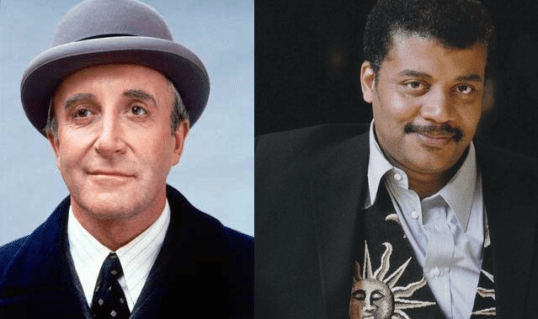
Chance and Neil

In many ways, Chauncey Gardiner was the Neil deGrasse Tyson of his era.

Being There is a one joke film and the idea of someone having no emotional skills beyond what he’s seen on television was probably a lot more mind-blowing back in 1979 than it is in 2015.  But I still enjoyed the film.  Peter Sellers gave a great performance as Chance, never sentimentalizing the character.  As well, the film’s point is still relevant.  If Being There were made today, Chance would be the subject of clickbait articles and Facebook memes.  (Chauncey Gardiner listed his ten top movies and number 8 will surprise you!  Or maybe This boy asked Chauncey Gardiner about his garden and his response was perfect.)

At its best, Being There is a film that will encourage you to question every expert you may see.  Especially if he’s just stepped out of a blizzardmobile…