A Movie A Day #6: The Cannonball Run (1981, directed by Hal Needham)


cannonball_runA legendary Hollywood stuntman, Hal Needham moved into directing in the 1970s and proved that all he required to make a successful film were willing stuntmen, fast cars, Coors beer, and Burt Reynolds.  Following that logic, The Cannonball Run may very well be the ultimate Hal Needham movie.

The Cannonball Run follows several teams of racers as they compete to see who can be the first to reach California from Connecticut.  Trying to stop them is Arthur J.  Foyt (George Furth), who represents the Safety Enforcement Unit and who believes that cars are a menace.  However, Foyt is no match for these racers, who include:

  • J.J. (Burt Reynolds), who is racing in memory of his father, and his mechanic Victor (Dom DeLuise), who turns into Captain Choas whenever he is feeling threatened.  J.J. and Victor are driving an ambulance and are accompanied by crazy Dr. Van Helsing (Jack Elam) and a fake “patient” (Farrah Fawcett),
  • Bradford Compton (Bert Convy) who is riding a motorcycle and who, because of the weight of his mechanic, has to pop a wheelie for the entire race,
  • An Arab oil sheik (Jamie Farr) who is racing for “the glory of Islam” and who would probably not be in the movie if it were made today,
  • Sidney Goldfarb (Roger Moore), the heir to a mattress fortune who has had extensive plastic surgery to make himself look like Roger Moore,
  • Jackie Chan and Michael Hui, called “The Japanese team” even though they both speak Cantonese throughout the entire movie,
  • Terry Bradsahw and Mel Tillis because why the Hell not?,
  • Marcie (Adrienne Barbeau) and Jill (Tara Buckman), using their cleavage to get out of speeding tickets, or at least they do until they’re pulled over by Valerie Perrine,
  • And Dean Martin and Sammy Davis, Jr., pretending to be priests and apparently drunk throughout filming.

Based on a real life (and very illegal) cross-country race that was held four times in the 1970s, The Cannonball Run is profoundly stupid movie that, if you’re in the right mood for it, is also profoundly fun.  It’s a movie that really has no plot but it does have a lot of cars, a lot of stunts, a lot of cleavage, and a lot of politically incorrect humor, some of which has not aged well.  Despite being hated by the critics, The Cannonball Run was a huge box office hit and it still remains a nostalgic guilty pleasure for a lot of people, myself included.  One person who did not like The Cannonball Run was Burt Reynolds who, in an interview with the New York Times, once said, “”I did that film for all the wrong reasons.  I never liked it. I did it to help out a friend of mine, Hal Needham. And I also felt it was immoral to turn down that kind of money. I suppose I sold out so I couldn’t really object to what people wrote about me.”

Burt has a point but, in defense of The Cannonball Run, what other movie actually features Jackie Chan beating up Peter Fonda?
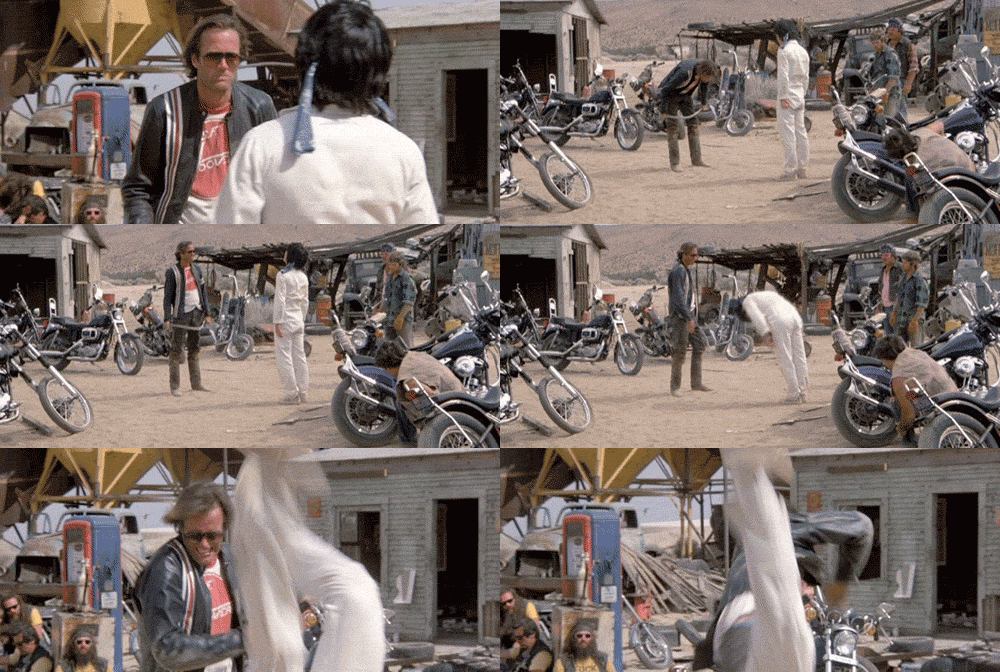
chan-fonda-cannoball-run

Or Roger Moore playing someone who thinks that he’s Roger Moore?

roger-moore

Or Jack Elam playing a mad scientist?

jack-elam

Or Sammy and Dino, phoning it in one last time?

sammy-and-dean

Or Captain Chaos?

captain-chaos

Like most of Hal Needham’s films, The Cannonball Run ends with outtakes of Burt Reynolds blowing his lines and hitting people.

Tomorrow’s movie a day will be a film that Burt Reynolds is presumably much more proud of, Sharky’s Machine.
Embracing the Melodrama Part II #45: Double Indemnity (dir by Jack Smight)


di3vh6

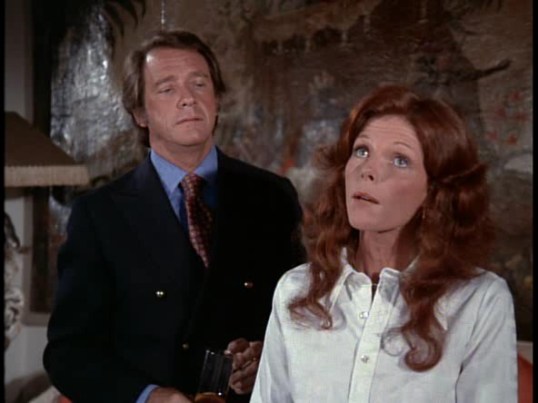
Nothing can make you appreciate a classic film more than by watching a really bad remake.  As proof, I would offer up the 1973 made-for-television version of the classic 1944 film Double Indemnity.  The original Double Indemnity is a classic example of film noir, one that remains intriguing and powerful over 70 years since it was first released.  The remake features the exact same plot as Double Indemnity and a few of the original’s scenes are recreated shot-by-shot but it just does not work.

Part of the problem is that the remake is in color.  In fact, since it was made in 1973 and for television, it’s in very bright and somewhat tacky color.  Bright and vibrant doesn’t work for film noir.  You need the shadows and the visual ambiguities that are unique to black-and-white.  If the original Double Indemnity was full of secrets and mysteries, the remake is all on the surface.  There are no secrets to be found in this remake.

That goes for the cast as well.  In the original, Fred MacMurray made Walter Neff into the epitome of the bored, post-war American male.  You watched him with a certain sick fascination, trying to figure out what was going on behind the blandly friendly facade.  In the remake, you know that Richard Crenna is a serpent from the minute he first appears.  If MacMurray’s Walter was motivated by ennui, Crenna’s Walter is just bad and therefore, far less interesting.  Meanwhile, in the role of Phyllis, Samantha Eggar has none of Barbara Stanwyck’s ferocious determination.  Instead, Eggar’s performance is curiously refined (which is another way to say boring).

Probably the most interesting thing about the remake of Double Indemnity is that the role of Keyes is played by Lee J. Cobb.  Cobb actually gives a pretty good performance and, unlike Crenna and Eggar, he’s actually entertaining to watch.  In the original film, Keyes was played by Edward G. Robinson and was roughly around the same age as Walter.  They were contemporaries and friends and that made the original’s ending all the more poignant.  In the remake, Cobb is quite a bit older than Crenna and, as a result, their relationship feels more paternalistic.  It’s almost as if Crenna is the prodigal son who has betrayed his father and who tells his story as a way of begging for forgiveness.

But that’s probably reading too much into the remake!  For the most part, the remake of Double Indemnity is bland and boring.  The best thing about it is that it’ll make you love the original even more.

As for how I ended up watching the remake of Double Indemnity, it was included as an extra on my DVD of the original.  Watching them back-to-back, as I did, really serves to make you appreciate Billy Wilder as a filmmaker.

12 Reasons To Love 12 Angry Men


Everyone already knows that the 1957 Best Picture nominee 12 Angry Men is a classic.  We all know the film’s story — a teenage boy is on trial for murdering his family.  11 jurors want to convict.  1 juror doesn’t.  Over the next few hours, that one juror tries to change 11 minds.  Some of the jurors are prejudiced, some of them are bored, and some of them just want to go home.  And, as the film reminds us, all 12 of them have a huge  responsibility.  You don’t need me to tell you that this is a great movie.  Therefore, consider this to be less of a review and more of an appreciation of one of the best movies ever made.

1) The film is the feature debut of director Sidney Lumet.  As any student of American film can tell you, Sidney Lumet was one of the most important directors in the history of cinema.  After beginning his career in television, Lumet made his film directing debut with 12 Angry Men and he was rewarded with a much deserved Oscar nomination for best director.

2) The film’s story is actually a lot more complex than you might think.  12 Angry Men is such an influential film and its story has been imitated so many times that it’s easy to forget that the film’s plot is a lot more nuanced than you might think.  Despite what many people seem to think, Juror Number 8 never argues that the defendant is innocent.  Instead, he argues that the state has not proven its case beyond a reasonable doubt and, as a result, the defendant cannot be convicted.  That’s an important lesson that is too often forgotten.

3) The movie celebrates the power of one person determined to do the right thing.  Again, that’s a lesson that remains very relevant today.

4) As Juror Number Eight, Henry Fonda makes human decency believable.

5) As the angry and bullying Juror Number Three, Lee J. Cobb is the perfect antagonist.

6) As Juror Number Ten, Ed Begley makes Cobb seem almost reasonable.  To be honest, the scene where Begley’s racist ranting causes all of the other jurors to stand up and turn their back on him feels a bit too theatrical.  But it’s still undeniably effective.  Alone among the jurors, Juror Number Ten is the only one without any hope of redemption.  It’s a bit of a thankless role but Begley does what he has to do to make the character believable.

7) E.G. Marshall makes the wealthy Juror Number Four into a worthy opponent of Fonda without crossing the line into prejudice like Cobb and Begley.  In many ways, Marshall’s role is almost as important as Fonda’s because Marshall’s performance reminds us that not all disagreements are the product of ignorance or anger.

8) As the Jury Foreman, Martin Balsam is the epitome of every ineffectual authority figure.

9) As Juror Number Seven, Jack Warden is hilariously sleazy.

10) As Juror Number Nine, Joseph Sweeney grows on you.  The first time I saw the film I thought that Sweeney went a bit overboard but, on more recent viewings, I’ve come to appreciate Sweeney’s performance.

11) As Juror Number Twelve, Robert Webber is hilariously shallow.  Juror Number Twelve is in advertising and Webber seems like he was right at home on Mad Men.

12)  Though they don’t get as much of a chance to make an impression, John Fiedler, Jack Klugman, Edward Binns, and George Voskovec all do good work as the other jurors.  If there’s ever been a film that proves the value of a great ensemble, it’s 12 Angry Men.

Scenes I Love: 12 Angry Men


With the recent passing of filmmaker Sidney Lumet I’ve gone through some of the films of his I’ve come to see as favorites of mine. One film which always came to the forefront whenever I spoke about Lumet as a filmmaker is his directorial film debut in 1957 with his adaptation of 12 Angry Men. Of all his films this is the one which I always go back to time and time again. Part of me is somewhat biased in regards to this film since I was part of a class reading of the original teleplay and played the role of Juror #3.

The scene in the film which I love the most has to be when Juror #8 (played with calm assurance by Henry Fonda) and Juror #3 (played with seething rage by Lee J. Cobb) finally get into it after a very long deliberation in trying to find a consensus on the guilt or innocence of the defendant in their case. I love how in this scene everything that’s right about the American jury system was being upheld by Juror #8. How the guilt or innocence of the defendant should come down to just the facts of the case and combing through all the testimony. How emotions and personal feelings and bias should never enter the equation. It is a person’s life in their hands and it is a responsibility too great to leave it to emotions to find the verdict.

This scene also shows the darker side of the American jury system in that there will be, at times, people chosen to preside as a juror in a case will come in with emotional baggage and a hidden agenda which clouds their decision making. They don’t look at the facts and testimony at hand but at what they believe to be true no matter what the facts may say otherwise. this is how the jury system becomes twisted and becomes part and parcel to the notion that justice is never truly blind but always colored by human frailties and prejudices.

Even 54 years since the films first premiered it still holds a powerful effect on me and those who sees it for the first time. It helps that you have a master filmmaker in Sidney Lumet guiding an exceptional cast of actors. One could come to the conclusion that the audience has the angel on one shoulder with Juror #8 and the devil on the other with Juror #3. All in all, a great scene that always stays with me long after the film has ended.