Late Night Retro Television Review: Highway to Heaven 4.15 “Time In A Bottle”


Welcome to Late Night Retro Television Reviews, a feature where we review some of our favorite and least favorite shows of the past!  On Thursdays, I will be reviewing Highway to Heaven, which aired on NBC from 1984 to 1989.  The entire show is currently streaming on Tubi and several other services!
This week, it’s another courtroom drama on Highway to Heaven.

Episode 4.15 “Time In A Bottle”

(Dir by Michael Landon, originally aired on January 20th, 1988)

A homeless man who goes by the name of Humphrey Bogart (Henry Bal) is arrested for trying to steal a bottle of cheap wine from a liquor store.  The hard-nosed assistant D.A. (Robin Strasser) charges him with a felony.  Jonathan and Mark recruit Humphrey’s friend, Matthew (John Rubinstein), to defend him in court.  Matthew may be homeless but he’s also a lawyer!

It turns out that a corrupt city councilman (Alan Fudge) wants to crack down on the homeless because he wants to turn the homeless district into a commercial area.  If you already guessed that this episode ends with Matthew leading a march of homeless people into a city council meeting while they chant “We will be heard,” then you’ve obviously seen quite a few episodes of Highway to Heaven.

Highway to Heaven frequently did stories about the homeless and I really can’t criticize the show for that.  This was an issue that Michael Landon obviously cared a lot about and the show was usually so earnest and sincere that you could overlook just how heavy-handed it often was.  The homeless people on Highway to Heaven are always a lot more clean-cut and polite than the ones that I used to yell at me when I worked in downtown Dallas.  On Highway to Heaven, the homeless are always funny and philosophical and they have wonderful lessons to teach everyone.  In Dallas, they come up to your car window while you’re stuck in traffic.  In order to visit my aunt when she was dying at Medical City last month, I had to endure being shouted at and occasionally threatened by all sorts of people.  By the end of it, I was running red lights because paying a fine was less annoying than having that guy whole lived at the Forest/Central intersection calling me the C-word while I was waiting for the light to change.

(That’s not say that the homeless should not be treated with compassion or helped because they certainly should.  I’m just saying that this habit that some people have of idealizing and infantilizing anyone living on the streets is, in many ways, as destructive as just ignoring the problem.)

As for this episode, it was a bit too preachy for its own good.  And I know what you’re going to say.  “It’s Highway to Heaven, it’s always preachy.”  That’s true to an extent but the first three seasons were also a bit less self-righteous than the fourth season has been.  The first three seasons featured characters who were often misguided but who were also capable of being redeemed.  In the past, this episode would have been about the city councilman seeing the error of his ways.  This season, though, the city councilman is just evil because he is.  It’s a far more heavy-handed approach to take and, as a result, far less effective.

This is another episode where one impassioned speech manages to change everyone’s mind.  If only things were as simple in the real world.
Horror on the Lens: The Bat (dir by Crane Wilbur)


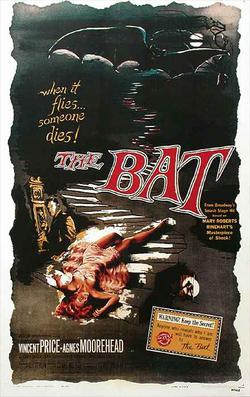
Today’s Horror on the Lens is 1959’s The Bat.  A simple case of bank embezzlement leads to a murder that may or may not be connected to a series of other murders that are apparently being committed by a mysterious killer known as “The Bat.”  The Bat is said to have no face and steel claws and, needless to say, everyone in town is worried about becoming the next victim.

Who is the Bat?  Is Dr. Malcolm Wells (Vincent Price), the shady scientist whose work has led to him doing experiments on bats?  Is it Victor Bailey (Mike Steele), the bank clerk who is a prime suspect in the embezzlement case?  Is it the butler (John Sutton) with a secret past?  Could it even be one of the cops (Gavin Gordon and Robert B. Williams) who has been tasked with capturing The Bat?  Can mystery novelist Cornelia van Gorder (Agnes Moorehead) solve the mystery before becoming The Bat’s next victim!?

The Bat is based on a play and it’s definitely a bit stagey but when you’ve got performers like Agnes Moorehead and Vincent Price onscreen, it really doesn’t matter.  The Bat is an entertaining and atmospheric mystery, featuring a Vincent Price playing another one of his charmingly sinister cads.

Enjoy!

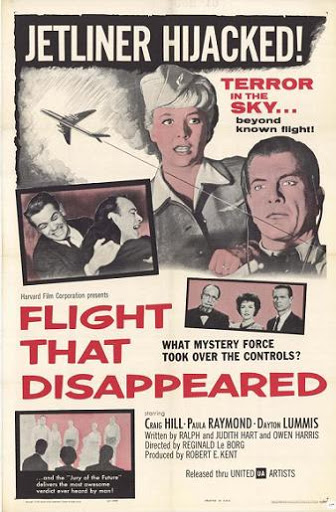
18 Days of Paranoia #1: The Flight That Disappeared (dir by Reginald Le Borg)


Way back in the early days of the site, I did a series of reviews called 31 Days of Paranoia, in which I reviewed films about mysteries, cover-ups, and conspiracies.  Unfortunately, because I wasn’t all that disciplined about posting during the early days of the Shattered Lens, my 31 Days of Paranoia ended up being something like 24 days.  Still, it was a lot of fun and, historically, it was important because it was the very first “themed” series of reviews that I had ever done.  Shattered Politics, Embracing the Melodrama, Back to School, Sprin Breakdown, and all the rest started with 31 Days of Paranoia.

So, with this being the 10-year anniversary of the Shattered Lens’s founding and Spring Breakdown wrapping itself up tomorrow, I figured why not return to where it all started.  From now til April, please enjoy …. 18 Days of Paranoia!

We begin with:

The 1961 film, The Flight That Disappeared, deals with an airplane that …. wait for it …. disappears!

What’s happened to Trans-Coast Airways Flight 60?  When it first took off from Los Angeles, everything seemed fine.  It was carrying a small but well-behaved group of middle-aged people to Washington D.C.  The pilots all seemed like good professionals.  The two flight attendants were busy serving people coffee and having conversations about whether or not one of them would ever get married.  She had every right to be concerned, of course, seeing as how she was in her 20s and still unmarried and childless, despite the fact that this film was made in 1961.

It doesn’t take too long for something strange to happen.  The plane suddenly starts to climb upward, eventually going up over 10 miles high in the sky.  The pilots can’t do anything to get the plane to come back down.  Due to the lack of oxygen, some of the passengers start to pass out.  One passenger panics and opens a door, out of which he promptly falls.  Oddly, this doesn’t create the whole vacuum effects that we always see in other movies where a window or a door is opened while a plane is in the air.  Stranger still, no one thinks to close the door afterwards.  Was this intentional or was it just crappy filmmaking?  It’s hard to say.

Why is the plane being lifted up into the air?  Could it have something to do with the three atomic scientists who are all on the plane?  One of them, Dr. Morris (Dayton Lummis), is wearing glasses and has a van dyke beard so you know he’s smart!  It turns out that Dr. Morris has been working on the Beta Bomb, which is apparently the most powerful atomic bomb ever built.  I kept waiting for someone to ask Dr. Morris why it was called the Beta Bomb and not the Alpha Bomb or the Omega Bomb or the Big Scary Bomb or the …. well, seriously, anything would be better than Beta Bomb!  Everyone in the movie says, “Beta Bomb,” in a tone that’s meant to communicate reverence but it just sounds too much like “Beta Male” for me to really take it seriously.

But, again, who is responsible for the flight climbing?  Is it the Russians?  Is it aliens?  Is it some enemy of the American way?  While everyone else on the plane is passed out, the three scientists find themselves awake.  Their watches are no longer running and, despite the fact that they appear to be alive, their hearts are no longer beating.  Are they dead?  Or have they been transported to the future where they will now be put on trial for the crime of developing the Beta Bomb?

Of course, the thing with being put on trial in the future is that it provides the perfect defense for making weapons in the present.  “Hey,” a smart defense attorney would say, “you’re still alive in the future and you’ve got time travel technology so what are you bitching about?”  But the jurors explain that they’re actually the ghosts of the people who would have been born in the future if not for the Beta Bomb which …. what?  So, is the plane in the future or is it in the afterlife?  The film itself doesn’t seem to be sure.

I’m probably making it sound like this is a more intriguing film than it actually is.  This movie is about 72 minutes long and all the stuff with the people in the future takes place during the final 10 minutes.  That means that the film is essentially just 60 minutes of people saying, “We’re still climbing.”  From a historical point of view, it’s an interesting example of people being paranoid about the arms race.  (If the film were made today, the future the ghostly jurors would be the souls of people who were not born in the future due to climate change.)  From an entertainment point of view, it’s a forgettable dud.