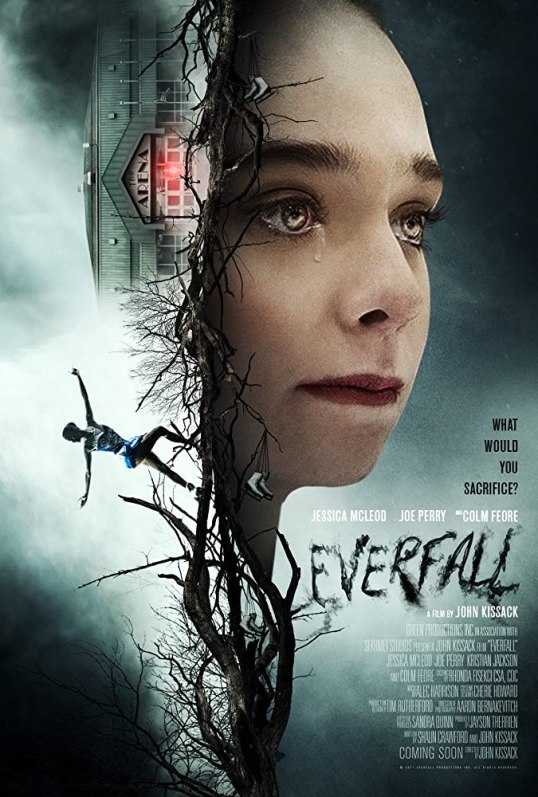
The 2018 horror film, Everfall, tells the story of Eva and Daniel.
Eva Saint (Jessica McLeod) is a figure skater who, at one time, had a bright future.
Daniel (Joe Perry) is the world’s worst boyfriend.
Daniel is also the reason why Eva’s skating career get derailed. Daniel hosts his own “extreme sports YouTube channel,” which he calls “The Daniel Show.” Daniel is the type who tends to say things like, “This is going to be a totally new direction for the Daniel Show!” One of Daniel’s new directions was to convince his girlfriend to stand on a ledge. Unfortunately, while Daniel was showing off for the camera, Eva fell off that ledge and broke her leg.
A year later, Eva’s leg is scarred but healed. She wants to get back into the world of competitive figure skating but she’s struggling. She’s no longer as confident in herself as she once was. None of her old partners want to work with her anymore. Even worse, she’s still going out with Daniel. I’m not sure why. If I was dating a guy who was responsible for me falling off a roof, I’d probably break up with him as soon as I regained consciousness.
Eva’s coach gives her one last option. She can go to an obscure little town called Everfall, where they have an annual skating competition. Eva’s never heard of it before but she knows that she has to do something so she agrees. And again, for some reason, she takes Daniel and Daniel’s cameraman, Jordan (Kristian Wang), with her.
The competition at Everfall turns out to be even worse than Eva was expecting. First off, the ice skating rink appears to be on the verge of collapse. Secondly, there don’t seem to be another other skaters around. The mysterious Mrs. Redgrave (Catherine Gell) sends Eva to Dressing Room #5. Dressing Room #5 turns out to be a not very pleasant place to be….
Everfall is an effectively creepy film, one that makes good use of its eerie location and which features an excellent performance from Jessica McLeod. Everfall is also a film that never really makes much sense but, in this case, that’s acceptable. When you’re dealing with a skating rink that may or may not be haunted by several ghosts, you can get away with a little incoherence. The film is full of surreal moments and disturbing imagery. Characters appear to die and then, just as quickly, they show back up again. It’s a film that was obviously influenced by Kubrick’s The Shining — particularly the final few scenes — but it also manages to carve out its own rather odd identity.
While Eva, Daniel, and Jordan are wandering around the skating rink from Hell, there’s also wildfire raging around the town of Everfall. Amazingly enough, Eva’s father is a fireman but he refuses to acknowledge that Eva’s in any sort of danger. Eva’s parents are played by Jayson Therrien and Julie Orton. They bicker through the entire film and, to be honest, I could have done without the majority of their scenes. The scenes between Therrien and Orton wreck havoc on the film’s narrative momentum. Whenever you’re really starting to get into whatever’s happening to Daniel, Eva, and Jordan, Eva’s parents pop up and start arguing with each other. The main theme of these scenes is that Eva’s dad isn’t willing to rescue her from a fire despite the fact that he is a fireman and that’s literally his job. You really can’t help but feel sorry for Eva. She never had a chance.
Everfall has its flaws. This is one of those films where the camera is always moving, even when it should be sitting still. That said, there’s enough strange details and out-there plot twists to make it an effective head trip and it ends on a nicely surreal note. That’s always a good thing.
In 1978, just based on what I’ve read, everyone in America was regularly doing huge amounts of cocaine. Whether you were in a disco or at a PTA meeting, you knew that eventually someone would produce a small mirror covered with white powder. President Carter even snorted it during that year’s State of the Union speech. Sure, some people used gold spoons and others had to make do with a one dollar bill but, in the end, cocaine brought all Americans together as a nation and helped the country heal after the trauma of Watergate.
It also contributed to some the year’s best films. Days of Heaven, Superman, The Deer Hunter, Coming Home, Grease, Animal House, Interiors, Halloween, Midnight Express, Convoy, Go Tell The Spartans, and An Unmarried Woman; these were all films fueled by the Peruvian Headache Powder.
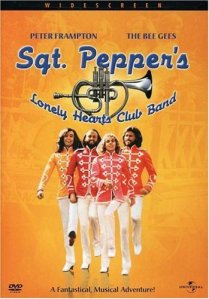
However, no discussion of 1978 cocaine-fueled films would be complete with mentioning Sgt. Pepper’s Lonely Hearts Club Band. Featuring songs originally performed by the Beatles and starring the Bee Gees, Peter Frampton, and a whole bunch of other people that my mom liked, Sgt. Pepper’s is a film that, quite honestly, should just be retitled 1978.
Plotwise — oh God, do I really have to try to describe the plot? Seriously, this could take forever. I mean, the film isn’t quite two hours long but a lot of stuff happens and really the only connection between any of it is that these odd cover tunes of classic Beatles songs keep popping up in the weirdest places. Okay, let me try to get this all into one paragraph —
There’s a small town called Heartland that is very small and simple but it’s also the home of the legendary Sgt. Pepper who, throughout history, has maintained world peace by playing his magic instruments. But then Sgt. Pepper dies and apparently turns into a gold weather vane. His magic instruments are given to the mayor of Heartland, Mr. Kite (George Burns, who also narrates the entire movie). The world is in mourning. But then one day, the Henderson Brothers (the Bee Gees) decide to form a new Sgt. Pepper’s Lonely Hearts Club Band and they invite Sgt. Pepper’s grandson, Billy Shears (played by Peter Frampton) to be their lead singer. Heartland rejoices and George Burns has a surprisingly sweet scene where he sings Fixing A Hole.
Anyway, the new band is such a hit that the owner of a record company invites them to come to Los Angeles and record an album. Billy says goodbye to his girlfriend, Strawberry Fields (Sandy Farina) and then joins the Hendersons in a hot air balloon which promptly leaves for California. En route, the balloon collides with an airplane but nobody is seriously injured.
In Los Angeles, they meet the record company owner and it turns out that he’s played by Donald Pleasence. (It’s interesting to think that Pleasence filmed this and Halloween around the same time.) Pleasence proceeds to sing the creepiest version of I Want You ever heard. I’d include a clip of the performance but Pleasence manages to go on for a good ten minutes, repeating “I want you,” in an odd little voice while staring at Peter Frampton.
The boys sign a contract with Pleasence. Billy Shears is led astray by Lucy and her band, the Diamonds. (Guess which song they get to sing.) Somehow, this allows Mean Mr. Mustard to steal Sgt. Pepper’s magic instruments. Mr. Mustard drives around in a yellow van and he’s assisted by two female robots who, at one point, sing She’s Leaving Home in their electronic, robot voices.
The band is informed that the instruments have been stolen. Outraged, they jump back in their hot air balloon and quickly start a recovery operation. It turns out that Mean Mr. Mustard has given the instruments to three separate villains.
The first villain is Dr. Maxwell Edison who uses his silver hammer to turn old people into boy scouts. This may sound ludicrous and silly but fortunately, Maxwell is played by Steve Martin. His cameo is one of the highlights of the film, if just because he seems to be one of the few people who actually enjoyed himself on set.
The second villain is the Reverend Sun. He brainwashes people or something. I’ve seen this movie a few times and I still can’t quite figure out what Reverend Sun’s deal is. When I first saw this movie, I got excited because I thought that Tom Savini was playing Rev. Sun. Then I forced my sister Erin to watch the movie and she told me I was stupid because Rev. Sun was obviously being played by Frank Zappa. Well, I did some reasearch and discovered that we’re both stupid. That’s neither Savini nor Zappa. It’s Alice Cooper.
The final villains are played by a very young (and very, very hot!) Aerosmith. Here, they are called the Future Villain Band and oh my God, Joe Perry…this film needed a lot more Joe Perry. I mean, it’s understandable that Steve Tyler gets most of the screen time and young Steve actually looks pretty good in a Mick Jagger sort of way but Joe Perry…Oh. My. God. Anyway, Aerosmith does a cover of Come Together and Joe Perry circa 1978 was just so freaking gorgeous, oh my God. Eventually, Frampton and the Bee Gees come along and ruin things by getting into a fight with Steve Tyler which leads to the camera constantly cutting away from Joe Perry who is really, really, really hot and all kinds of sexy in this movie. They should have just called this movie Joe Perry. Oh. My. God.
Uhmm, where was I? Oh yeah — so, anyway, eventually the weather vane comes to life and suddenly, Sgt. Pepper’s a black man who sings Get Back and ends up magically resetting the past and turning Mean Mr. Mustard into an altar boy or something like that. Oh, and the Bee Gee who looks like a New Age healer ends up singing my favorite Beatles song, A Day in the Life.
Finally, it appears that every single person on the planet shows up in the film’s final scene where a huge group of “stars” show up and sing the film’s title tune one last time. In the end credits, these people are listed as being “Our Guests At Heartland.” Doing some research (i.e., looking the thing up in Wikipedia), I’ve discovered that these folks were apparently all pop cultural icons in the 70s. I didn’t recognize a single one of them but I’m sure they probably all snorted a lot of cocaine.
(And, by the way, Joe Perry does not get to return for the finale so bleh on you, movie.)
For some reason, this movie kept showing up on Starz last November and that’s where I first discovered it. The first time I saw it, I came in right at the start of Steve Martin’s cameo and the film itself was so just plain weird that I had to jump on twitter and let the world know what I was watching. (Actually, it doesn’t take much to make me jump on twitter and tell the world what I’m doing.) As a result, I soon discovered that, apparently, I was the only person on the planet who didn’t know about this film.
Sgt. Pepper’s Lonely Hearts Club Band is really a pretty bad movie. The plot tries way too hard, the pacing is terrible with some scenes lasting forever and others ending before they really start, and Frampton and the Bee Gees are all distinguished by an utter lack of charisma. The youngest Bee Gee appears to be cheerfully stoned throughout the entire movie while the other two (and Frampton) are trying way too hard to act.
And yet, the film fascinates me. After I saw it the first time, I forced my sister to watch it with me a second time. I then watched it again on my own. Finally, I went down to the local Fry’s and nearly did a happy little dance when I found it on DVD. I’ve watched it since several times. Whenever I’m depressed, it always cheers me up.
What’s the appeal? Some of it is definitely the whole “so-bad-its-good” thing. Actually, that’s probably most of it. Another thing fascinating thing is how literally the filmmakers choose to interpret the Beatles lyrics. Considering the fact that the Beatles themselves were rather open about the fact that a lot of their lyrics were simply nonsense and word games, it’s interesting to try to understand logic behind trying to force them into a coherent storyline. (This is also the appeal of 2007’s Across The Universe, which is technically a better movie than Sgt. Pepper’s but isn’t half as fun to watch.) For instance, Billy Shears isn’t in the film because he’s an interesting character. Instead, he’s just here because — 10 years earlier — either John Lennon or Paul McCartney choose to toss the name into a song. We’re never quite sure what Mean Mr. Mustard’s dastardly motivation is beyond the fact that the filmmakers had the rights to his song. If nothing else, the film is an interesting example of what happens when people try to create a novel out of somebody else’s short story.
However, I think the main appeal of Sgt. Pepper’s is the appeal of 1978. Watching the movie, you feel almost as if you’re literally sitting beside the cast at Studio 54, watching as everyone snorts a line. I think that, for future historians, this film may very well turn out to be a cinematic Rosetta Stone.
Then again, maybe it really is just so bad that it’s good.
 Through the Shattered Lens