Quick Review: Elysium (dir. by Neill Blomkamp)


elysium-firstposter-full2In 2009, director Neill Blomkamp gave us District 9, a quiet film that amazed with its visuals of an Earth populated by refugee aliens from space. Produced by Peter Jackson and Carolynne Cunningham, the film was a great success in some ways for both the director and its lead, Sharlto Copley. Both Copley and Blomkamp reunite in Elysium, also adding Matt Damon, Jodie Foster, Alice Braga, William Fichtner & Diego Luna.

I’ll admit that on seeing the film, I was impressed by the visuals, but my hype machine was cranked just a little too high. Any disappointments with the film are the result of my expectations after seeing the trailer. I thought I was going to see something similar to the upcoming game Watch Dogs, where maybe Matt Damon’s character would be able to hack & control a whole network, using it as he saw fit.  He’d flip cars, crash planes and cause all sorts of interesting mayhem. The kid in me jumped in his seat at the thought of that.

What I got, however, wasn’t quite that. It came off feeling like a cooler, much better written version of 1995’s Johnny Mnemonic. This isn’t a bad thing by any means. The first hour of the film was very solid, but the second half shifted gears somewhat (at least for me, anyway).

Elysium is the tale of Max Da Costa (Damon), a former car thief who lives and works on Earth in the year 2154. The world is divided into an even greater scale of the Have’s and Have-Not’s. Most live on the overpopulated planet under horrid working conditions, run down pavelas and broken down roads. Those who can afford it can buy a ticket to live on Elysium, a large habitat orbiting the planet, filled with Mansions and other luxury homes. The houses also contain medical systems that can cure any ailment. When Max suffers an accident on the job that leaves him with only 5 days left to live, his immediate goal is to get to Elysium to cure himself. With the help of his friend Julio, Max meets up with a former associate from his crime days for a job that could give him what he needs. In order to complete his mission, Max is outfitted with an exosuit that makes him stronger. Considering that most of his enemies are robot sentries, the suit becomes a necessary asset.

Elysium is protected by Delacourt (Foster), who makes sure that any unauthorized ship is diverted. When Max’s job directly intervenes with plans of her own, she enlists the aid of Kruger (Copley), a somewhat unstable mercenary to clean things up. Will Max be able to heal himself? That’s what you’ll need to see to find out.

Visually, the movie is pretty good. Elysium itself is a marvel. If there was ever a Mass Effect movie to be made, effects makers wouldn’t have any problems recreating the Citadel space station, based on what you see here. Robot Police using futuristic weapons are well rendered, though they don’t really have the cool factor of something like say, I, Robot or Total Recall. It’s minimal in some ways, but effective. For a budget of just $115 Million, Blomkamp and his crew knew where to put the money.

Musically speaking, I did a bit of searching and found that supposedly the score comes from newcomer Ryan Amon, who Blomkamp found on YouTube. The music does the film some justice, though it isn’t anything sweeping and grand. It does what it needs to for the film, at least that’s how I felt. I hope to see more in the future from Amon, actually.

Cast wise, Damon is effective as always and I’ll admit that I liked Jodie Foster in this one, though she didn’t seem like she was given too much to do. The same almost applies to Alice Braga, who plays Da Costa’s childhood friend, Frey. Both Diego Luna and Wagner Moura (as Spider, Max’s former associate) had some interesting moments. The standout by far is Sharlto Copley. His Afrikaans accent is pretty strong, and almost makes it hard for you to catch what he’s saying, but he’s creepy. If the Simpsons’ Groundskeeper Willy somehow caught rabies, his mannerisms would probably be what you get from Copley in this film. Very wild stuff there. He and the effects are the best parts of the film for me.

On the second half of the film, I felt as if the film shifted from a drama to an action film, but I don’t know. There was something odd about it. It wasn’t new for me – District 9 did the same thing in it’s 2nd half, but Elysium seemed as if with all the robots and all the guards, some of the events occurred just too easily and without their intervention. I didn’t get a feeling that there was danger around every corner, but that’s just me and it’s a very minor gripe on my part. There weren’t too many cheer moments for me (and by “cheer moments”, I refer to those scenes where you want to yell something but keep yourself in check – or forget to do so and yell anyway like with Pacific Rim). It was a little generic for me, despite the original and fresh elements leading up to it in the setting and Da Costa’s sense of purpose.

Overall, Elysium gives the audience an interesting situation, and populates it with at least 2 good characters (in Kruger and Da Costa). See it for the visuals and the solid first half, but don’t expect the story to be the best thing in the world. Just enjoy it for the escapism.

Trailer: Elysium (2nd Official)


Elysium

I know it’s been done and written for what seems like hundreds of times that Neill Blomkamp was given the chance to direct a planned live-action film adaptation of the highly popular video game franchise Halo. Seeing how his directorial full-feature debut with District 9 proved that Peter Jackson was correct in trying to give the mega-budgeted project to the young South African, but also set Blomkamp as filmmaker who had given himself that rare commodity in Hollywood: the ability to pick and choose his next projects.

He could easily have taken the money and accolades from that first film and taken the first major action project sent his way, but Blomkamp took that rare commodity and decided to do another sci-fi film that combined not just his flair for action and gritty sci-fi visuals, but what looks to be his storytelling style of using current sociological problems (immigration, class divide, etc…for his latest film) as themes for his film.

Elysium arrives with a new trailer from TriStar Pictures and it’s parent company Sony Pictures. The first trailer gave a taste of the ideas that drive the film’s plot. This second (and much longer trailer) gives us a much more detailed look into the film’s three main characters played by Matt Damon, Jodie Foster and Sharlto Copley. It also gives us a longer look at the two contrasting art designs for society on Earth and that on Elysium.

Oh, did I also mention that the trailer almost makes it seem that it could be a trailer-run for any future Mass Effect live-action film. I saw more than one instance of what could be the use of “biotics” in the trailer by Sharlto Copley’s Kruger character.

Elysium is set to arrive in theaters on August 9, 2013 in both regular and IMAX screens.

Lisa Marie Talks About The Beaver (dir. by Jodie Foster)


So, there’s this thing in Hollywood that they call the Black List.  The Black List comes out at the end of each year and basically, it’s a list of the “best” unproduced screenplays of the year.  The reason I put best in quotation marks is because the list is 1) determined by studio people and studio asskissers and we all know that those people are toadsuckers, 2) film is not a writer’s medium so the best screenplay in the world can still be ruined if the wrong director gets involved with it, and 3) the films made from the scripts on the blacklist always seem to end up sucking like I did during my sophomore year of high school.  Seriously, that was a lot of sucking.

The Beaver (written by Kyle Killen) was at the top of the Black List in 2008 and now, 3 years later, it’s finally been made by Jodie Foster and released to mixed reviews and indifferent box office.  I saw The Beaver on Saturday.  So does, the Beaver continue the tradition of disappointing movies being produced from Hollywood’s “best” screenplays?  Well, yes and no.  The final 20 minutes of the Beaver are incredibly effective and almost moving.  Unfortunately, they’re not effective enough to make up for the wildly uneven 90 minutes that come before.

One thing that films that top the Black List tend to have in common is that they almost always try to tell a very traditional, rather obvious story by using some quirky gimmick that becomes less and less clever the more you think about it.  The Beaver continues that tradition.  Mel Gibson plays a guy named Jerry who runs a toy company and who has become clinically depressed.  After a unsuccessful attempt to commit suicide, he comes up with a novel solution to deal with his inability to communicate his feelings.  He starts to walk around with a beaver hand puppet and whenever he has to talk to his estranged wife (Jodie Foster) or his angry son (Anton Yelchin), he does so through the puppet.  And, as long as he has that beaver puppet, he has the strength to be a good husband and a good father.  At first, Foster is happy — if confused — but soon she finds herself growing frustrated with always having to talk to the Beaver as opposed to speaking to her husband.  However, Gibson has now grown so dependent on the Beaver that he can’t give it up, even though the Beaver has now started to insult Gibson whenever there’s no one else around.

Eventually, this leads Gibson to doing something very shocking and quite disturbing and it’s once that happens that The Beaver actually starts to work as a film.  Unfortunately, by that point, there’s only 20 minutes left in the film and we’ve had to sit through a whole lot of subplots, none of which seem to belong in the same movie. 

On the one hand, we have Gibson reviving his company by launching a toy line based on the Beaver.  These scenes are probably the weakest in the film.  Gibson shows up at work and tells everyone that the Beaver hand puppet is in charge and nobody quits.  Apparently, nobody calls up the tabloids to tell them that CEO of a major toy company has apparently had a nervous breakdown.  Instead, work goes on as normal.  Every time I saw Gibson’s character sitting in his office with that hand puppet, I wondered, “Does this company not have shareholders?”

Meanwhile, Yelchin is dealing with the beginning stages of the same clinical depression that has crippled Gibson and (its implied) led to his grandfather killing himself years earlier.  A high school senior, Yelchin has a lucrative career writing other students papers for them.  He’s hired by Jennifer Lawrence who asks him to write her graduation speech.  It also turns out that Lawrence is not only a popular cheerleader who is graduating at the top of her class but she’s also a graffiti artist as well who has a convenient family tragedy that she needs help getting through.  Now, that’s not as impossible as it may sound because my sister Erin’s a truly talented artist who was also a cheerleader  in high school but that doesn’t change the fact that Lawrence’s character still basically came across as just being a typical male fantasy, the nurturing madonna figure who only exists to justify and/or excuse the behavior of an obviously autobiographical male figure.  Still, Lawrence and Yelchin’s subplot is probably the most compelling part of the movie. 

As you can probably guess, the main problem with the movie is that it’s essentially about a guy walking around with a Beaver puppet.  Neither Kellen’s screenplay nor Foster’s direction seems to be sure just how seriously we should take that beaver and as a result, it just comes across as being a really cutesy idea that never really works as well as the movie seems to think that it does.  As well, it’s hard to take anything seriously once the word Beaver is introduced into the conversation.  For instance, as we watched Gibson bonding with his employees, my friend Jeff suggested that all Gibson needed to do in order to feel better about his life was to “stick his hand up a beaver and move his fingers.”  However, I have to admit that the worst beaver joke was made by me and it happened about halfway through the film when we see Gibson and Foster having sex, with Gibson keeping that beaver on his hand.  After they finish, Foster turns her back to him and Gibson caresses her face with — yes, you guess it — the beaver.  “I bet that’s not the first time she’s had a beaver in her face,” I said.  All of this could have been avoided if the film just hadn’t been made in the first place.

Still, The Beaver is not a complete failure and when the film does work, it works so well that it makes it even more frustrating that the movie, as a whole, doesn’t.  Even before the final 20 minutes, the film has the occasional intelligent line or knowing detail that indicates that, if not for the whole beaver thing, this could have been a very touching film about the pain of mental illness.  Perhaps the film’s greatest strength is that it features a quartet of excellent performances.  Yelchin and Lawrence have a real chemistry and watching them, you kinda wish that the movie would have just focused on them.  Foster also does a good job as Gibson’s confused wife and, it must be admitted, that Mel Gibson is perfectly cast in the lead role.  He looks like hell here and there’s next to no vanity to be found in his performance here.  He actually probably gives the best performance of his career here but, I do have to admit, it was difficult to watch him onscreen without imagining some alcohol-soaked voice ranting and raving and spewing out a lot of anti-Semitic hate.

We saw the Beaver at the Plano Angelika and I have to admit that, even if the film didn’t really work, at least we had a good time seeing the film.  On the Saturday afternoon that we went to see it, the Shops at Legacy (where the Plano Angelika is located) were having a street fair with live music and booths and everything.  So, at the very least, I got to literally dance in the street both before and after seeing The Beaver.

That was fun.

Too Sordid To Ever Be Corrupted


“How could you have possibly enjoyed that movie?”

I hate that question.  I hate the self-righteous tone of it.  I hate the demand that I justify anything that I choose to do with my life.  I hate the implication of the question, the suggestion that somehow there is some sort of moral force at the center of the universe that determines whether or not a movie can be enjoyed.

Unfortunately, no matter how obviously justified I am in loathing that question, it’s still one that I am frequently asked.  How can I not only enjoy watching old school exploitation and grindhouse films (the majority of which were made before I was even born) but also devote a good deal of my time to not only watching these movies but tracking them down and then telling the rest of the world how much I love them?

(Of course, what they’re really asking is what are you doing watching exploitive trash like House On The Edge of the Park or Fight For Your Life when you should be out finding a husband, driving an SUV, and living a life of quiet desperation?)

First off, I should confess.  I have commitment issues, I know it.  I realize that, as a result of some personal experiences in the past, that I tend to beg for affection and attention even while I’m putting up my own invisible wall to keep anyone from getting too close.  It’s not easy for me to trust but, after writing for this site since May, I feel like maybe it’s time to share a little bit more about me.  Hi.  My name is Lisa Marie.  I’m 24.  I have three older sisters that I love.  I’m a proud to be an Irish-German-Spanish-Italian-American.  I lived in five different states before I was 13 and I’m rarely amused when people point out the country twang in my voice.  Up until I was 17, ballet was my life but then I fell down a flight of stairs, broke my ankle in two places, and that was the end of that.  I worked very hard to earn a degree in Art History.  Not surprisingly, my current job has nothing to do with art or history.  I have asthma and heterochromia (my right eye is a darker shade of green than the left).  I’m blind without my contacts.  I like cats, driving fast, and being single.  I dislike dogs, needy men, and those tiny little smart cars.  The only thing that can equal my love for the Grindhouse is my hatred for the Mainstream.

Here’s a few reasons why.

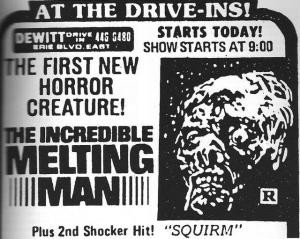
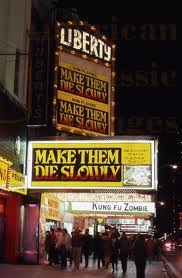
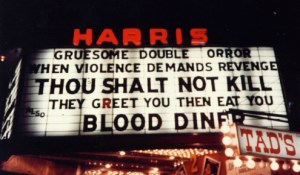
1) Before Independent Film, there was the Grindhouse.

Today, if a young director wants to show what he’s capable of doing, he makes his own little film and enters it into various film festivals and, if he’s made something interesting, he might sign a distribution deal and his film might pop up down here in Dallas at the Angelika theater.  In the 70s, that young director would make an exploitation film, hope that it had enough sleaze appeal to make back its budget by playing in a New York Grindhouse (or a Southern drive-in) and, if he had made something interesting, his cheap, exploitation film might eventually end up being released on DVD by Anchor Bay or Blue Underground.  The best Grindhouse films were made by director who were eager to show what they were capable of doing.  These movies were not made by multimillionaires with houses on both coasts of the country.  Grindhouse movies were made by director who had to work to create something memorable, filmmakers who knew that they might never get another chance to put their vision on-screen.

2) The Mainstream Lies.  The Grindhouse is honest.

Mainstream films are just that.  They are films designed to appeal to the widest possible audience.  A mainstream movie is not made for you.  A Mainstream movie is made to appeal to the brain-dead suburbanites who can be easily recruited at the local mall to be a part of a test screening.  A Mainstream movie is made to be inoffensive.  A Mainstream movie is edited and re-edited to remove anything that could possibly negatively reflect on the bottom line.

Grindhouse movies, however, didn’t have time for that.  Grindhouse movies were made to exploit the moment.  As a result, there was no time to worry about appealing to everyone.  There was no time to constantly edit until not a single rough edge remained.  Grindhouse films are messy.  Grindhouse films are not always pleasant.  They don’t always have the perfect ending.  In short, Grindhouse movies are like life itself.

In the end, safe and inoffensive mainstream movies are made to appeal to the who we wish we were.  Grindhouse movies — sordid, sometimes uncomfortable, and always appealing to the audience’s most primal thoughts, fears , and desires — are made to appeal to who we actually are.

3) The Mainstream is bland.  The Grindhouse is dangerous and unpredictable.

Where else but in a Grindhouse film could you hear a killer who speaks like a duck like in Lucio Fulci’s The New York Ripper?  Because the Grindhouse was free of the need to try to fit in with what the mainstream decreed to be normal, the Grindhouse had the freedom to come up with some of the most brilliantly demented plots in the history of film.  When was the last time that the plot of a Mainstream film really caught you off guard?  I’m not talking about safe, inoffensive surprises like Avatar‘s 3-D effects.  I’m talking about a plot where, halfway through, you look at your fellow viewer and you both say, “What the fuck was that!?”  Anything can happen in the Grindhouse.  As soon as things start to feel safe and a little boring, the Grindhouse has the ability to make things exciting again.  The Mainstream, meanwhile, just asks you to get married.

4) The Mainstream always condescends.  The Grindhouse occasionally empowers.

Here’s a story of two movies.  In the mainstream Brave One, Jodie Foster gets a gun after she’s raped and her dog is stolen.  (In typical mainstream fashion, the movie doesn’t seem to be sure which crime is supposed to be worse.)  In the grindhouse Ms. 45, Zoe Tamerlis gets a gun after she’s raped twice in one day.  In the Brave One, Foster passively sits on the New York subway and waits until she threatened with rape a second time before she kills the potential rapist.  In Ms. 45, Tamerlis shoots every man she sees because she knows that every man she sees is a potential rapist.  In The Brave One, Foster gets her revenge by remaining the victim.  In Ms. 45, Tamerlis becomes the aggressor.  Both Foster and Tamerlis act in self-defense but Foster is wracked with guilt because the mainstream cannot risk losing its audience.  Tamerlis becomes stronger and more confident with each murder as, for the first time, she has found a way to control her own destiny.  At the end of The Brave One, Foster is not only rescued by a man but she gets her dog back too.  At the end of Ms. 45, Tamerlis goes on a shooting rampage at a Halloween party and is finally killed by another woman.  The Brave One‘s tag line was “How many wrongs to make it right?”  Ms. 45’s tagline: “She was used and abused and it will never happen again!”

I know this is probably going to be my most controversial argument.  Don’t get me wrong, I’m not advocating that we should just go out and start randomly shooting men.  But, I will say this — in Ms. 45, Zoe Tamerlis refuses to be a victim and she — and the film — refuses to let society off the hook.  When I think about Ms. 45, it doesn’t inspire me to hate men (because, trust me, I don’t) and it certainly doesn’t inspire me to grab a gun and start shooting.  It does, however, inspire me to not allow myself to fall into that never-ending cycle of victimhood.

I’m not attempting to argue that Grindhouse films are secretly feminist films.  Grindhouse films are infamous for exploiting women.  However, so does the mainstream.  (Of the two films, The Brave One features nudity.  Ms. 45 does not.)  Both the Grindhouse and the mainstream obviously get off on victimizing women.  However, in the Grindhouse, women were occasionally (though certainly not often) allowed to fight back with the same aggression and determination that the mainstream, for the most part, usually reserves just for men.

(If The Girl With The Dragon Tattoo had been released in the 70s, it would have played at the Grindhouse.)

5) Lastly, and most importantly, the Grindhouse is still our little secret.

Let’s just admit it — independent films are trendy.  Contemporary independent films have, to a large extent, become the new mainstream.  The earnest film students who had a Sundance hit are now going to Hollywood to make the next Benjamin Button.  Sundance is just ShoWest with more facial hair.  However, the old school grindhouse will never sell out because it no longer exists.  It was destroyed by the morality police before it could sacrifice its soul.  While an independent filmmaker is just a director who will eventually grow up and break your heart, the great Grindhouse films are frozen in time, too sordid to ever be corrupted.  The Mainstream will never embrace the Grindhouse and for that reason, the Grindhouse will always be the ultimate statement of freedom.