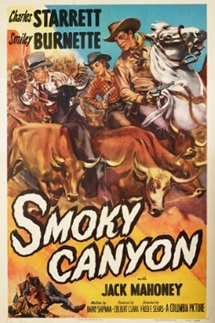
There’s a $2500 dollar reward out for the masked bandit known as the Durango Kid but little do the residents of Timber Rock know that the Kid is actually Steve Brent (Charles Starrett), a Treasury agent who puts on a mask whenever he needs to go undercover and discover what the bad guys are doing.
A range war has broken out between the sheep farmers led by Jack Mahoney (Jock Mahoney) and the cattlemen led by Carl Buckley (Tristram Coffin). To broker a peace and discover which side is the most to blame, Brent works for the cattlemen while the Durango Kid sides with the sheepmen. It turns out that Buckley’s to blame here. He’s using the war to thin out his cattle so that an Eastern beef syndicate can keep prices high. When Mahoney gets too close to the truth, he is framed for the murder of Mr. Woodstock and it’s up to the Durango Kid to prove that Mahoney is innocent. Meanwhile, Carl wants to blow up an entire mountain so that it will really thin out his cattle herd.
This is a typical Durango Kid movie, entertaining if you like B-westerns and probably boring if they’re not your thing. It has all the usual gunfights, horse chases, and dynamite explosions that are promised by every Durango Kid film. Starrett was always one of the most convincing cowboys on screen, even if his use of the Durango Kid alter ego didn’t always make sense. All the usual members of the Durango stock company show up, all playing different characters than they did in the previous Durango Kid film. Mahoney gets to play one of the good guys for once and his spirited girlfriend is played by the lovely Dani Sue Nolan. Smiley Burnett shows up to provide comic relief. This time, he’s a singing tour guide. He sings a song called It’s Got To Get Better. Let’s hope so.
College student Jack Mahoney (Jock Mahoney) returns to his hometown on the frontier to pay a surprise visit to his father, Old Henry (Edgar Dearing). Old Henry owns a local stagecoach line and is being targeted by outlaws. When Jack reaches his father’s house, he discovers that someone has shot Henry in the back. With the help of Steve Baldwin (Charles Starrett) and Betty Coulter (Anne James), two of Henry’s employees, Jack Mahoney tries to bring his father’s killers to justice.
Also helping is the masked Durango Kid, who tells Jack that Henry was an old friend of his. Durango, who is never present at the same time as Steve for some reason, teaches Jack how to handle a gun. When Steve is framed for murder, Durango works even harder to help bring the outlaws to justice.
This late Durango Kid entry has more of an edge that some of the other Durango films. Both Durango and Jack are out for vengeance and their grim determination sets this one apart from some of Durango’s other, more jokey adventures.
Even with Durango in a serious mood, Smiley Burnette is around to provide some humor. This time, Smiley is a traveling “specs specialist” who goes from town to town and sells people glasses. (He also sings two songs while accompanied by Harmonica Bill.) At the end of the movie, Smiley breaks the fourth wall, puts on a pair of glasses that he says allow him to see the future, and he lets us know whether or not Durango, Jack, and Betty are going to be safe. Smiley says that he can see himself singing but he can’t hear the song because he only has the glasses. “Looks like a good song, too.”
One final note: this movie actually features Jock Mahoney in two roles. Not only does he play college student Jack Mahoney but he was also Charles Starrett’s stunt double in the movie’s action scenes.
After spending the past few years cleaning up the west, Steve Leary (Charles Starrett) rides into the town of Red Mound and says that he is ready to buy a ranch and settle down. What Steve finds is an unfriendly town that is divided between law-abiding citizens on one side and cattle rustlers on the other. The cattle rustlers want to prevent Steve from purchasing the old Atkins ranch and they’ll do anything to keep the deed from being signed over. It’s a good thing that Steve also happens to be the legendary Durango Kid.
This is a standard entry in the Durango Kid series. To me, it’s interesting to see that, even though Steve seems like he wants to settle down and live a peaceful, ranching life, he still can’t bring himself to give up his secret identity. It is also interesting that Steve cannot escape Smiley Burnette. This time, Smiley is the owner of Red Mound’s restaurant and he’s accompanied by Texas Jim Lewis and the Lone Star Cowboys. It seems like Smiley sings even more than usual in this entry.
I liked the opening of The Stranger From Ponca City, in which Steve rides into town and all of the townspeople demand to know which side of Red Mound he supports. Smiley even explains that food made on one side of the town cannot be taken to the other without it leading to violence. After the opening sequence, The Stranger From Ponca City focuses on all of the usual horse chases and gunfights that showed up in all of the Durango Kid films. Most of the Durango Kid stock company shows up as well. Keep an eye out for Jock Mahoney, playing a bad guy with Kermit Maynard.
Director Derwin Abrahams keeps things moving, even if his direction is not up the level of the work of Durango’s usual directors, Ray Navarro and Fred F. Sears. This isn’t the best of the Durango Kid films but fans of the genre should enjoy it.
Steve Holden (Charles Starrett) is hired by an old friend, Jack Mahoney (played by Jock Mahoney), to serve as the sheriff of a frontier town. Steve soon discovers that his old friend has been corrupted by power and is plotting to cheat the locals out of their land and the gold that the land holds. Despite their friendship, Steve knows that Jack has to be stopped and made to see the errors of his way. It’s a good thing that Steve is secretly the Durango Kid and that his old sidekick, Smiley Burnette, is the town’s police chief. But even if Jack Mahoney does eventually see the error of his ways, will it be soon enough to stop his out-of-control henchmen?
This was one of the last of the Durango Kid films and it’s heavy on stock footage and Smiley Burnette musical numbers. It has all of the usual horse chases and gunfights but making the villain an old friend of the Durango Kid adds a little more emotional weight to this entry than some of the other Durango Kid films. As always, Charles Starrett is a strong western hero and Smiley Burnette’s antics are nowhere nearly as annoying as the antics of some of the other western sidekicks who were populating matinee movie screens in 1952. Western fans should enjoy this fast-paced and undemanding film.
This is not the first time that Jock Mahoney played a friend of the Durango Kid who is named Jack Mahoney, though I think the Jack Mahoney who appeared in Pecos River, Junction City, Smokey Canyon, The Hawk of Wild River, and The Kid From Broken Gun was meant to be a different character than the one who appeared in The Rough, Tough West. If Smiley Burnette could have a rotating cast of musicians who followed him from town-to-town, then the Durango Kid could very well have known multiple Jack Mahoneys.
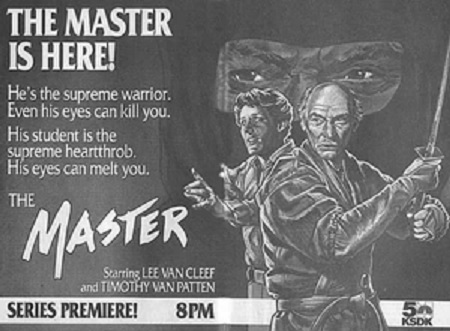
Welcome to Retro Television Reviews, a new feature where we review some of our favorite and least favorite shows of the past! On Fridays, I will be reviewing The Master, which ran on NBC from January to August of 1984. The show can be found on Tubi!
This week, The Master comes to an end.
Episode 1.13 “A Place To Call Home”
(Dir by Gordon Hessler, originally aired on August 31st, 1984)
The Master ends in much the same way that it began, with Max and John Peter McAllister in a small town that is controlled by an evil businessman. In this case, land developer Mark Richards (Jock Mahoney) wants to run the local orphanage out of town so that he can steal the land and expand his uranium mine. Max and McAllister not only help Kim Anderson (Susan Woollen) save her orphanage but they also provide some much-needed mentoring to two of the orphans, Mike (Doug Toby) and Bobby (played by Kane Kosugi). Bobby, it turns out, has some martial arts skills of his own! It’s amazing how McAllister and Max were always traveling to small towns that just happened to be home to other people who knew karate.
Though his son plays Bobby, Sho Kosugi does not appear in this episode, which is a shame considering that it would be turn out to be the show’s finale. For that matter, the show ends with McAllister having yet to find his daughter. In fact, Terri McAllister is only mentioned briefly at the end of the episode, when McAllister says that he and Max have to get back on the road because “I’m looking for my daughter.” Considering that the whole premise of the show was that McAllister was searching for Terri while Okassa was searching for McAllister, it seems like neither was really in a hurry to accomplish their goals.
A Place To Call Home feels like a greatest hits package, duplicating the plot of the pilot while tossing in a bit of the union episode‘s political subtext. Even the scene where McAllister attempts to hop onto a helicopter feels a bit reminiscent of the ghost town episode. The Master ended with an episode that resolved nothing and didn’t really bring anything new to show’s format.
Why did The Master end after thirteen episodes? When taken as a whole, the show wasn’t as bad as its reputation. While the stunt doubles did most of the work, Lee Van Cleef and Tim Van Patten still managed to develop a likable chemistry over the course of 13 episodes. At first, the show’s writer stried too hard to play up the idea of Max Keller being a rebel with a chip on his shoulder but, after the first few episodes, it appears that they realized that Van Patten’s greatest strength as an actor was that he had a sort of amiable goofiness to him. The stories were predictable but the fight scenes were usually (if not always) well-choreographed and entertaining. The stunt people earned their paycheck.
In the end, though, I think The Master never quite figured what it wanted to be. Did it want to be a straight action show? Did it want to be a goofy buddy comedy? In some episodes, McAllister was apparently a famous and well-known figure. In others, he was a total unknown. In some episodes, finding Terri was the most important thing in his life. In others, he really didn’t seem to care. The best episodes were the ones that winked at the audience and acknowledged just how ludicrous the whole thing was. But, far too often, The Master became a generic crime show that just happened to feature martial arts.
The Master is finished and, to my surprise, I’m going to kind of miss it. It had potential. But, it’s time to move on to a new series. Get ready because next week, it’s time for T & T!
 There’s a $2500 dollar reward out for the masked bandit known as the Durango Kid but little do the residents of Timber Rock know that the Kid is actually Steve Brent (Charles Starrett), a Treasury agent who puts on a mask whenever he needs to go undercover and discover what the bad guys are doing.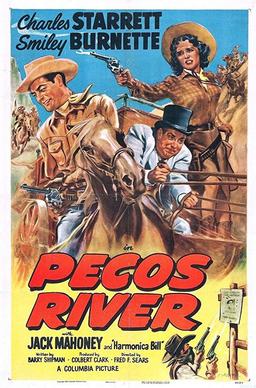



 Through the Shattered Lens