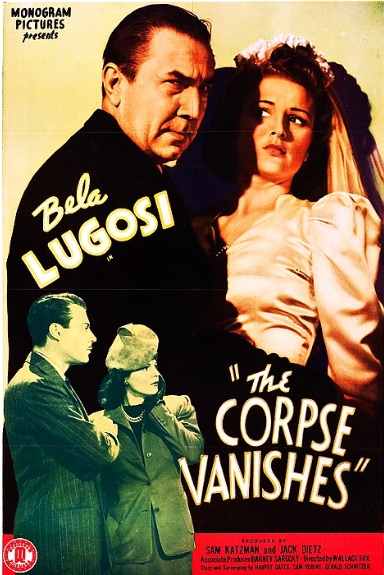
Horror Film Review: The Corpse Vanishes (dir by Wallace Fox)


1942’s The Corpse Vanishes opens with a young bride collapsing at her wedding.  A doctor runs over to her and says that she’s died.  A hearse — or a “stiff wagon,” as one witness puts it — pulls up and takes the body.  However, the body never reaches the morgue!

It turns out that this is not the first time this has happened.  In fact, there’s an epidemic of brides dying on their wedding day and their bodies disappearing.  One would think that this would cause a citywide panic or, at the very least, it would cause some people to maybe get married out-of-town.  Considering that the most recent victim was the daughter of one of the richest families in the community, you would think solving this mystery would be the police’s number one priority.

However, the police are useless.  And when the police can’t get the job done, it falls to journalists.  At least, that’s the way it worked in movies from the 1930s and the 40s.  While the cops were busy saying, “Scram!” and “Beat it, buster!,” it fell to the cynical and quick-witted journalist to find out what was going on.  In this case, Patricia Hunter (Luana Walters) investigates and discovers that all of the brides received an orchid on their wedding day.  (How the police didn’t notice this, I don’t know.)  Patricia tracks down the eccentric Dr. Lorenz (Bela Lugosi), who was once quite renowned for his orchids.

Dr. Lorenz now lives in a secluded mansion.  He’s polite when Patricia comes to speak to him but it’s obvious that he’s hiding something.  A sudden thunderstorm leads to Patricia and Dr. Foster (Tristram Coffin) getting stranded at Lorenz’s mansion.  Foster was visiting the mansion to examine Lorenz’s wife, the Countess (Elizabeth Russell).

Lorenz, as you probably already guessed, is behind the corpse abductions.  Except, of course, the brides aren’t dead.  Instead, the orchid has put them into a state of suspended animation.  Lorenz is extracting their blood and using it to keep his wife young.  Helping him out are his servants, a dwarf named Toby (Angelo Rossitto), Toby’s hulking half-brother, Angel (Frank Moran), and their mother, Fagah (Minerva Urecal).  Patricia figures out what is going on but will she be able to convince anyone else!?

From what I read about the film online, it would appear that The Corpse Vanishes has got a terrible reputation but, when I watched it, I actually found it to be entertaining when taken on its own Poverty Row terms.  No, the plot doesn’t make any sense.  But Bela Lugosi’s smile manages to be both sinister and inviting and Toby and Angel make for good henchmen.  The movie only has a 64-minute runtime and, as a result, the plot has to keep moving fairly quickly.  The film also features a lot of snappy “newsroom” dialogue between Patricia and her easily-annoyed editor (Kenneth Harlan), all delivered at a fast pace and with the the casually cynical outlook that makes 1940s newspaper movies so entertaining.  The Corpse Vanishes is a thoroughly ludicrous film that epitomizes an era and, as such, it’s far more diverting than one might otherwise expect.
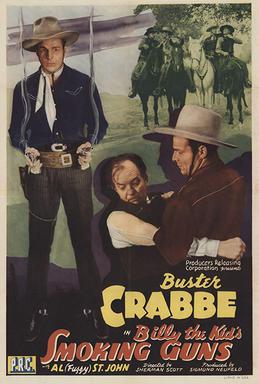
Billy The Kid’s Smoking Guns (1942, directed by Sam Newfield)


It’s a tale as old as time.  During the days when the west was wild, the U.S. Army is planning on setting up a new outpost near a town so the bad guys want to run all the ranchers off of their land so that they can be the ones to sell it.  Sheriff Carson (Ted Adams) is corrupt and working for the bad guys so the ranchers have to turn to Billy the Kid (Buster Crabbe) and his sidekicks, Jeff (Dave O’Brien) and Fuzzy (Al St. John) for help.  When Jeff is wounded in a fight, Fuzzy takes him to Doc Hagen (Milton Kibbee), little suspecting the doctor is actually the leader of the bad guys and using his medical practice to kill anyone who won’t give up their land!

Coming to us straight from Poverty Row, this B-western is interesting in that it seems to take a very cynical view of law enforcement.  Sheriff Carson is corrupt and Billy and his friends are running from the law themselves.  Buster Crabbe’s Billy the Kid films always kept it unclear why Billy was in trouble with the authorities.  Crabbe’s Billy the Kid always seemed to be the nicest guy in the west.  (Of course, Crabbe was also 33 and no longer seemed like he should have been known as “the Kid.”)  Eventually, the series was retconned and Buster Crabbe was no longer playing Billy the Kid but instead he was playing an upstanding citizen named Billy Carson.

Crabbe may not be a convincing outlaw but he is a convincing hero, which is all these films really required.  Billy the Kid’s Smoking Guns is a little bit interesting because of the character of Doc Hagen, whose occupation makes him a little more memorable than typical B-western bad guy.  The film is also interesting in that, for once, there’s no love interest.  Instead, it’s just men in hats shooting at each other.  That probably made the film’s youthful target audience happy.

The real-life Billy The Kid was killed when he was only 21 and after he had been an outlaw for only three years.  Buster Crabbe would g0 on to play Billy (or o some variation of Billy) until he was closing in on 40.


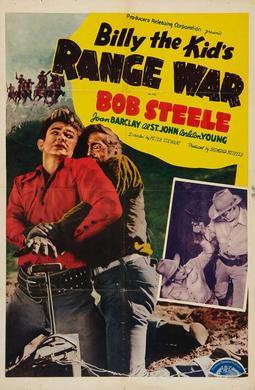
Billy The Kid’s Range War (1941, directed by Sam Newfield)


Billy the Kid was a big damn hero.

At least that’s the claim of Billy The Kid’s Range War, in which Billy (played by middle-aged Bob Steele) is a do-gooder with a comedic sidekick named Fuzzy (Al St. John) and a hankering to help Ellen Gorman (Joan Barclay) bring a new stagecoach line to town.  Williams (Karl Hackett) does want to the Gorman family to success so he hires Buck (Rex Lease) to dress up like Billy the Kid and ride a horse that looks like Billy the Kid’s and commit crimes, like killing Ellen’s father.  Framed for all those crimes that he didn’t commit and with his best friend (Carleton Young) ordered to arrest him, Billy decides to go under cover so that he can clear his good name.  Someone pretending to be Billy the Kid got him into this mess.  Now, Billy’s going to get out of it by pretending to be someone else.

The action is pretty standard for a B-western.  Mostly, it’s interesting to see a movie where Billy the Kid is actually a nice guy who gets framed.  No wonder a whole generation grew up with no idea about true history of the American frontier.  Sam Newfield directed a handful of Billy the Kid films and the capable Bob Steele starred in most of them but this is the only one that I’ve sat down and watched and it actually left me missing the production values of the Johnny Mack Brown films.  For fans of these type of westerns, there’s the promise of seeing familiar actors like George Cheseboro and Ted Adams doing there thing.  Even the outstanding character actor Milton Kibbee makes an appearance.  For those who do not like westerns, this film is not going to change their minds.

Despite the promise of the title, there is no range war in this movie.  There’s just Billy the Kid, trying to clear his good name.

The Fabulous Forties #2: Second Chorus (dir by H.C. Potter)


I’m currently in the process of watching and reviewing all 50 of the films in Mill Creek’s Fabulous Forties DVD box set.  Yesterday, I got things started by reviewing Port of New York.  Today, I’m looking at the set’s 2nd film, 1940’s Second Chorus.

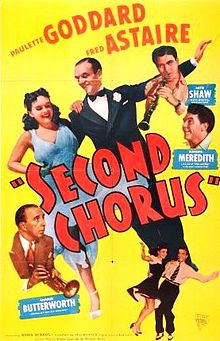
Second_Chorus_poster

As much as I love all of my Mill Creek box sets, watching Second Chorus reminded me of one of the drawbacks of watching a Mill Creek release.  Since Mill Creek specializes in films that have fallen into the public domain, a lot of their DVDs are more than a little rough.  The Mill Creek version was obviously transferred from a seriously deteriorated print.  As a result, the picture is often dark or blurry while the sound is occasionally iffy at best.  That’s a shame because Second Chorus is an entertaining little film.

In Second Chorus, Fred Astaire and Burgess Meredith both play college students.  (Burgess is the wacky one while Fred is … well, he’s Fred Astaire.  He’s confident, he’s suave, and he’s always ready to perform.)  Fred appears to be in his late 30s while Burgess looks closer to 50 but, fortunately, their age is meant to be a part of the joke.  Fred and Burgess have intentionally failed their final exams for seven years so that they can stay in school and continue to lead the college jazz band.  They are perennial college students and who hasn’t known a few of them?  (Apparently, in 1940, there was no such thing as academic suspension.)

When a debt collector comes looking for them (apparently, Burgess bought a set of encyclopedias that he never paid for), Fred manages to charm the collector’s secretary (Paulette Goddard) away from him.  Paulette agrees to serve as Fred and Burgess’s manager and even manages to get them a job with real-life band director Artie Shaw.  (Shaw plays himself and seems to be perpetually annoyed whenever he’s on screen.)  Will Fred finally accept some responsibility, act maturely, hold down a job, and maybe win the heart of Paulette Goddard?

Now, I should point out that, while I enjoyed Second Chorus, Fred Astaire apparently considered Second Chorus to be the worst film that he ever made.  While Second Chorus is definitely no Top Hat, I think that Fred Astaire was being a little too harsh in his assessment. The music is good, the dancing is fun to watch, and the plot … well, who really cares about the plot? It’s undoubtedly a silly film that has very little going on underneath the surface but Astaire and Meredith make for a surprisingly effective comedy team.

And while nondancer Paulette Goddard may not have had as effective a chemistry with Fred as Ginger Rogers (but then again, who did?), I still loved watching them perform the I Ain’t Hep To That Step But I’ll Dig It number.  This entire number was reportedly filmed in one take.  Goddard had little dance experience but it didn’t matter because her partner was Fred Astaire and Fred was so good that he could make anyone look like a natural.

Second Chorus is an entertaining little movie.  Just avoid the Mill Creek transfer.