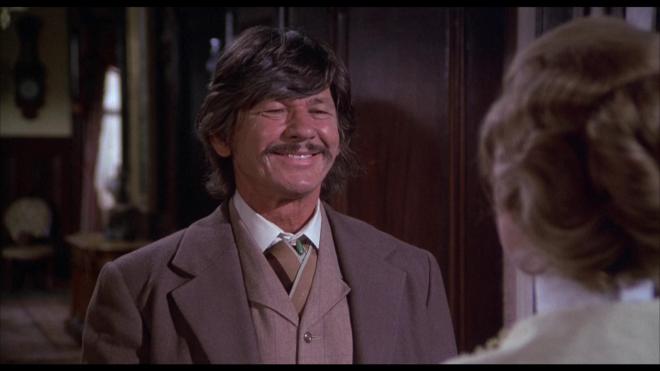
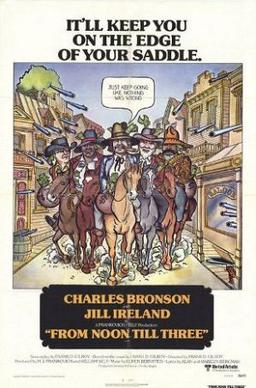
During the height of his popularity in 1976, Charles Bronson tried something quite different with this romantic comedy costarring his wife Jill Ireland. And to be honest, he’s darn funny in the role. This movie has grown on me over the years.
Bronson plays Graham Dorsey, a bank robber who spends an afternoon with the lonely widow Amanda Starbuck (Ireland) while his gang is robbing a bank in town. After his gang is all killed during the robbery, Dorsey must take off and go into hiding, eventually being arrested for impersonating a quack dentist. While he’s in jail, and through a variety of circumstances, a book is written about their afternoon together and it becomes an international sensation. As soon as Dorsey gets out of jail, he goes back to Starbuck’s home to rekindle their affair. Unfortunately for Dorsey, the book has created such a legend of him and their affair that Ms. Starbuck doesn’t even recognize the man he really is. His method of convincing her that he’s the “real” Graham Dorsey is the funniest moment in Bronson’s entire filmography.
Charles Bronson & Jill Ireland are clearly having a wonderful time making this movie together, which is one of the main reasons I enjoy the film. He may not have done it often, but Bronson could play comedy and he’s excellent in this film cast completely against his normal type. Jill Ireland is also very good as the widow Starbuck and her rendition of the song “Hello and Goodbye” was even nominated for a Golden Globe for Best Song. We had the privilege of interviewing Jill Ireland’s niece, Lindsay Ireland, and she told us of singing this song with her aunt Jill and her cousin when she would spend summers with them in Vermont in the 70’s. It’s so fun for me to hear firsthand about those times when the Bronson’s were one of the biggest celebrity couples of the world! The best part, Bronson valued his time with his family over anything else. They were everything to him.
**BONUS CONTENT** – I’ve included a link to the “This Week in Charles Bronson” podcast episode where Lindsay Ireland describes her time with her aunt Jill Ireland, and how they would sing “Hello & Goodbye,” the song that was in FROM NOON TILL THREE, while they were driving down the roads in Vermont. It’s a really nice insight into Jill Ireland.
I’ve been called “Charles Bronson’s biggest fan” on multiple occasions and by people I greatly respect. It’s possible that’s close to being true, but I chose to buy the entire TV series of SHANE on DVD because I wanted to watch Bronson’s wife, Jill Ireland, in a role that doesn’t include her more famous husband. I also wanted to see a young David Carradine as Shane. It doesn’t hurt that the 1953 film starring Alan Ladd is one of my absolute favorite movies.
The very first episode of SHANE starts off with Mr. Starett (Tom Tully) and the new schoolmarm (Diane Ladd) riding into town. They immediately run into Mr. Ryker (Bert Freed) and his henchman Harve (Lawrence Mann), who tells them in no uncertain terms that there will never be a school in this town. Enter Shane (David Carradine), who works for Mr. Starett. He tells Harve to get out of the way, and Mr. Starett, the school teacher and Shane head out to their ranch.
The new school is going to be in Ed Howell’s (Karl Lukas) barn. Mr. Howell is concerned about the school and his own personal safety since he’s heard of Ryker’s threats. Mr. Starett reassures him that everything will be okay so they head to Grafton’s general store to purchase supplies. Mr. Ryker shows up there and tries some more intimidation. When they leave the store, they notice a fire off in the distance. It’s Ed Howell’s barn. Appalled by all of this violence, the schoolteacher catches the next stage out of town.
Marian Starett (Jill Ireland), old man Starett’s daughter, decides she will teach the school. She knows her son Joey (Christopher Shea) needs to be educated along with the other children in the area. Since the barn was burned down, Marian asks Mr. Grafton if they can use the saloon to hold their classes since men don’t come to drink until 4:00 or later. Of course, now Mr. Ryker decides to come early and start drinking. They break bottles and glasses on the floor while the kids try to do their multiplication tables. Scared for the children, Marian takes the kids out and the future of the school appears to be in doubt again.
Shane decides he’s had enough of this crap. He begins building a school out in the country and tells Marian that school will start there tomorrow. He’s prepared to defend the school against Ryker, Harve and anyone else who gets in the way. The next morning, Shane tells Marian & Mr. Starett to listen for the school bell. If they hear it, come on. If they don’t, there will be no school. Harve confronts Shane at the new school building. If Shane is defeated, the idea for the school and the education of the kids in the valley will be dead with him…
I enjoyed this first episode. The main cast does a fine job. David Carradine is a solid Shane. He has the confidence of a man who knows his true value is his ability with a gun. He doesn’t lead with the gun, but he’ll go there when it’s required. Jill Ireland is also good as Marian Starett. There’s a nice bit of sexual tension between her and Shane, and she’s also good as the doting mother to Joey. It is nice to see her in a role that doesn’t involve Charles Bronson, and she’s good in this first episode. Tom Tully is good as old man Starett, Marian’s father-in-law. His character is necessary as a guy who provides some needed relief between Shane and Marian. Finally, Joey is played by Christopher Shea. I’ll have to see how he grows on me as the series progresses. He’s fine in the first episode. Interestingly, he voiced Linus in the classics, “A Charlie Brown Christmas” and “It’s the Great Pumpkin, Charlie Brown” so I’m willing to give him some space to grow!
I’m looking forward to seeing where the series goes. It’s a total of 17 episodes so it won’t take too long to get there!
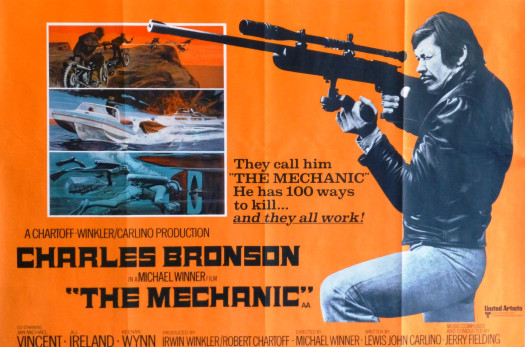
THE MECHANIC features an iconic performance by Charles Bronson, a performance that would represent a blueprint for the type of character he would play in many films…the strong, silent, unstoppable, man of action. Bronson plays Arthur Bishop, a hit man with a gift for planning and executing his hits in a way that make the deaths look like natural deaths rather than murders. Facing health issues and loneliness, he takes on a young protégé named Steve McKenna, played by Jan-Michael Vincent. This upsets his bosses in the underworld because he takes on the apprentice without asking them. Will they allow him to train up this new protégé and complete tag team hits going forward, or will they decide that Bishop is no longer worth the risk?
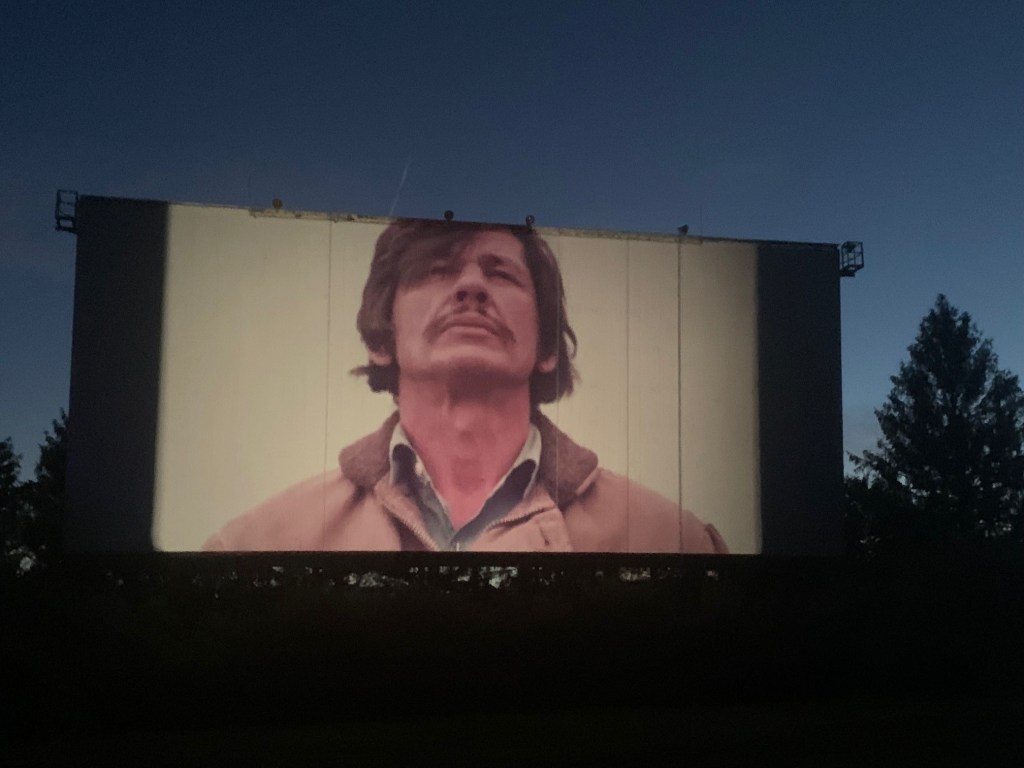
I’ll start off by stating up front that I love THE MECHANIC. The first Charles Bronson movie I ever owned on VHS was a nearly unwatchable, 2nd hand version of the film, but I still tried to watch it. The first Charles Bronson movie I ever saw on the big screen was a beautiful 35mm print of the film at the Mahoning Drive-in theater in Lehighton, PA. I also believe that this film has the best ending of any Charles Bronson film. Needless to say, the following review will be full of praise, so if you’re looking for a real critical take on the piece, this is probably not the place to look!
To start off, THE MECHANIC has a uniquely amazing opening sequence. The first 16 minutes of the film features hitman Bishop going through the mundane tasks of setting up a hit. We watch him set up shop across the street from the mark, we watch him break into the mark’s apartment to rig the things needed to accomplish the hit, we watch him squeeze a wax ball, etc. Bishop speaks no dialogue during these 16 minutes, and the only things we hear are the sounds of the soundtrack and the street. Bronson’s unique screen presence makes it mesmerizing. Could you imagine an action film trying this strategy in this day and age?
Once Bishop has successfully completed the first hit, we’re introduced to Bishop’s world outside of what we’d observed during the opening sequence. We meet Harry McKenna (Keenan Wynn), the “uncle-like” figure who has gotten himself in trouble with the organization. We’re not surprised who’s given the job to eliminate this problem. We meet Harry’s son Steve (Jan-Michael Vincent) who hits it off with Bishop at the funeral where their relationship really begins. On a side note, the film’s script featured these two characters as gay men, and the sexuality element was going to be a major way that Steve would get close enough to Bishop to gain his trust. That part of the script was changed to get Bronson and secure financing for the film. Since that element is not part of the movie I’ll move on. We meet a prostitute (Jill Ireland) who’s visited by Bishop. This is a very interesting scene that gives us a strong insight into just how lonely Bishop is and also helps us understand why he’s open to the idea of bringing on an apprentice. I think Jill Ireland is quite effective in her one scene.
Once the various characters are introduced, the film settles nicely into a mentoring relationship between Bishop & Steve. The experienced hitman shares his knowledge, and we follow along with them as they complete various assignments. The movie seems most interested in the relationship between the men, but this is an action movie, so we have a couple of very solid action sequences in the middle portion of the film, as well as the end. Director Michael Winner, who directed Charles Bronson in six different films, stages these sequences extremely well, especially the sequence that ends the film in Naples, Italy. We see necks snapped. We see faces knuckle punched. We see a motorcycle chase ending with a motorcycle flying off a cliff and exploding into a ball of flames upon impact. We see boats exploding. We see Bronson using my favorite weapon, the pump shotgun, with expert precision. We see cars chasing each other along the Italian coast. We see bombs being dropped out of moving cars with precision timing to blow up the cars behind them. We even see a bulldozer pushing a moving car off the side of a cliff. It’s some amazing stuff, with Bronson & Vincent appearing quite badass at times. And then the ending, the ending that proves just how awesome Bishop truly is! I won’t say anymore about that. Just watch and enjoy!
**BONUS CONTENT** – We dedicated an episode of the “This Week in Charles Bronson” podcast to THE MECHANIC. It was one of the most enjoyable episodes for me to record. If you’re interested in learning more about the film from a group of guys who love Charles Bronson, give it a listen!
I’m on Day 2 of my discussion of Charles Bronson’s DEATH WISH series in chronological order. This series has brought me countless hours of entertainment over the last 40 years, so enjoy and let me know your thoughts!
Charles Bronson returns as vigilante Paul Kersey in DEATH WISH II. In this installment, Kersey is trying to get his life back on track in Los Angeles with his daughter Carol, who’s still traumatized from the events of the first film, and with his new lady friend Geri Nichols (Jill Ireland). One day when he takes these two out for a fun day of shopping and ice cream, Kersey runs afoul of a group of young thugs who take his wallet. They use the wallet to find Kersey’s address, stand outside his house and make a plan like they’re diagramming a back yard football play, and then break in and rape his housekeeper. They set up shop to wait on Kersey to come home. When Kersey and his daughter finally arrive, the thugs knock out Kersey and kidnap his daughter. They take her back to their warehouse / hideout, where they rape her and she then falls to her death trying to escape. After this series of horrific events, Paul Kersey again turns vigilante to hunt down and kill every person responsible.
DEATH WISH II (1982) came along at a time in Charles Bronson’s career when he needed a box office hit. His prior three movies, DEATH HUNT, BORDERLINE & CABOBLANCO, had barely made a dent at the box office. Around the same time that Bronson needed a hit, the infamous Cannon Films, recently purchased by cousins Menahem Golan & Yoram Globus, was also looking to make a big splash in the American movie market. Cannon decided that a sequel to DEATH WISH was just what they needed, and with a big paycheck, they were able to convince Bronson to come along for the ride. Director Michael Winner was also hired to direct. The resulting film was a big success, earning back eight times its production budget at the box office alone. Its success also started a relationship between Bronson & Cannon Films that lasted for a total of eight films all the way to the end of the 1980’s.
Now that we’ve discussed how important DEATH WISH II was to extending Charles Bronson’s leading man career and providing Cannon Films a needed hit, let’s talk about the movie itself. I’m just going to say upfront that it’s my least favorite of the DEATH WISH series. Even though it presents itself as a serious film, it’s more of an exploitative retread of the 70’s classic than a realistic continuation of the Kersey character. And the first thirty minutes is hard to watch. Not content with just allowing Kersey to lose a beloved family member, Winner has crafted two graphic rape and murder sequences. These scenes are rough. While they do make sure we want to see Paul Kersey get his revenge, they leave a bad taste in our mouth that doesn’t go away as the creeps are being dispatched one by one. Vincent Gardenia returns as Frank Ochoa, the New York detective who investigated the original vigilante killings in DEATH WISH. Gardenia was so good in the original, but he’s not given much to do here. Jill Ireland doesn’t really add much either as his new lady friend.
This is a Charles Bronson film though, so there are definitely some things about DEATH WISH II that I really do like. First, I think Bronson looks like a total badass in his beanie that he wears when he’s hunting down the creeps on the mean streets of LA. It’s a classic 80’s Bronson look. Second, Kersey has some cool sayings as he dispatches the bad guys. The “Do you believe in Jesus” exchange is the best example. Third, it’s fun seeing a young Laurence Fishburne show up as one of the creeps, extending the franchise’s ability to cast future big stars as horrific rapists. Jeff Goldblum had that distinction in DEATH WISH. And finally, Led Zeppelin guitarist Jimmy Page composed the music for DEATH WISH II. It’s a memorable soundtrack that’s different than just about anything I’ve ever heard. It’s the most unique thing about the entire movie!
The bottom line is that I would watch Charles Bronson read a phone book, so I will always find something to enjoy about his films. Well, maybe every one but LOLA. DEATH WISH II isn’t as fun as most Bronson movies, even if it does have some good moments. I’m glad DEATH WISH 3 went a completely different direction with Kersey’s character.
BONUS: Robert “Bobby” Lyons had a part in DEATH WISH II. On our THIS WEEK IN CHARLES BRONSON PODCAST, my partner Eric Todd and I interviewed Bobby about his time on DEATH WISH II and a whole bunch of other topics. He has some interesting stories to tell about working with Charles Bronson, as well as clashing on the DEATH WISH II set with Michael Winner. Give it a listen if you get a chance!
HARD TIMES is probably the best movie that features Charles Bronson in the lead, and it’s my personal favorite movie of all time as of the date of this review. I reserve the right to change this opinion at any time!
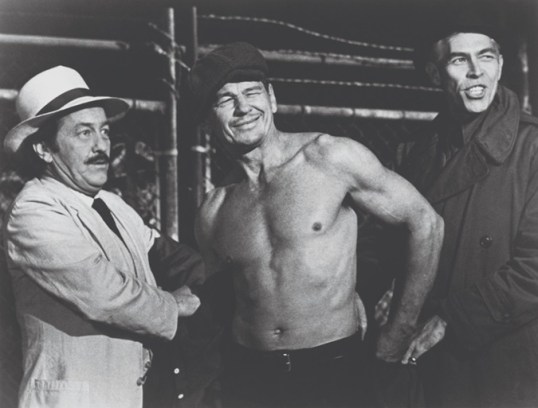
Charles Bronson is Chaney, a drifter who’s riding the rails in the south during the great depression. Soon after getting off the train in some unnamed southern town, Chaney comes across an underground “fight” where we first meet Speed, played by the great James Coburn. It seems Speed is the money man for this big lug of a fighter who gets his butt kicked in front of God, the local underground fighting world, a man with horrible teeth, and Chaney. After witnessing this fiasco, Chaney follows Speed to a local restaurant where he apparently waits in the shadows until Speed goes up to the counter to get a refill of oysters and a couple of lemons. I say this because when Speed turns from the counter with his newly filled tray, Chaney is sitting at Speed’s table. I’m surprised that Speed even talks to him because the first thing Chaney does is help himself to an oyster, WITHOUT EVEN ASKING! Even with this breach of etiquette, Speed discusses the fight from earlier in the evening with Chaney, who offers his fighting services to Speed since the “big lug” is clearly not a good investment into the future and who is probably in a hospital overnight dealing with a concussion. Speed is hesitant to accept this offer since Chaney appears to be fairly old (Bronson was 53 when he made the film), but he changes his mind when Chaney offers his last $6 bucks to Speed to bet on him. Cut to Chaney getting his chance to fight. This is a fun scene because his opponent is the same fighter from earlier who kicked the big lug’s butt. The guy even taunts Chaney for being too old. The fight starts and it consists of two hits, Chaney hits the smartass, the smartass hits the ground. Somewhat amazed, Speed takes Chaney to New Orleans, and the two embark on an odyssey together to win fights and make thick wads of cash. The remainder of the film documents that odyssey, although it does take time out for a few “in-betweens.”
HARD TIMES is one of Bronson’s best films, and one of the main reasons why is that it provides a boatload of audience satisfaction. There are many examples of this. First is the scene mentioned above where Chaney takes out the smirking, dismissive fighter who sees our hero as too old. Too old my ass! In another scene, a bunch of unrefined Cajuns out in the boondocks refuse to pay up after Chaney kicks their fighter’s butt. Rather than pay up, the slimy Cajuns pull out a gun and dare Speed and Chaney to come take the money. Our heroes leave at that time, but Chaney convinces them to hang around out in the country for awhile so they can surprise the Cajuns under the cover of darkness at the local honkytonk, which happens to be owned by the head slimy Cajun. Chaney takes the gun, takes the money, and then shoots up the place with the gun, grinning as he saves the last bullet to shoot a mirror he’s looking directly into. It’s a fun scene that ends with Chaney, Speed and the gang speeding off into the night laughing like hyenas! In another scene, Chaney takes on the big, bald-headed, unbeatable fighter Jim Henry (Robert Tessier) in an awesome cage match. Let’s just say Jim Henry thought he was unbeatable and leave it at that. And finally, a competing New Orleans money man (Jim Henry’s guy) just can’t stand that he no longer has the top fighter in town, so he brings in a fighter from Chicago to take on Chaney. I won’t tell you what happens, but it’s some really fun stuff!
The cast of HARD TIMES also elevates the film to top tier status. I’ve already discussed Bronson and Coburn, but Strother Martin and Jill Ireland also add to the joy. Martin plays Poe, Chaney’s drug addict cut man, who dresses up like he could grow up to be Colonel Sanders in his older age. It’s a fun performance that adds a lot to the film. Jill Ireland plays Chaney’s love interest. She’s quite beautiful, but she seems to always be giving Chaney a hard time about what he does for a living. His response is usually to simply leave when she starts that BS. I thinks that’s kind of fun too.
And finally, this was the directorial debut of Walter Hill, the man behind THE WARRIORS, THE DRIVER, THE LONG RIDERS, SOUTHERN COMFORT, 48 HOURS, and RED HEAT. His movie is lean and mean, without a wasted moment that isn’t moving the film along. Hill has crafted a fun movie, filled with great performances. I think it’s one of the most underrated films of the 1970’s!
Graham Dorsey (played by Charles Bronson) is an outlaw in the Old West who is eager to get out of his gang’s plan to robb a bank in a small town. He’s been having nightmares in which he and his entire gang are wiped out by the townspeople. However, the other members of the gang insist on trying to rob the bank. Because Graham needs a new horse, they stop off at a ranch owned by the widowed Amanda Starbuck (Jill Ireland). Both because he doesn’t want to die and also because he wants to spend time with the beautiful Amanda, Graham lies to the gang and tells them that Amanda doesn’t have a horse. The gang leaves Graham behind, saying that they’ll return for him in a few hours. The gang, of course, ends up getting captured by the townspeople while Graham and Amanda make love three times over the next three hours.
When Graham learns that the other members of the gang have been arrested, he’s content to just allow them to hang so that he can spend the rest of his life with Amanda. However, Amanda insists that Graham go into town and rescue his fellow outlaws. Graham agrees, even though he’s planning on actually just laying low for a few hours until the others have been executed. Through a series of events that are far too complicated to even try to recount here, Graham ends up switching clothes with a traveling dentist. When a posse guns down the dentist, Amanda believes that Graham has been killed. Meanwhile, Graham is arrested for practicing dentistry without a license and is put in prison for a year.
While Graham is away, Amanda writes an idealized account of the three hours that she spent with Graham. A play is produced. Songs are written. Tourists flock to Amanda’s ranch. Amanda becomes a celebrity and even she begins to believe that, instead of being a cowardly and uncouth outlaw, Graham was actually a tall, handsome, and cultured gentleman. When Graham finally gets out of jail, he heads for the ranch. Graham thinks that Amanda will be happy to learn that he’s alive and to see him but instead, there’s another surprise waiting for him.
Speaking of surprises, who would have though that one of Charles Bronson’s best films would be a romantic comedy? Bronson pokes fun at his own image in From Noon Till Three, playing a laid back outlaw who would rather catch a few extra hours of sleep than spend his time robbing people and seeking vengeance. The film’s entire third act, in which Amanda is reminded that the real-life Graham is far different from her idealized memory, feels like a commentary on Bronson’s entire film career. Just as Graham isn’t a typical romantic hero, Charles Bronson was never a typical movie star but, like Graham, he never gave up his dream. This is one of Bronson’s most likable and appealing performances. From Noon Till Three also features one of Jill Ireland’s best performances. She was, of course, Bronson’s wife at the time and their chemistry in this film goes a lot towards making the film’s complex story credible. Ireland’s best moments come at the end of the film, when she reveals how far she’ll go to maintain the myth of what happened between noon and three.
“When the legend becomes fact, print the legend,” the newspaper editor said at the end of The Man Who Shot Liberty Valance and that also describes the main theme of From Noon Till Three, a clever romance that will be appreciated by even by those who would normally watch a Charles Bronson film.
Dr. Laurence Jeffries (Anthony Perkins) is an American-born neurosurgeon living in the UK. One night, as Dr. Jeffries is preparing to head home, he meets a confused and frightened man who is identified in the credits as being The Stranger and who is played by Charles Bronson. The Stranger has no memory of who he is or how he came to be where he is. Dr. Jeffries takes the Stranger back to his house. Dr. Jeffries says that he often takes patients back home for overnight observation but it turns out that he has more than treatment on his mind. Dr. Jeffries knows that his wife, Frances (Jill Ireland, who was Bronson’s offscreen wife), has been cheating on him with her French lover. What if Dr. Jeffries can convince the Stranger that Frances is married to and cheating on him? Could The Stranger, who may have already attacked another woman on the beach, be manipulated into murdering Frances’s lover?
Before Death Wish made Charles Bronson a box office force in the United States, he was a huge star in Europe. Someone Behind The Door is one of many films that Bronson made in France before he returned to America. It’s always interesting to see Bronson’s European films because European directors were willing to cast him as something other than just a vengeance-driven vigliante. In Someone Behind The Door, Bronson actually gets to play someone who isn’t in control of his fate and who doesn’t always have the perfect tough guy quip on the end of his tongue and Bronson gives a surprisingly good performance. He brings The Stranger’s inarticulate fear and eventual rage to life. Indulging in his usual nervous mannerisms, Anthony Perkins matches him every step of the way.
Someone Behind The Door largely takes place in just one location and it’s really too stage-bound to be successful. Still, fans of Perkins and Bronson should find the pairing of the two to be interesting. The pair play off each other surprisingly well, with Perkins nervy energy bouncing off of Bronson’s physicality. It’s too bad that this was the only time that these two actors appeared opposite each other.
To quote John McClane, “How can the same shit happen to the same guy twice?”
It has been eight years since Paul Kersey (Charles Bronson) lost his wife and single-handedly cleaned up New York City. The first Death Wish ended with Paul in Chicago, preparing to gun down a new group of criminals. I guess Chicago didn’t take because, at the start of Death Wish II, Paul is in Los Angeles and he’s working as an architect again. He has a new girlfriend, a bleeding heart liberal reporter named Geri (Jill Ireland, Bronson’s real-life wife) who is against the death penalty and who has no idea that Paul used to be New York’s most notorious vigilante. Having finally been released from the mental institution, Carol (Robin Sherwood) is living with her father but is now mute.
Crime rates are soaring in Los Angeles and why not? The legal system is more concerned with the rights of the criminals than the victims and Paul has retired from patrolling the streets. But when a group of cartoonish thugs rape and kill his housekeeper and cause his daughter to fall out of a window while trying to escape them, Paul picks up his gun and sets out for revenge.
Death Wish II was not the first sequel to Death Wish. Brian Garfield, the author of the novel on which Death Wish was based, never intended for Paul to be seen as a hero and was disgusted by what he saw as being the film’s glorification of violence. As “penance,” he wrote a sequel called Death Sentence, in which Paul discovered that he had inspired an even more dangerous vigilante. When Menahem Golan and Yoram Globus bought the rights to produce a second Death Wish film, they decided not to use Garfield’s sequel and instead went with a story that was co-written by Golan.
It’s the same basic story as the first film. Again, Paul is a mild-mannered architect who is a liberal during the day and a gun-toting reactionary at night. Again, it’s a home invasion and a death in the family that sets Paul off. Again, Paul gets help from sympathetic citizens who don’t care that the police commissioner (Anthony Franciosa) wants him off the streets. Jeff Goldblum played a rapist with a switch blade in the first film. This time, it’s Laurence Fishburne who fills the role. (Fishburne also carries a radio, which he eventually learns cannot be used to block bullets.) Even Detective Ochoa (Vincent Gardenia) returns, coming down to Los Angeles to see if Paul has returned to his old ways.
The main difference between the first two Death Wish films is that Death Wish II is a Cannon film, which means that it is even less concerned with reality than the first film. In Death Wish II, the criminals are more flamboyant, the violence is more graphic, and Paul is even more of a relentless avenger than in the first film. In the first Death Wish, Paul threw up after fighting a mugger. In the second Death Wish, he sees that one of the men who raped his daughter is wearing a cross, leading to the following exchange:
“Do you believe in Jesus?”
“Yes, I do.”
“Well, you’re going to meet him.”
BLAM!
Death Wish II is the best known of the Death Wish sequels. It made the most money and, when I was a kid, it used to show on TV constantly. The commercials always featured the “You believe in Jesus?” exchange and, every morning after we saw those commercials, all the kids at school would walk up to each other and say, “You believe in Jesus? Well, you’re going to meet him.” It drove the teachers crazy.
Overall, Death Wish II is a lousy film. Michael Winner, who was always more concerned with getting people into the theaters than anything else, directs in a sledgehammer manner that makes his work on the first film look subtle. He obscenely lingers over every rape and murder, leaving no doubt that he is more interested in titillating the audience than getting them to share Paul’s outrage. The script is also weak, with Geri so poorly written that she actually gets more upset about Paul going out at night than she does when she learns that Paul’s daughter has died. When Paul sets out to track down the gang, his method is to merely wander around Los Angeles until he stumbles across them. It doesn’t take long for Paul to start taking them out but no one in the gang ever seems to be upset or worried that someone is obviously stalking and killing them.
There are a few good things about the film. Charles Bronson was always a better actor than he was given credit for and it’s always fun to watch Paul try to balance his normal daily routine with his violent night life. Whenever Geri demands to know if he’s been shooting people, Paul looks at her like he is personally offended that she could possibly think such a thing. Also, the criminals themselves are all so cartoonishly evil that there’s never any question that Paul is doing the world a favor by gunning them down. For many otherwise sensible viewers, a movie like Death Wish II may be bad but it is also cathartic. It offers up a simple solution to a complex issue. In real life, a city full of Paul Kerseys would lead to innocent people getting killed for no good reason. But in the world of Death Wish II, no one out after nightfall is innocent so there’s no need to worry about shooting the wrong person.
Finally, the film’s score was written by the legendary Jimmy Page. The studio wanted Isaac Hayes to do the score but Winner asked his neighbor, Page. Page took the film, retreated into his studio, and returned with a bluesy score that would turn out to be the best thing about the movie. The soundtrack was the only one of Page’s solo projects to be released on Led Zeppelin’s record label, Swan Song Records.
Joe Bomposa (Rod Steiger) may wear oversized glasses, speak with a stutter, and spend his time watching old romantic movies but don’t mistake him for being one of the good guys. Bomposa is a ruthless mobster who has destroyed communities by pumping them full of drugs. Charlie Congers (Charles Bronson) is a tough cop who is determined to take Bomposa down. When the FBI learns that Bomposa has sent his girlfriend, Jackie Pruit (Jill Ireland), to Switzerland, they assume that Jackie must have information that Bomposa doesn’t want them to discover. They send Congers over to Europe to bring her back. Congers discovers that Jackie does not have any useful information but Bomposa decides that he wants her dead anyway.
Love and Bullets is an uneasy mix of action and comedy, with Bronson supplying the former and Ireland trying to help out with the latter. Not surprisingly, the action works better than the comedy. Because Charlie is an American in Switzerland, he is not allowed to carry a gun and he is forced to resort to some creative ways to take out Bomposa’s assassins. Unfortunately, the scenes where Charlie and Jackie fall in love are less interesting, despite Bronson and Ireland being a real-life couple. Ireland occasionally did good work when she was cast opposite of Bronson but here, she’s insufferable as a ditzy gangster moll with a strange accent. While everyone else is trying to make an action movie, she’s trying too hard to be Judy Holliday. Steiger’s peformance starts out as interesting but soon devolves into the usual bellowing and tics.
Love and Bullets does have a good supporting cast, though. Bradford Dillman, Michael V. Gazzo, Val Avery, Albert Salmi, and Strother Martin all pop up. The two main hit men are played by Paul Koslo and Henry Silva. Silva’s almost as dangerous here as he was in Sharky’s Machine.
Stone-faced Charles Bronson is perfect as an ice-cold, classical music loving hit man who mentors young Jan-Michael Vincent in 1972’s THE MECHANIC. I’d say this is one of Charlie’s best 70’s actioners, but let’s be serious – they’re ALL damn entertaining!
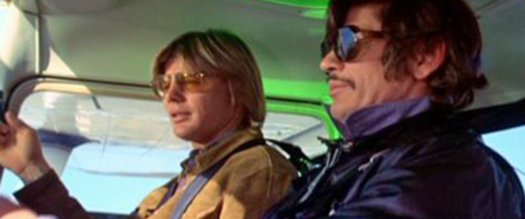
Arthur Bishop (Bronson) takes his work seriously, meticulously planning every assignment he receives from his Mafia boss (Frank De Kova ). Given a job to kill family friend Big Harry McKenna (Keenan Wynn), Bishop does the deed with chilling precision. McKenna’s son Steve (Vincent) is a stone-cold sociopath himself, and soon worms his way into becoming Bishop’s apprentice. Their first caper together goes sour, bringing Bishop’s boss much displeasure. Bishop’s next hit takes the two overseas to Naples, where they’re set up to be killed themselves, resulting in a violent conclusion and a deliciously deadly twist ending.
Bronson, after over twenty years and 50 plus movie roles, became…


 Dr. Laurence Jeffries (Anthony Perkins) is an American-born neurosurgeon living in the UK. One night, as Dr. Jeffries is preparing to head home, he meets a confused and frightened man who is identified in the credits as being The Stranger and who is played by Charles Bronson. The Stranger has no memory of who he is or how he came to be where he is. Dr. Jeffries takes the Stranger back to his house. Dr. Jeffries says that he often takes patients back home for overnight observation but it turns out that he has more than treatment on his mind. Dr. Jeffries knows that his wife, Frances (Jill Ireland, who was Bronson’s offscreen wife), has been cheating on him with her French lover. What if Dr. Jeffries can convince the Stranger that Frances is married to and cheating on him? Could The Stranger, who may have already attacked another woman on the beach, be manipulated into murdering Frances’s lover?
 To quote John McClane, “How can the same shit happen to the same guy twice?”
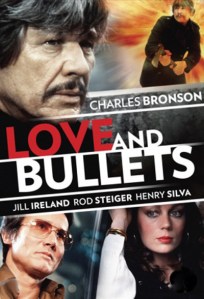 Joe Bomposa (Rod Steiger) may wear oversized glasses, speak with a stutter, and spend his time watching old romantic movies but don’t mistake him for being one of the good guys. Bomposa is a ruthless mobster who has destroyed communities by pumping them full of drugs. Charlie Congers (Charles Bronson) is a tough cop who is determined to take Bomposa down. When the FBI learns that Bomposa has sent his girlfriend, Jackie Pruit (Jill Ireland), to Switzerland, they assume that Jackie must have information that Bomposa doesn’t want them to discover. They send Congers over to Europe to bring her back. Congers discovers that Jackie does not have any useful information but Bomposa decides that he wants her dead anyway.

 Through the Shattered Lens