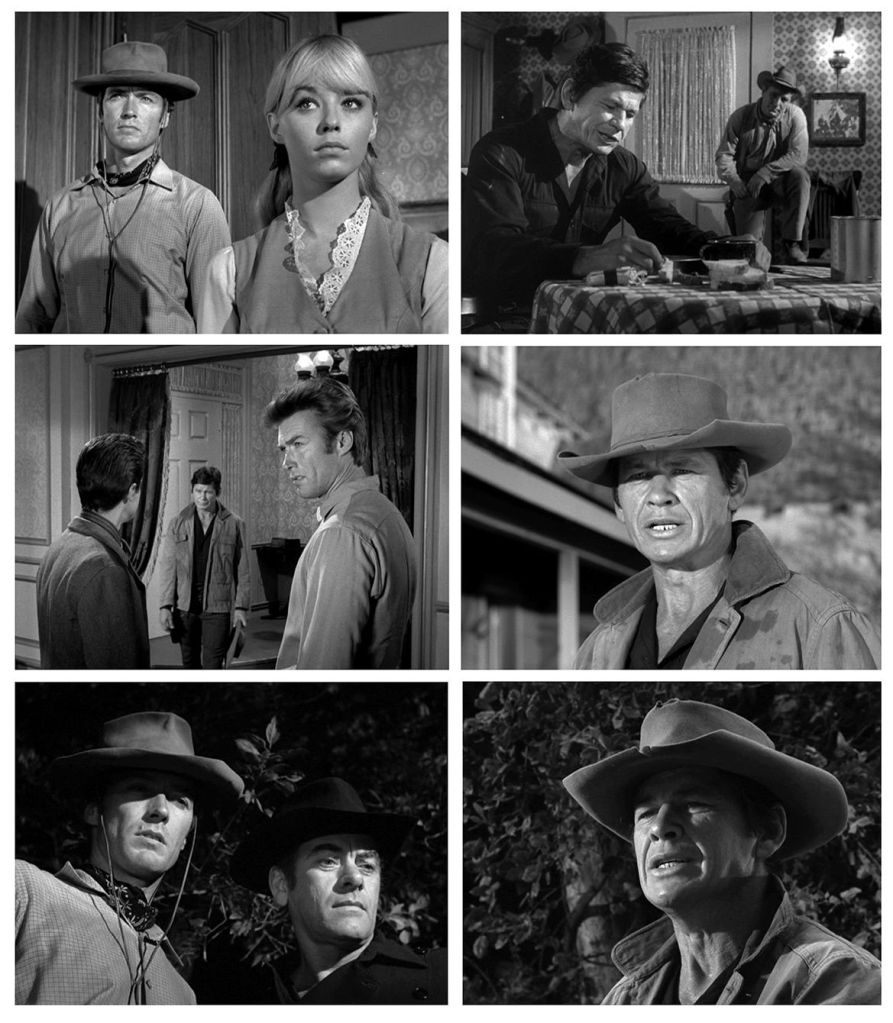
RAWHIDE (TV Series) – starring Clint Eastwood – S8, E10: “Duel at Daybreak” (Guest star – Charles Bronson)


This episode of the classic western TV series RAWHIDE opens as Rowdy Yates (Clint Eastwood) and his group of drovers agree to drive 750 head of cattle belonging to rancher Mason Woodruff (Larry Gates) to market. The deal gets off to a bad start when Roman Bedford (Brendon Boone), who’s part of Yates’ outfit, finds himself trying to romance Vicki Woodruff (Jill Haworth), the daughter of the ranch owner. Woodruff’s foreman and world class A-hole, Del Lingman (Charles Bronson) sees Roman making his move and gets pissed. You see, Del wants Vicki for himself, so he tries to bully Roman into a gunfight. Luckily for young Roman, Rowdy and Mason Woodruff are able to momentarily diffuse the situation before the cowboy can be blown away by the experienced gunman. Unable to accept the humiliation that he suffered at the hands of Del, Roman challenges him to a duel to settle the score. Roman is a good shot, but he’s not a fast draw, so a couple of the men with Yates’ crew, Jed Colby (John Ireland) and Simon Blake (Raymond St. Jacques), try to teach him some tricks that just may give him a chance against Del’s superior gunplay. To complicate matters even further, Mason Woodruff has a hidden criminal past that Roman may know about. Because of this, the rancher has another reason to want Roman dead, and Del Lingman is just the man to take care of the problem. Who will survive the duel at daybreak?!! 

As hard as it is to believe, my viewing of “Duel at Daybreak” is the only episode of RAWHIDE that I’ve ever watched, and it’s special to me for two reasons. First, the episode premiered on my mom’s 14th birthday, November 16, 1965. And second, it’s the only time that tough guy icons Clint Eastwood and Charles Bronson would appear on screen together. For historical reference, this was the last season of RAWHIDE, with only three episodes of the classic series to come after this. Eastwood was at the beginning of his legendary movie career after filming FISTFUL OF DOLLARS (1964) and FOR A FEW DOLLARS MORE (1965) for director Sergio Leone. Bronson, who was already a well-respected character actor, was two years away from making THE DIRTY DOZEN (1967) and three years away from breaking out as an international superstar by playing Harmonica in Leone’s masterpiece, ONCE UPON A TIME IN THE WEST (1968). 

For the episode itself, Charles Bronson is the true standout as Del Lingman. He’s the kind of mean SOB who would goad a man into a gunfight, kill him, and then sit down for dinner without a care in the world. Bronson has a face that makes for a good villain, and he often played the bad guy in his early TV shows and movies. He projects real menace and danger in this role. Clint Eastwood’s Rowdy Yates may be the star of the show and the trail boss, but he’s a bit more of a secondary character in this specific episode as the main tension is between Bronson and the young cowboy played by Brendon Boone. Looking back now, it’s an incredible missed opportunity that the “duel at daybreak” wouldn’t feature Eastwood versus Bronson. Eastwood mostly tries, and fails, to play peacemaker in the episode. The two legends do exchange a potentially badass back and forth when Eastwood is trying to deescalate the situation and keep Bronson from shooting the young cowboy over a little mud on his pants:

Rowdy Yates: “Putting a high price on a pair of pants, ain’t you?”

Del Lingman: “Perhaps you’d like to pay for them.”

Rowdy Yates: “Any time, mister.”

It’s a good scene, but it’s just a shame that they didn’t get a chance to mix it up at the end. 

As Charles Bronson’s biggest fan, I enjoyed seeing a couple of actors who worked with him in the 80’s. John Ireland, who plays Jed Colby in this episode, co-starred with Bronson in MESSENGER OF DEATH (1988) as Morman patriarch Zenus Beechum. It’s not one of Bronson’s best, but one of the highlights of the film is its strong cast. Ireland has roles in so many great films, including MY DARLING CLEMENTINE (1946), RED RIVER (1948), GUNFIGHT AT THE O.K. CORRAL (1957) and FAREWELL MY LOVELY (1975). He would appear in 11 episodes of RAWHIDE. Raymond St. Jacques, who plays Simon Baker in this episode, has a very memorable role in Bronson’s disturbing hitman thriller THE EVIL THAT MEN DO (1984). In a unique twist in the Bronson filmography, Jacques’ bodyguard character Randolph gets duped into thinking he’s about to get some three-way action with Bronson and Theresa Saldana only to end up dead with a knife sticking out of his throat. It’s a memorable meet and kill. I noticed he played a character named “Coffin” Ed Johnson in COTTON COMES TO HARLEM (1970). With a name like that, he’s got to be good! He would appear in 13 episodes of RAWHIDE. 

Overall, “Duel at Daybreak” is a special episode of RAWHIDE since it put Eastwood and Bronson on screen together for the only time in their careers. I wish they could have fought with fists or guns, but it wasn’t meant to be. Beggars can’t be choosers, and at this point, I’ll gladly take what we got.
Film Review: The Cardinal (dir by Otto Preminger)


The 1963 film, The Cardinal, opens with an Irish-American priest named Stephen Fermoyle (Tom Tyron) being instituted as a cardinal.

In a series of flashbacks, we see everything that led to this moment.  Stephen starts out as an overly ambitious and somewhat didactic priest who, over the years, is taught to be humble by a series of tragedies and mentors.  It’s a sprawling story, one that encompasses the first half of the 20th Century and, as he did with both Exodus and Advice and Consent, Preminger tells his story through the presence of several familiar faces.  Director John Huston plays the cardinal who takes an early interest in Stephen’s career.  Burgess Meredith plays a priest with MS who teaches Stephen about the importance of remaining humble and thankful.  When Stephen is in Europe, Romy Schneider plays the woman for whom he momentarily considers abandoning his vows.  When Stephen is assigned to the American South, Ossie Davis plays the priest and civil rights activist who teaches Stephen about the importance of standing up for those being oppressed.  In the days leading up to World War II, Stephen is sent to Austria to try to keep the local clergy from allying with the invading Nazis.  Stephen also deals with his own family drama, as his sister (Carol Lynley) runs away from home after Stephen counsels her not to marry a good Jewish man named Benny (John Saxon) unless Benny can be convinced the convert to Catholicism.  Later, when his sister becomes pregnant and Stephen is told that she’ll die unless she has an abortion, Stephen is forced to choose between his own feelings and teachings of the Church.  Along the way, performers like Dorothy Gish, Cecil Kellaway, Chill Wills, Raf Vallone, Jill Haworth, Maggie McNamara, Arthur Hunnicut, and Robert Morse all make appearances.

All of the familiar faces in the cast are used to support Tom Tryon and Tryon needs all the support that he can get.  Despite Otto Preminger’s attempts to make Tom Tyron into a star, Tryon eventually retired from acting and found far more success as a writer of the type of fiction that Stephen Fermoyle probably would have condemned as blasphemous.  Tryon gives a stiff and unconvincing performance in The Cardinal.  The entire film depends on Tryon’s ability to get us to like Stephen, even when he’s being self-righteous or when he’s full of self-pity and, unfortunately, Tryon’s stiff performance makes him into the epitome of the type of priest that everyone dreads having to deal with.  Tryon gives such a boring performance that he’s overshadowed by the rest of the cast.  I spent the movie wishing that it would have spent more time with John Saxon and Burgess Meredith, both of whom give interesting and lively performances.

The Cardinal is a long and rather self-important film.  The same can be said of many of Preminger’s films in the 60s but Exodus benefitted from the movie star glamour of Paul Newman and Eva Marie Saint and Advice and Consent was saved by an intelligent script.  The Cardinal, on the other hand, is a bit draggy and makes many of the same mistakes that many secular films make when they try to portray Catholicism.  Oddly enough, The Cardinal received more Oscar nominations than either Exodus or Advice and Consent.  Indeed, Preminger was even nominated for Best Director for his rather uninspired work here.  Considering the number of good films for which Preminger was not nominated (Anatomy of a Murder comes to mind), it’s a bit odd that The Cardinal was the film for which he was nominated.  (Of course, in 1944, the Academy got it right by nominating Preminger for his direction of Laura.)  The Cardinal is largely forgettable, though interesting as a type of self-consciously “big” films that the studios were churning out in the 60s in order to compete with television and the counterculture.

Film Review: Exodus (dir by Otto Preminger)


First released in 1960 and based on a novel by Leon Uris, Otto Preminger’s Exodous is two films in one.

The first half of the film takes place in Cyprus in the days immediately following World War II.  A young war widow named Kitty (Eva Marie Saint) is sightseeing when she learns of the Karaolos Internment Camp, where the British are interning thousands of Jewish refugees who demand to be allowed to go to the land that will eventually become the State of Israel.  Kitty visits with General Sutherland (Ralph Richardson), who oversees the camp and who is rumored to secretly be Jewish because of his relatively benevolent attitude towards the internees.  Disgusted by the anti-Semitism displayed by many of the British officers (one of whom is played by Kennedy in-law Peter Lawford), Kitty volunteers at the camp and learns about the Holocaust from those who survived it.  She also meets Ari Ben Caanan (Paul Newman), a former officer in the British army.  Ari manages to get control of a cargo ship, one that is renamed Exodus.  Six hundred refugees stage a hunger strike, vowing that they will willingly starve to death rather than be returned to Europe.

The second part of Exodus takes place in what will become the modern State of Israel.  It follows Ari, Kitty, and several of the passengers of the Exodus as they adjust to life and continue to fight for a land of their own, despite the opposition of the British and much of the rest of the world.  Karen (Jill Haworth) is a young woman who searches for her father, a brilliant man who has been driven into a nearly catatonic state by the horrors of the Holocaust.  Dov Landau (Sal Mineo) is an explosives expert who survived Auschwitz as a Sonderkommando and who was repeatedly raped by the guards at the camp.  Dov joins the Irgun, a paramilitary organization that the British consider to be terrorists.  Leading the Irgun is Ari’s uncle, Akiva (David Opatoshu), and Dov soon finds himself being targeted by both the British and the Arabs who, despite the moderating efforts of men like Taha (John Derek, who would later direct Ghosts Can’t Do It), want to violently force the Jews out of the land.

Legend has it that, after a private screening on Exodus, comedian Mort Sahl turned to director Otto Preminger and said, “Otto, let my people go.”  And it’s true that Exodus is a very long film.  Preminger, who started out making film noirs like Laura, spent the latter part of his career making “important” epics and, like many Golden Age directors struggling to compete with television and the 60s counterculture, he tended to make long, star-studded films that dealt with current events and which pushed the envelope just enough to be controversial without actually being radical.  However, I would argue that the three-hour running time of Exodus is justified.  To understand why Ari, Dov, Karen, and the other passengers of the Exodus would rather risk their lives by staying in what will become the State of Israel, one has to understand both what they went through to get there and also the anti-Semitism that they faced even in post-World War II Europe.  If Exodus were made today, it would be a mini-series.  Since it was made in 1960, it was instead a 3-hour film with an intermission.

Exodus holds up relatively well, with the sprawling action anchored by the presence of a cast of familiar faces.  Paul Newman and Eva Marie Saint bring a good deal of movie star glamour to scenes that would have otherwise just been dry exposition.  The film’s heart truly belongs to Jill Haworth and Sal Mineo, both of whom bring two life characters who have very differing views of the world.  Karen remains an optimist, one who is convinced that people can live together.  Dov, fueled by his own guilt and anger, has no room for negotiations and compromises.  Mineo received his second and last Oscar nomination for his performance in Exodus, though he lost to Peter Ustinov’s showy turn in Spartacus.  Exodus itself was clearly made with a hope for Oscar glory.  While Exodus did pick up a handful of nominations, it was left out of the five movie Best Picture slate.  The Academy only had room for one historical epic and they went for John Wayne’s The Alamo.  The eventual winner was The Apartment, the best of the nominated films.  (Indeed, even if Exodus had taken the Alamo’s spot, The Apartment would still be the best of the nominees.)  The Oscars aside, Exodus remains a good example of the type of epic filmmaking that once defined the Hollywood studios.

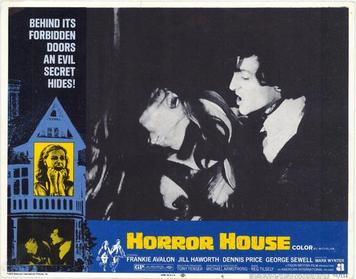
Horror On The Lens: Haunted House of Horror (dir by Michael Armstrong)


First released in 1969, The Haunted House of Horror features a group of 20-somethings who, bored with the usual parties, decide to that it might be a kick to hang out in a supposedly haunted mansion.  Once they’re in the mansion, they decide that it might be even more fun to hold a seance!

(Seriously, what is the deal with people holding séances in haunted mansions?  That really seems like the last place where you would want to mess with potentially malevolent spirits!)

The party becomes much less fun once someone starts killing off the group, one-by-one.

This film is notable for two reasons.  First off, it features Frankie Avalon in one of his attempts to break free of his Beach Party typecasting.  Secondly, the role of Richard, who is played by Julian Barnes, was originally offered to a young singer named David Bowie.  Reportedly, Bowie was quite excited about doing the film but, in the end, the producers worries that he and Frankie Avalon would not get along.  I’m not sure why.  David Bowie had a sense of humor and, judging from his Casino cameo, so does Frankie.

Killer Christmas: HOME FOR THE HOLIDAYS (ABC-TV Movie 1972)


gary loggins's avatarcracked rear viewer

Four daughters reunite at the old family homestead during Christmas to visit their estranged, dying father. Sounds like the perfect recipe for one of those sticky-sweet Hallmark movies, right? Wrong, my little elves! HOME FOR THE HOLIDAYS, originally broadcast as part of ABC-TV’s “Movie of the Week” series (1969-1975) is part proto-slasher, part psycho-biddie shocker, and a whole lot of fun! It plays kind of like a 70’s exploitation film, only with a high-powered cast that includes Sally Field, Eleanor Parker, Julie Harris , and Walter Brennan, a script by Joseph (PSYCHO) Stefano, and direction courtesy of John Llwellyn Moxey (HORROR HOTEL, THE NIGHT STALKER).

Rich old Benjamin Morgan (Brennan) has summoned his daughters home on a dark and stormy Christmas Eve, claiming his second wife Elizabeth (Harris) is slowly poisoning him to death. Elizabeth was once ‘suspected’ of poisoning her first husband (though never proven) and spent some time…

View original post 442 more words

Horror On The Lens: It! (dir by Herbert J. Leder)


For today’s Horror on the Lens, we are happy to present It!, a Hammer-style British horror film from 1966.

In It!, Roddy McDowall plays Arthur Pimm.  Arthur works as an assistant at a museum and, needless to say, he’s eager to move up in his profession.  There’s nothing unusual about that.  And I guess you could argue that, while it’s certainly not ideal, it’s not necessarily unusual that Arthur still lives with his mother.  What is unusual is that Arthur’s mother happens to be dead.

That right — Arthur is totally and completely insane.

As you can probably guess, Arthur is probably the last person who should have control of the immortal and indestructible Golem.  But that’s exactly what happens!  Soon, Arthur is using the Golem to kill his enemies and kidnap the woman that he loves.

Needless to say, things end with a bang.

Along with being a time capsule of 1966, It! is worth watching for Roddy McDowall’s memorably unhinged lead performance.

http://www.youtube.com/watch?v=8BrPGrVfWck