The setting is the Korean War. After getting information that American POWs are being tortured and brainwashed in North Korean prisoner-of-war camps, Major Hale (Harry Morgan) assigns Webb Sloane (Ronald Reagan) to go undercover. After parachuting behind enemy lines, Webb spots a group of POWs being marched through the snow and joins the group. From the minute that Webb joins the march, he begins to observe war crimes. The death march itself, with the POWs being forced to move in freezing weather, is itself a war crime. At the POW camp, Webb discovers the presence of an arrogant Soviet interrogator (Oscar Homolka) and a routine designed to break the POWs down until their ready to betray their native country. Some POWS, like Captain Stanton (Steve Forrest), refuse to break. Others, like cowardly Jesse Treadman (Dewey Martin), break all too quickly. Webb sends the information back to Hale and eventually tries to make his escape.
It’s not terrible. That the North Koreans and, later, the North Vietnamese tortured their POWs and forced some of them to denounce America is a matter of the historical record and, for a 1954 film, PrisonerofWar doesn’t shy away from the brutality of the torture that POWs were often subjected too. Of all of Reagan’s film, PrisonerofWar had the strongest anti-communist message, though Reagan himself feels miscast as a hard-boiled secret agent. (Reagan’s affability comes through even in a film set in a POW camp.) Sending someone undercover into a prisoner of war camp and then hoping that they’ll find a way to escape doesn’t sound like the most efficient way to determine if the Geneva Convention is being violated.
The film features a dog who is found by one of the POWs. Don’t get attached.
Welcome to Retro Television Reviews, a feature where we review some of our favorite and least favorite shows of the past! On Thursdays, I will be reviewing Beane’s of Boston, which aired on CBS in 1979. The entire show is currently streaming on YouTube!
This week, we take a look at an attempt to bring a British show to America.
Episode 1.1 “German Week”
(Dir by Jerry Paris, originally aired on May 5th, 1979)
Beane’s of Boston is a venerable department store, a landmark of Boston. The store is housed in a multi-story building and it is run by the elderly but still horny Frank Beane (Tom Poston). Frank takes a break from ogling his secretary and sneaking off to the strip club to demand this his nephew, Franklin Beane (George O’Hanlon, Jr.), explain why the 4th floor — which houses the Men and Ladies’ Wear Department — is losing money.
Franklin admits that sales have been off but he has a plan. What if the store only sold German products for a week? And what if the employees dressed in lederhosen and did German dances?
The 4th floor employees are not particularly enthused. The head of Ladies’ Wear, Mrs. Slocum (Charlotte Rae), served as a WAC during World War II and once found herself with a German soldier on top of her after a landmine went off. Mr. Peacock (John Hillerman), the stuffy floor manager, feels that he looks like an idiot dressed in a German outfit. Meanwhile, in the Men’s Department, elderly Mr. Granger (Morgan Farley) sleeps while the flamboyant Mr. Humphries (Alan Sues) answers the phone in his most “masculine” voice and Mr. Lucas (Larry Bishop) hits on the just-hired administrative assistant, Ms. Brahms (Lorna Patterson).
German week is a disaster, bringing in a profit of $12.94. But, fortunately, old Frank Beane is dating a German woman and she loves the idea. So, no one loses their job….
If this sounds familiar and if you’re reading this in America, you’ve probably seen an episode of the infamously terrible British sitcom Are You Being Served? on PBS. Beane’s of Boston was an attempt to do an American version of that sitcom and, just as The Office would do decades later, the pilot essentially took a script from the British series and populated it with American actors.
Setting aside the question of whether or not the world needed more than one version of Are You Being Served?, the idea of transporting that very British sitcom to Boston was not, in itself, a terrible one. Boston is one of our oldest cities and, while it may be best-known today for its robust blue collar culture, there were still enough stuffy Protestants around to make it believable that a store like Beane’s could survive. That said, the pilot still falls flat, largely because everyone but John Hillerman seems to be miscast and even Mr. Peacock is considerably less amusing once you take away his title of colonel. While the British original was known for its broad comedy, it appears like a model of subtlety when compared to the performances of Alan Sues as Mr. Humphries and Larry Bishop as Mr. Lucas. As well, why would any store do a German week in a city that is best-known for its strong Irish community? Why not do an Irish Week? It perhaps made sense in Are You Being Served? but, in Beane’s of Boston, it just makes Franklin seem like such an idiot that you almost feel like he deserves to lose his job.
Beane’s of Boston did not have the same success as Are You Being Served? German Week would be the only episode aired.
Welcome to Retro Television Reviews, a feature where we review some of our favorite and least favorite shows of the past! On Sundays, I will be reviewing the made-for-television movies that used to be a primetime mainstay. Today’s film is 1972’s Call Her Mom! It can be viewed on YouTube!
While all of the other college campuses across America are in turmoil with protests and student walk-outs, Beardsley College remains at peace. It’s a place where the 50s never ended. Everyone is perfectly behaved. No one is into politics. Fraternity Row is a peaceful place, largely due to the elderly housemothers who keep the frats in order.
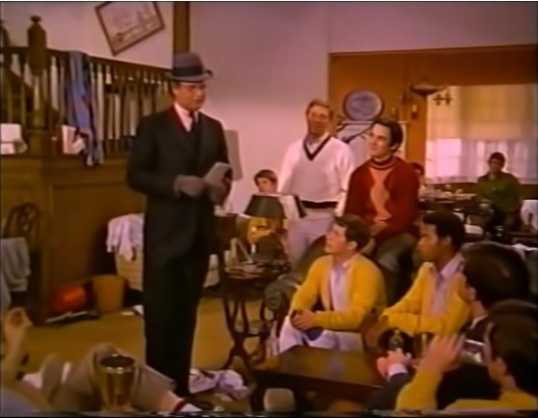
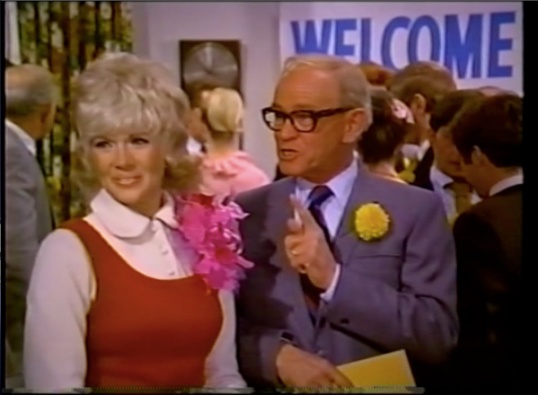
Except for Alpha Phi Epsilon, that is. The A.P.E. House is known for being the wildest house on campus and every housemother that they get walks out on them. If they can’t find a new housemother, they’ll lose their charter. President Chester Hardgrove (Van Johnson) and Assistant Dean Walden (Charles Nelson Reilly) are practically salivating at the possibility of kicking A.P.E. off of campus. And who can blame them? Take a look at how wild these guys are:
These guys are crazy! They wear yellow sweaters! They play tennis indoors! Occasionally, they leave a towel or two hanging on the bannister. A.P.E. is out of control!
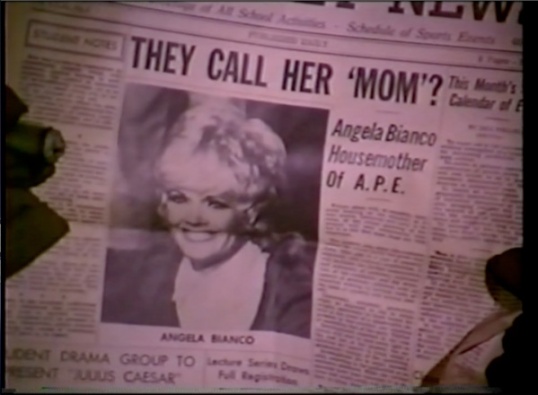
A.P.E. tries to find a new housemother but the word is out that A.P.E. is no good. Not a single elderly woman in town is willing to work with them. However, when the members of the frat realize that there’s not actually an age requirement for housemothers, they offer the job to Angie Bianco (Connie Stevens), who works as a waitress at the local pizza place. Angie accepts the job.
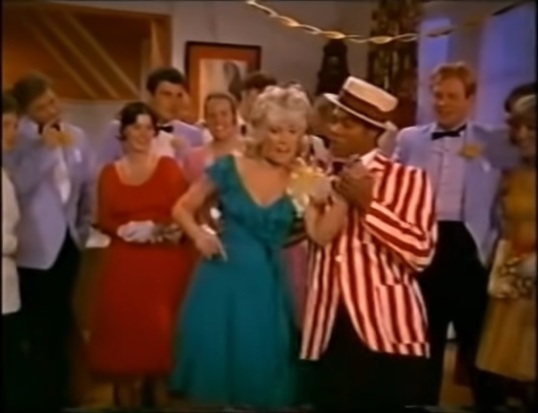
It’s a scandal! All of the older folks say that Angie is too young and too attractive to be trusted as the housemother for A.P.E. Angie, however, proves herself to be a lot tougher than anyone was expecting. The members of the frat soon come to respect her. However, President Hardgrove is determined to force her out of the job and off of the campus. Rumor has it that she’s encouraging the A.P.E. brothers to hold rollicking 20s style parties and she’s also allowing them to dance!
Check out this decadence!
The attempts to force Angie out of her job makes national news. Soon, Angie and the frat brothers are featured in Time Magazine. President Hardgrove points out that he’s never appeared in Time Magazine. While an group of middle-aged women march outside of the A.P.E. House and demand that Angie be fired, the younger female students rally to Angie’s side. Suddenly, Beardsley College is home to a protest! (The protest is about as a wild as the 20s dance party at the A.P.E. House.) President Hardgrove realizes that keeping Angie at the A.P.E. House will actually lead to the college getting more donations but Angie has decided that she has to quit. Not only is she in love with A.P.E.’s sponsor, Prof. Calder (Jim Hutton), but a member of the fraternity has decided that he’s in love with her and he’s going to drop out of school to be with her.
Can A.P.E. convince Angie to come back?
Call Her Mom is a silly movie that was obviously meant to serve as a pilot for a television show, one in which I imagine Angie would have solved the fraternity’s problems on a weekly basis. Seen today, it’s mostly memorable for its thoroughly innocent portrayal of college life. A.P.E. House is the wildest frat on campus but no one is ever seen drinking. Certainly no one is indulging in anything stronger than perhaps a Coke or a Pepsi. I imagine this show was an accurate portrayal of what most parents hoped college was like. That said, Connie Stevens and Jim Hutton made for a cute couple. Hopefully, there were many good times in the future for the residents of A.P.E. House.
Welcome to Retro Television Reviews, a feature where we review some of our favorite and least favorite shows of the past! On Sundays, I will be reviewing the made-for-television movies that used to be a primetime mainstay. Today’s film is 1971’s The Feminist and The Fuzz! It can be viewed on YouTube!
At first glance, Jane Bowers (Barbara Eden) and Jerry Frazer (David Hartman) don’t have much in common.
Jerry is a cop, though he’s attending night school with the hope of someday becoming a lawyer. Jerry is an old-fashioned law and order man. He expects the law to be followed. He’s also the type who definitely believes that there are clear differences between men and women. As he explains it, there are some thing that men are just better at. Jerry is dating Kitty (Farrah Fawcett), who works as a waitress at the local Playboy Club.
Dr. Jane Bowers is a pediatrician and a proud feminist, one who takes it personally when a cop like Jerry refuses to give her a parking ticket just because she’s a woman. She wants to be treated as an equal in all matters. She’s dating Wyatt Foley (Herb Edelman), an attorney who still lives with his mother and who constantly goes out of his way to let everyone know that he’s an ally. Jane’s best friend is Dr. Debby Inglefinger (Jo Anne Worley), who has decided that it’s time to lead a protest at the Playboy Club.
The only thing that Jerry and Jane have in common is that they both desperately need an apartment but apparently, apartments were not easy to find in San Francisco in the early 70s. Fortunately, a hippie (Howard Hesseman) has just been evicted from his apartment because the landlord (John McGiver) didn’t like the fact that he was constantly having overnight guests. Jane and Jerry both end up at the apartment at the same time, with Jane getting offended by Jerry’s refusal to give her a traffic ticket. (Jerry makes the mistake of saying that he’s going to let her off “with a warning.” He wouldn’t give a warning to a man! Seriously, though, who in their right mind would actually demand a ticket? Those things cost money.) Even though they take an instant dislike to each other, Jane and Jerry still decide to pretend to be husband and wife so that they can rent the apartment together. With their busy schedules, they figure that they’ll never have to see each other. They won’t even know the other is around.
Of course, it doesn’t work out like that. Jane allows Debby to hold a consciousness raising meeting at the apartment. (Future director Penny Marshall appears as a participant.) Meanwhile, Jerry lets a prostitute (Julie Newmar) stay at the apartment, just to keep her off of the streets for the night. The landlord is getting suspicious. So, for that matter, is Jane’s father (Harry Morgan). And, as you probably already guessed, Jerry and Jane are falling in love.
With its hippies and its militant feminists and its jokes about the Playboy Club, The Feminist and the Fuzz is a film that practically yells, “1971!” Unfortunately, script’s attempt to turn the film’s rather predictable plot into a Neil Simon-style jokefest never quite works. The “humorous” dialogue feels forced and the film’s 75-minute run time doesn’t do it any favors, as we never really have the time to get to know Jerry or Jane as human beings. Instead, they just remain “The Fuzz” and “The Feminist.” As a result, it’s not that easy to care about whether or not they actually get together. Some of the supporting performances are amusing. Barbara Eden manages to avoid turning Jane into a caricature of a humorless activist but poor David Hartman is stiff as a board and in no way convincing as a veteran cop.
The main thing I took away from this movie is that the Playboy Clubs were exceptionally tacky. Way back in 2011, NBC actually tried to air a drama series that took place at a Playboy Club in the 60s. (This was when every network was trying to come up with the next Mad Men.) The pilot started with creepy old Hugh Hefner assuring the viewers that, “Everybody who was anybody wanted to be a member of the club.” I mean, seriously? What a strange world.
Man on the Prowl is a surprisingly intense film from 1957.
Doug Gerhardt (played by James Best) is an overly friendly young man with a pompadour and a quick smile. Doug works as a deliveryman for a car dealership and he seems like a nice enough person. He’s maybe a little bit goofy and, if you talked to him, you might think that he’s a little bit slow. Still, it’s hard not to get caught up in his endless enthusiasm. Doug is a very friendly man and he certainly does seem eager to help everyone that he meets.
Of course, Doug is also a sociopathic murderer. He’s just been released from a mental hospital and, as we see when he strangles his date during the first few minutes of the movie, he’s still got some issues. However, no one ever seems to really notice, just because he is so friendly and kind of dorky. Even though his own mother (Vivi Janiss) tries to warn people that Doug is not well, most people just think that he’s a little bit eccentric.
When Doug nearly runs over Marian Wood (Mala Powers) and her son, Marian is not very happy with him. Doug apologizes for driving too fast and he even insists on helping Marian carry in her groceries. Marian goes from hating Doug to being somewhat forgiving of his reckless driving. That’s the power of Doug’s charm. He can go from nearly killing someone to making a new friend in just a matter of minutes.
Marian is married to Woody (Jerry Paris), though it’s not a particularly happy marriage. Woody is always traveling on business, leaving Marian to take care of the house on her own. Seeing an opening, Doug starts to casually drop by so that he can do things like help Marian fix the washing machine. Of course, it’s hinted that Doug might be the one who broke the washing machine in the first place. Doug is determined to replace Woody in Marian’s life. When it turns out that Marian isn’t ready for husband to be replaced by a delivery boy (even if that delivery boy can fix a washing machine) …. well, Doug doesn’t take it well.
Man on the Prowl really took me by surprise. For a film made in 1957, the story didn’t feel particularly dated, beyond a few things that couldn’t be helped. (Doug’s pompadour comes to mind.) If anything the film feels refreshingly honest in its willingness to admit that not all marriages are happy and not all wives are content with the idea of just sitting at home and waiting for their husband to return. However, the thing that really took me by surprise was how Doug was portrayed. Considering that the term “serial killer” wouldn’t be coined until 23 years after this film was originally released, Man on the Prowl is a surprisingly realistic portrayal of a serial killer. Doug is someone who is empty on the inside but who keeps the world from noticing by deploying a charming smile and a friendly manner. He’s Ted Bundy, decades before Bundy became a household symbol of evil. As played by James Best, Doug is a very realistic and very frightening modern monster.
In many ways, Man on the Prowl is a prophetic film. In 1957, someone like Doug was probably seen as being an aberration, a once-in-a-lifetime example of the natural order of things getting screwed up. Now, however, we know that the world is full of Doug Gerhardts. And we all feel a little less safe as a result.
Police Academy 3 opens with a state in the middle of a fiscal crisis. Money has to be saved somewhere and the governor (Ed Nelson) has decided that it’s not necessary for the state to have two police academies. I am not sure why the governor would be the one to make that determination since the previous two Police Academy films established that the academies are run by the city but I guess I should remember that I’m watching a Police Academy film and not ask too many questions.
Which academy is going to be closed down? Will it be the academy run by Commandant Lassard (George Gaynes) or the one run by Commandant Mauser (Art Metrano, returning from the second film)? Mauser is willing to use any dirty, under-handed trick to keep his academy open. Meanwhile, Lassard has his most recent graduating class returning to instruct his latest batch of recruits. Can Mahoney (Steve Guttenberg) and Michael Winslow’s human sound effects machine save the academy?
When I watched Police Academy 3 this weekend, I was surprised to discover that it wasn’t as bad as I remembered. Maybe it’s because I watched it immediately after the first two films and my senses were dulled but Police Academy 3 turned out to be an amiable and enjoyably stupid comedy. It helped that two of the new recruits were played by Tim Kazurinsky and Bobcat Goldthwait. Returning to the roles that they first played in the second movie, Kazurinsky and Goldthwait make for a good comedic team. As for the rest of the Police Academy regulars, they all do their usual comedy bits like pros and without any fuss. It’s predictable and sometimes, funny.
Police Academy 3 was the first Police Academy film to have a PG-rating and, as a result, the jokes were still as juvenile and crude as the first two movies but, at the same time, Police Academy 3 seems to have made peace with the fact that it’s target audience was a bunch of adolescent boys dropped off at the theater by their mothers. Mauser is still regularly humiliated but no one gets a blow job while standing in front of a podium. This is a Police Academy for the entire family, assuming that your family is easily amused and not too demanding.
Police Academy 3 is a dumb movie and the recurring joke about policemen accidentally entering the Blue Oyster Bar is even less funny the third time that it’s used. There’s also a Japanese recruit who only seems to be included because, back in the 80s, American films were obsessed with making fun of Japan. Despite all that, Police Academy 3 is still not as bad as the usual Police Academy sequel.
But what about Police Academy 4? Check in tomorrow to find out if it’s also better than I initially remembered.
In an unnamed city that is probably meant to be Los Angeles but which looks like Toronto, a criminal gang known as the Scullions have taken over the 16th precinct. Led by the loud, marble-mouthed Zed (Bobcat Goldthwait), the Scullions are terrorizing the citizens and harassing one shop owner, Carl Sweetchuck (Tim Kazurinsky), in particular. The captain of the 16th precinct, Pete Lassard (Howard Hesseman), calls his brother, Eric Lassard (George Gaynes), and asks for the best cadets to have recently graduated from the police academy.
Carey Mahoney (Steve Guttenberg) and a few other of the cadets from the first Police Academy movie end up in the 16th. Tackleberry (David Graf) is there and so is accident-prone Douglas Fackler (Bruce Mahler). Bubba Smith is back as Hightower and so is Michael Winslow, the human sound effects machine. They’re determined to help Lassard’s brother but it’s not going to be easy because they have to work with Lt. Mauser (Art Metrano) who is basically a dick who wants to be captain. Mauser is exactly like Harris from the first film, except his name is Mauser and, instead of getting his head stuck up a horse’s ass, he gets his hands super-glued to his head.
Police Academy 2 is less raunchy than the first film but still not quite as family friendly as the films that would follow. There’s still one f-bomb dropped and a few adult jokes, as if the film wasn’t fully ready to admit that it was destined to become associated with juvenile viewers who would laugh at almost anything involving a bodily function. There is one funny moment where Steve Guttenberg goes undercover to join Zed’s gang, mostly because he’s Steve Guttenberg and he’s even less believable as a gang member than he was as a cop. The closest thing that movie has to a highlight is Bobcat Goldthwait’s manic turn as Zed and Tim Kazurinsky’s desperation as he watches his store get repeatedly destroyed. Tackleberry also gets an amusing romantic subplot, where he meets a police woman (Colleen Camp) who loves guns almost as much he does. Unfortunately, Tackleberry’s romance gets pushed to the side by all of the gang activity.
Police Academy 2 is stupid but, depending on how much tolerance you have for Bobcat Goldthwait, sometimes funny. It’s not as “good” as the first film but it’s still better than most of what would follow. Speaking of which, tomorrow, I will be reviewing the first Police Academy film to get a PG-rating, Police Academy 3: Back in Training.
Motorcycles have always been unbelievably sexy and, in 1953, so was Marlon Brando.
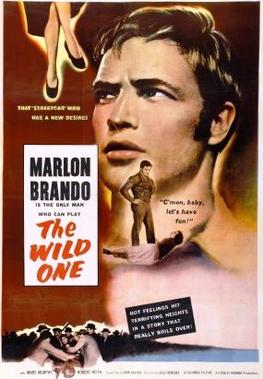
1953 was the year that Brando played Johnny Strabler in The Wild One. Johnny’s the leader of the Black Rebels Motorcycle Club. He wears a leather jacket and always has a cap tilted rakishly on his head. When Johnny moves, he makes it a point to take his time. He doesn’t run from anyone and, perhaps most importantly, he doesn’t run to anyone. Johnny’s a rebel and he doesn’t care who knows it. “What are you rebelling against?” Johnny is asked. “Whaddya got?” Johnny replies and, when he says it, you not only believe him but you want to join him in his rebellion.
And yet, from the minute that we see Johnny, it’s obvious that there’s more to him than just his jacket and his attitude. He speaks softly and when he smiles, there’s something almost shy about the expression. You look into his brooding, soulful eyes and you know that Johnny isn’t just about making trouble. He’s searching for something that society alone can’t deliver. Johnny’s a bad boy, the type who you fool yourself into thinking that you — and only you — can reach and help heal.
At least, that’s the way that Kathie (Mary Murphy) feels about him, even though she’s way too smart to accept his invitation to go to a dance with him. Kathie works at a diner in a small California town. When Johnny and his gang ride into the town, all of the boring, responsible citizens want to force him to leave. Kathie, alone, sees that Johnny’s not as bad as everyone assumes he is. And if there’s any doubt about the fact that Johnny’s got a good soul despite his brooding nature, Chino (Lee Marvin) shows up to remind everyone of what a truly bad biker is like.
Chino and Johnny may both love their motorcycles but otherwise, they’re opposites. If Johnny has the soul of a poet, Chino has no soul at all. Johnny’s searching for freedom while Chino is merely searching for power. Chino and Johnny were once friends, all part of the same gang. However, Johnny eventually went off on his own and took the younger gang members with him. Chino, in many ways, represents America’s destructive and wild path. He’s an old west outlaw who rides a motorcycle instead of a horse. Johnny, meanwhile, is a wanderer who represents the part of America that created Kerouac and Dylan.
(Interestingly enough, both Brando and Marvin were 29 years old when they made The Wild One. However, Brando looked much younger and Marvin looked considerably older, which only added to the film’s theme of generational conflict. Brando, himself, has never rode a motorcycle before making The Wild One and reportedly avoided the actual bikers who were hired to act as extras. Lee Marvin, on the other hand, was an experienced rider and fit right in with the film’s cast. To be honest, Lee Marvin is actually more convincing than Brando but Brando had the eyes and the wounded way of speaking whereas Marvin was every single guy who needlessly revs his motorcycle’s engine in the middle of the night.)
Anyway, needless to say, the townspeople are even less happy once Chino’s gang shows up. Unfortunately, few of them understand the difference between Johnny and Chino. In fact, the majority of the upright citizens prove themselves to be just as and, in some cases, more violent than the bikers that they’re trying to run out of town. It all leads to violence, tragedy, and, ultimately, understanding. This was a 50s film after all. Director Laszlo Benedek may have played up the more sordid aspects of the story but the film was produced by the reliably and safely liberal Stanley Kramer and the film concludes on a very Krameresque note.
If you only know Marlon Brando from the latter half of his career, when he was best known for his weight, his eccentricities, and his personal tragedies, than watching The Wild One is quite a revelation. It’s a well-directed film with a host of effective supporting turns but it’s Brando who makes the film unforgettable. Watching the film, you understand why Brando became a star and you also see just how much he inspired so many of the actors who came after him. James Dean’s performance in Rebel Without A Cause owes a huge debt to Brando’s work here. In fact, every rebel owes a debt to The Wild One. In the role of Johnny, Brando invites and inspires us all to ride down the road and see what we find.
The Wild One was a huge hit in 1953, leaving teenagers excited and parents concerned. That same year, Brando also played Mark Anthony in Julius Caesar and received an Oscar nomination for the performance. The Wild One was ignored at the Oscars but lives on whenever anyone hit the road and goes searching for America.
“It’s very simple what I want to be: totally happy; totally different; and totally in love.”
— Christine Adams (Jacqueline Bisset) in The Grasshopper (1970)
Seriously, is Christine asking for too much?
Total happiness? That may sound like a lot but trust me, it can be done.
Totally different? That’s a little bit more challenging because, to be honest, you’re either different or you’re not. If you have to make the effort to be different, then you definitely are not.
Totally in love? Well, it depends on how you define love…
At the start of The Grasshopper, Christine thinks that she’s heading to America to find love. While an oh-so late 60s/early 70s theme song plays in the background, Christine leaves her small hometown in Canada and she heads down to California. She’s planning on meeting up with her boyfriend Eddie (Tim O’Kelly) and taking a job as a bank teller.
Of course, it soon turns out that working in a bank isn’t as exciting as Christine originally assumed. Eddie expects Christine to just be a conventional girlfriend and that’s not what Christine is looking for. As well, it’s possible that Christine may have seen Targets, in which O’Kelly played an all-American boy who picks up a rifle and goes on a killing spree.
And so, Christine abandons Eddie and heads to Las Vegas. Since this movie was made in 1970 and Uber didn’t exist back then, Christine’s preferred method of traveling is hitchhiking. This gives her a chance to meet the usual collection of late 60s weirdos who always populate movies like this. One driver crosses herself when Christine says that she plans to have a baby before getting married. Another is a hacky Las Vegas comic.
In Vegas, Christine applies for a job as a showgirl. As she explains to sleazy casino owner Jack Benton (Ed Flanders), she “once did Little Women in school.”
Anyway, thing do get better once Christine meets and falls in love with Tommy Marcott (Jim Brown), a former football player who is now working as a door greeter in Jack’s casino. Everyone tells Christine not to get involved with Tommy. One of Jack’s men, a menacing hitman who looks just like Johnny from Night of the Living Death (he even wears glasses), warns Christine to watch herself.
Through a long series of events, Christine ends up on her own again. The usual collection of 70s events occur: murder, drugs, prostitution, and ultimately a stint as the mistress of a rich man played by Joseph Cotten. The important thing is that it all eventually leads to Christine and a skywriter getting stoned, stealing a plane, and deciding to write a message in the sky.
That’s when this happens:
Yes, it’s all very 1970!
Anyway, The Grasshopper is one of those films that tries to have it both ways. Establishment audiences could watch it and think, “Wow, those kids are really messed up.” Counterculture audiences could watch it and say, “Old people are such hypocrites.” Oddly enough, The Grasshopper was written by future director Garry Marshall and it’s an incredibly overwrought film. There’s not a subtle moment to be found in the entire film and the film’s direction is flashy but empty. However, for those of us who love history, it’s as close to 1970 as we’re going to get without hopping into a time machine.
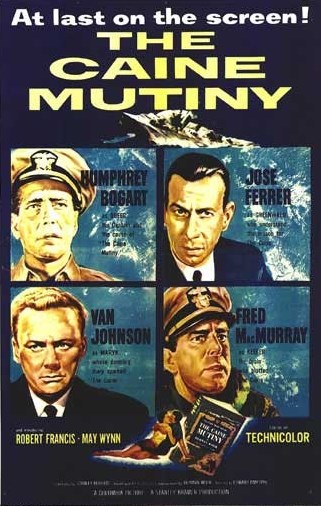
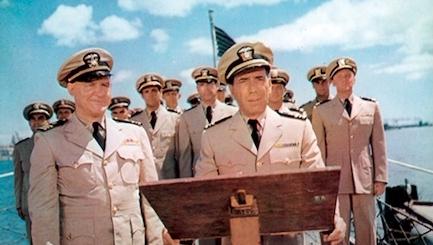
It’s the 1940s and World War II is raging. The U.S. Navy is model of military discipline and efficiency. Well, except for the U.S.S. Caine, that is. The Caine is something of a disorganized mess, where no one takes his job seriously and sailors have names like Meatball (Lee Marvin) and Horrible (Claude Akins). The men love Lt. Commander DeVriess (Tom Tully), largely because he has given up on trying to enforce any sort of discipline. However, DeVriess has recently been relieved of his command. As he leaves, Meatball gives him a new watch, a gift from all the men. DeVriess admonishes them, snapping that the gift is violation of Naval regulations. He then puts the watch on his wrist and leaves the ship.
DeVriess’s replacement is Captain Francis Queeg and, at first, we have reason to be hopeful because Captain Queeg is being played by Humphrey Bogart. Surely, if anyone can get this ship into shape, it’ll be Humphrey Bogart! From the moment he arrives, Queeg announces that he’s going to enforce discipline on the Caine and if that means spending hours yelling at a man for not having his shirt tucked in, that’s exactly what Queeg is prepared to do. However, it also quickly becomes apparent that the awkward Queeg has no idea how to talk to people. He is also overly sensitive and quick to take offense. Whenever Queeg makes a mistake (and he does make a few), he’s quick to blame everyone else.
Realizing that the men are turning against him, Queeg even begs his officers for their help. He asks them if they have any suggestions. They all sit silently, their heads bowed as Queeg somewhat poignantly rambles on about how his wife and his dog both like him but the crew of the Caine does not.
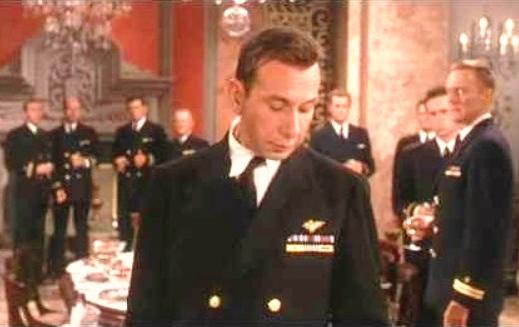
Queeg’s officers are a diverse bunch, none of whom are quite sure what to make of Queeg or the state of the Caine. Ensign Willie Keith (Robert Francis) is a wealthy graduate of Princeton University who, at first, likes Queeg but quickly comes to doubt his abilities. On the other hand, Lt. Steve Marsyk (Van Johnson) has doubts about Queeg from the start but, as a career Navy man, his natural instinct is to respect the chain of command above all else.
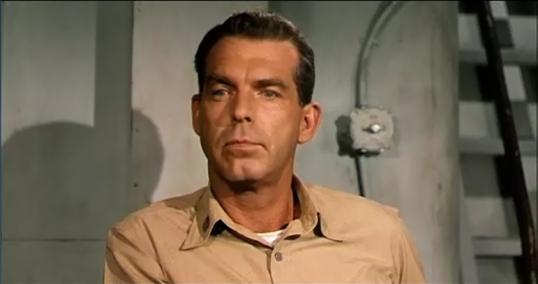
And then there’s Lt. Tom Keefer (Fred MacMurray). Keefer is a self-styled intellectual, a novelist who is always quick with a snarky comment and a cynical observation. (If The Caine Mutiny were remade as a B-horror film, Lt. Keefer’s name would probably be Lt. Sardonicus.) From the minute the viewers meet Lt. Keefer, our inclination is to like him. After all, he seems to be the only person in the film who has a sense of humor. If we had to pick someone to have dinner with, most of us would definitely pick the erudite Tom Keefer over the humorless and socially awkward Francis Queeg. As such, when Keefer starts to suggest that Queeg might be mentally unstable, our natural impulse is to agree with him.
It’s Tom Keefer who first suggests that it may be necessary to take the command away from Queeg. And yet, when it comes time to take action, it’s Keith and Marsyk who do so while Keefer stands to the side and quietly watches. And, once the Caine arrives back in the U.S., it Keith and Marsyk who are court martialed. Will they be found guilty of treason or will their lawyer, Lt. Barney Greenwald (Jose Ferrer), prove that Queeg was unfit for command?
Made in 1954 and based on a novel by Herman Wouk, The Caine Mutiny is one of those big and glossy 1950s productions that holds up a lot better than you might expect. The film has its flaws. In the role of Keith, Robert Francis is a bit on the dull side and a subplot in which he courts May Wynn feels unneccessary and only serves to distract from the main story. But, for the most part, it’s an intelligent and well-directed film. Humphrey Bogart turns Queeg into a pathetic and lonely figure and you can’t help but feel sorry for him when he talks about how his dog loves him. Van Johnson also does well as Marsyk, effectively portraying a well-meaning character who is in over his head. Jose Ferrer gets a great drunk scene at the end of the film and, of course, you can’t go wrong with Lee Marvin as a smirking sailor, even if Marvin only appears for a handful of minutes.
But for me, my favorite character (and performance) was Fred MacMurray’s Tom Keefer. Technically, Keefer is not meant to be a likable character. He’s totally passive aggressive. He’s pretentious. He’s smug. At times, he’s rather cowardly. And yet, Tom Keefer remains the most memorable and interesting character in the entire film. He gets all of the good one-lines and MacMurray delivers them with just the right amount of barely concealed venom. (“If only the strawberries were poisoned…” he says as he considers dinner aboard the Caine.) It’s a great role and Fred MacMurray gives a great performance. And you know what? I don’t care how bad a character he may have been. I still want to read Tom Keefer’s book!
The Caine Mutiny was nominated for best picture of 1954. However, it lost to On The Waterfront.
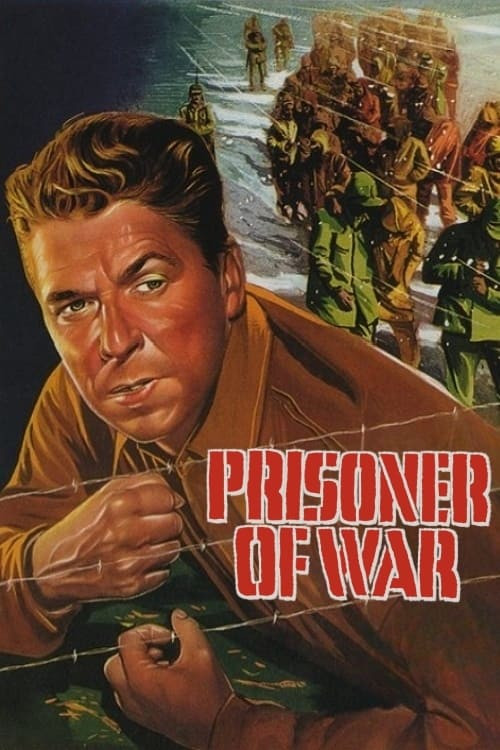 The setting is the Korean War. After getting information that American POWs are being tortured and brainwashed in North Korean prisoner-of-war camps, Major Hale (Harry Morgan) assigns Webb Sloane (Ronald Reagan) to go undercover. After parachuting behind enemy lines, Webb spots a group of POWs being marched through the snow and joins the group. From the minute that Webb joins the march, he begins to observe war crimes. The death march itself, with the POWs being forced to move in freezing weather, is itself a war crime. At the POW camp, Webb discovers the presence of an arrogant Soviet interrogator (Oscar Homolka) and a routine designed to break the POWs down until their ready to betray their native country. Some POWS, like Captain Stanton (Steve Forrest), refuse to break. Others, like cowardly Jesse Treadman (Dewey Martin), break all too quickly. Webb sends the information back to Hale and eventually tries to make his escape.




 Through the Shattered Lens