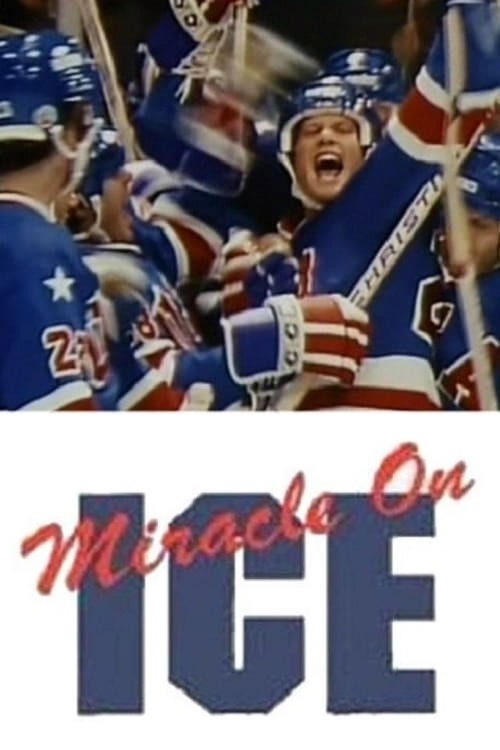
Miracle On Ice (1981, directed by Steven Hilliard Stern)


On February 22nd, 1980, the U.S. Olympic Hockey team pulled off one of the greatest upsets in sports history when they defeated the Soviet team during the Winter Olympics.  At a time when America was struggling under Jimmy Carter and the Soviet Union appeared to be winning the propaganda war, a group of unheralded college students brought the U.S. together in celebration as they defeated the Soviets and then went on to defeat Finland for the gold medal.

Everyone knows that the Miracle On Ice, as it was called, served as the basis of the Disney film Miracle, with Kurt Russell playing coach Herb Brooks.  What is now forgotten is that the story was first recreated in 1981, with a made-for-tv movie called Miracle On Ice.  Who played Herb Brooks in that movie?

Karl Malden.

Keep in mind, Herb Brooks was 42 years-old when the U.S. team defeated the Soviets and he was a former player himself.  Malden was 69 when he starred in Miracle On Ice and didn’t look like he had ever worn skates in his life.  Malden is convincingly grumpy and hard-nosed as Brooks but he’s still very miscast and the movie misses the point that one of the reasons why Brooks could coach the young American team was because he was still relatively young himself.  The actors playing the members of the team are better cast, with Andrew Stevens playing team leader Mike Eruzione and Steve Guttenberg cast as goalie Jim Craig.  A lot of time is devoted to Craig’s financial difficulties and his fear that remaining an amateur for the Olympics, instead of going pro, will continue to make life difficult for his family.  On the one hand, it is messed up that the U.S., at the time, did not allow its Olympians to turn professional.  On the other hand, the fact all of the players were considered to be “amateurs’ made their victory over the Soviets all the more special.

It takes a while for Miracle on Ice to get to the main event.  There’s a lot of scenes of Brooks dealing with everyone’s skepticism and Eurozione trying to keep the players from giving up in the face of the Soviet Union’s previous domination of the game.  Once the movie does finally reach the Winter Olympics, it relies on actual footage from the game, which is actually pretty cool.  Watching the real footage, you can still feel the growing excitement in both the stadium and the broadcast booth as people started to realize that the American team was going to pull it off and defeat the Soviets.  It’s impossible not to be inspired by the Soviet Union getting humiliated by a bunch of American college players.  The Soviets may have had the performance enhancing drugs but the Americans had the spirit!

Of the two films about America’s victory, Miracle is definitely the one to see but Miracle On Ice still pays tribute to a great moment.
Horror Film Review: Magic (dir by Richard Attenborough)


There have been many disturbing ventriloquist’s dummies over the years but I don’t know if there’s ever been one who is quite as hateful as Fats, the dummy that is used by Corky Withers (Anthony Hopkins).

Corky and Fats are at the center of the 1978 film, Magic.  When we first meet Corky, he’s an aspiring magician without a dummy.  He’s a talented magician and it’s obvious that performing is one of the only things that brings Corky happiness.  But, from the start, there’s something off about Corky.  There’s a desperation to him and his performance.  He craves the applause of the audience just a bit too much, as if he doesn’t know who he is unless people are clapping for him.  (This performance, from a youngish Anthony Hopkins, is quite a contrast to the characters that Hopkins is today known for playing.)  Corky is told that he needs to get a “gimmick” if he’s ever going to be a success and that gimmick turns out to be Fats, a ventriloquist dummy who is as confident as Corky is insecure.  Whereas Corky often seems to be struggling to find the right thing to say, Fats always has the perfect comeback ready.

Of course, Fats is Corky.  Fats is the self-absorbed and cocky “person” that Corky wishes he could be.  When Fats tells Corky that he’s a useless loser, it’s actually Corky saying that to himself.  When Corky argues with Fats, he’s arguing with himself.  With Fats, Corky has found a way to express himself but he’s also sacrificed half of his identity as a result.  Can Corky survive without Fats?  He’s not sure but he does know that Fats is a hit with audiences.

When Corky’s agent (Burgess Meredith) announces that he has gotten Corky a network television special, Corky panics.  Corky doesn’t want to take the medical or mental exams that the network would probably require before giving him a contract.  He flees to the Catskills, where he grew up.  (Corky’s obsession with performing makes sense when one realizes that he grew up in the Catskills, a region that played home to many aspiring comedians.)

Corky visits Peggy Ann Snow (Ann-Margaret), with whom Corky went to high school and who he had a huge crush on.  (Imagining Anthony Hopkins in high school — especially an American high school — is not particularly easy.)  Peggy is unhappily married to Duke (Ed Lauter) and she soon finds herself falling in love with Corky.  Corky appears to finally have a chance for happiness but Fats has other plans.  Murder follows and it says something about how well this film is done that we think of Fats as being the mastermind behind the murders even though we know that Fats is really just Corky talking to himself.

Magic is the definitive evil ventriloquist’s dummy film, one that is beautifully shot by Richard Attenborough and which features a great performance from Anthony Hopkins.  It’s a sign of the strength of his performance that we still feel sorry for Corky, even though he ends up killing one of the most likable characters in the film.  Of course, it’s a dual performance for Hopkins because he’s playing both Corky and Fats.  He is excellent and frightening in both roles.

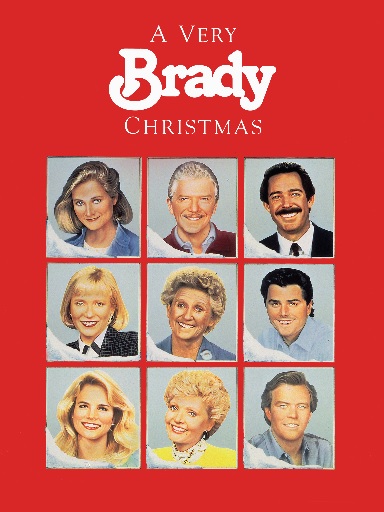
Retro Television Reviews: A Very Brady Christmas (dir by Peter Baldwin)


Welcome to Retro Television Reviews, a feature where we review some of our favorite and least favorite shows of the past!  On Sundays, I will be reviewing the made-for-television movies that used to be a primetime mainstay.  Today’s film is 1988’s A Very Brady Christmas!

In A Very Brady Christmas, America’s creepiest family reunites for the holidays.

Mike and Carol Brady (played by Robert Reed and Florence Henderson, of course) have finally got their house to themselves!  The children have all moved out.  A few have even gotten married and started families of their own.  Mike is still an architect, though he now has a mustache that, along with his gray hair, makes him look more like a retired porn actor.

With Christmas approaching, Mike and Carol have each been secretly saving up their money to give the other a trip.  Carol knows that Mike loves Greece.  Mike suspects that Carol would love to go to Japan.  In the end, though, they realize that they would much rather have the entire family come together for Christmas!  They buy tickets for everyone.  Of course, what they don’t know is that each of the Brady kids has an issue of their own.

For instance, consider the youngest of the Brady kids.  Cindy isn’t even herself anymore, mostly because Susan Olsen declined to return for the reunion and Jennifer Runyon was cast in her place.  Cindy is away at college and she’s upset that she has to cancel her plans to go skiing just so she can spend the holidays with her family.  Meanwhile, Bobby (Mike Lookinland) has dropped out of college so that he can race cars on the NASCAR circuit but he hasn’t told his parents yet!  Of course, if Bobby never tells them, he can just keep pocketing that sweet, sweet tuition money.

Meanwhile, Peter Brady (Christopher Knight) is upset because his girlfriend is his boss and she makes considerably more money than he does.  Jan (Eve Plumb) is secretly separated from her husband but, because it’s the holidays, they agree to pretend to still be together so that Mike and Carol don’t get upset.  Greg (Barry Williams) has grown up to be a smarmy doctor but he is upset that his wife will not be joining him for Christmas with his parents.  And Marcia (Maureen McCormick) is trying to keep everyone from discovering that her loser husband has lost his job.

And let’s not forget Alice (Anne B. Davis)!  Alice finally married Sam The Butcher but their marriage is on the rocks….

Could the Bradys be more cursed?

Luckily, Mike and Carol are pretty good at uncovering problems and fixing things.  (Except, of course, for that time that Mike never figured out that Marcia was acting strange because she wanted to surprise him with his father of the year prize….)  Unfortunately, Mike is a bit distracted because his latest building was constructed with cheap material.  When an earthquake causes the building collapse, Mike takes it upon himself to rescue two trapped workers.  (Most of this takes place off-screen, of course.)  When an aftershock hits, it seems like Mike might never emerge from the tomb that he helped to design.

Much like the show that inspired it, A Very Brady Christmas is painfully earnest and …. well, it’s a little dumb.  Of course, the main appeal of The Brady Bunch was always the unapologetic mix of earnestness and stupidity but it’s a bit different when all the Brady kids are grown up and they’re still acting just as dumb as they did when they were younger.  Robert Reed looks annoyed.  Florence Henderson is trouper and gives it her all.  With the notable exception of Maureen McCormick, none of the kids grew up to be particularly good actors.  (In all fairness, Barry Williams is likable when he makes fun of himself but, in this film, he’s somewhat stiff as the most successful of the Brady kids.)  That said, the family singing a Christmas carol while waiting to discover whether or not Mike is dead is one of those moments that is somehow both silly and effective at the same time.  It’s pure Brady Bunch.  To quote Tony Montana, it’s the yayo of nostalgia.

A Very Brady Christmas aired in 1988 and was enough of a rating success that it actually led to the Brady Bunch being (briefly) revived.  Today, it’s impossible to watch the movie without imagining Gary Cole and Shelley Long as Mike and Carol Brady.  Even the collapse of the building is no longer an effective dramatic moment due to it being referenced in The Brady Bunch Movie.  When Mike does emerge from that collapsed building, you half expect him to say, “Wherever you go, there you are.”

In the end, the Bradys have a merry Christmas.  I hope you have one too!

Film Review: Years of the Beast (dir by D. Paul Thomas)


This low-budget 1981 film opens with a professor, Stephen Miles (Gary Bayer), giving his last lecture at Seattle’s University of Washington.  He’s been laid off from his job.  He’s depressed.  The students around him don’t seem to be interested in anything that he has to say.  The world seems to be plunging deeper and deeper into chaos.  Society seems to be collapsing.  Stephen just can’t understand why everything just seems to be getting so bad.

Having taught his last class, Stephen walks across campus and drops in on his friend, Dr. Carl Kilneman (Malcolm McCaimen).  Dr. Kilneman says that things may look bad now but they’re only going to get worse.  He then talks about how his research has led to him discovering that every bad thing in the world was previously predicted by the Bible.  Stephen starts to laugh him off but he’s interrupted by what sounds like an overhead explosion.  Suddenly, Dr. Kilneman has vanished.

Dr. Kilneman is not the only person who has vanished.  In fact, every believer in the world has vanished.  Without any Christians around telling people how to behave, it doesn’t take long for Seattle to descend into chaos.  (Seattle in chaos?  Well, it was bound to happen someday….)  Soon, people are raiding the grocery stores and roving bands of frat boys are flooding the streets, openly drinking beer and smoking weed….

Yes, I know that actually kind of sounds like the sort of stuff that happens everyday and not just in Seattle but you have to remember that this film is from 1981 and, from what I can tell, it was apparently mostly shown to church groups.  So, for the time, maybe it was shocking….

Anyway, Stephen and his wife, June (Alana Rader), decide to go out to June’s father’s farm.  They manage to get out of Seattle and probably not a minute to soon as Seattle itself is soon wiped off the face of the planet by a storm of biblical proportions.  When Stephen and June reach the farm, they discover that her father has vanished.  They also meet up with one of the farmhands, Gary (Jerry Houser) and a young woman named Cindy (Sarah Reed), who needs a place to stay.

Meanwhile, with the world in chaos, an enigmatic man known as the Prime Minister (Michael Amber) takes control and promises to bring peace to the planet but only if people agree to follow him and be branded with a special mark.  At one point, the Prime Minister gets shot in the head and then comes back to life a few days later so …. well, we all know what that means.

Stephen, June, Gary, and Cindy do not want to take the mark so they go running into the wilderness.  Pursuing them is the local sheriff (James Blendick), who is determined to make sure that the law is followed even if the law is being written by Satan.

Years of the Beast is a bit of an oddity.  On the one hand, it’s an extremely low-budget film and the pace is often painfully slow.  One of the reasons why the film’s destruction of Seattle is so much fun to watch is because the special effects are so extremely cheap that they’re almost charming but, at the same time, the film’s narrative momentum dies right after the city.  Unlike a lot of faith-based film, the cast was made up of character actors who actually had a career in mainstream cinema so, on the whole, the performances are better than you might expect to find in a film like this but, at the same time, none of the characters have much depth.  They start out as nonbelievers and then they become believers and that’s pretty much it as far as their characterization tends to go.  I liked the fact that the outwardly friendly Sheriff was actually a fascist but that has more to do with my own natural distrust of authority than anything else.

At the same time, if you’re looking for a time capsule of tacky 80s fashion and interior design, Years of the Beast will deliver.  I especially liked the interior of Stephen and June’s home in Seattle, which was basically so bland that it become oddly fascinating.  Actually, oddly fascinating is a good way to describe the entire film.  It’s hard not to enjoy epic film making at discount prices.  It’s almost like a bit of outsider art.  For all of its flaws, it did get made and it apparently did play in theaters and now, nearly 40 years later, it can still be found on YouTube.  Such is the power of cinema.


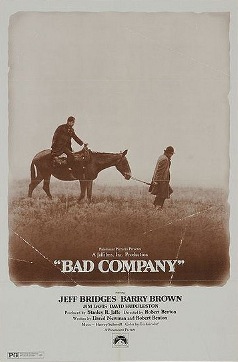
A Movie A Day #152: Bad Company (1972, directed by Robert Benton)


Missouri during the Civil War.  All young men are being forcibly constricted into the Union army, leaving those who want to avoid service with only two options: they can either disguise themselves as a woman and hope that the soldiers are fooled or they can head out west.  Drew Dixon (Barry Brown) opts for the latter solution but his plans hit a snag when he’s robbed and pistol-whipped by Jake Rumsey (Jeff Bridges).  When Drew coincidentally meets Jake for a second time, he immediately attacks him.  Jake is so impressed that he insists that Drew join his gang of thieves.
Jake’s gang, which include two brothers (one of whom is played by John Savage) and a ten year-old boy, is hardly the wild bunch.  They spend most of their time robbing children and are, themselves, regularly robbed by other gangs, including the one run by Big Joe (David Huddleston).  Their attempt to rob a stagecoach goes hilariously wrong.  Less hilarious is what happens when they try to steal a pie from a window sill.

Bad Company was the directorial debut of Robert Benton and it has the same combination of comedy and fatalism that distinguished both his script for Bonnie and Clyde and several of the other revisionist westerns of the 1970s.  While the interplay between Drew and Jake may remind some of Butch Cassidy and the Sundance Kid, the film’s sudden bursts of violence feel like pure Peckinpah.  Fortunately, the combination of Robert Benton’s low-key direction and the excellent performances of Jeff Bridges and Barry Brown allows Bad Company to stand on its own.  Brown and Bridges make for an excellent team, with Bridges giving a charismatic, devil-may-care performance and the late Barry Brown holding his own as the more grounded Drew.  (Sadly, Brown, who appears to have had the talent to be a huge star, committed suicide six years after the release of Bad Company.)  This unjustly forgotten western is one of the best films of the 1970s.

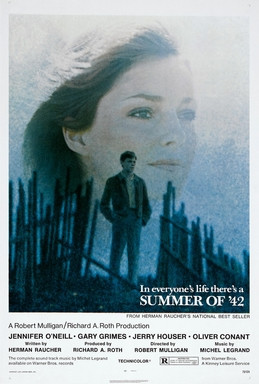
Back to School Part II #4: Summer of ’42 (dir by Robert Mulligan)


Summer_of_'42_POSTER

Originally, I was going to finish up the first day of my back to school reviews by talking about A Clockwork Orange.  I figured that, since the second film I reviewed was Andy Warhol’s Vinyl, it would just make sense that the fourth film would A Clockwork Orange.

But, I don’t know.  As I sat down and started to work on my fourth review, I realized that I’m not quite ready to write about A Clockwork Orange.  Instead, I’d rather hold off on that until tomorrow.  So, instead, I’m going to talk about Summer of ’42, another coming-of-age film that came out the same year.

That’s right — A Clockwork Orange and Summer of ’42 both came out in 1971 but — in content and sensibility — they might as well exist in different universes.  In fact, the only thing that they have in common is that they both tend to show up on TCM fairly frequently and that they’ve both influenced countless other films.

Speaking of TCM, that’s where I first saw Summer of ’42.  I have to admit that I’m writing this review from memory and that may not be the best way to review a film.  I saw Summer of ’42 about four months ago and, at the time, I thought it was a well-done but predictable little movie.  I even took notes for a future review but I didn’t get around to writing that review because … well, at the time, it just seemed like there wasn’t a lot to say about it.  Summer of ’42 is a sweet film but almost everything about it is right on the surface.  What you see is what you get.  I’m not surprised to discover that it was the 6th highest grossing film of 1971.  In a year that saw not only A Clockwork Orange but The Last Picture Show, The French Connection, Brother John, Billy Jack, Carnal Knowledge, Dirty Harry, Harold and Maude, Let’s Scare Jessica To Death, Klute, Straw Dogs, Pretty Maids All In A Row, and The Zodiac Killer, audiences were probably relieved to see a film that was neither violent, morally ambiguous, nor apocalyptic.

Instead, Summer of ’42 is a coming-of-age story that was specifically crafted to appeal to a world-weary audience’s nostalgia for the simple and carefree days of World War II.  This is one of those films where an older narrator continually reassures us that we’re seeing the most defining moment of his youth and all of the pretty images are in soft focus.  Hermie (Gary Grimes), Oscy (Jerry Houser), and Benjie (Oliver Conant) are three fifteen year-olds, all of whom are spending their summer on Nantucket Island.  Benjie is obsessed with sex but he’s nerdy.  Oscy is obsessed with sex but he’s a jerk.  Hermie is obsessed with sex but he’s the narrator so we already know that he’s too sensitive to lose his virginity to any girl his own age.

Luckily, there’s a woman in her 20s who is living in a nearby beach house.  Dorothy (Jennifer O’Neill) is beautiful but she’s married.  However, her husband’s a soldier and it is 1942 so, pretty soon, he’s out of the picture.  Hermie develops a mad crush on her and then, luckily for him, her husband dies and she spends a night teaching him the ways of love.  The next morning, she vanishes but leaves Hermie a note, telling him that she will never forget him and that it’s up to him to decide what their night together meant.

(Hermie never gets around to telling us what their night together meant so I guess it’s up to us to decide.  Personally, I just hope Hermie was careful who he told because, nowadays, a 23 year-old can get in a lot of legal trouble if she’s caught having sex with a 15 year-old.  Maybe things were different in 1942…)

As I said before, my initial response was that Summer of ’42 was sweet but predictable.  And that’s the way I still feel about it.  It was well-acted, well-filmed, and Jennifer O’Neill was amazingly beautiful but there was still something about Summer of ’42 that kind of bothered me.  We never really got to know who Dorothy was.  Her entire character was defined by her one night with Hermie.  Yes, I do understand that was kind of the point because the story was being told exclusively from Hermie’s point of view.  But it still bothered me.  Beyond being beautiful, tragic, and ultimately available, who was Dorothy?

But really, it wasn’t just something about the Summer of ’42 that was bothering me.  Instead, it was something about the coming-of-age genre in general.  I have lost track of how many nostalgic films and TV shows that I have seen that feature a narrator talking about the summer that he “became a man.”  It’s amazing how many awkward teenage boys apparently lost their virginity to a beautiful older woman who promptly vanished afterwards.  If, as has been recently suggested, I spent next summer in a rented beach house, am I going to be obligated to be the first lover of every 15 year-old, aspiring writer who happens to come wandering down the beach?  That could be time consuming, depending on how popular the beach is.

I guess what I’m saying is that perhaps somebody needs to remake Summer of ’42 and tell it from Dorothy’s point of view.

Just a thought.