Jack Burton (Kurt Russell) is not a complicated person. He drives a truck for a living. He’s loyal to his friends. He likes a good beer and a pretty girl. He tries to do the right thing so when the fiancée of his best friend, Wang Chi (Dennis Dun), is kidnapped, he teams up with Wang to rescue her. And when Jack’s truck gets stolen after he runs over an evil, ancient Chinese sorcerer named Lo Pan (James Hong), Jack just wants to get his truck back. Instead, Jack finds himself in the middle of an ancient battle between good and evil as Lo Pan searches for a green-eyed woman to sacrifice so that he can defeat a curse that was put upon him centuries ago.
Big Trouble In Little China is one of John Carpenter’s most exuberant films. It mixes kung fu action with special effects and a good dose of physical humor from Kurt Russell. When Lisa and I watched this movie a few months ago, Lisa commented that this film was Kurt Russell’s “Bruce Campbell movie,” and the more I think about it, the more I agree. Russell plays Jack with a mix of cockiness and klutziness that should be very familiar to anyone who has followed the adventures of Ash Williams. While Dennis Dun gets to do the typically heroic stuff that you would expect from the star of a movie like this, Russell is just someone who wants to get his truck back and who is consistently weirded-out by the magic around him. Carpenter makes sure that the movie is full of action as he pays tribute to the kung fu films that he watched when he was still in film school. James Hong is great villain and the rest of the cast, including Kim Cattrall as lawyer Gracie Law, all match the energy of Russell, Hong, and Dun. Complete with flying swordsmen, demons with glowing eyes, and a lightning-wielding warrior that probably inspired Mortal Kombat‘s Raiden, Big Trouble In Little China is a fun slice of 80s action.
Unfortunately, the film was not appreciated when it was first released. Stung by the critical reaction to the film, Carpenter abandoned working for the studios and instead become an independent filmmaker. Big Trouble In Little China, however, has stood the test of time and has become better appreciated with age. Today, it’s rightly viewed as one of Carpenter’s best films.
Welcome to Late Night Retro Television Reviews, a feature where we review some of our favorite and least favorite shows of the past! On Tuesdays, I will be reviewing Baywatch Nights, a detective show that ran in Syndication from 1995 to 1997. The entire show is currently streaming on You tube!
This week, the stars align and David Hasselhoff finally meets …. THE YAKUZA!
Episode 1.17 “Code of Silence”
(Dir by Charles Bail, originally aired on March 16th, 1996)
While her mother has a desperate conversation on a nearby payphone, young Mariko (Nicole Iiada) wanders onto the beach and spots a sea gull who has gotten tangled up in a fishing net. Fortunately, Mitch Buchannon drives up in his red Baywatch jeep and is able to set the sea gull free. Unfortunately, no sooner has the sea gull flown away then a bunch of Yakuza pull up and promptly kidnap Mariko’s mom.
Is there a detective in the house?
Why, yes, there is!
Well, kinda….
This is yet another episode of Baywatch Nights in which Mitch gets involved in a case as a result of being a lifeguard as opposed to being a private investigator. Indeed, if not for the presence of Angie Harmon, there would be little to distinguish this from an episode of Baywatch. While watching the last few episodes of Baywatch Nights‘s first season, you really can tell that the producers were desperate to bring over the audience that was watching just plan Baywatch. If the first half of the first season was all about David Hasselhoff wearing suits and providing hard-boiled narration, the second half is more about getting everyone onto the beach as quickly as possible.
As for this week’s case, it turns out that the kidnapped woman is a geisha who has a computer disk that the Yakuza wants. While the members of the Yakuza are busy threatening her with all sorts of violence, Mitch is teaming up with her grandfather (played by Soon-Tek Oh) and trying to discover where she’s being held. When Garner and Mitch find out about the Yakuza’s secret headquarters, they launch an assault. You might think that this would be difficult, seeing as how the members of the Yakuza are all ruthless martial artists. Well, it turns out that karate is no match for Mitch’s fists. The ancient art of combat falls before the power of the Hoff.
Somewhat inevitably, the episode ends with Mitch being given two samurai swords by Soon-Tek Oh. When Mitch says that he can’t accept such an expensive gift, Soon-Tek Oh says that no one gets the swords as a gift. Instead, they must be earned by truly displaying the spirit of the samurai. Mitch looks truly touched while Angie Harmon suppresses a laugh.
David Hasselhoff vs. The Yakuza! Well, we all knew it was going to have to happen at some point. That said, I don’t think the Hoff was dealing with first-grade Yakuza. It seems like the Yakuza sent the B-team to California. Well, that was their mistake. It didn’t take much effort for the Hoff to track them down and defeat them and in fact, it felt almost too easy. The Yakuza probably thought the Hoff would be too busy recording a new album to care. Again, their mistake.
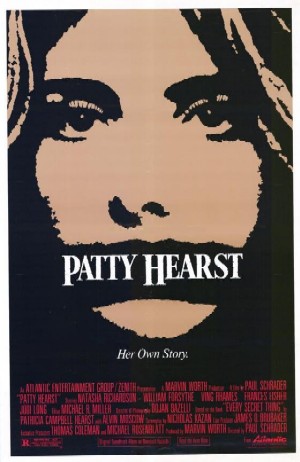
The 1988 film, Patty Hearst, is based on a fascinating true story.
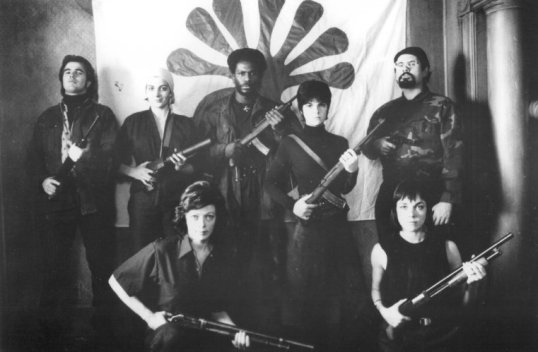
In 1974, newspaper heiress Patty Hearst was a 19 year-old student at Berkeley who was kidnapped from her apartment by a group of self-styled leftist revolutionaries known as the Symbionese Liberation Army (SLA). The SLA was led by a charismatic escaped prisoner who called himself Field Marshal Cinque and who announced — via messages that Hearst read into a tape recorder — that Hearst was being held hostage in the name of social justice. The police and FBI spent several months unsuccessfully searching for Hearst until one day, the SLA released an audio tape in which Hearst announced that she had now joined the SLA and would now be known as Tania. Hearst was soon robbing banks and went from being a hostage to a wanted criminal. When she was arrested in 1975, Hearst claimed to have been brainwashed by the SLA and people still debate whether she was a sincere revolutionary, a calculating criminal, or a victim.
(From what I’ve read about the Hearst kidnapping, I guess the modern day equivalent would be if Kendall Jenner disappeared and then resurfaced in Portland, setting cars on fire with Antifa.)
What can said for sure is that, after being arrested and convicted of bank robbery, Patty Hearst was sentenced to 7 years in prison. Hearst served less than three years before her sentence was commuted by President Jimmy Carter. Twenty years later, another President — Bill Clinton — gave her a full pardon. Needless to say, the rest of the SLA did not receive a pardon or, for that matter, even a commutation. The majority of them, including Field Marshal Cinque, died in a fiery explosion that came at the climax of a gun battle with police. The rest were arrested, convicted, and ended up serving their full sentences. Of course, while the majority of the SLA came from middle and upper middle class backgrounds, only one of them was the heir to a fortune. When she was arrested, Patty may have given her career as being an “urban guerilla,” but ultimately, she was the granddaughter of William Randolph Hearst.
(Regardless of whether you believe Patty Hearst was brainwashed or not, it’s an undeniable fact that it’s easier to be a revolutionary when you know you won’t face any serious consequences if the revolution eventually fails. If the members of the SLA were around today, they could just spend their time on twitter, retweeting John Fugelsang’s thoughts on Jesus. But, in 1974, there was no twitter…)
Based on Every Secret Thing, Hearst’s own account of her kidnapping and subsequent life as a fugitive, Patty Hearst opens with the heiress (played by Natasha Richardson) being kidnapped and held prisoner by the SLA. For the first fourth of the film, we see everything exclusively through Patty’s eyes. She spends her days locked in a dark closet that’s so tiny that she can barely stand. Whenever the door is opened, shafts a bright light flood both the closet and the screen, blinding not only Patty but the audience as well. At first, Patty cannot even see the faces of the people who have kidnapped her. All she knows are their voices. Whenever that door opens, neither Patty nor the viewer knows whether she’s going to fed, berated, comforted, or raped. All four of them happen to her, several times over the course of her time in that closet. It’s harrowing to watch, all the more so because Natasha Richardson gives such an empathetic and bravely vulnerable performance as Patty. When Patty is finally allowed to leave that closet, the audience is almost thankful as she is. And, when Patty gets out of the closet, the look of the film changes as well. It goes from being darkly lit to almost garishly colorful. Patty’s entire world has changed.
The first part of the film is so powerful that it’s not surprising that the rest of Patty Hearst suffers by comparison. Once Patty gets out of the closet and declares her allegiance to the revolution, she becomes a bit of a dead-eyed zombie and the focus naturally shifts to the rest of the SLA. Ving Rhames gives a powerful performance as Cinque, the head of the SLA. Cinque may be a passionate revolutionary but he also has a dangerous messianic streak. Even worse, the film suggests, is Cinque’s lieutenant, Teko (William Forsythe). Teko claims to be a revolutionary but ultimately reveals himself to be as much of a misogynist as those who he claims to oppose. (Today, Teko would probably be one of those guys arguing that it’s okay for him to use the C word because he’s an “ally.”) Whereas Cinque has no doubt about his revolutionary commitment, Teko always seem to be trying to prove something to everyone, especially himself.
Ultimately, Patty becomes almost a bystander to her own story. For a time, she is the most famous bystander in the country. Though the film is sympathetic to Patty, Natasha Richardson plays her with just a hint of ambiguity. Ultimately, Patty comes across as someone desperately searching for an identity. Since she is not sure who she ultimately is, it’s easy for Patty to become an “urban guerilla” and it’s just as easy for to her go back to being an heiress. By the end of the film, it’s obvious that Patty is just as confused by her life as everyone else.
Patty Hearst was directed by Paul Schrader, who is best known for writing the scripts for such films as Taxi Driver and Rolling Thunder. (Among Schrader’s other directorial credits: Blue Collar, Hardcore, American Gigolo,Cat People, and The Canyons. Needless to say, he’s had an interesting career.) In many ways, Patty Hearst is probably more relevant today than it was first released. Considering that our culture is currently dominated by people pretending to be revolutionaries and celebrities famous solely for being famous, Patty Hearst feels rather prophetic.
Watching this film and experiencing Patty’s transformation from vapid heiress to brainwashed political activist to briefly notorious celebrity, I realized that we now live in a world of Patty Hearsts.
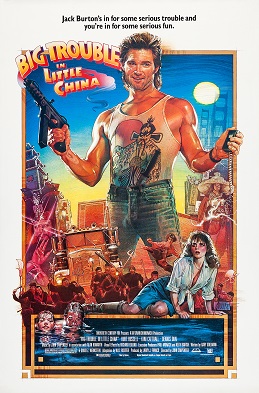 Jack Burton (Kurt Russell) is not a complicated person. He drives a truck for a living. He’s loyal to his friends. He likes a good beer and a pretty girl. He tries to do the right thing so when the fiancée of his best friend, Wang Chi (Dennis Dun), is kidnapped, he teams up with Wang to rescue her. And when Jack’s truck gets stolen after he runs over an evil, ancient Chinese sorcerer named Lo Pan (James Hong), Jack just wants to get his truck back. Instead, Jack finds himself in the middle of an ancient battle between good and evil as Lo Pan searches for a green-eyed woman to sacrifice so that he can defeat a curse that was put upon him centuries ago.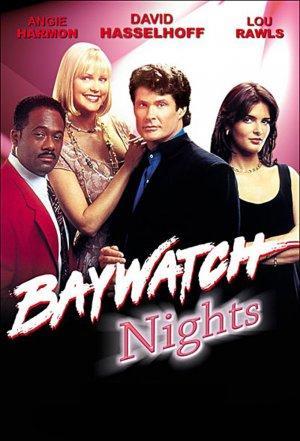
 Through the Shattered Lens