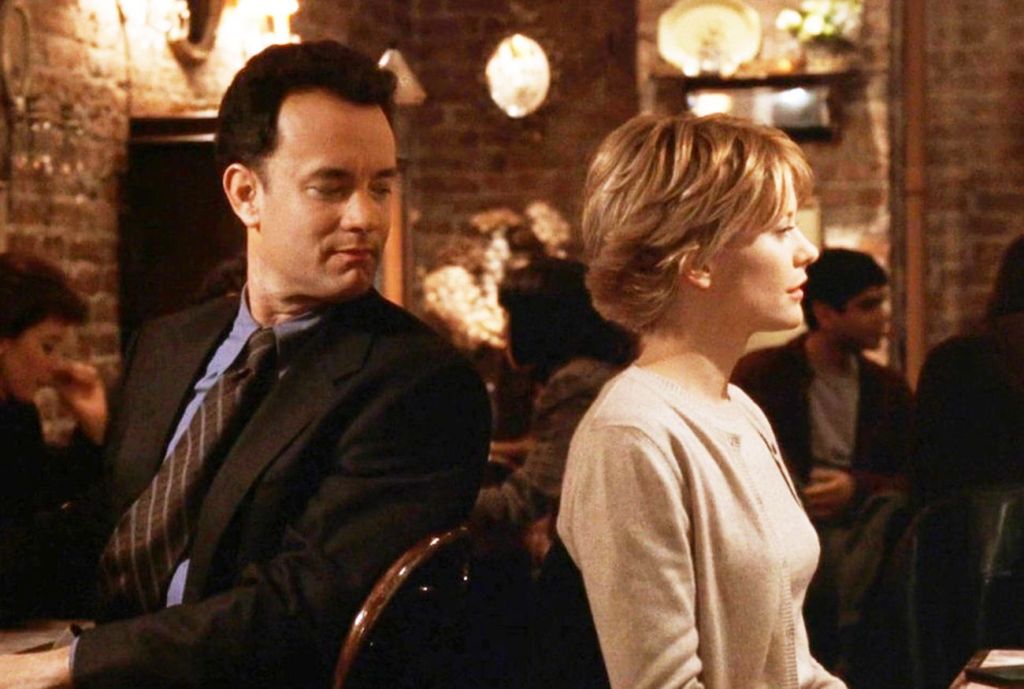
Kathleen Kelly (Meg Ryan) owns a children’s bookstore in New York City named “The Shop Around the Corner.” It’s a small, cozy store that she inherited from her dear mother, and it’s part of the lifeblood of who she is as a person, as well as the community itself. Joe Fox (Tom Hanks), on the other hand, is the heir to a major bookstore chain, Fox Books (think Barnes & Noble), that threatens to wipe places like Kathleen’s off the map. As fate would have it, the two meet anonymously online where they trade their hopes, dreams and insecurities through daily e-mails, with both excitedly opening their computers each night hoping to hear those three little words, “You’ve Got Mail.” Things begin to get interesting when Joe plans to open up a Fox Books Superstore just around the corner from Kathleen’s place with neither knowing that they’re real-life business adversaries. When will they find out that they’re enemies in the business world? Can true love find a way in the most difficult of circumstances? And isn’t that why we watch these kinds of movies in the first place?!
I’ll start off by saying that Meg Ryan is operating at the top of her “America’s sweetheart” phase here… she’s cute, sincere, nostalgic, slightly neurotic, and ultimately quite believable as a person who romanticizes her world and truly believes there will always be a place for her small store and the gigantic superstores! I grew up and still live in the state where Wal-Mart started so I definitely know how hard it is for the “mom and pop” stores to compete. Tom Hanks walks a bit more of a tightrope as Joe Fox. He’s likable enough that you want him to be able to win her heart, but he’s also just arrogant enough that you understand why Kathleen resents everything he stands for. Ultimately, Hanks is able to pull it off with enough charm that you still root for him even when he can be a little bit of a jerk at times.
What’s really strange about revisiting YOU’VE GOT MAIL at this point in my life is the fact that it takes me back to the late 90’s when the internet was something new to me and it seemed like something magical. In this movie, the internet connects two souls, and when we hear “you’ve got mail” as they fire up their computers, the movie expects you to feel genuine excitement, without a hint of irony. Compare that with where the world is today with almost any kind of online activity, especially social media. While there are still a lot of positives to be found, it’s sad that going online now is often exhausting, hateful, and stressful! In 1998, though, it was still possible to believe that logging on could lead to something incredible!
Nora Ephron, who directed the film and co-wrote the screenplay, does a good job of presenting a sad reality of the real world underneath this romantic comedy’s love story. “Progress” can be cruel, and it seems like it just can’t be stopped no matter what! I spend a lot of time talking about the wonderful hours I spent in the video stores of my youth. Those stores are all gone now and have been for decades. The stores that replaced them are mostly gone now, and almost all of my movie viewing is now done through online streaming. In YOU’VE GOT MAIL, Fox Books certainly isn’t better than Kathleen’s Shop Around the Corner. As a matter of fact, it’s not nearly as educational or personal. What it is, however, is bigger, cheaper, and more efficient, and that’s what seems to win in the end, just like it did with the local video stores and Wal-Mart. This is where Ephron does her strongest balancing act. Joe Fox and Kathleen Kelly still fall in love despite the fact that the realities of the world around them take their realistic and natural course. A true human connection is made in the most difficult and painful of circumstances, and that ultimately means more than anything else in the film.
Revisiting YOU’VE GOT MAIL now doesn’t feel that much different than revisiting the film that inspired it, 1940’s THE SHOP AROUND THE CORNER, starring Jimmy Stewart and Margaret Sullavan. Both films are time capsules of a world that no longer really exists. However, both films ultimately realize the time-tested truth that it’s our relationships with other people that provides the most meaning to our lives. That’s a truth that won’t change whether we’re writing letters, sending e-mails, exchanging texts or whatever “progress” the human race achieves in communication in the future! I find some comfort in that.
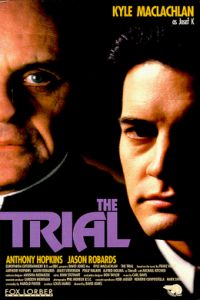 One morning, in turn of the century Prague, Josef K. (Kyle MacLachlan) wakes up to discover that two detectives are in his room. They tell him that he is under arrest but they do not tell him the charges. Josef remains free to go about his everyday life but he must report to the court whenever the court deems to see him. No matter where Josef turns or who he talks to, he cannot get any answers concerning what he has been charged with. Even his disinterested attorney (Jason Robards) can not give him a straight answer on why he is being prosecuted. No matter how much Josef protests that he is innocent of whatever has been accused of, his fate has already been decided.
 Through the Shattered Lens