Welcome to Retro Television Reviews, a feature where we review some of our favorite and least favorite shows of the past! On Tuesdays, I will be reviewing the original Fantasy Island, which ran on ABC from 1977 to 1984. Unfortunately, the show has been removed from most streaming sites. Fortunately, I’ve got nearly every episode on my DVR …. nearly being the word to remember.
This week, Sammy Davis Jr. comes to Fantasy Island.
That’s be cool, right?
Episode 6.19 “Edward/Extraordinary Miss Jones”
(Dir by Don Ingalls, originally aired on April 9th, 1983)
Or, it would have been cool if my DVR had actually recorded this episode!
Sorry, it’s the curse of the DVR. This is one of the episodes that my DVR did not record. I’m not sure if it’s a case of the episode not being aired or perhaps the cable itself was out when it should have been recording but, for whatever reason, I do not have this episode and I also don’t remember having watched it in the past.
For now, I can’t review it. But I’m going to leave this here as a placeholder, in case the show ever starts streaming again.
Again, I regret not being able to review this episode at this time. But, as Mr. Roarke always says, “Smiles, everyone, smiles!”
In TIGHTROPE, a psychiatrist makes the following comment to New Orleans police detective Wes Block (Clint Eastwood) while he’s trying to catch a serial killer who’s targeting sex workers:
“There’s a darkness inside all of us, Wes; you, me, and the man down the street. Some have it under control. Others act it out. The rest of us try to walk a tightrope between the two.”
This statement definitely hits home to Wes, whose personal life has gotten rather dark. His wife has recently left him and their two daughters (Alison Eastwood and Jenny Beck), and the detective seems to be drowning himself in his work, at times in a bottle, and at other times in the arms of some of the local ladies of the night. Whenever he does try to plan something with his girls, his job always seems to get in his way. As he investigates the murders in a variety of the seediest locations in New Orleans, we learn that Wes is very much into the kinds of women who inhabit these places, and he gives into his secret desires on multiple occasions. This becomes personal when the killer, who knows that Wes is the detective in charge of the case, begins targeting and killing some of the very same women who helped ease Wes’ emotional pain, and then taunts him about it. It becomes even more personal when the killer goes after his daughters and his new “legitimate” lady friend Beryl Thibodeaux (Geneviève Bujold), a rape counselor Block has gotten to know as part of the broader investigation. As the bodies continue to pile up, will Wes be able to stop the killer in time to save the most precious people in his life?!!
TIGHTROPE is a special movie to me. I’ve mentioned this before in other reviews, but FOX-16 out of Little Rock played a lot of good movies in the mid to late 80’s when I was a teenager. Some of those movies hold a strong nostalgic value in my life because I first discovered them and my true love of movies during those years. The channel advertised and showed TIGHTROPE, and many other Eastwood films, quite often. Of course, the movie broadcast on FOX-16 was heavily edited, and I didn’t realize the true sexual complexity of detective Wes Block until I was quite a bit older. In the original DIRTY HARRY, there’s a running gag where different people ask Eastwood’s iconic character, “Why do they call you Dirty Harry?” From what we see in TIGHTROPE, if someone asked, “Why do they call you Dirty Wes,” the answer would be more than obvious as he engages in various kinky forms of sexual relations with at least three of the sex workers he hits up for information. The killer knows of his sexual activities with these women, even watching on occasion. The movie leans hard into this connection between Wes’ kinky sex that often involves handcuffs, and the kinship that the killer feels with Wes when he’s perpetrating violence on these same women. It adds an uneasy and unsettling quality to the proceedings when the killer publicly taunts his rival, who understandably doesn’t want his peers to know of his more private nocturnal activities. He can’t fool his new lady friend, the tough as nails Beryl Thibodeaux, who senses his hidden desires and accepts him for who he is, especially after spending some quality time with him and his daughters. I like Genevieve Bujold in the role and the French-Canadian actress is able to even nail the local accent on a couple of occasions. I also wanted to mention the excellent chemistry between Clint Eastwood and his real-life daughter Alison, who play father and daughter in the movie as well. Alison was only 12 years old when TIGHTROPE was released, but she gives a strong performance as the older daughter who’s still trying to come to terms with her parents’ divorce. The killer really messes up when he targets her.
I’ll tell anyone who’s willing to listen that I love the city of New Orleans as a movie location. I personally love to visit the city and partake in its fun atmosphere and wide variety of excellent cuisine. TIGHTROPE hits many of the highlights of New Orleans in 1984… Bourbon Street, Jackson Square, the Super Dome, the Creole Queen, a warehouse full of Mardi Gras floats, the famous cemeteries, Randi Brooks in a hot tub, etc. etc. One thing about New Orleans is that its famous streets like Bourbon Street have not been cleaned up or become “family friendly” in the same way as a place like Times Square in New York City. To this day, it retains that same feeling of sexual decadence that is portrayed here in 1984.
I personally consider TIGHTROPE to be a must-see film for fans of Clint Eastwood, as Wes Block is a wholly unique addition to his cavalcade of tough cop characters, and he makes us justifiably uncomfortable at times. Eastwood’s conflicted performance, the serial killer storyline and the fun New Orleans locations add up to a very good movie that’s aimed squarely at adults.
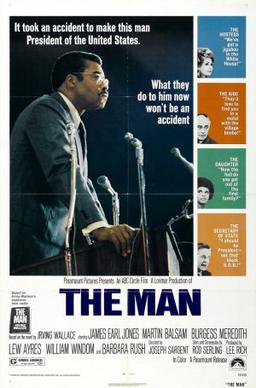
In 1972’s The Man, James Earl Jones stares as Douglass Dilman.
Dilman is a black college professor and a U.S. Senator. To his friends, he’s a symbol of progress. To his enemies, he’s a sell-out who is viewed as being improperly radical. The U.S. Senate, eager to prove that it’s not a racist institution, has elected Dilman as the President Pro Tempore. He is now fourth in line for the presidency but that doesn’t concern racist senators like Senator Watson (Burgess Meredith). A lot would have to happen before Dilman would ever become President.
Needless to say, a lot does happen.
The President and the third-in-line Speaker of the House are attending a conference at a historic building in Frankfort when the roof collapses on them. We don’t actually see this happen. We just hear the people in the White House talk about how it’s happened. We also don’t really learn many details about why the roof collapsed. Someone nonchalantly says, “It’s an old building.” Myself, I spent the entire movie waiting for some sort of big revelation of a conspiracy behind the roof collapse but it didn’t happen. Apparently, in 1972, the Secret Service just let the President go anywhere without checking the place out first. That said, it’s not a good thing when a serious movie opens with a dramatic plot development that, at the very least, draws a chuckle from the audience. Seriously, we lost our President because a roof fell on him? How is America ever going to live that down>
Vice President Noah Calvin (Lew Ayres) is wheeled into the White House cabinet room. This was not the first time that a Ayres played a Vice President called upon to succeed the President. Unlike in Advice and Consent, the Vice President announced that he cannot accept the honor of being sworn in because he’s too sick. (Since when does the Vice President have the option to refuse to do his Constitutional duty?) With Calvin putting the country ahead of his own ambition, Senator Watson announces that Secretary of State Eaton (William Windom) will be the new President. No, Eaton says, Dilman will be the new president. But once Dilman screws up and is either impeached or resigns, fifth-in-line Eaton will be sworn in.
Except …. it wouldn’t work that way. Excuse me while I put my history/political nerd hat on….
First off, Calvin is apparently still Vice President so if Dilman did step down, Calvin would once again be the successor. What if Calvin refused a second time? As soon as the Speaker of the House died, the House of Representatives would elect a new Speaker and that person would be third-in-line. And, as soon as Dilman became President, the Senate would elect a new President Pro Tempore and that person would be fourth-in-line. In other words, Eaton is no closer to being President than he was before.
My reason for going into all of this is to illustrate that The Man is a film about American politics that doesn’t really seem to know much about American politics. That said, it does feature the great James Earl Jones as Douglass Dilman and Jones gives such a good and thoughtful performance that it almost doesn’t matter that no one else in the film seems to be taking it all that seriously. Jones plays Dilman as being a careful and cautious man, one who understands that he occupies a huge place in history (Barack Obama was only 11 years old when this film came out) but whose main concern is just doing a good job as President. Dilman finds himself in the middle. On one side, he has advisors warning him not to scare America by being too radical. On the other side, his activist daughter (Janet MacLachlan) brands Dilman a sell-out. When a black student named Robert Wheeler (Georg Stanford Brown) is arrested for assassinating a South African government official, Dilman’s first instinct is to believe Wheeler’s been framed but, as the film progresses, doubts start to develop and Dilman must decide whether or not to risk an international incident. It’s an interesting story, well-played by James Earl Jones and Georg Stanford Brown.
It was originally mean to be a made-for-TV movie but, in order to capitalize on the excitement on the 1972 presidential election, it was released into theaters. As a result, the film often has the cheap look of a made-for-TV movie and quite a few members of the cast give performances that feel more appropriate for television than the big screen, (Some members of the cast, like Burgess Meredith, just overact with ferocious abandon.) In the end, The Man is mostly of interest from a historical point of view. (In 1972, the idea of a black man being elected President seemed so unrealistic that the movie actually had to drop the roof on 50% of the government just to get Dilman into the Oval Office.) James Earl Jones, who would have turned 94 today, is the main reason to watch.
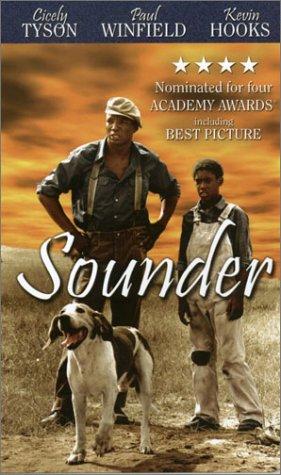
The 1972 film Sounder follows the Morgans, a family of black sharecroppers living in 1930s Louisiana.
When we first see Nathan Lee Morgan (Paul Winfield) and his young son, David Lee (Kevin Hooks), they’re hunting. Accompanying them is their loyal dog, Sounder. As they hunt, two things become very obvious. Number one, David Lee is a good father who is doing his best to provide for his family under the most difficult circumstances possible. Number two, the family is desperately poor. When Nathan finally gives in to temptation and steals a ham to feed his family, the local Sheriff (James Best) shows up at the farmhouse the next day and arrests him. Nathan is taken away to prison and one of the deputies even shoots Sounder.
Fortunately, Sounder survives and so do the Morgans. Under the stern but loving leadership of their mother, Rebecca (Cicely Tyson), the Morgan children manage to bring in the season’s crops. Unfortunately, having to work out in the fields doesn’t leave much time for David Lee to get an education. When he does go to school, he and the other students listen as a middle-aged, white teacher reads to them from Huckleberry FInn.
After the wounded Sounder finally returns to the Morgan family and recovers from his wounds, David Lee decides that he wants to go to the prison and see his father. Unfortunately, the sheriff refuses to even tell the family where Nathan has been incarcerated. None of the white authority figures in town care that the Morgans are struggling or that they’ve managed to bring in the crops themselves. None of them cares or seems to even understand that David Lee is missing his father. The sheriff presents himself as being a reasonable man and is never heard to the use the n-word. Instead, he and every other white person in town refers to David Lee as being “boy,” diminishing everything that he’s done since his father was arrested.
David Lee finally figures out the location of a prison that might (or might not) currently be housing his father. It’s several miles away. Accompanied by Sounder, David Lee sets out to make the long journey to the prison. Along the way, he discovers another school and a far more empathetic teacher named Camille (Janet MacLachlan). David Lee is forced to make a decision that will effect not only his future but also the future of his family.
Sounder is a heartfelt film. It’s a film that’s less interested in telling a story with a traditional beginning and end as opposed to just sharing scenes of everyday life. In this case, it’s the life of family that manages to survive despite it often seeming as if the entire world is arrayed against them. The film was based on a book that pretty much centered around the dog. The movie, on the other hand, is more about the family and, despite the fact that the film is still named after him, the dog is pretty much superfluous to the plot. That said, Sounder still plays an important role because, just as Sounder survives being shot at and remains loyal to the people that he loves, the Morgans survive whatever adversity is tossed at them. Watching the film, the viewer is very much aware that life is never going to be easy for the Morgans but, at the same time, it’s impossible not take some comfort in the fact that they have each other. Paul Winfield and Cicely Tyson both give strong performances as the resilient Nathan Lee and Rebecca and the entire film is the type of movie that’ll inspire tears even as it inspires happiness.
At the Oscars, Sounder was nominated for Best Picture, where it provided a gentle contrast to the other nominees, Cabaret, Deliverance, The Emigrants, and The Godfather. Paul Winfield and Cicely Tyson were nominated for Best Actor and Best Actress, making 1972 the first year in which black performers were nominated in both of the lead categories. (It was also the first year in which more than one black actress was nominated for Best Actress as Tyson ended up competing with Lady Sings The Blues‘s Diana Ross.) In the end, Tyson lost to Cabaret‘s Liza Minnelli while Winfield lost to The Godfather‘s Marlon Brando. And, of course, The Godfather also went on to deservedly win the award for Best Picture.
Normally, having a law named after you would be pretty cool but it appears that this is just a law that Jack came up with himself. Having to come up with your own law is kind of like having to come up with your own nickname. Dude, it’s just lame. Since Jack Murphy is played Charles Bronson, we can cut him some slack.
Murphy’s Law was one of the many film that, towards the end of his career, Bronson made for Cannon Films. He played a detective in almost all of them. Jack Murphy is Dirty Harry without the fashion sense. He is also an alcoholic who cannot get over his ex-wife (Angel Tompkins) and her decision to become a stripper. Not only has Murphy managed to piss off his superiors with his bad attitude but the mob is out to get him. Everyone has forgotten Murphy’s Law. Everyone is fucking with Jack Murphy.
Jack’s main problem, though, is Joan Freeman (Carrie Snodgress). Years ago, Murphy sent Joan to prison for murder but, because it’s California and Jerry Brown appointed all of the judges, Joan gets out after just a few years. Joan starts to systematically murder everyone that Murphy knows, framing Murphy for the murders. Murphy’s arrested by his fellow cops, all of whom need a refresher on Murphy’s Law. Though handcuffed to a young thief (Kathleen Wilhoite), Murphy escapes from jail and set off to remind everyone why you don’t fuck with Jack Murphy.
Murphy’s Law is a typical Cannon Bronson film: low-budget, ludicrously violent, borderline incoherent, so reactionary than it makes the Dirty Harry films look liberal, and, if you’re a fan of Charles Bronson, wildly entertaining. Bronson was 65 years old when he played Jack Murphy so he cannot be blamed for letting his stunt double do most of the work in this movie. What’s interesting is that, for once, Bronson is not the one doing most of the killing. Instead, it is Carrie Snodgress, in the role of Joan Freeman, who gets to murder nearly the entire cast. There is nothing subtle about Snodgress’s demonic performance, which makes it perfect for a Cannon-era Bronson film. In fact, Carrie Snodgress gives one of the best villainous performances in the entire Bronson filmography. There is never any doubt that Snodgress is capable of killing even the mighty Charles Bronson, which makes Murphy’s Law a little more suspenseful than most of the movies that Bronson made in the 80s.
Whatever else can be said about Murphy’s Law, it does feature one of Bronson’s best one liners. When Joan threatens to send him to Hell, Murphy replies, without missing a beat, “Ladies first.” Only Bronson could make a line like that sound cool. That’s Bronson’s Law.
Governors, ranchers, former congressmen — nearly every prominent Democrat in Montana announced that he didn’t want the nomination. It looked like all hope was lost but then a petition appeared online, asking the Democrats to nominate Jeff Bridges for the U.S. Senate! This petition made national headlines and, in just a few hours, it had received thousands of signatures. For a few brief days, everyone was truly excited about the prospect of U.S. Sen. Jeff Bridges. I even signed the petition myself, despite the fact that 1) I don’t live in Montana and 2) I’m not even a Democrat!
(I’m a member of the Personal Choice Party. PCP in 2016!)
Ultimately, he announced that he had no interesting running and wasn’t even sure if he was registered to vote but, until that happened, why were so many of us excited about Jeff Bridges running for the Senate?
Because, in this time of division and conflict, everybody loves Jeff Bridges!
He’s just an incredibly likable actor. Even when he’s playing a villain, like in Iron Man, he still comes across like someone you would want to live next door to. He’s everyone’s perfect hippie uncle, the guy that even people who don’t smoke weed want to get stoned with. If you ever watch any of his early films — and Bridges has been making movies for nearly 50 years now — you’ll discover that this unique and likable charm is something that Jeff Bridges has always possessed.
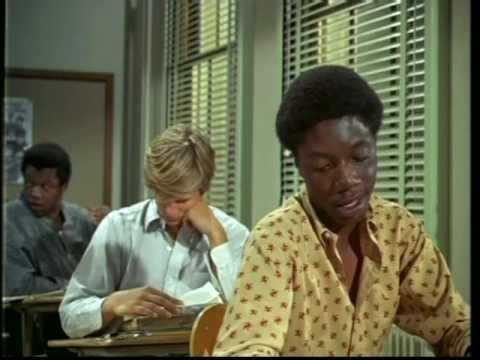
It’s certainly present in 1970’s Halls of Anger. This was Jeff Bridges’s film debut, made at a time when he could still pass for a high school student. He was 20 when he made this film and I have to say that for those of us who best know him as the Dude, Rooster Cogburn, and whoever he was playing in Crazy Heart, it’s always interesting to see just how handsome Jeff Bridges was when he was young.
Jeff Bridges, hiding his face in Halls of Anger
In Halls of Anger, he plays Doug, one of 60 white kids who have been transferred to a majority black inner city high school in an attempt to integrate it. Of all the new white students, Doug is probably the most confident and the most open-minded. He’s also the most friendly. His attempt to join the high school basketball team upsets the other students but — even after getting beaten up — Doug sticks with it. You knew that he would because, after all, he’s played by Jeff Bridges.
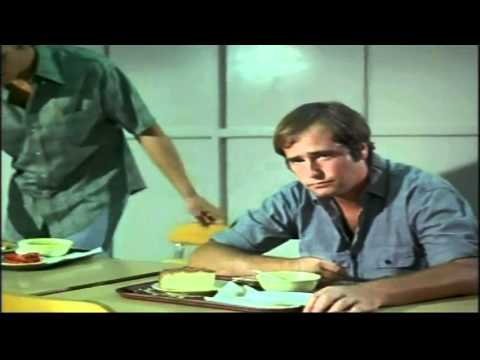
Of course, Doug’s story is just one of the many stories told in Halls of Anger. Another one of the transfers — a weak-willed and balding racist named Leaky (played by future director Rob Reiner!) — tries to provoke a fight with a black student, hoping that he’ll be sent back to his old school for his own protection. White Sherry (Patricia Stich) dates a black classmate and is savagely assaulted as a result. Newly assigned vice principal Quincy Davis (Calvin Lockhart) tries to both keep the peace and teach a group of functionally illiterate students how to read. Militant J.T. Walsh (James Edwards) wanders the hallways and speaks of revolution…
Rob Reiner in Halls of Anger
Actually, I’m probably making Halls of Anger sound a lot more interesting than it actually is. For the most part, it’s pretty much your standard 1970 social problem film, in that it’s full of good intentions but those good intentions don’t always add up to compelling drama. Paul Bogart’s direction is often flat (the scene where Davis teaches his students how to read seems to drag on for hours) and the characters don’t so much talk to each other as they make narratively convenient speeches.
That said, Halls of Anger is worth watching just to see Calvin Lockhart’s authoritative performance, Rob Reiner’s hilariously bad performance, and Jeff Bridges’s charismatic debut performance. He may never be a member of the U.S. Senate but everybody will always love Jeff Bridges.


 What is Murphy’s Law?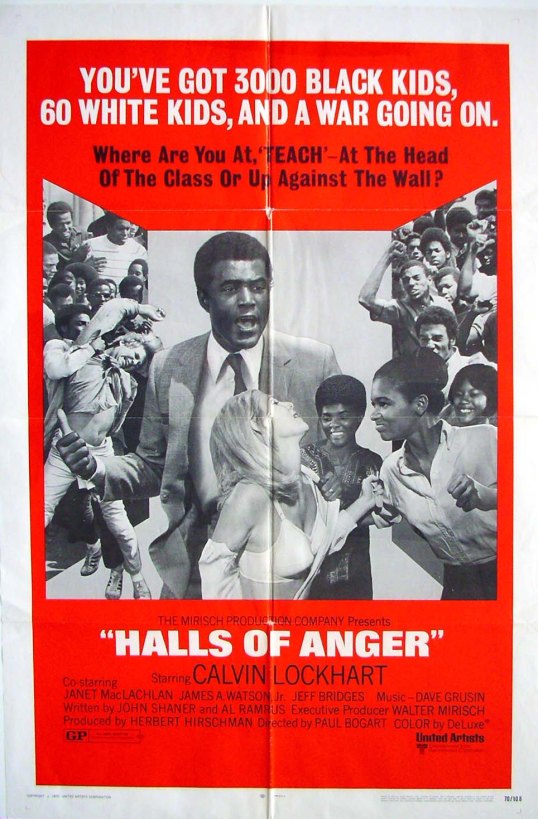
 Through the Shattered Lens