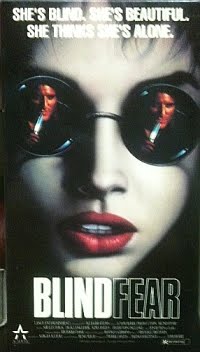
Wait Until Dark With Shelley Hack: Blind Fear (1989, directed by Tom Berry)


Three criminals, two men and a woman, go from robbing an armored car to invading a seemingly deserted New England inn.  Led by psycho Ed (Kim Coates, of course), they kill the elderly caretaker (Jan Rubes) and then settle in to wait for the arrival of their contact.  However, when a pizza is delivered, they notice that only half of the pizza has anchovies.  “Not everyone likes anchovies!”  Ed declares.  That means that the pizza was ordered for two and there’s someone else in the Inn!

That other person is Erica (Shelley Hack), who was the inn’s switchboard operator.  She’s now hiding in the inn, desperately trying to figure out how to avoid getting captured by Ed and the gang.  Complicating things for Erica is that she’s blind.  Complicating things for the criminals is that they’re no match for her other heightened senses.  While the gang searched the inn, Erica kills the lights and sets some traps of her own.

The VHS box art for Blind Fear (which I don’t think has ever been released on DVD), says, “She thinks she’s alone,” which is actually the exact opposite of the film’s plot.  (it also features Erica wearing tinted glasses, something that she doesn’t do in the actual film.) Erica never thinks that she’s alone and spend almost the entire film in hiding because she knows that she’s not alone.  Ed and the criminals briefly think that they’re alone but then the pizza arrives and the anchovies give everything away.  I guess “She thinks she’s alone” sounded better than “Shelley Hack spends 90 minutes in the dark.”

Imagine a remake of Wait Until Dark starring the least interesting star of Charlie’s Angels and you have a pretty good idea of what this efficient but forgettable Canadian thriller is like.  As an actress, Shelley Hack never had much screen presence but she’s not really bad in this movie, in which she spends most of the runtime crawling around in the dark while never getting a single blonde curl out of place.  Not surprisingly, the best performance in the film comes from Kim Coates, who has been playing psychos and lowlifes for almost longer than I’ve been alive.  Nobody does it better than Kim Coates!

Cold Terror: Dead of Winter (1987, directed by Arthur Penn)


Katie (Mary Steenburgen) is a struggling actress with an out-of-work husband (William Russ) and a deadbeat brother (Mark Malone).  Desperately in need of money, Kate goes to an open audition and is immediately hired by Mr. Murray (Roddy McDowall), who explains that Katie will have to meet with one of the film’s investors, the wheelchair-bound Dr. Lewis (Jan Rubes).  In the middle of a raging snowstorm, they go to Dr. Lewis’s home and, once they’ve arrived, Katie discovers that she is meant to replace an actress who looked exactly like her but who Dr. Lewis claims had a nervous breakdown.  She’s told that she must stay the night so she can meet the director in the morning and when she tries to call her husband to let him know where she is, the line is dead.  (For those born after 1996, the line being dead was the 80s equivalent of not being able to get a signal.)  Dr. Lewis says it must be due to the storm but he promises to have Mr. Murray take her into town in the morning.  Of course, the next morning, the car doesn’t start and it becomes clear that Dr. Lewis is not planning on ever letting Katie leave his home.

Dead of Winter is a throw-back to the type of gothic, damsel-in-distress films that actresses like Nina Foch, Ingrid Bergman, and Linda Darnell used to make back in the 1940s and 50s.  If you can accept that anyone could ever be as naive as Katie, it’s not that bad of a thriller.  Director Arthur Penn fills his movie with homages to Hitchcock and the scene where a drugged Katie wakes up to discover that she’s missing a finger is an effectively nasty shock.  By the end of the movie, Mary Steenburgen has played three different characters and she does a good job as all three of them.  Jan Rubes makes Dr. Lewis’s too obviously evil but Roddy McDowall is great as the polite but psychotic Mr. Murray.  When Mr. Murray sees that Katie has tried to escape by climbing out a window, he yells, “Oh dear!” and only Roddy McDowall could have pulled that off.

Dead of Winter was Arthur Penn’s second-to-last theatrical film.  After making films like Bonnie and Clyde, Little Big Man, and Alice’s Restaurant, Penn’s career went into decline as the American film industry became increasingly centered around blockbusters and Penn’s cerebral approach fell out of favor.  After Dead of Winter, Penn would direct Penn & Teller Get Killed before returning to his roots as a television director.  Penn ended his long and distinguished career as an executive producer on Law & Order.

Embracing the Melodrama Part II #75: Witness (dir by Peter Weir)


Witness_movieLast night, I was lucky enough to watch Witness, a best picture nominee from 1985.

Taking place in Pennsylvania, Witness tells the story of what happens when an Amish widow named Rachel (Kelly McGillis) and her 8 year-old son Samuel (Lukas Haas) decide to take a trip to visit Rachel’s sister.  Traveling on an Amtrak train, Samuel is amazed by his first view of the world outside of the close-knit and insular Amish society.  However, Samuel’s excitement soon turns to horror when they arrive in Philadelphia and he witnesses a man being brutally murdered.

Detective John Book (Harrison Ford, who received his first and, to date, only Oscar nomination for this film) is assigned to the case and arranges for Rachel and Samuel to stay with his sister.  John soon discovers that the murder was committed by two crooked cops, McFee (Danny Glover, who is pure evil in this film) and Ferguson (Angus MacInnes).  John goes to his superior officer, Chief Schaefer (Josef Sommer) with his evidence.  Soon after, McFee attempts to kill and seriously wounds John.  John realizes that Schaefer must be corrupt as well.

Book manages to drive Rachel and Samuel back to their farm in Lancaster County but, after dropping them off, he passes out from blood loss.  Knowing that sending John to the hospital would reveal Rachel and Samuel’s location to Schaefer, Rachel’s father (Jan Rubes) reluctantly allows John to stay at the farm.

And so, while McFee, Ferguson, and Schaefer search for him, John temporarily pretends to be Amish.  He works in the fields.  He helps to build a barn.  He becomes something of a surrogate father to Samuel and he begins a forbidden flirtation with Rachel.

He also goes to town, where he watches as an idiotic local bullies the Amish, knowing that their religion forbids them from fighting back.  John responds by punching a bully, upsetting both the Amish and the a local store owner who yells that this will be terrible for the tourism.  In many ways, the scene is played for laughs and applause but there’s a very serious subtext here, as it would appear that the area’s main appeal to tourists is that you can humiliate the Amish without having to worry about any sort of retaliation.

While we, as viewers, definitely get some satisfaction from seeing John punch that jackass, it also allows Schaefer to discover where he and Rachel are hiding.  One morning, McFee, Ferguson, and Schaefer pull up outside the farm.  They get out of their car and, as the sun rises and with beautiful green fields on either side of them, the three men hold up their shotguns and start to walk down the road….

Witness may technically be a cop film but it’s actually so much more.  It’s a character study of a deeply cynical man who finds himself changed by simple and innocent surroundings.  It’s a love story, with Ford and McGillis illuminating the screen with their chemistry.  It’s a celebration of community, with the harshness of Philadelphia being contrasted with life among the Amish.  It’s a film full of beautiful images and it also features an excellent performance from Harrison Ford.

It’s a good film.  I’m glad that I witnessed Witness.