Lisa Marie Reviews The Oscar Nominees: Battleground (dir by William Wellman)


I love February.

Why?  Well, first off, we all know that February is the most romantic month of the year.  February is Valentine’s Day, romantic movies, flowers, lingerie, and chocolate.  February is also the month when, in a lead up to the Oscars, TCM devotes a good deal of its programming to showing Oscar nominees of the past.

As I’ve mentioned in the past, one of my dreams is to watch and review every single film that has ever been nominated for best picture. Now, realistically, I’ll never be able to accomplish this goal because the 1929 Best Picture nominee The Patriot is currently a lost film.  But, even if it does mean that I’ll only be able to see 510 out of the 511 nominated films, it’s still a dream that I’m pursuing and, with the help of TCM and the month of February, it’s a dream that’ll come true.

Take, for instance, Battleground.  This 1949 Best Picture nominee (it lost All The King’s Men) recently aired on TCM.  I’m not exactly a fan of war films but, since it was a best picture nominee, I still made sure to DVR and watch it.

Set during the final days of World War II, Battleground follows one platoon of soldiers as they fight and attempt to survive the Battle of the Bulge.  The platoon is made up of the type of characters that we usually expect to find in a WWII film but, fortunately, they’re played by an ensemble of likable actors who all bring their familiar characters to life.  There’s Jim Layton (Marshall Thompson), the newest member of the platoon who nobody wants to run the risk of getting close to.  There’s Holley (Van Johnson), the cheerful soldier who is unexpectedly thrust into a position of leadership that he might not be right for.  Roderiques (Ricardo Montalban) is from Los Angeles and is amazed by the sight of snow.  “Pops” Stazak (George Murphy) is the type of older soldier who you would totally expect to be nicknamed “Pops.”  Bettis (Richard Jaeckel) is scared of combat.  Kippton (Douglas Fowley) spends nearly the entire film looking for his lost teeth.  And finally, of course, there’s the hard-boiled but warm-hearted Sgt. Kinnie (James Whitmore).

In some ways, Battleground is a very conventional film and it’s easy to wonder how it ended up getting nominated for best film of the year.  (Among the eligible films that were not nominated: The Bicycle Thief, Champion, The Fountainhead,  On The Town, Sands of Iwo Jima, She Wore A Yellow Ribbon, They Live By Night, and White Heat.)  However, the film’s nomination makes a bit more sense when you consider that it was released just four years after the end of World War II.  It was a film that appealed both to the veterans who were able to relate to the film’s story and to the patriotic spirit of a country that had just defeated the greatest evil of the 20th Century.

Battleground did not exactly make me a fan of war movies but it’s still a well-made and effective film. As opposed to a lot of other war films, Battleground never makes war look like fun.  For the most part, the emphasis is less on strategy and combat and more on the soldiers who are simply trying to survive from day-to-day.  The end result is a film that serves as a moving tribute to the soldiers who fought in World War II.

A Quickie With Lisa Marie: The Harrad Experiment (dir by Ted Post)


Earlier this week, when I reviewed the obscure Sissy Spacek film Katherine, I mentioned that I had seen Katherine as one of the three films included on the Classic Films of the 70s DVD.  The other two films included on the DVD were Born to Win and The Harrad Experiment.  Now, I have to admit that I’m having trouble recalling much about Born To Win but The Harrad Experiment … seriously, that’s a film that I’ll never forget.

First released in 1973 and reportedly based on a “daring” book about the sexual revolution, The Harrad Experiment opens with Sheila (Laurie Walters) hugging a tree and it’s all downhill from there.

Sheila Hugging A TreeSheila is excited because she’s just enrolled at Harrad College, an experimental school that’s run by Prof. Stuffy Q. Borington (James Whitmore) and his wife, Cougar Milf (Tippi Hedren).  Okay, I made up those two names.  Prof. Borington is actually named Philip Harrad and his wife is named Margaret but seriously, I like my names for them better.  Anyway, Philip and Margaret are obsessed with the need for society to throw off the shackles of sexual repression and Harrad College’s entire curriculum is devoted to students debating monogamy, taking yoga classes, and standing in a circle while holding hands and chanting, “Zoom.”  Everyone has a roommate of the opposite sex and they’re encouraged to have sex with every other student enrolled at the college.  (Interestingly enough, all of the students at the college appear to be heterosexual.)

Sheila, it turns out, is not only a virgin but is also so extremely prudish that you have to kind of wonder why she enrolled at Harrad College to begin with.  Her roommate Stanley (Don Johnson, who was so criminally hot here that it’s hard to believe that he would eventually end up playing the loathsome Big Danny Bennett in Django Unchained) has the opposite problem.  Stanley’s a long-haired rebel type and both Philip and Margaret are worried that he’s mostly attending their sex school because he just wants to get laid as opposed to getting laid and then discussing the social ramifications of getting laid.

Now, you’re probably thinking that The Harrad Experiment, being a film about sex, would feature a lot of sex.  Well, you would be wrong.  Instead, there’s a lot of scenes of Philip smoking a pipe and talking about sex and explaining why the concept of marriage is a dying one.  At one point, a students asks Philip to explain why, if he believes that, he’s still married to Margaret.

“We represent the past,” Philip explains, which is seriously such a cop-out.

(While I agreed with a lot of what Philip had to say about the prudish ways of our hypocritical society and I’m certainly not a believer in traditional marriage, I still found myself wondering what one would actually do with a degree from Harrad College.  This led to me imagining that annoying Everest College pitchman doing commercials for Harrad College — “You’re spendin’ all day on the couch, you ain’t getting none…” — and I started giggling for so long that I temporarily forgot that I was watching a movie.)

While there isn’t much sex, there is a lot of nudity and almost the entire cast (except for Whitmore, Hedren, and Fred Willard — yes, Fred Willard is in this movie) appears naked at some point.  That’s pretty good when it’s someone like Don Johnson but, unfortunately, the majority of the cast is made up of people like this guy:

Harrad Nudity

The Harrad Experiment is a slow, boring, and bad film but it’s one that everyone should see at least once, if just so they can say that they’ve seen it.  If nothing else, it’s a time capsule of the late 60s and the early 70s and we all know the only saying about those who forget the past.

Zoom indeed!

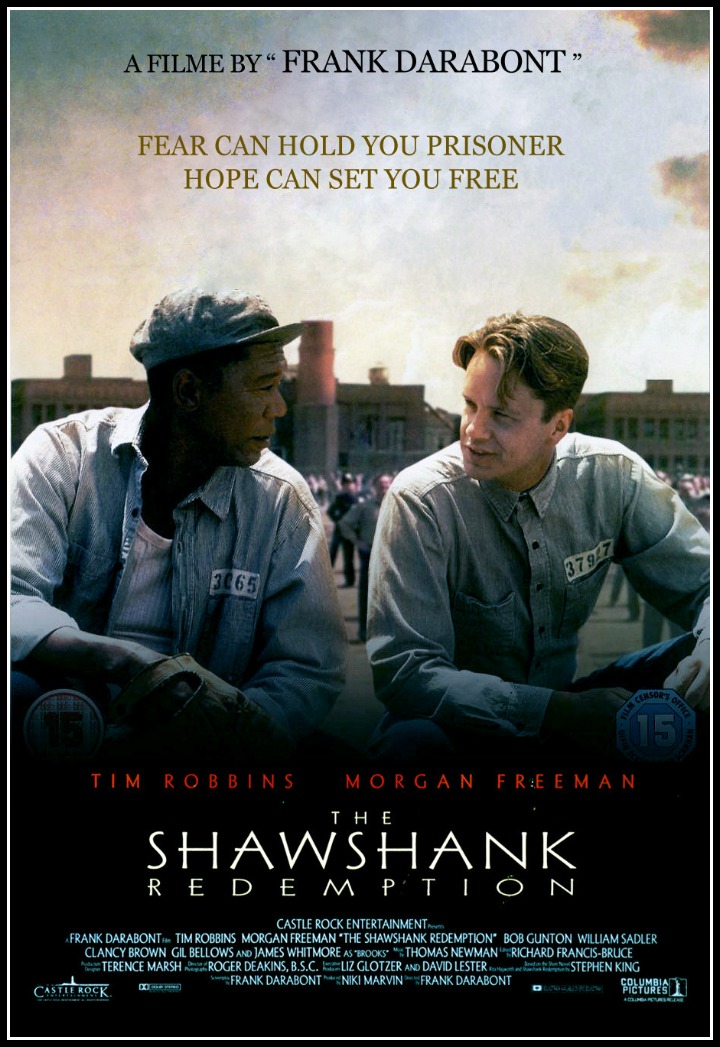
Review: The Shawshank Redemption (dir. by Frank Darabont)


“Remember, Red. Hope is a good thing, maybe the best of things, and no good thing ever dies.” — Andy Dufresne

1994 was the year that men finally got their version of Fried Green Tomatoes and Beaches. We men we’re always perplexed why so many women liked those two films. Even when it was explained to us that the film was about the bond of sisterhood between female friends and how the march of time could never break it we were still scratching out heads. In comes Frank Darabont’s film adaptation of the Stephen King novella Rita Hayworth and Shawshank Redemption.

Using a script written by Darabont himself, the film just takes the latter half of the novella’s title and focuses most of the film’s story on the relationship between the lead character of Andy Dufresne (played by Tim Robbins) who gets sent to Shawshank Penitentiary for the crime of killing his wife and her lover and that of another inmate played by Morgan Freeman. The film doesn’t try to prove that Andy is innocent even though we hear him tell it to the convicts he ends up hanging around that he is. The relationship between Andy and Red becomes a great example of the very same bond of sisterhood, but this time a brotherhood who are stuck in a situation where their freedom has been taken away and hope itself becomes a rare and dangerous commodity.

Darabont has always been a filmmaker known for his love of Stephen King stories and has adapted several more since The Shawshank Redemption, but it would be this film which has become his signature work. It’s a film that’s almost elegiac in its pacing yet with hints of hope threaded in-between scenes of men clinging to sanity and normalcy in a place that looks to break them down and make them less human. It’s nothing new to see prison guards abusive towards inmates in films set in prisons, but in this film these scenes of abuse have a banality to them that shows how even the hardened criminal lives and breathes upon the mercy and generosity provided by the very people who were suppose to rehabilitate them.

While the film’s pacing could be called slow by some it does allow for the characters in the film, from the leads played by Robbins and Freeman to the large supporting cast to become fully formed characters. It doesn’t matter whether it’s Clancy Brown playing the sadistic Capt. Byron Hadley to James Whitmore as Brooks Hatlen the inmate who has spent most of his life in Shawshank and whose sudden parole begins one of the most heartbreaking sequences in the film. The whole cast did a great job in whatever role they had been chosen to play. Freeman and Robbins as Red and Andy have a chemistry together on-screen that makes their fraternal love for each other very believable that the final scenes in the film doesn’t feel too melodramatic or overly sentimental.

The Shawshank Redemption was a film that lost out to Forrest Gump for Best Picture, but was a film that would’ve been very deserving if it had won the top prize at the Academy Awards. It was a film that spoke of hope even at the most degrading setting and how it’s the very concept of hope and brotherhood that allows for those not free to have a sense of freedom and camaraderie. Darabont’s first feature-length film remains his best work to date and one of the best Stephen King adaptations which is a rarity considering how many of his stories have been adapted. So, while the fairer sex may have their Fried Green Tomatoes, Beaches and the like, we men will have ours in the fine film we call The Shawshank Redemption.