Horror On The Lens: Beginning of the End (dir by Bert I. Gordon)


Giant locusts are attacking Chicago!

That’s the plot of this 1957 film from director Bert I. Gordon.  Chicago-haters will love this film, especially the scene where General Morris Ankrum announces that he has no  choice but to nuke the entire city.  If you don’t hate Chicago, you can still enjoy watching Peter Graves somehow retaining his dignity while dealing with the threat of giant locusts.

For the record, I’m enough of a country girl that I fully understand just destructive locusts can be.  That said, when it comes to their appearance, they’re not the most intimidating creatures out there.  The worst that can be said about them is that they look like really ugly grasshoppers.  A giant grasshopper still looks like a giant grasshopper.  And, needless to say, locusts do not attack humans.

(I’m also enough of a Southern girl that I can remember collecting the locust exo-skeletons that would always show up in the fall and winter.)

Here is the ludicrous and entertaining Beginning of the End!


Horror on TV: One Step Beyond 2.7 “The Open Window” (dir by John Newland)


If tonight’s episode of One Step Beyond seems familiar, that’s because it’s a remake of a story that was originally filmed as an episode of The Veil. 

This time, instead of witnessing a murder occurring in another apartment, it’s a suicide that is witnessed by artist Anthony March (Michael Higgins).  Of course, when he investigates, he discovers that the apartment in empty.  Is Anthony hallucinating or has he gone one step beyond and is he seeing the future?  Watch to find out!

By the way, that’s future Oscar winner Louise Fletcher playing Anthony’s model.

This originally aired on November 3rd, 1959.

Enjoy!

Horror Film Review: Beginning of the End (dir by Bert I. Gordon)


The 1957 film, Beginning of the End, is perhaps the ultimate horror film for people who dislike Illinois.

Because it’s a Bert I. Gordon film and Gordon took his “Mr. Big” nickname seriously, it deals with giant monsters.  In this case, the monsters are a bunch of locust who ate all of this radioactive grain that was being stored in a silo.  The locusts grew to giant size and then they went on a rampage.

Fortunately, the rampage appears to be localized to Illinois.  Apparently, the locusts have enough respect for state boundaries that they know better than to hop into Indiana, Missouri, or Wisconsin.  Instead, the locusts take out the farming community of Ludlow and then start making their way to Chicago, perhaps hoping to battle the Chicago Outfit for control of the city’s politics.  Do they seriously think Mayor Daley is just going to sit back while a bunch of locusts overrun his city?

The government wants to cover up the locust rampage because they don’t want to risk a mass panic in the 47 states that they actually care about.  (This film came out before Alaska and Hawaii joined the Union.)  However, when enterprising reporter Audrey Aimes (Peggie Castle) comes across the remains of Ludlow and discovers that the U.S. military has taken over the area, she is determined to discover what happened.  She hooks up with Dr. Ed Wainwright (Peter Graves), whose work in making food bigger led to the giant locust attacks in the first place.  In most movies, Ed would shoulder most of the blame for the locust attack but Beginning of the End seems to understand that these things happen when you’re dousing food with radiation and then keeping the food in a poorly secured silo.

Of course, the main reason why it’s not Ed’s fault is that Ed is played by Peter Graves and seriously, who could blame anything on Peter Graves?  Graves was one of those actors who could deliver even the silliest of dialogue with a straight face and he certainly gets to do that in Beginning of the End.  He seems to be taking the situation seriously, even if no one else is.

One reason why it is a little bit difficult to take the situation seriously is because it’s about giant locusts.  Now, make no mistake about it.  I’m enough a country girl that I know how destructive locusts can be.  The problem is that locusts may be destructive but they don’t look all that menacing.  Even giant locusts just look like really ugly grasshoppers.  This film uses a lot of rear projection and still photography to create the idea of giant locusts crawling over buildings and threatening the soldiers who have been sent to fight them.  As is so often the case with Bert I. Gordon’s film, there’s a definite charm to the cheap special effects.  But still, locusts are locusts.

Chicago haters will love the scene where General Hanson (Morris Ankrum) announces that the locusts have only left him with one option, the drop an atomic bomb and wipe the city off the face of the Earth.  Fortunately, Ed is there to suggest another solution.  Good old Peter Graves.  I don’t know what we would have done without him.

As a final note, I’ll just mention that the poster for this film is actually more exciting than the film itself:

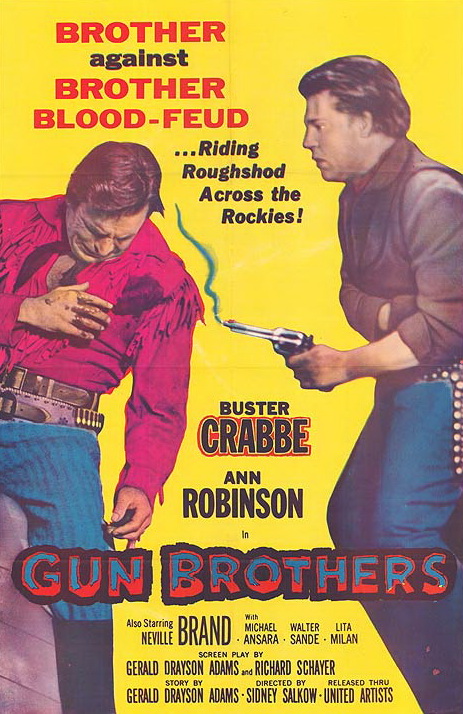
Gun Brothers (1956, directed by Sidney Salkow)


In this western, Buster Crabbe plays Chad Santee, a former Calvary officer who has traveled to Wyoming so he can visit his brother Jubal (Neville Brand) and see Jubal’s ranch.  Traveling by stagecoach, Chad meets and falls in love with a saloon singer named Rose Fargo (Ann Robinson).  When the stagecoach is held up by outlaws and one of them steals Rose’s broach, Chad decides to track the outlaws down.  What Chad doesn’t know is that Jubal is one of those outlaws.

Gun Brothers is an entertaining B-western.  There’s nothing surprising about the story but Buster Crabbe is a believable hero and Ann Robinson gets a chance to show off her saloon singing skills.  Neville Brand steals the film as Jubal.  Before going into acting, Brand was a highly decorated World War II combat officer and he brought his real-life toughness to every role that he played.  He could throw a punch and shoot a gun with an authority that few other actors could match.  Jubal, like Brand, has obviously seen and experienced things that his self-righteous brother will never be able to understand and, as a result, he’s not as tied down to the laws of society as everyone else.   Also turning in good performances are Michael Ansara as an outlaw and Lita Milan, as a Native American woman who is involved with the gang.

Not surprisingly, for a B-western, Gun Brothers is full of characters with names like Shawnee Jack, Yellowstone Kelly, Blackjack Silk, and Moose McClain.  It’s a simple movie but one that will be enjoyed by fans of old fashioned western action.

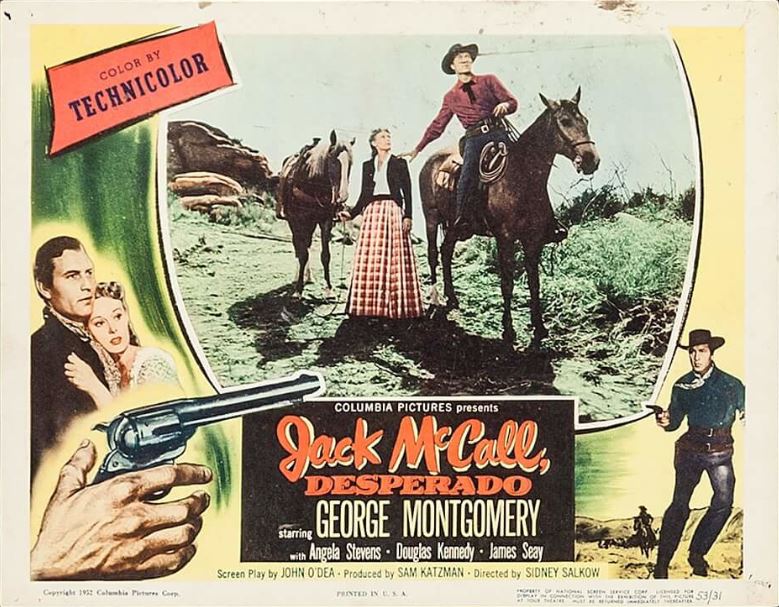
Jack McCall, Desperado (1953, directed by Sidney Saklow)


On August 2nd, 1876, the legendary western lawman “Wild Bill” Hickok was shot and killed while playing poker in Deadwood, South Dakota Territory.  His murderer, who shot Hickok in the back, was Jack McCall.  McCall was known for being a local drunk and it is believed he shot Hickok because he had lost money to him in a previous game.  After shooting Hickok, McCall attempted to flee but ended up falling off of his horse.  When McCall was put on trial for Hickock’s murder, he clamed that it was revenge for Hickok having murdered his brother in Kansas.  Since no one knew much about McCall’s past, he was acquitted.  (Modern historians believe that McCall grew up in Kentucky and never had a brother.)

Unfortunately, for McCall, it was later determined that the Deadwood courts didn’t have legal authority to try anyone and he was hauled into federal court.  After first claiming that he had been too drunk to remember why he shot Hickok, McCall then claimed that he was actually wasn’t Jack McCall at all and that the wrong man had been arrested.  The judge didn’t believe either one of McCall’s claims and Jack McCall was subsequently hanged on March 1st, 1877.  It’s believed that he was 24 years old.

The life and murder of Wild Bill Hickok has been the subject of many books and films, the majority of which have portrayed Hickok in a heroic light while Jack McCall has typically been portrayed as being a low-life coward.  Jack McCall, Desperado, however, takes the opposite approach.  In this film, George Montgomery plays McCall as being an upstanding hero while Douglas Kennedy portrays Hickok as being a cruel and sociopathic murderer.

Jack McCall, Desperado comes up with a backstory for McCall and Hickok, one that I don’t think has ever been suggested by any of the many books written about Hickok’s life and death.  The movie portrays McCall as being a Southerner who, during the Civil War, joined the Union Army.  Because of his Southern heritage, he is distrusted by most of the other men in his unit.  When a group of rebel spies trick McCall into revealing the location of the Union army’s headquarters, McCall is accused of treason and sentenced to death.  McCall manages to escape but, upon returning to his family’s plantation, he discovers that both his mother and his father have been killed by Hickok and Jack’s cousin, Bat (James Seay).  When McCall discovers that Wild Bill and Bat have headed up to the Deadwood, plotting to swindle the Native Americans out of a gold mine, and that they’re accompanied by a former Confederate who can clear Jack’s name, Jack purses them, intent on getting revenge for his family and justice for himself.

It’s a pretty standard western, one that is notable mostly for its portrayal of Wild Bill Hickok as being a bloodthirsty outlaw.  While Hickok may not have been the hero that he was often made out to be (and let’s not even talk about the reality of Wyatt Earp), he probably wasn’t the mustache-twirling villain that he’s portrayed to be here.  Still, Douglas Kennedy is an effectively dastardly villain and George Montgomery is an adequate hero.  Even if it’s in no way based on fact, the Civil War subplot, with Jack supporting the Union cause despite his Southern heritage, is occasionally interesting.  If you’re already a fan of B-westerns and not a stickler for historical accuracy, Jack McCall, Desperado is a decent enough way to pass the time.

Horror on the Lens: The Amazing Colossal Man (dir by Bert I. Gordon)


For today’s horror on the lens, we present the 1957 film, The Amazing Colossal Man!

Directed by Bert I. Gordon, The Amazing Colossal Man tells the story of what happens when Lt. Col. Glenn Manning (Glen Langan) is exposed to an atomic blast, the force of which not only burns off his clothes but leaves him bald as well!  At first, everyone is convinced that there’s no way Glenn Manning will survive but, to everyone’s surprise, he does survive.

And he starts to get bigger!

That’s right — radiation does the craziest things!

Soon, Glenn’s a giant and he’s not very happy about it.  As the government tries to keep both the accident and the mutation a secret, Glenn grows more and more bitter and angry.  And it certainly doesn’t help matters when the scientists decide they want to inject him with a giant syringe.

Seriously, you’ve got to see this syringe!

Anyway, The Amazing Colossal Man is one of those fun sci-fi films that elitist critics love to criticize.  But you know what?  If you’re watching a movie like this because you want to nitpick every little detail, you’re missing the point.  The Amazing Colossal Man is a 1950s B-movie and, when taken on those terms, it’s a lot of fun.

Add to that, Glen Langan really throws himself into the title role!

Enjoy The Amazing Colossal Man!

http://www.youtube.com/watch?v=UaCcMVTAKME