Lisa Cleans Out Her DVR: Hemingway’s Adventures Of A Young Man (dir by Martin Ritt)


(Lisa is currently in the process of cleaning out her DVR!  It’s going to take a while.  She recorded this 1962 literary adaptation off of FXM on January 30th!)
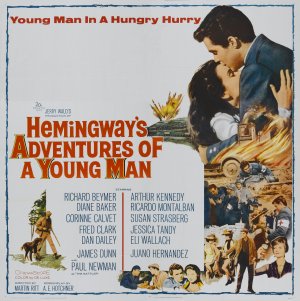
Hemingway’s Adventures Of A Young Man is one of those films that you just know was made specifically to win Oscars.  It’s a big prestige production, complete with a historical setting, an epic scope and big, all-star cast.  That most of those stars appear in relatively small roles was undoubtedly meant to evidence of the film’s importance.

“Look!” the film seems to shout at times, “This is such an important film that even Paul Newman was willing to stop by for a day’s work!”

The film is based on ten short stories by Ernest Hemingway and, loosely, A Farewell to Arms.  The stories all dealt with the early life of Nick Adams, who was a literary stand-in for Hemingway.  Since the Nick Adams stories were autobiographical (and, for that matter, so was A Farewell to Arms), the film can also be viewed as biopic.  Richard Beymer (who, a year earlier, had starred in West Side Story and who is currently playing Ben Horne on Twin Peaks) may be playing Nick Adams but the film leaves little doubt that he was actually meant to be playing Ernest Hemingway.

The film opens with Nick hunting with his father, Dr. Harold Adams (Arthur Kennedy).  He is present when his father travels to an Indian camp and helps to deliver a baby.  He respects his father but Nick wants to see the world and the film follows him as he explores America, working odd jobs and meeting colorful characters along the way.  Paul Newman shows up as a punch-drunk boxer and proceeds to overact to such an extent that he reminded me of Eric Roberts appearing in a Lifetime film.  Nick meets rich men, poor men, and everything in between.  He works as a journalist.  He works as a porter.  Eventually, when World War I breaks out, Nick enlists in the Italian army and the film turns into the 100th adaptation of A Farewell to Arms.

And really, I think it would have been an enjoyable film if it had been directed by someone like Otto Preminger, George Stevens, or maybe even Elia Kazan.  These are directors who would have embraced both the pulpy potential of the Nick Adams stories and the soapy melodrama of the war scenes.  A showman like Preminger would have had no fear of going totally and completely over the top and that’s the approach that this material needed.  Instead, Hemingway’s Adventures Of A Young Man was directed, in a painfully earnest style, by Martin Ritt.  Ritt tries to imitate Hemingway’s famously understated style with his understated direction but, cinematically, it’s just not very interesting.  Ritt portrays everything very seriously and very literally and, in the end, his direction is more than a little dull.

Sadly, the same can be said for Richard Beymer’s performance in the lead role.  Beymer comes across as being the nice guy who everyone says you should marry because he’ll be able to get a good and stable job and he’ll probably never go to jail.  Two months ago, when I watched and reviewed Twin Peaks, I really loved Beymer’s performance as Ben Horne.  He just seemed to be having so much fun being bad.  Unfortunately, in Hemingway’s Adventures Of A Young Man, he never seemed to be having any fun at all.  No wonder he temporarily put his film career on hold so that he could fully devote himself to working as a civil rights activist.

In the end, this is a movie that’s a lot more fun to look at than to actually watch.  Visually, the film is frequently quite pretty in an early 1960s prestige movie so sort of way.  And there are some good performances.  Eli Wallach, Ricardo Montalban, Susan Strasberg, Arthur Kennedy — there’s a whole host of performers doing memorable supporting work.  Unfortunately, even with all that in mind, this well-intentioned film largely falls flat.
Lisa Reviews An Oscar Nominee: Bad Girl (dir by Frank Borzage)


bad-girl

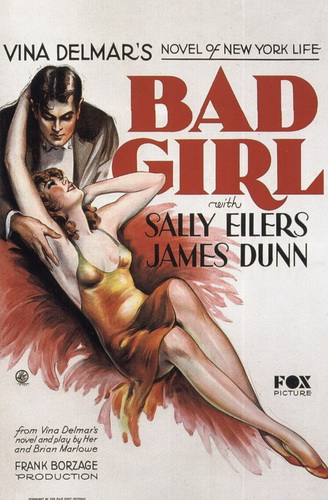
Seeing as how I started this day by watching Fifty Shades Darker, it seemed appropriate to end the day by watching yet another film about the difficulty of finding love and commitment.  This film came out a little bit earlier than Fifty Shades of Grey.  In fact, it even predates the whole concept of fan fiction.  This film came out in 1931 and it would probably be totally forgotten today if not for the fact that, 85 years ago, it was nominated for Best Picture.

Of course, that’s not to say that Bad Girl is particularly well-known.  Until I came across it on my list of best picture nominees, I didn’t know that it even existed.  According to Wikipedia, it was based on a novel and a play and it did rather well at the box office.  The Academy apparently liked it, awarding it Oscars for both Best Director and Best Adapted Screenplay.  It’s currently available on YouTube.  That’s where I saw it.  But, despite all of that, it definitely appears to be one of the more obscure films to have ever been nominated for best picture.

Bad Girl opens with Dorothy Hailey (Sally Eilers) in a wedding gown.  However, she’s not getting married.  Instead, she’s a store model and, in a rather surreal little sequence, Dorothy and her co-workers walk through the store in their bridal gowns while sleazy men leer at them.  As Dorothy complains to her best friend, Edna Diggs (Minna Gombell), men are “only interested in one thing.”  When Dorothy’s boss propositions her, Dorothy claims to have a prizefighter husband waiting for her at home.  In truthfulness, Dorothy lives with her overprotective brother (William Pawley), a judgmental brute who accuses her of being a tramp if she stays out too late.

At Coney Island, Edna makes a bet that Dorothy won’t be able to get surly Eddie Collins (James Dunn) to talk to her.  Dorothy takes the bet and then proceeds to go over to Eddie and play a ukulele, until Eddie gets annoyed enough to tell her to be quiet.  Eddie claims to not like women  and he accuses Dorothy of being a tease.  “Listen, sister,” he tells her, “if you don’t want guys to salute, take down the flag.”

Wow, Eddie sure does seem to be a jerk, doesn’t he?

Well, don’t worry.  It turns out that Eddie isn’t as bad as he seems, it’s just that he’s often in a bad mood because he doesn’t have much money and he wants to open up his own radio store.  However, Eddie and Dorothy quickly fall in love and soon, they’re married…

But, of course, things never go that smoothly.  It turns out that Eddie is proud and stubborn.  Fortunately, he’s played by a charming actor named James Dunn because, without Dunn’s considerable working class charm, Eddie would probably be insufferable.  Dorothy, meanwhile, fears letting Eddie know that she’s pregnant…

And you know what?

I liked Bad Girl.  

On the one hand, Bad Girl is definitely a dated film.  Any film released in 1931 is going to seem dated when watched in 2017.  But, at the same time, that also means that Bad Girl works as a nice little time capsule.  Watching Bad Girl was like stepping into a time machine.  And it turns out that the 1930s weren’t that bad!  Everyone wore nice clothes and talked like James Cagney.

But, dated it may be, there is also an almost timeless quality to Bad Girl.  Even decades after the film was originally released, the likable chemistry between James Dunn and Sally Eilers feels real and you really do care about what happens to them.  You feel like they belong together and it’s hard not to worry when they fight or when they misunderstand each other’s intentions.  (This happens rather frequently.)  Furthermore, Bad Girl is a film about people who, often times, are struggling just to make ends meet.  That’s something to which everyone can still relate.  It certainly sets it apart from a lot of the other films made both then and today.

Bad Girl was nominated for best picture but it lost to a film that was almost its total opposite, Grand Hotel.  Unlike most of the other old best picture nominees, I have never seen Bad Girl on TCM but it is on YouTube and you can watch it below!