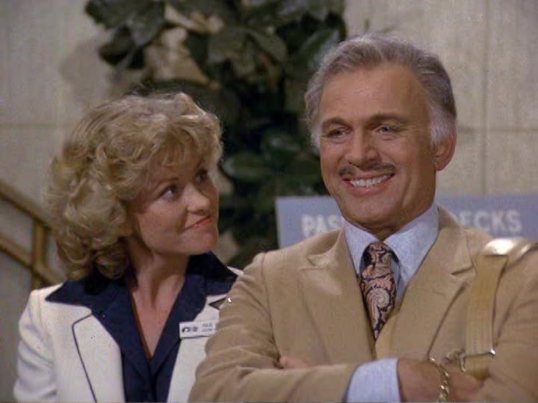
Retro Television Review: Fantasy Island 4.19 “The Proxy Billionaire/The Experiment”


Welcome to Retro Television Reviews, a feature where we review some of our favorite and least favorite shows of the past!  On Tuesdays, I will be reviewing the original Fantasy Island, which ran on ABC from 1977 to 1984.  Almost the entire show is currently streaming on Daily Motion.

This week, things get weird.

Episode 4.19 “The Proxy Billionaire/The Experiment”

(Dir by Richard Benedict, originally aired on March 21st, 1981)

This week’s episode is a bit of an odd one.

The first fantasy is fairly typical for the series.  Playing two roles, Robert Goulet is cast as both a billionaire and as Frank Miller, a Wall Street analyst who wants to be a billionaire.  The real billionaire agrees to allow Frank to live his life for the weekend.  Frank soon discovers that being a billionaire is …. well, actually, it’s pretty cool.  Except, of course, Phyllis Davis and Troy Donahue are plotting to poison him at a luau so that they can steal all of his money.  Fortunately, Mr. Roarke shows up at the luau in time to catch the vial of poison as Davis and Donahue attempt to toss it away.  Frank learns that being a billionaire is fine as long as no one wants to kill you.  Still, he has to return to his normal life at the end of the weekend.  Fortunately, the millionaire’s administrative assistant (Britt Ekland) has fallen in love with Frank and she decides to leave the Island with him.

As I said, this story felt pretty typical of Fantasy Island.  Probably the highlight was Mr. Roarke walking in on Tattoo badgering Frank for financial advice.  Roarke responded by giving Tattoo a strong glare that, if nothing else, reminded the audience that Tattoo and Roarke absolutely despise each other.

The other fantasy was …. well, it was weird.  Dr. Lucas Bergmann (James Broderick) and his daughter,  Lisa (hey!), come to the Island.  Each has a fantasy.  Lisa (played by Laurie Walters) says her fantasy is for Lucas to relax and enjoy himself and to stop obsessing over bringing the dead back to life.  Lucas’s fantasy is to bring the dead back to life.  Roarke sets Lucas and Lisa up in a bungalow that once belonged to another scientist who also wanted to play God.  Roarke warns Lucas that the local Islanders are superstitious and they might not appreciate him tampering in God’s domain.

(If the Islanders are that superstitious, how are they handling living on a magical island that is ruled by a mercurial demigod?)

Soon, the Islanders are beating their drums and Lucas’s mute assistant (Woody Strode) is looking concerned.  Lucas steps outside and discovers that Lisa has apparently drowned in a nearby lake.  Lucas decides that she’ll be the subject of his experiment.  Can he bring her back to life?  Lucas doesn’t find out because the Islanders storm his bungalow and Lucas runs into the jungle, fleeing until he eventually runs into Roarke, Tattoo, and …. LISA!

It turns out that Lisa was only pretending to be dead in order to teach her father a lesson.  And it also turns out that the Islanders were in on it and Woody Strode can speak.

WHAT!?

Seriously, was there not a simpler and perhaps less traumatic way to teach Lucas a lesson?  This seems like an awful lot of trouble to go to.  Lucas does realize that he doesn’t need to raise the dead to be happy so that’s good.  Still, this whole thing just feels weird.

Of course, weird is good when it comes to Fantasy Island.  With Roarke and Tattoo barely on speaking terms, it’s even more important for the fantasies to be memorable.  And I will never forget about the time Mr. Roarke tricked a scientist into believing his only child was dead.  Seriously, I’m stunned Mr. Roarke was never sued.

Next week, we meet Mr. Roarke’s goddaughter!
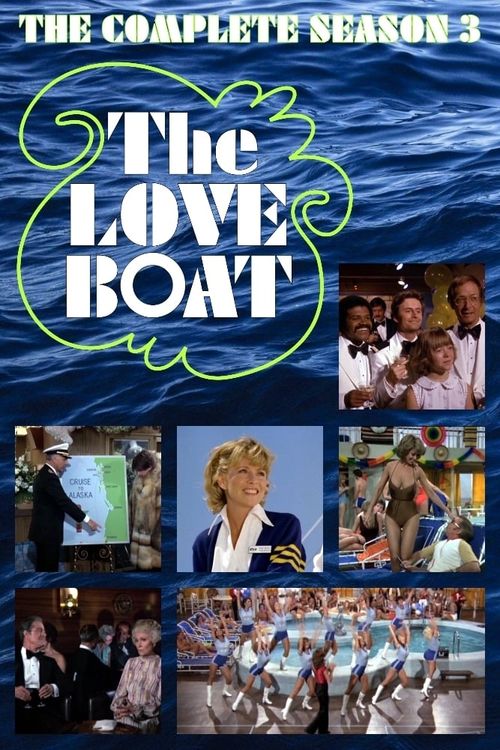
Retro Television Review: The Love Boat 3.21 “The Remake/The Perfect Match/The Captain’s Ne’er Do Well Brother”


Welcome to Retro Television Reviews, a feature where we review some of our favorite and least favorite shows of the past!  On Wednesdays, I will be reviewing the original Love Boat, which aired on ABC from 1977 to 1986!  The series can be streamed on Paramount Plus!

This week, special guest star O.D. Warbux brings The Love Boat to life!

Episode 3.21 “The Remake/The Perfect Match/The Captain’s Ne’er Do Well Brother”

(Dir by Richard Kinon, originally aired on February 2nd, 1980)

At the start of this week’s episode, Marshall Stubing boards the ship.  As you can guess by his last name, Marshall is Captain Stubing’s brother.  He bears a pretty strong resemblance to Merrill, except he’s a little thinner and he has more hair and a pencil-thin smile.  He wears suits and has a quick smile and is quick to flirt with every woman the he sees.  He’s played by an actor named O.D. Warbux and….

Wait a minute….

That’s not O.D. Warbux!  That’s Gavin MacLeod!  Yes, in this episode, Gavin MacLeod plays both the serious Captain Stubing and his carefree, free-loading brother.  And you know what?  MacLeod/Warbux actually does a pretty good job playing the two roles.  In the scenes in which the brothers argue, MacLeod really does seem to be sincerely annoyed with himself.  Seriously, though, you have to give MacLeod some credit.  If he had joked his way through the double role, I doubt anyone would have called him out on it.  Instead, MacLeod gives two believable and emotionally nuanced performances.

As for why Marshall is on the boat, he’s looking for a woman to continue to fund his life.  Merrill threatens to kick Marshall off the cruise but Marshall reveals that he bought a ticket and he has ever right to be there.  As Merrill watches with a disapproving frown, Marshall meets and romances Ruby Gibson (Diane Ladd), who is the millionaire widow of an Oklahoma oilman.  Marshall actually does fall in love with Ruby but he fears that he’s not good enough for her.  Ruby announces that Marshall is perfect for her and even Merrill says that Marshall is actually a good guy.  Marshall leaves the boat with Ruby and I assume they got married a few weeks later.  That’s good.  Hopefully, Ruby will help to pay for Vicki’s college education (assuming Vicki is actually allowed to leave the boat to attend school).

Marshall Stubing is not the only family member on the boat.  Julie’s aunt, Christine (Florence Henderson), is also on the boat.  When she meets Neal Rich (James Broderick), he immediately reminds her of her late husband.  Neal and Christine fall in love on the boat but will Christine ever stop trying to make Neal behave just like her late husband?  Of course, she does.  This is The Love Boat!  Back when I was reviewing The Brady Bunch Variety Hour, I said some fairly negative things about Florence Henderson as an actress but she’s actually really good in the episode and she has great chemistry with James Broderick so I guess it was really the Brady children who were holding her back on the Variety Hour.  This was a sweet story and I have to say that I actually found myself really hoping that Christine and Neal would work things out.

Finally, Holly Christopher (Connie Stevens) boards the ship because she’s spent the last few weeks stalking Howard Samuels (Kent McCord), the man who she has decided will be the father of her child.  As Holly explains it to Doc, she doesn’t want to get married.  She doesn’t want a family.  She just wants a baby.  Doc, who has like a dozen ex-wives and whose entire life seems to revolve around searching for one-night stands on the boat, tells her that marriage and traditional courtship are wonderful and that she should consider them.  Holly realizes that she agrees with Doc and she decides that she wants an old-fashioned romance after all.  This whole storyline felt like it could have come from one of those old 1950s films that would star Troy Donahue and Sandra Dee as teenagers learning the facts of life.  Kent McCord was pretty dull as Howard but Connie Stevens brought a lot of energy to the role of Holly.  Out of the three couples who left the ship at the end of the cruise, Howard and Holly is the one that’s definitely not going to last.

With this episode, The Love Boat kept it all in the family and, overall, this was a pretty good cruise.  Both Gavin MacLeod and O.D. Warbux deserve a lot of credit for giving performances that elevated the entire episode.

Film Review: The Taking of Pelham One Two Three (dir by Joseph Sargent)


Welcome to New York in the 1970s!  While the intellectuals flock to the latest Woody Allen movie and the wealthy throw radical chic parties in Manhattan and disturbed young men drive taxis at night and pray for a real flood to clear away all the vermin, most of the city’s citizens are just trying to make it through the day.  For many of them, that means spending an hour or two riding the subway.  In some ways, the subway is the great equalizer.  The minute that you sit down on a filthy train car, it doesn’t matter how old you are or how you vote or the color of your skin.  All that matter is finding a way to avoid making eye contact with anyone else.

Four men, all wearing obvious disguised, board the downtown Pelham 1-2-3 train.  They all look suspicious but, this being New York, no one wants to make eye contact.  Everyone just wants to reach their next stop.  The men — who are known as Mr. Blue (Robert Shaw), Mr. Green (Martin Balsam), Mr. Grey (Hector Elizondo), and Mr. Brown (Earl Hindman) — have other plans.  Revealing that they’re armed, they take the 18 passengers of the first car hostage.  Their leader, Mr. Blue, has a simple demand.  He wants a million dollars to be delivered to the car within an hour.  If the money’s late, he will kill one hostage every minute, until he receives what he wants.

While the cold-stricken mayor (Lee Wallace) tries to figure out how to 1) raise a million dollars and 2) handle the situation without losing any potential votes in his reelection campaign, Lt. Zach Garber (Walter Matthau) communicates with Mr. Blue via radio.  With Mr. Blue underground and Zach above ground, the two of them establish a cautious rapport.  Robert Shaw plays Blue as being efficient, polite, but ruthless while Walter Matthau plays Garber with his usual rumpled but intelligent style.  As embodied by Matthau, Garber is New York City in human form while Shaw is perfectly cast as the outsider who, for at least an hour or two, has managed to bring the city to its knees.

Even though the original The Taking of Pelham One Two Three is often described as being a Walter Matthau film or a Robert Shaw film, the film’s main character actually is the city of New York City.  The film portrays the city as being chaotic, angry, and unpredictable but, at the same time, also resilient and strong.  Yes, Garber may spend a lot of time bickering with his co-workers but, in the end, he and Lt. Rico Patrone (Jerry Stiller, another great New York figure) work together to do what has to be done to resolve the situation.  For all the time that’s spent on how Mr. Blue and his compatriots take that train hostage, just as much time is spent focusing on how the police, the politicians, and the Transit Authority react to what’s happened.  Not having any firsthand knowledge of the New York subway system (beyond being told not to use it when I was in NYC a few years ago), I can’t say whether or not the film is realistic but what’s important is that it feels realistic.  Even though the film is full of familiar character actors, it still seems as if you’re just watching a bunch of New Yorkers having a very long day.  Though guns are fired and there is a runway train, The Taking of Pelham One Two Three takes a refreshingly low-key approach to its story.  There’s no huge action set pieces.  The film’s classic final shot hinges not on Garber’s marksmanship but instead on his ability to remember the small details.

The Taking of Pelham One Two Three is one of my favorite heist movies.  It’s well-acted.  It’s got an interesting plot.  It’s got a few moments of unexpected humor.  Robert Shaw is a great (and, at times, almost compelling) villain while Walter Matthau and Jerry Stiller make for a great detective team.  The great Martin Balsam also turns in a wonderful turn and, even though he’s playing a bad guy, it’s hard not to sympathize him.  You need only see his apartment to understand why exactly he felt the city of New York owed him more than it had given him.  Best of all, The Taking of Pelham One Two Tree is a tribute to a great American city.  The Taking of Pelham One Two Three celebrates New York City in all of its rude, messy, and brilliant glory.

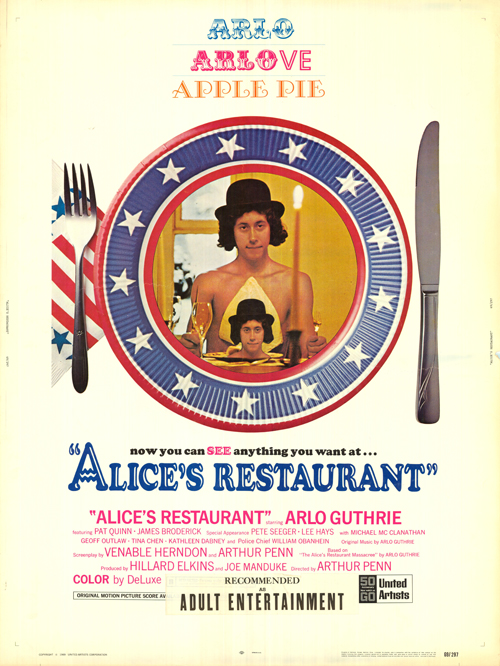
Thanksgiving Tradition: ALICE’S RESTAURANT (United Artists 1969)


gary loggins's avatarcracked rear viewer

There’s another Thanksgiving tradition besides gorging on turkey’n’trimmings and watching football (which usually ends up with me crashed on the couch!), and that’s listening to Arlo Guthrie’s 1967 story/song “The Alice’s Restaurant Massacree”. Here in chilly Southern New England, I catch the annual broadcast on 94-HJY (Providence’s Home of Rock’N’Roll) at noontime, just before the yearly chow down. Arlo’s one of our own, though born in Brooklyn a long-time Massachusetts resident, and still frequently plays concerts around the state (catch him if he’s in your neck of the woods, he always puts on a good show).

Director Arthur Penn stretched Arlo’s 18-plus minute autobiographical tune into a 111 minute film back in 1969. ALICE’S RESTAURANT is not a great film, but it is a good one, with Penn and coscenarist Venable Herndon hitting all the touchstones of the counterculture movement: free love (read: sex), drug use, the Vietnam War, long-haired…

View original post 366 more words