There are more hippies in Texas than you might realize.
Enjoy!
There are more hippies in Texas than you might realize.
Enjoy!

The 1958 film I Married A Monster From Outer Space tells the story of Marge (Gloria Talbott) and Bill Farrell (Tom Tryon).
Just one year ago, they seemed like the perfect couple. They were newlyweds, looking forward to starting a family and living in a nice house in the suburbs. Bill seemed like the perfect guy, warm, friendly, humorous, and loving.
However, things have changed. On their one-year anniversary, Bill is cold and distant. He certainly seems to have little interest in romance or anything like that. When Marge gives Bill a new dog as his anniversary present, he doesn’t seem to be sure how to react to it. When the dog later ends up dead, Bill gives her an implausible excuse.
Bill has changed but he’s not the only one. Marge notices that all of her friend’s husbands are acting strange as well. It’s as if something has magically turned every man into the neighborhood into a stiff, humorless jerk.
(Either that or it’s the 50s!)
One night, Marge decides to follow Bill into the forest and she sees something that challenges everything that she previously thought she knew about her husband. What does she discover? Well, it’s right there in the title. Marge has married a monster from outer space!
I imagine that most people’s natural instinct with a film like this is to make fun of the title and just go on from there but actually, I Married A Monster From Outer Space is an intelligent and well-done sci-fi film. Gloria Talbott does a great job in the lead role and Tom Tryon’s rather stiff screen presence is perfectly suited for the role of Alien-Bill. Gene Fowler, Jr. directs the film as if it were a film noir where the usual gangsters and bank robbers have been replaced by humanoid aliens who don’t like dogs.
Since this movie is from 1958, there’s all sorts of subtext creeping around. The most obvious, of course, is that America is being invaded from within. You don’t think your husband could be an alien? Well, Alger Hiss’s mother probably didn’t think her son was a communist spy! You think it’s a silly idea that normal seeming humans would be working to conquer the world? Have you not heard of Julius and Ethel Rosenberg? When Bill and the other men turn cold and impersonal, it’s easy to see that they’ve embraced an ideology opposed to individual freedom and we all know what that means.
However, for me, this film works because it strikes at a very primal fear. How well do you really know the people who you love? Is he always going to be as perfect as he seems when you first start going out or is he going to totally change once he’s sure that you’re not going to leave him? Like many women who have tried to escape from abusive boyfriends and spouses, Marge discovers that no one believes her. She lives in a world controlled by men and all of the men have been taken over by the same thing that’s taken over Bill. Even if you’ve never married a monster from outer space, you know what Marge is going through.
So, don’t dismiss this film because of the melodramatic title. I Married A Monster From Outer Space is an intelligent sci-fi horror film, one that’s still relevant today.

1961’s The Connection opens with a title card and voice over from someone identifying himself as being J.J. Burden. Burden explains that what we are about to see is the last known work of an aspiring documentarian named Jim Dunn. Burden explains that, after he and Dunn filmed the footage that’s about to be shown, Dunn disappeared. It was left to Burden to put the footage together and he swears that he has gone out of his way to stay true to Dunn’s intentions.
Of course, if you’ve watched enough old movies, you might recognize Burden’s resonate voice as belonging to the distinguished actor, Roscoe Lee Browne. And, once the film starts, you may also notice that you’ve seen Jim Dunn in other movies. That’s because Dunn is played by William Redfield, a character actor who specialized in playing professional types.
The Connection takes place in a New York loft. A group of jazz musicians are waiting for their drug dealer. Sometimes, they play music. Sometimes, they look straight at the camera and answer questions about what it’s like to be a heroin addict. While Burden always remains behind the camera, Jim Dunn occasionally steps in front of it and scolds the men for not being dramatic enough. Dunn is attempting to stage reality. Leach (Warren Finnerty), the most verbose of the addicts, taunts Dunn over never having done drugs himself. Dunn jokingly says that maybe he could start with some marijuana.
This is no Waiting for Godot. The dealer does eventually arrive. His name is Cowboy and he’s slickly played by Carl Lee. (Carl Lee was the son of Canada Lee, who appeared in Hitchcock’s Lifeboat. Sadly, 25 years after filming his role in The Connection, Lee would die of a heroin overdose.) He’s accompanied by a flamboyant woman named Sister Salvation (Barbara Winchester). As Burden films, the musicians enter a small bathroom one-by-one, so that they can shoot up. Music is played. Overdoses are dealt with. And Dunn, who was originally so detached, becomes more and more drawn into the junkie life style…
Was The Connection the first mockumentary? To be honest, I’m really not sure but it definitely has to be one of the first. The beginning title card (and Burden’s narration) feels like it could easily be used in front of any of the hundreds of found footage horror films that have been released over the last few years. The film itself makes good use of the found footage format, though it’s also trapped by the genre’s limitations. With all of the action taking place in just one room, there’s no way that The Connection can’t feel stagey. (And, indeed, it was based on a play.) Along with detailing the lives of those on the fringes of society, The Connection makes some good points about the staging of reality, though it never goes quite to the lunatic extremes of Ruggero Deodato’s Cannibal Holocaust.
(The Cannibal Holocaust comparison is not as crazy as it may sound. Much as how the arrogant filmmakers in Deodato’s film attempted to exploit the cannibals, Jim Dunn attempts to exploit the addicts. When the addicts and Cowboy start pressuring Dunn to try heroin, it’s not that much different from the cannibals eating the cameraman in Cannibal Holocaust. The exploited are getting their revenge.)
The Connection was the first dramatic film to be directed by documentarian Shirley Clarke and, like many of Clarke’s films, it struggled to find an audience. (Both the film and Clarke would have to wait several decades before getting the recognition that they deserved.) The subject matter was considered to be so sordid (and the language so shocking) that the film was originally banned in New York. The filmmakers actually had to file a lawsuit to get the film released. The New York State Court of Appeals ruled the film was “vulgar but not obscene.”
Seen today, the film seems to be neither vulgar nor obscene. Instead, it seems like a time capsule of the era in which it was made. We tend to think of the early 60s as a time of beach movies, drive-ins, early rock and roll, and Kennedy optimism. The Connection reveals that there was a lot more going on than just that.
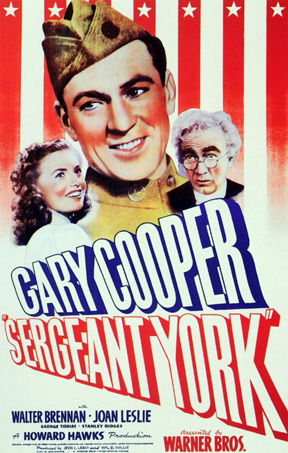
The 1941 film Sergeant York was the American Sniper of its day. A biopic of Alvin York, one of the most decorated American soldiers of World War I, Sergeant York was not only a huge box office hit but it was a film that celebrated American patriotism in the type of unabashed fashion that you would never see in a film made today. Though Sergeant York went into production at a time when the United States was officially pursuing a policy of international neutrality, it was released shortly before the Japanese attacked Pearl Harbor and, whether intentionally or not, Sergeant York served as a strong recruiting tool. According to Wikipedia (and we all know that Wikipedia is never wrong), there were reports of young men going straight from the movie to the nearest military recruitment office.
Clocking in at nearly two and a half hours (and running at least 40 minutes too long), Sergeant York is two films in one. The second half of the film deals with the military career of Alvin York (Gary Cooper), a plain-spoken and honest Tennessee farmer who, because of his strong religious beliefs, unsuccessfully attempts to register as a conscientious objector. Forced into the Army, York is, at first, dismissed as a simple-minded hillbilly. (His fellow soldiers are amused to discover that York doesn’t know what a subway is.) However, to the shock of his commanding officers, he proves himself to be an expert marksman. As he explains it, being from the country means that he’s been shooting a rifle his entire life.
On the basis of his skills as a marksman, York is given a promotion but he still says that he refuses to kill. It’s not until his superior officer reminds him of the sacrifices that past Americans have made that York starts to reconsider his position. Then, a gust of wind opens York’s bible to a verse about giving unto Caesar what is Caesar’s and York realizes that he can go to war and, if need be, he can kill.
And it’s a good thing that he can! Because World War I is heating up and York may be the only guy around with the strength and confidence to single-handedly defeat and capture over 170 German soldiers.
The army section of Sergeant York is predictable but well-done. As you’d expect from a film directed by Howard Hawks, a lot of emphasis is put on how the soldiers work together. York is portrayed not as being super human but instead as just an honest man who is exceptionally good at his job. There’s nothing surprising about the second half of Sergeant York but Hawks keeps the action moving and Cooper gives a good performance.
To be honest, I preferred the first half of the film, which examined York’s life before he joined the Army. When we first meet Alvin York, he drinks too much, he fights too much, and he’s totally irresponsible. It’s not until he falls in love with Gracie Williams (Joan Leslie) that York starts to change his ways. The scenes of York in the backwoods of Tennessee had a lively feel to them and it was enjoyable to see Cooper play a somewhat disreputable character. Cooper seemed to be having fun playing a ne’er-do-well and, in the scenes before York finds God, his bad behavior was a lot of fun to watch.
Considering its success at the box office, it’s not surprising that Sergeant York was nominated for best picture of the year. While Gary Cooper won the Oscar for best actor, the award for Best Picture went to How Green Was My Valley.

So, I guess I should explain why I’m including the classic 1962 film (and best picture nominee), To Kill A Mockingbird, in this series of reviews of films about politicians. After all, while To Kill A Mockingbird dealt with the issue of racism in Alabama in a surprisingly honest manner, it doesn’t feature any elected officials. Nobody shows up playing Gov. Benjamin J. Miller or President Franklin Roosevelt. Instead, this film is about a wise lawyer named Atticus (Gregory Peck), an innocent man named Tom (Brock Peters), a girl named Scout (Mary Badham) and her older brother Jem (Philip Alford), and a mysterious recluse named Boo (Robert Duvall).
However, if you’ve read Harper Lee’s wonderful novel, then you know that Atticus is not just the smartest man in Maycomb, Alabama. He’s also a member of the Alabama state legislature and his political career is a fairly important subplot in the book, with him occasionally having to leave home so he can go down to Montgomery and help to write the budget. (Incidentally, Harper Lee’s father actually was a member of the Alabama House of Representatives.)
In the film, no mention of Atticus being a member of the state legislature is made but I still choose to believe that he was. Because, as played by Gregory Peck, Atticus Finch is exactly the type of man who you would want to think of as serving in government. He’s wise, compassionate, and firm. For much of To Kill A Mockingbird, he is literally the only sane adult in Maycomb. He’s the only attorney willing to defend Tom Robinson when Tom is accused of raping a white girl. When a mob shows up to lynch Tom, Atticus is the only adult willing to stand up to them. (Fortunately, Jem also runs up and shames the mob by reminding them that she goes to school with their children.) And, in court, it is Atticus who proves that Tom is innocent.
When Tom is still convicted, what makes it all the more devastating is that wise and compassionate Atticus doesn’t seem to be surprised as all. If even Atticus feels that there is no hope for a black man to get a fair trial from an all-white jury, the film seems to be saying, then there truly is no hope.
Of course, the film is not just about Atticus. It’s about Scout and Jem and their friend Dill (John Megna) and how the three of them grow up and learn the truth about their world. Watching them from behind the closed doors of his house is the mysterious and reclusive Boo Radley. When Boo shows up towards the end of the film, I always find tears in my mismatched eyes. Boo is played, in his film debut, by Robert Duvall. Duvall doesn’t say a word but he still makes an incredible impression as the shy and withdrawn Boo.
So, I may be cheating a lot by including To Kill A Mockingbird in this series of reviews. Oh well. Who am I to turn down a chance to rewatch it? To Kill A Mockingbird is just a great film.
 Through the Shattered Lens