On-Stage With The Lens: Medea (dir by Mark Cullingham)


In 431 BC, the Greek playwright Euripides premiered his latest play, Medea.  The story of a woman scorned who deals with her anger by murdering her ex-husband’s soon-to-be wife, future father-in-law, and finally her own children, Medea has lived on as one of Euripides’s most-performed plays.  Three actresses have won Tony awards for playing Medea on Broadway, setting the record for the most Tonys won for playing the same role.

Medea is a play that is open to a lot of interpretations.  Quite a few stagings of the play present Medea as being a sympathetic character, a victim of a misogynistic culture who was driven to extremes by the men around her.  I can see that argument and it is true that the play does emphasize that all the men in Medea’s life treat her terribly.  Creon plots to send Medea into exile so that his daughter can marry her husband.  Medea’s smarmy husband, Jason, says that he has no choice but to marry a princess because Medea is only a “barbarian,” fit to be his mistress but not his wife.  In many ways, Medea is a sympathetic character.  But, for me, all of that sympathy goes out the window as soon as she murders her children.  The fact that, in most stage versions of the play, the Gods then help her to escape makes her even less sympathetic in my eyes.  (Needless to say, it certainly doesn’t do much for the reputation of the Greek Gods.  Then again, one gets the feeling that even the ancient Gods didn’t particularly like their Gods.)

In 1983, Zoe Caldwell won a Tony for playing Medea.  (Interestingly enough, in this production, the Nurse was played by Judith Anderson, who also won a Tony for playing Medea, in 1947.)  A performance at the Kennedy Center was filmed for PBS.  The production, with its minimalist sets and atmosphere of growing dread, captures the nightmarish intensity of the story.  Zoe Caldwell gives a riveting performance as Medea, alternating between wild-eyed madness and subtle manipulation.

As the most horrific of the Greek plays, Medea is a production that just feels right for the Halloween season.  Here is Zoe Caldwell in 1983’s Medea.
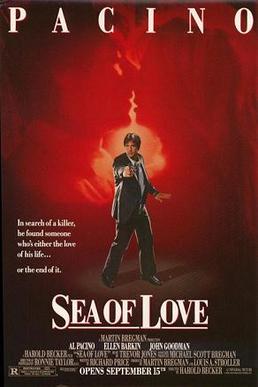
Sea of Love (1989, directed by Harold Becker)


In New York City, someone is ritualistically murdering the men who are placing rhyming personal ads in a tabloid newspaper.  Assigned to the case is Frank Keller (Al Pacino), an alcoholic burn-out whose wife just left him for another cop.  Keller and his partner (John Goodman) decide to go undercover.  Frank places a rhyming personal ad of his own and then goes to a restaurant to see who shows up.  When Helen Cruger (Ellen Barkin) answers the ad, it leads to a relationship between Frank and Helen.  Frank is falling for Helen but what if she’s the murderer?

Sea of Love is a superior thriller, even though it doesn’t really work as a mystery.  As soon as you see a certain person’s name in the cast list, you’re going to guess who the killer is because that person is always the killer.  Sea of Love isn’t really about the mystery, though.  It’s about people looking something that’s missing from their lives and realizing that the world is passing them by.  The movie works because of the performances of Al Pacino and Ellen Barkin, cast as two lonely middle-aged people who are desperately looking for some sort of connection.  Helen and Frank are both in their 40s and wondering if their current situation is really as good as it’s going to get.  The film uses Frank’s fear that Helen could be the killer as a metaphor for the fear that anyone feels when they are first starting to open up to someone.  Both Pacino and Barkin give emotionally raw and poignant performances.  I don’t think I’ve ever seen Al Pacino look as miserable as he did for the majority of Sea of Love.  This was Pacino’s first film role after the disaster of Revolution and the movie’s box office success was revived Pacino’s career and convinced him to give movies a try again.

Director Harold Becker captures the feel of New York at its grittiest and least welcoming and Richard Price’s script is full of priceless dialogue.  This is one of the rare films in which everyone has something intelligent or meaningful to say.  Featuring a strong supporting cast and career-best performances from Ellen Barkin and Al Pacino, Sea of Love is much more than just another cop film.