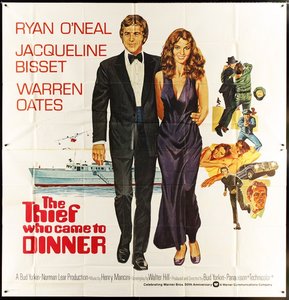
In The Thief Who Came To Dinner, Ryan O’Neal plays Webster McGee, a Houston-based computer programmer. After deciding that living in a capitalist society means that everyone steals from everyone else, Webster quits his boring job and decides to become a real thief. Figuring that they can afford to lose a little wealth, Webster only targets the rich and powerful. After he steals some incriminating documents from a crooked businessman (Charles Cioffi), Webster uses those documents to blackmail his way into high society. Soon, Webster owns a mansion of his own and is living with a gorgeous heiress (Jacqueline Bisset, who played a lot of gorgeous heiresses back in the day). Webster also has an insurance investigator after him. Dave Reilly (Warren Oates) knows that Webster is a thief but he also can not prove it. As Dave obsessively stalks him, Webster plots one final heist.
Until I saw it on TCM on Monday, I had never heard of The Thief Who Came To Dinner. Directed in a breezy style by Bud Yorkin, The Thief Who Came To Dinner was an early script from Walter Hill. Though the film is much more comedic than his best known work, it’s still easily recognizable as coming from Hill’s imagination. The obsessive Dave and the coolly professional Webster are both prototypical Hill characters and their adversarial yet friendly rivalry would be duplicated in several subsequent Hill films.
The Thief Who Came To Dinner is an engaging movie that doesn’t add up to much. The normally stiff Ryan O’Neal gives one of his better performances, though he struggles to hold his own whenever he has to act opposite the far more energetic Warren Oates. Ned Beatty, Gregory Sierra, John Hillerman, Michael Murphy, and Austin Pendleton all appear in minor roles, making the film’s cast a veritable who’s who of 70s character actors. And, of course, the film features Jacqueline Bisset at her loveliest.
The Thief Who Came To Dinner may not be well-known but it is an enjoyable and satisfying piece of 70s entertainment.
The 1968 film The Sweet Ride takes the audience on a ride through Malibu and reminds us all that, in many ways, the 1960s sucked.
The Sweet Ride opens with actress Vicki Cartwright (Jacqueline Bisset) losing her top while swimming in the ocean. While Vicki panics and tries to figure out how to get back to the beach without anyone seeing her breasts, she’s spotted by a surfer named Denny McGuire (Michael Sarrazin). Denny hands her a towel and then leads her back to the beach house that he shares with aging tennis player Collie (Anthony Franciosa) and stoned musician Choo-Choo (Bob Denver).
The rest of the film is a 90 minute tour of California beach life in the late 60s. Despite Collie’s cynical warning against falling in love, Denny does just that, despite the fact that Vicki refuses to tell him anything about her past or even where she lives. Meanwhile, Collie spends his time hustling on the tennis court and the married Choo-Choo pretends to be gay in an attempt to get out of being drafted. (Choo-Choo probably could have gotten out of the draft by pointing out that he appears to be 40 years old but the filmmakers decided to have him walk around with a poodle and speak in falsetto. Just in case you had any doubt that this film was made in 1968…) It’s a mix of comedy, romance, and drama and it’s features footage of some real bands performing in actual Malibu nightclubs and that’s a good thing for all of us history nerds.
And, since The Sweet Ride was made in 1968, the whole film gets progressively darker as it reaches its conclusion. Choo-Choo does get drafted and it’s hard to believe he’ll survive a day in Viet Nam. Collie’s perfect life is revealed to be an empty facade. Denny realizes that his friends are all immature losers. And Vicki ends up getting assaulted by a high-power studio executive (Warren Stevens). It all leads to more violence, disillusionment, and general ennui.
For some reason, The Sweet Ride shows up on FXM fairly regularly. It’s a strange film because it doesn’t really work and yet it’s also compulsively watchable. It tries to be about everything and, as a result, it often feels like it’s about absolutely nothing. And yet, somehow, it remains compelling…
Why is the film compelling despite itself? It’s not because of the main characters, that’s for sure. The boys in the beach house are probably some of the least likable film protagonists in cinematic history. Anthony Franciosa gave some great performances in his career (check him out in A Face in the Crowd and Tenebrae) but Collie is such a smug jerk that you find yourself hoping that someone will just punch him in the face. Meanwhile, Denny tends to come across like a weak-willed and obsessive stalker and Choo-Choo — well, Choo-Choo often seems to be a character in a totally different movie. As for Vicki, her character pretty much exclusively exists to be victimized.
Ultimately, I think The Sweet Ride is watchable because it is such an imperfect time capsule. If I wanted to know what it was like to be alive in the 60s, The Sweet Ride is one of the films that I would watch. It’s not the best film ever made but it is a chance to look into the past.
(Incidentally, The Sweet Ride was directed by Harvey Hart, who also directed the underrated Shoot.)
If I had been alive in the 70s, I would have been terrified if I had ever found myself in the same general location of Paul Newman, William Holden, Ernest Borgnine, Red Buttons, Jacqueline Bisset, or Burgess Meredith. Just based on the movies that they spent that decade appearing in, it would appear that disaster followed them everywhere.
Ernest Borgnine and Red Buttons both ended up taking an unexpected Poseidon Adventure together.
Jacqueline Bisset was a flight attendant in the first Airport and nearly got killed by a mad bomber.
And finally, Burgess Meredith was a passenger on The Hindenburg.
Seriously, that’s a dangerously disaster-prone bunch of thespians!
So imagine how terrifying it must have been on the set of the 1980 film When Time Ran Out when all 6 of those actors — along with a lot of other disaster film veterans — were first gathered in one place. People were probably running for their lives, both on-screen and off.
When Time Ran Out takes place on an island in the South Pacific. Shelby Gilmore (William Holden, playing yet another ruthless but essentially good-hearted businessman) owns a luxury resort that happens to be sitting dangerously close to an active volcano. Oil rigger Hank Anderson (Paul Newman) is convinced that the volcano is about to erupt but Shelby’s son-in-law, Bob Spangler (James Franciscus), refuses to listen and claims that even if the volcano does blow, the resort will be safe.
(As a sidenote, why were William Holden’s son-in-laws always too blame in disaster movies? First, you had Richard Chamberlain in The Towering Inferno and now, it’s James Franciscus in When Time Ran Out…)
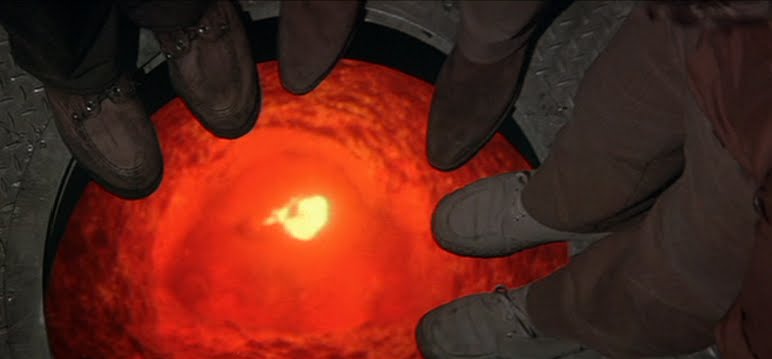
Suspended over a volcano
You can just look at the film’s title (When Time Ran Out!) and guess that Bob is probably wrong. However, Bob has other things on his mind. First off, he’s cheating on his neurotic wife (Veronica Hamel) with a native islander (Barbara Carrera) who happens to be married to the hotel’s general manager, Brian (Edward Albert). Brian also happens to be Bob’s half-brother and is therefore owed at least half of Bob’s fortune but nobody but Bob realizes that.
And, of course, there are other colorful guests at the hotel who will soon find themselves either fleeing from or drowning in molten lava. There’s a white-collar criminal (Red Buttons) who is being pursued by a detective from New York (Ernest Borgnine, of course). There’s also two retired tightrope walkers (Burgess Meredith and Valentina Cortese) and you better believe that there’s going to be a scene where one of them is going to have to walk across a plank that happens to be suspended over a river a lava…
Told ya!
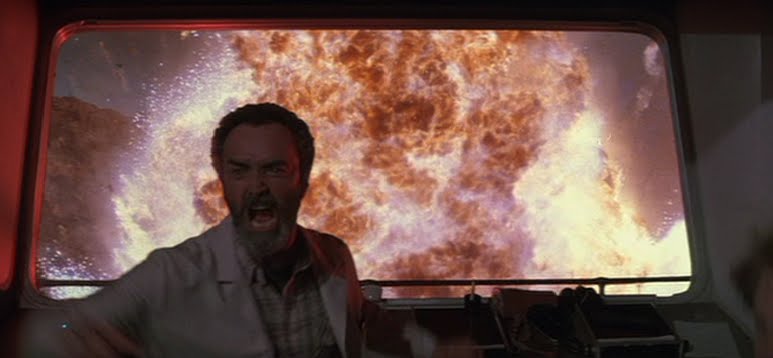
Eventually, that volcano does erupt and…well, let’s just say that When Time Ran Out is no Towering Inferno as far as the special effects are concerned. The scene where one random fireball flies out of the volcano and heads for the resort is particularly amusing for all the wrong reasons. Not only does the volcano apparently have perfect aim but it’s also painfully obvious that the fireball is streaking across a matte painting. This is the type of film where, when people plunge into a river lava, they do so with heavy lines visible around their flailing bodies. That, along with the cast’s obvious lack of interest in the material, adds up to make When Time Ran Out a film that is memorable for being so ultimately forgettable.
The Horror!
(It’s odd to consider that this film was directed by the same James Goldstone who directed such memorable films as Rollercoaster and Brother John.)
When Time Ran Out is something of a historical oddity because it was the last of the old 70s all-star disaster films. (This may have been released in 1980 but it’s a 70s film through and through.) The movie was such a monumental failure at the box office that it pretty much ended an era of disaster films.
For that reason, it also feels like an appropriate film with which to close out the 70s. Tomorrow, we’ll continue to embrace the melodrama with the 1980s.
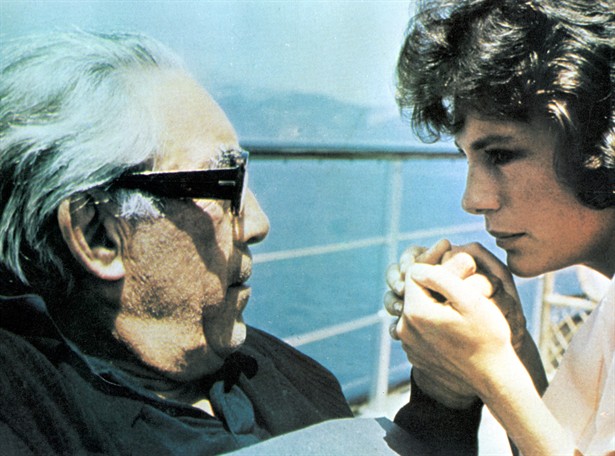
“The characters in this film are fictitious and any resemblance to persons living or dead is purely coincidental”. — Completely And Totally False Disclaimer From The Greek Tycoon (1978)
In order to appreciate a film like 1978’s The Greek Tycoon, it helps to be a history nerd like me.
If you are, then you probably know that, 5 years after her husband was assassinated in Dallas, former first lady Jacqueline Kennedy remarried. Her new husband was Aristotle Onassis, a Greek shipping magnate who was 23 years older than her and who had an unsavory reputation. Onassis was one of the world’s richest men and was known for both his extravagant life style and for being a ruthless operator. Depending on which books you read, Onassis is portrayed as either being either one of the world’s greatest villains (and, in fact, there’s a whole school of conspiracy theorists who believed that Onassis was somehow involved in John Kennedy’s assassination) or just a casually amoral rich man who treated his new wife like his latest trophy. Either way, he was not the sort of person who Americans expected to become the second husband of a widowed first lady.
Of course, the Greek Tycoon is not about Aristotle and Jackie Onassis. It’s about another Greek shipping magnate with a ruthless reputation who shocks the world by marrying the widow of a martyred President. And, if you stick with the film all the way through the end credits, you’ll even see a disclaimer to prove it!
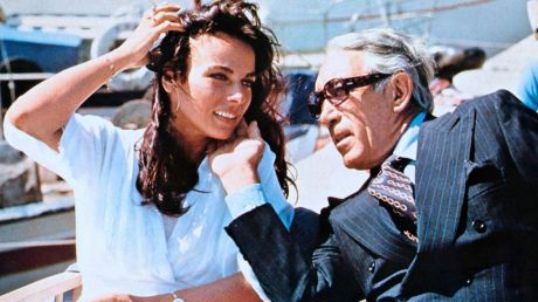
Anthony Quinn plays Theo Tomasis. When we first meet him, he’s content to spend his time making crooked business deals and attending parties on a seemingly endless collection of white yachts. He is grooming his son (Edward Albert) to take over the family business. He loves both his wife Simi (Camilla Sparv) and his mistress (Marilu Tolo). In fact, the only problem he has in his life is his business rival, Spyros (Raf Vallone, who played another Greek tycoon in The Other Side of Midnight). Spyros happens to be Theo’s brother. But other than that, Theo is content to spend all of his time dancing and breaking plates because, as the film reminds us every chance that it gets, he’s Greek.
However, things change for Theo when he meets Liz Cassidy (Jacqueline Bisset), the wife of young and charismatic Senator James Cassidy (James Franciscus). Within minutes of meeting her, Theo is hitting on her but Liz loves her husband. However, Sen. Cassidy soon becomes President Cassidy and this, of course, leads to Cassidy being assassinated while he and Liz are strolling down the beach.
Liz is soon married to the freshly divorced Theo and proving herself to be far more strong-willed than anyone realized. Despite the anger and efforts of both Theo’s son and the dead President’s brother (Robin Clarke), Liz and Theo’s love endures and soon, they are such a glamorous and famous couple that its surprising that nobody ever suggests making a movie about them.
The Greek Tycoon is a big mess of a movie but it’s enjoyable if you know what inspired it. (Of course, if you’re not into history and you don’t know anything about Aristotle and Jackie then you’ll probably find The Greek Tycoon to be one of the most boring movies ever made.) To be honest, the story is never important in a film like this. Instead, you watch for the clothes and the sets and they’re all properly glamorous in a 1970s sort of way. Finally, you can watch this movie for Anthony Qunn’s unapologetically over-the-top performance as Theo. I don’t know if you could necessarily say that Quinn gave a good performance here but, watching the film, it certainly does look like he was having fun.
Since I realized I wasn’t going to get any sleep, I decided I might as well watch a random movie via Encore On Demand. That movie turned out to be Class, a dramedy from 1983. (I love dramedies, especially when I’ve got insomnia.) I just finished watching it about 30 minutes ago and what can I say? If there’s any film that deserves to be known as a guilty pleasure, it’s Class.
Class tells the story of two prep school roommates. Skip (Rob Lowe) is rich and spoiled. Jonathan (Andrew McCarthy) is poor but brilliant. As the result of getting a perfect score on his SAT, Jonathan has already received a scholarship to Harvard. Their friendship gets off on a rocky start. Skip locks Jonathan outside while Jonathan is wearing black lingerie. Jonathan responds with a fake suicide. (Boys are so weird.) Not surprisingly, Jonathan and Skip become best friends and even share their darkest secrets. Skip admits to killing a man. Jonathan confesses to cheating on his SAT. One of the two friends is lying. Try to guess which one.
When Skip also discovers that Jonathan is a virgin, Skip makes it his mission to help his friend get laid. Skip pays for Jonathan to spend a weekend in Chicago. While there, Jonathan meets an older woman named Ellen (Jacqueline Bisset). Soon, Jonathan and Ellen are having a torrid affair.
Once Christmas break arrives, Skip takes Jonathan home with him. Jonathan meets Skip’s parents. Guess who turns out to be Skip’s mom.
Meanwhile, an officious investigator (Stuart Margolin) has shown up on campus. What is he investigating? SAT fraud, of course.
Class is a weirdly disjointed movie. On the one hand, it attempts to tell a rather melancholic coming-of-age tale, in which a naive young man learns about love from a beautiful but sad older woman. (This part of the film perhaps would have been more effective if there had been a single spark of chemistry between Andrew McCarthy and Jacqueline Bisset.) On the other hand, it also wants to be a heartfelt comedy about two best friends who come from opposite worlds. And then, on the third hand (that’s right — this movie has three hands!), it wants to be a raunchy teen comedy, complete with a stuffy headmaster, misogynistic dialogue, gratuitous nudity, and a lengthy scene where all of the students attempt to get rid of all of their weed and pills because they’ve been incorrectly told that there’s a narc on campus. That’s three different movies being crammed into a 90-minute film. Not surprisingly, the end result is an uneven mishmash of different themes and styles.
And yet, as uneven as the film may be, I still enjoyed it. As I watched, I knew that I should have been far more critical and nitpicky about the film’s many flaws but the movie itself is just so damn likable that I found myself enjoying it despite myself. Ultimately — like many guilty pleasures — Class is a film that is best appreciated as a portrait of the time it was made. Everything from the questionable fashion choices of the characters to the film’s not-so-subtle celebration of wealth and narcissism, serves to remind the viewer that Class was made in the 80s.
Finally, Class should be seen just for its cast. It’s undeniably odd to see an impossibly young and goofy-looking John Cusack making his film debut here as a rather snotty student named Roscoe. While Andrew McCarthy doesn’t have much chemistry with Jacqueline Bisset, he still gives a good performance and is simply adorable with his messy hair and glasses. And finally, who can resist young Rob Lowe, who was just as handsome in Class as he would be 30 years later in Parks and Recreation?
As you probably already know, we here at the Shattered Lens have been counting down the days until the American release of Skyfall by reviewing every single film in the James Bond franchise. Today, we take a look at the first non-EON Bond film, the epic, psychedelic 1967 spoof Casino Royale.
Where to begin?
When Ian Fleming’s first James Bond novel, Casino Royale, was published in 1953, veteran Hollywood producer Charles K. Feldman bought the film rights. However, Feldman didn’t buy the rights to Fleming’s subsequent novels and was forced to sit by and watch as Albert Broccoli and Harry Saltzman had unexpected success with Dr. No and the subsequent EON-produced Bond films. Much as Kevin McClory did with Thunderball, Feldman first attempted to co-produce a serious adaptation of Casino Royale with Broccoli and Saltzman. However, when Feldman, Broccoli, and Saltzman couldn’t come to an agreement on how each side would be compensated in the proposed production deal, Feldman decided to make Casino Royale on his own. He also decided that, instead of trying to compete with EON by making a “straight” James Bond film, his version of Casino Royale would be a satirical extravaganza.
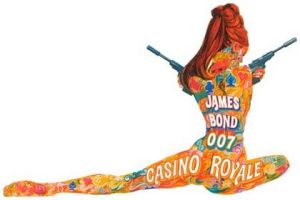
Feldman’s vision of James Bond is apparent from Casino Royale’s opening credits. While the credits are definitely based on the iconic openings of the EON Bond films, they’re also designed to play up the fact that Casino Royale — in the grand tradition of the Hollywood studios at their most excessive — is meant to be a big budget, all-star extravaganza.
Casino Royale actually starts out with a pretty clever premise. It seems that the name “James Bond,” is simply a code name that has been assigned to several British spies over the years. As M (played by John Huston, who also directed the first third of the film), explains it, the name “James Bond” strikes such fear in the hearts of Britain’s enemies that the name must be kept alive.
(Speaking for myself, this is an idea that I kinda wish that the official James Bond series would adopt. If nothing else, it would certainly explain how Pierce Brosnan and Daniel Craig could possibly be the same person.)
The original James Bond (played by David Niven) has long since retired to his stately country estate, where he spends his time playing the piano and complaining about how the agents who have inherited his name are sullying his reputation with excessive womanizing and violence. It turns out the Sir James Bond is a man renowned for his “celibate image.” At the start of the film, Bond is asked to come out of retirement by not only M but the heads of the CIA, KGB, and French secret service as well. SMERSH, an organization of female assassins that’s led by the mysterious Dr. Noah, has been eliminating agents worldwide and only the original (and very chaste) Bond can defeat them. Bond, however, refuses and M responds by ordering a mortar attack on Bond’s estate. The estate is blown up but so is M and Bond soon finds himself returning to London as the new head of MI6.
Interestingly enough, David Niven was one of the actors who was considered for the role of James Bond in Dr. No. Reportedly, Ian Fleming was quite enthusiastic for Niven to take the role but, by the time that Dr. No went into production, Niven was considered to be too old. There’s a nice bit of irony here in seeing David Niven playing a retired James Bond who spends a good deal of the film complaining about the men who have subsequently assumed his name.
Once Niven takes over MI6, he orders that, in order to confuse SMERSH, all British agents (including female agents) will be known as James Bond. The rest of the film is divided into episodes that feature these new James Bonds battling SMERSH and the mysterious Dr. Noah.
Among these agents, there’s the handsome Coop (played by Terrence Cooper) who has been trained to resist all sexual temptations.
There’s Mata Bond (Joanna Pettet), the daughter of Sir James Bond and Mata Hari.
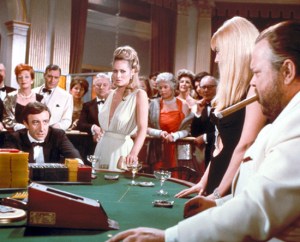
There’s Vesper Lynd (Ursula Andress) who is sent to seduce and recruit the expert gambler Evelyn Tremble (Peter Sellers) so that Tremble can beat SMERSH agent Le Chiffre (Orson Welles) at the Casino Royale.
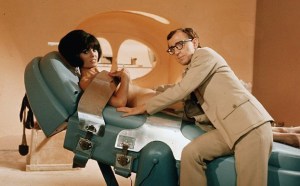
Best of all, there’s Sir James Bond’s nephew, Jimmy Bond. Jimmy Bond is played by Woody Allen and … well, let’s just take a look at Jimmy’s first scene in the film:
Casino Royale had a notoriously troubled production history and most of those troubles seemed to center on Peter Sellers. While the film was designed to be a broad, slapstick comedy, Sellers reportedly insisted on trying to play his role straight and even rewrote his lines to make his scenes more dramatic. Welles eventually grew so disgusted with Sellers that he refused to be in the same room with him. This caused quite a bit of difficulty since Sellers was in almost every scene that featured Welles. Eventually, Sellers walked off the film and the film had to be hastily (and awkwardly) rewritten to account for his sudden absence.
When one watches Casino Royale today, it’s hard to escape the conclusion that Sellers was essentially correct. While most of Casino Royale often feels disjointed and incoherent, the scenes featuring Sellers, Andress, and Welles are some of the strongest in the film. Sellers’ dramatic approach doesn’t negate the film’s comedy. If anything, it makes the comedy even stronger because Sellers actually seems to be invested in the reality his character, regardless of how ludicrous a situation that character may find himself in.
When I watched Casino Royale, I was struck by the stark contrast between the parts of the film that worked and the parts that didn’t. This is a movie that truly swings from one extreme to another. Either the film’s satire is working brilliantly (mostly in the scenes featuring Woody Allen and Peter Sellers) or it’s falling completely flat (like in an extended sequence that features Deborah Kerr as a SMERSH assassin).
I found myself laughing more at the little scenes than the big set pieces. For instance, I loved it when David Niven embraces Miss Moneypenny (Barbara Bouchet) just to be then told that she’s actually the daughter of the original Miss Moneypenny. I don’t know much about the actor Terrence Cooper (though, according to Wikipedia, he was also a contender to take the role of James Bond in the official series) but I enjoyed the brief sequence where Moneypenny “tests” him to see if he can take on the Bond identity. Unfortunately, the film doesn’t really have enough of these small, clever moments.
Ultimately, I found that Casino Royale works best when viewed as a time capsule. Casino Royale was made at a time when the established major Hollywood studios (and veteran producers like Charles K. Feldman) were struggling to remain relevant. Foreign films (including, it must be said, the James Bond films) were challenging the common assumptions of what could and what couldn’t be shown on-screen and the studio system reacted by trying to make films that would appeal to younger audiences while also reassuring older audiences that the movies hadn’t really changed that much. The end result were films like Casino Royale that featured the occasional psychedelic sequence along with cameos from old (and safe) Hollywood stars like George Raft, William Holden, and Charles Boyer. Casino Royale is the type of self-indulgent film that could only have been made in 1967 and, as such, it’s a valuable time capsule for all of us cinematic historians.
I also have to admit that, as excessive as Casino Royale may be, I happen to love excess. Casino Royale might be overlong and occasionally incoherent but the costumes are simply to die for. The film is a visual feast, if nothing else.
Casino Royale was released to scathing reviews and terrible box office but, in the years since, it has become something of a cult favorite. Our own Trash Film Guru has identified Casino Royale as his favorite Bond film. Myself, I found the film to be extremely flawed and yet oddly fascinating to watch. Casino Royale is a total mess and that is both its greatest flaw and greatest strength.
Tomorrow, we’ll return to the official James Bond series by taking a look at You Only Live Twice.