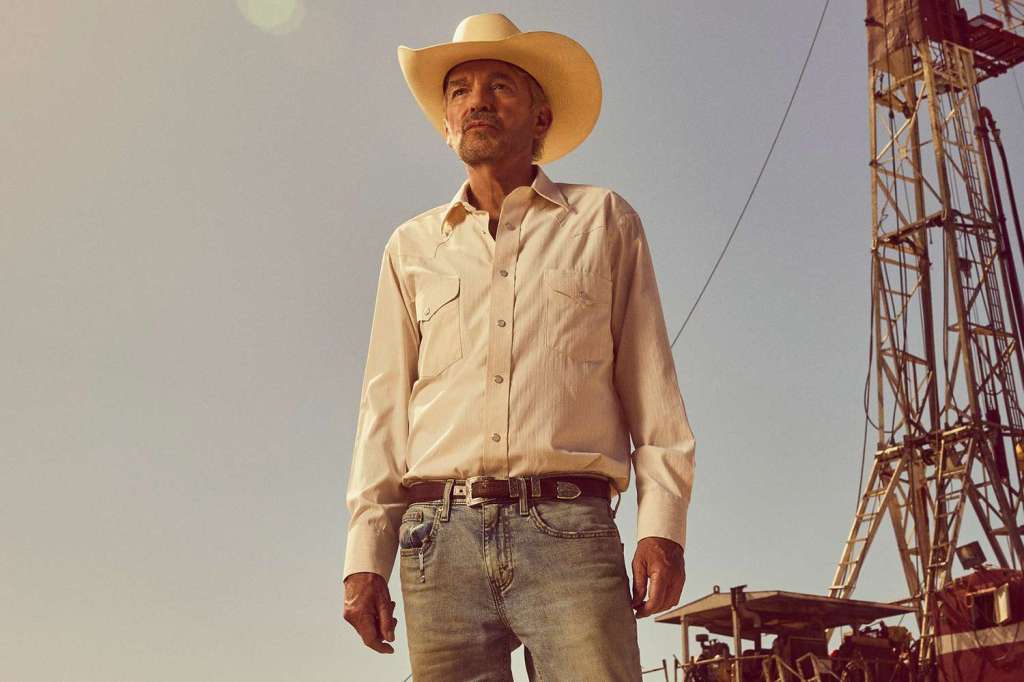
Brad’s Thoughts on Season 1 of LANDMAN, Starring Billy Bob Thornton!


Taylor Sheridan has become a fairly big part of my life over the last decade. It started when I saw HELL OR HIGH WATER in the movie theater back in 2016. It was one of my favorite movies of the year, and it was written by a guy named Taylor Sheridan. Well, the next year brought us WIND RIVER, which was both written and directed by Taylor Sheridan, and it was one of my favorite movies of 2017. Then came the series YELLOWSTONE, which was created by Taylor Sheridan and began airing in 2018. I didn’t watch the first couple of seasons, but I thought it looked good and even bought the first season on DVD when I saw it for sale at Wal Mart. When my wife Sierra came home from performing her nursely duties at the hospital and told me that everyone was saying that we needed to watch YELLOWSTONE, I informed her that I just so happened to own Season 1 on DVD. So, we popped it in the DVD player, and we were soon obsessed with the world of the Duttons. My wife took special joy in the characters of Beth (Kelly Reilly) and Rip (Cole Hauser), while John Dutton (Kevin Costner) and Rip kept my attention. I’ll admit that it scared me a little bit that Sierra enjoyed Beth so much, and I’m glad to report that, up to this point, she has not started trying to emulate her actions in real life!

When YELLOWSTONE ended its run at the end of 2024, the Paramount network was putting a major marketing push into their latest “Taylor Sheridan” series, that being LANDMAN, which had started its first season around the same time YELLOWSTONE was wrapping up its final season. I’m a huge fan of actor Billy Bob Thornton, so the fact that he was headlining a series set in Texas oil country automatically piqued my curiosity. Not ready to commit to 10 hours’ worth of LANDMAN episodes quite yet, we put the show on the backburner for a bit, knowing that we could jump in and watch it whenever we wanted to. Well, this past weekend, we got snowed in here in Central Arkansas, so I asked Sierra if she’d like to watch a few episodes of LANDMAN. Needless to say, over the course of the day we watched every episode of Season 1. I really enjoyed the first season and decided to share some of my thoughts with you.

First off, if I’m going to commit to watching 10 hours’ worth of anything, I need to really like at least some of the characters. I don’t just like Billy Bob Thornton’s portrayal of the “Landman” of the title, his Tommy Norris is now one of my favorite characters that he’s ever played. He’s the ultimate realist, because no matter what situation he finds himself in, whether he’s dealing with the head of a drug cartel, the head of his oil company, or his ex-wife, he tackles every situation by uniquely framing the specific issues in a matter of moments and then providing solutions that appeal to his audience’s most base instincts. Alternatively hilarious, serious, heartbreaking and genius, Thornton gives a masterful performance that I don’t think anyone else could have pulled off any more effectively. His ex-wife Angela (Ali Larter) is probably the toughest of all for him to deal with as his own sense of self-preservation seems to go out the window whenever she’s around. Ali Larter’s performance as Angela is loud, brash, attention-seeking, hypersexual, and every so often, just vulnerable enough that you can kind of like her. I think she’s great, and quite sexy, in the role. Michelle Randolph and Jacob Lofland get a lot of screen time in the first season as their children, Ainsley Norris and Cooper Norris. Michelle is cute and spunky, definitely her mother’s daughter, but she also loves her dad so much. I like her. Lofland, who, like Thornton, is from my state of Arkansas, has a meatier role, having to deal with tragedy from the very beginning and then serious family drama as the season plays out. It’s not a showy role, but he does a solid job. The other performance that I really enjoy throughout season 1 comes from Jon Hamm as the head of the oil company, Monty Miller. I kept referring to him as J.R. Ewing as I watched because he’s the big boss. He’s the person that Tommy Norris calls when he can’t solve their problems. Unlike J.R. Ewing, although Miller is a tough businessman, he’s also a committed family man who tries to be there for his wife Cami (Demi Moore) and their daughters when they need him. He is as hard-nosed as it gets in his business dealings, though, and it’s easy to see why he had emerged as the main guy over Tommy. I did want to shout out the actors Colm Feore, James Jordan and Mustafa Speaks as various employees of the oil company who provide different elements of humor and toughness to the proceedings over the course of the season. Finally, as far as the primary cast, while prominently credited throughout the first season, Demi Moore has relatively little to do until the very end of season 1. If you’re a big fan of hers, just know that going in. Her character seems primed to be a big part of season 2, though, so it will be interesting to see where that goes.

Second, like with any popular dramatic TV series, LANDMAN Season 1 contains some storylines that I really enjoy, while there are some that I don’t really care for. Where LANDMAN really works for me is when it features Billy Bob Thornton’s Tommy Norris as a fixer of some sort. It was in these storylines that we get to see his ability to use his intelligence, communication skills, and understanding of human nature to come up with solutions that are best for everyone. It might not always be easy, and he might have to take a beating every now and then, but Tommy knows how to get things done, and the show is at its best when it’s focused on him. We see this throughout season 1 as Norris deals with a variety of cartel henchmen, hotshot attorneys, and unhappy leaseholders in order to advance his company, M-Tex’s interests. There are also a few badass moments when it becomes clear that talking won’t get the job done, and even more direct methods will have to be used to get his point across. This usually happens when Tommy’s feeling the need to protect his children. If there is a weakness to the show, for me, it’s the fact that when Tommy Norris isn’t part of the proceedings, I don’t like it nearly as much. For example, while scenes involving Jacob Lofland’s character, Cooper, and the recently widowed young mother Ariana (Paulina Chavez), whose husband was an employee of the company, ramp up the melodrama, they also take up a lot of time, and I don’t find them very appealing. The same can be said when Ali Larter’s character, Angela, and her daughter Ainsley, decide they’re going to volunteer at a nursing home, and then proceed to hook the residents up with alcohol and even take them to a strip club. While I smiled at some of the proceedings, they weren’t realistic and didn’t really add anything to the story. I even found myself worrying about some of the residents, I mean, I’m sure some of their medication was NOT compatible with tequila! I’m guessing that these quibbles really just come down to a matter of personal preference, as I’m sure there are some who enjoy these moments more than I do. I will admit that these scenes are well-acted and performed even if they’re not advancing my favorite parts of the story.  

Overall, I really enjoyed season 1 of LANDMAN, and I’m looking forward to jumping into season 2 soon, which is now streaming. The last couple of episodes of season 1 introduced or elevated some very interesting characters who will have more prominent roles moving forward (played by Andy Garcia and Demi Moore), and peaking ahead, season 2 also appears to have some interesting additions to the cast (I’m looking at you Sam Elliott). I’m looking forward to the next 10 hours of fun!

Film Review: Maze Runner: The Death Cure (dir by Wes Ball)


Here are a few good things about Maze Runner: The Death Cure.

First off, and most importantly, Dylan O’Brien is still alive.  When The Death Cure first went into production way back in 2016, O’Brien was seriously injured on the set.  While it’s never really been disclosed just how serious the injuries were, they were bad enough that it took O’Brien several months to recover.  There was even some speculation that his career might be over.  Fortunately, that wasn’t the case.  Last year, O’Brien returned to the screen and gave a superior performance as the lead in American Assassin.  In The Death Cure, O’Brien returns as Thomas and even if the character is still a bit of cipher, O’Brien does a good job playing him.

Secondly, Gally lives!  In the first Maze Runner, Gally was a villain but, because he was played by Will Poulter, he was also strangely likable.  Maze Runner was the first film in which I ever noticed Will Poulter and I have to admit that I’ve always felt that both the actor and the character deserved better than to be casually killed off at the end of the first movie.  Since Maze Runner, Poulter has given great performances in both The Revenant and Detroit.  (He was also briefly cast as Pennywise in It, though the role was ultimately played by Bill Skarsgard.)  In The Death Cure, it is not only revealed that Gally is still alive but he also finally gets to be one of the good guys.

Third, the Death Cure confirms what I felt when I first saw The Maze Runner.  Wes Ball is a talented director.  Despite whatever narrative flaws that the Maze Runner films may have, they’re always watchable.  Death Cure opens with a genuinely exciting action sequence and there are more than a few visually striking shots.

Fourth, Death Cure actually ends the Maze Runner saga.  That may sound like a strange or back-handed compliment but it’s not.  Death Cure resists the temptation to try to milk more money out of the franchise by unnecessarily splitting the finale in two.  I’ve always felt that The Hunger Games made a huge mistake with its two-part finale.  (The first part was good but the second part dragged.)  Divergent appears to be destined to be forever unfinished because the first part of it’s two-part finale bombed at the box office.  Death Cure refuses to indulge in any of that nonsense.  Unfortunately, this also means that Death Cure ends up lasting an unwieldy 142 minutes but still, that’s better than forcing the film into two parts.  With the current YA dysptopia cycle winding down, now is the right time to end things.

Finally, I appreciated the fact that the bad guys in Death Cure were named WCKD.  There’s nothing subtle about that but this isn’t a movie the demands subtlety.  As opposed to many other films based on dystopian YA fiction, The Maze Runner films have always been aware of just how ludicrous they often are.  Unlike the Divergent films or The Fifth Wave, the Maze Runner films have always been smart enough not to take themselves too seriously.

Anyway, as for Death Cure itself, it’s big and noisy and your enjoyment will largely depend on how much you remember about the first two films.  It’s been nearly three years since The Scorch Trials came out, which is an eternity when it comes to a franchise like Maze Runner.  Death Cure pretty much jumps right into the action and if you don’t remember all of the details from the first two films … well, good luck getting caught up!  (Unfortunately, it doesn’t help that, while the first movie was fun, Scorch Trials was a lot easier to forget.)  It’s pretty much a typical tale of YA dystopia, complete with tragic deaths, shocking betrayal, and a chosen one.  If you’re a fan of the previous two films or the books, you’ll probably enjoy Death Cure.  For the rest of us, it’s a bit of a confusing ride but at least there’s a lot of up-and-coming talent on display.

Lisa’s Homestate Reviews: Arkansas and Mud


Mud

When it comes to Arkansas, people seem to automatically think of two things.  Arkansas is the former home of Bill and Hillary Clinton and it’s also the state that accused three teenage boys of committing horrific acts of murder, largely on the basis of the fact that one of the boys used to dress in black and listen to heavy metal music.  Between the state’s largely rural image and repeat showings of Paradise Lost on HBO, Arkansas does not exactly have the best reputation.

Myself, I have a lot of childhood memories of Arkansas.  Some of them are good and some of them aren’t so good. My grandmother lived in Fort Smith so, even when my family was living in another state, we would still always find the time to come visit her every summer.  As well, I had (and still have) cousins spread out all over the state.  Almost every road trip that I’ve ever taken has involved at least a few stops in Arkansas.  When I think about Arkansas, I don’t think about the Clintons or Damien Echols.  Instead, to me, Arkansas is where I used to get excited whenever I saw we were approaching grandma’s house and where my mom once grabbed me right before I stepped on a snake that was hidden in the high grass that surrounded my cousin’s farm.

As often as I visited Arkansas while I was growing up, I also actually lived there twice.  I don’t remember the first time, because I was only two years old at the time, but my family spent 3 months living in Ft. Smith before going back to Texas.  Then five years later, we returned to Arkansas and, over the course of 19 months, we lived in Texarkana, Fouke, Van Buren, North Little Rock, and, finally, Ft. Smith once again.

Originally, for Arkansas, I was planning on reviewing The Legend of Boggy Creek, a 1974 psuedo-documentary that deals with a bigfoot-like creature that was said to live near the town of Fouke.  It made perfect sense as not only was The Legend of Boggy Creek filmed in Arkansas but it was produced by an Arkansan as well.  It remains one of the most financially successful independent films of all time and, because it’s presented as being a documentary, it features authentic Arkansans in the cast.  Even more importantly, my family actually lived in Fouke from August of ’93 to May of ’94.  I’ve been down to Boggy Creek!  (Though, to the best of my memory, the monster never made an appearance while we were living in Fouke.)

But then I thought about it and something occurred to me.  The Legend of Boggy Creek is not that good of a movie.  I watched it a few weeks ago and, once I got passed the fact that it was filmed in a town that I have vague memories of living in back when I was seven years old, I found the film itself to be almost unbearably dull.

So, instead of unleashing my snark on a 40 year-old exploitation film, I’m going to use this opportunity to recommend another film that was shot in Arkansas.  This film, however, was one of the best films of 2013.  It’s a film that, if you haven’t watched it yet, you owe it to yourself to see.

It’s a film called Mud.

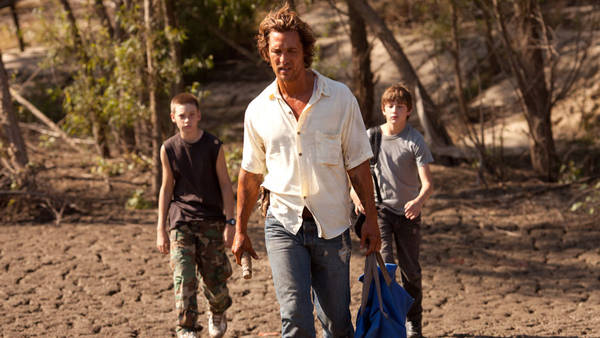
Directed by Jeff Nichols (who previously gave us the excellent Take Shelter), Mud takes place in the town of DeWitt, Arkansas.  Two teenage boys, Ellis (Tye Sheridan) and Neckbone (Jacob Lofland) spend their days going up and down the Arkansas River.  Ellis, the more introspective of the two, dreams of escaping his homelife with an abusive father (Ray McKinnon) and a compliant mother (Sarah Paulson).  Quietly watching over the two boys is Tom (Sam Shepard), an enigmatic older man who lives across the river from Ellis’s family.

One day, Ellis and Neckbone come across a mysterious man living on a small island.  The man’s name is Mud (Matthew McConaughey) and he tells them that he’s waiting for his girlfriend, Juniper (Reese Whitherspoon).  Mud explains that he killed a man who once pushed her down a flight of stairs while she was pregnant.  Ellis and Neckbone agree to help Mud, secretly supplying him with food and delivering notes from him to Juniper.

However, the father (Joe Don Baker) of the man who Mud killed has arrived in town as well.  He’s brought an army of mercenaries with him and, each morning, he gathers them together for a quick prayer and then sends them out to track down and kill Mud…

Mud is a wonderful film, one that is full of visually striking images and excellent performances.  (If Dallas Buyers Club hadn’t come out later that same year, Matthew McConaughey could have just as easily been nominated for his charismatic and sympathetic performance here.)  Even more importantly, the film is full of authentic local culture and color.  If, decades from now, someone asked me what Arkansas was like in the early 21st Century, Mud is the film that I would show them.

Much as how Richard Linklater can capture Texas in a way that a non-Texan never could, Mud is fortunate to have been directed by a native of Arkansas.  Watching Mud, it quickly becomes obvious that Jeff Nichols knows and understands Arkansas and, as such, he presents an honest portrait of the state.

Every state should hope to inspire a film as well-made and entertaining as Mud.