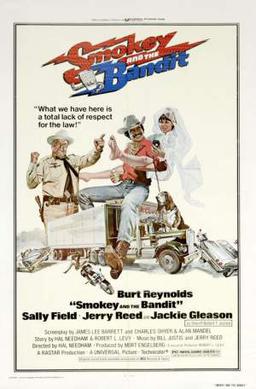
In honor of National Speed Limit Day, today’s scene that I love features Burt Reynolds breaking the speed limit over and over again in 1977’s Smokey and the Bandit. This scene is almost enough to make me want to go on a road trip.
In honor of National Speed Limit Day, today’s scene that I love features Burt Reynolds breaking the speed limit over and over again in 1977’s Smokey and the Bandit. This scene is almost enough to make me want to go on a road trip.
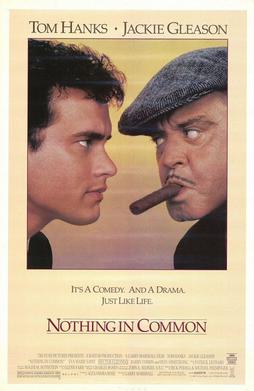 Tom Hanks plays David Basner (Tom Hanks), an advertising executive whose immature lifestyle gives him insight into what sells but has also left him totally unprepared to deal with the fallout when his mother (Eva Marie Saint) leaves his father, Max (Jackie Gleason). David, who is struggling to come up with the perfect commercial for a demanding client (Hector Elizondo), has to come to terms with both his father’s bad health and his history of infidelity.
This isn’t my favorite Tom Hanks movie. It comes from that awkward period when Hanks was trying to make the transition from comedy to drama and its attempt to mix the two genres is not always successful. The scenes of Hanks at the ad agency are often so cartoonish that they don’t seem like they belong in a movie where Jackie Gleason loses a foot to diabetes and realizes that he spent his entire marriage emotionally abusing his wife. The movie, though, is worth watching for the teaming of Hanks and Gleason, two comedic actors who eventually proved themselves to equally as skilled at playing it serious. Gleason, especially, gives a strong performance. This was his final film and Garry Marshall convinced him to take it by asking, “Do you really want to go out on Smokey and the Bandit 3?” Gleason would die a little over a year after the release of Nothing In Common and this film, even if it wasn’t perfect, gave the world a chance to see what a good actor he really was.
This film is often cited as the the movie that started Hanks on the way to becoming a dramatic actor. Like Punchline, Nothing In Common played a role in Hanks becoming more than just a comedian but I think Big was ultimately the better showcase for Hanks’s ability to mix pathos with laughs. Nothing In Common was directed by Garry Marshall and, as was usually the case with Marshall, he often doesn’t trust the audience to figure things out for themselves. He goes overboard trying to force an emotional response instead of just trusting the material. Tom Hanks still does a good enough job in Nothing In Common. Hanks is as likable as always and you can see the dramatic actor emerging in Hanks’s performance even if Hanks still wasn’t totally comfortable with it.
Nothing In Common is flawed but it was definitely a better swan song for Jackie Gleason than Smokey and the Bandit 3.
The first Smokey and the Bandit is a classic. What about the sequels?
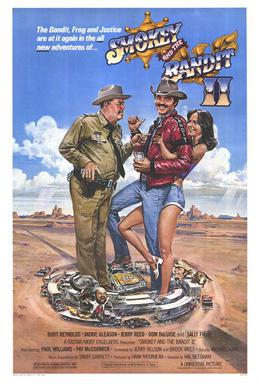
Smokey and the Bandit II (1980, directed by Hal Needham)
The gang’s all back in this sequel to Smokey and the Bandit! Burt Reynolds is the Bandit! Jackie Gleason is Sheriff Buford T. Justice and his two brothers, Reginald and Gaylord! Jerry Reed is Snowman! Sally Field is Carrie! Pat McCormick and Paul Williams are Big and Little Enos! Mike Henry is Junior! Dom DeLuise is an Italian doctor! Terry Bradshaw and Mean Joe Greene play themselves! There’s an elephant!
You get the idea. Smokey and the Bandit II promises more of the same. In some ways, it delivers. There are some entertaining stunts. The finale features what was, at the time, the biggest car chase ever filmed. But Smokey and the Bandit II fails at the most important part. It fails to recreate the fun of the first film. Everyone is just going through the motions. Burt Reynolds later said that he only made the film as a favor to Hal Needham while Sally Field said that she agreed to appear in the film as a favor to Burt Reynolds. Jackie Gleason did the movie because he needed the money but, because he was also in poor health, he requested that his scenes be filmed first and that they be filmed quickly. That the three stars didn’t have much enthusiasm for the project is obvious while watching the movie.
This time, Big Enos wants the Bandit to transport an elephant to the Republican National Convention in Dallas. The Bandit, however, has been an alcoholic wreck ever since Carrie left him to, for some reason, get back with Junior. Snowman manages to sober up the Bandit and, after they help Carrie run out on her wedding for a second time, it’s time to transport an elephant.
In hot pursuit, Sheriff Justice gets help from his brothers, all of whom are also played by Gleason. Reginald Justice is a Canadian Mountie who speaks with a posh accent that is in no way Canadian. Gaylord Justice is a flamboyant state patrolman. Whenever the brothers talk to each other, doubles are used. There are a few split screen shots that are so ineptly handled that it ends up looking like a page from a comic book with each Gleason standing in a separate panel. The end credits list Gaylord as having been played by “Ms. Jackie Gleason,” just in case you’re wondering the level of this film’s humor.
Dom DeLuise gets some laughs as an Italian doctor who is recruited to take care of the elephant but otherwise, this is a depressing movie. Burt Reynolds and Sally Field were on the verge of breaking up when this film was made and neither one of them acts their scenes with much enthusiasm. Watching the movie, it’s impossible not to compare their strong chemistry in the first movie to their total lack of it in the second movie. There’s a subplot about the Bandit trying to prove that, even though he’s getting older, he’s still a legend and, for those who know anything about Burt Reynolds’s career, it hits too close to home. Combining that with the sight of an obviously unwell Jackie Gleason and you’ve got a surprisingly depressing comedy.
There is one cool thing about Smokey and the Bandit II. After the critics thoroughly roasted the film, Hal Needham took out a one-page ad in Variety. The ad was a picture of Needham sitting in a wheel barrow full of money. That’s one way to answer your critics!

Smokey and the Bandit 3 (1983, directed by Dick Lowry)
Smokey and the Bandit 3 is even more depressing than the second film. Not surprisingly, Sally Field is nowhere to be found. She had broken up with Burt after the second film and was busy pursuing a career as the type of actress who didn’t appear in car chase films. Burt does appear in the film but he only makes a cameo appearance, showing up for a few minutes at the end with a resigned look on his face as if he realized that he was never going to escape being typecast as an aging good ol’ boy. Also not returning was Hal Needham. Needham was busy directing Stroker Ace so he was replaced by Dick Lowry. What type of director was Dick Lowry? Other than Smokey and the Bandit 3, Lowry’s best known credit is for Project Alf.
Jackie Gleason, Jerry Reed, Pat McCormick, Mike Henry, and Paul Williams all return but none of them look happy to be there. The plot is that Sheriff Buford T. Justice has retired to Florida but he just can’t turn down a challenge from Big Enos and Little Enos to drive a stuffed shark from Miami to Dallas. Smokey is the Bandit! (That was originally the title of this film.) When it looks like Buford is doing too good of a job of transporting the shark, the Enoses hire Snowman to chase Buford and slow him down. It doesn’t make any sense and Jerry Reed and Jackie Gleason don’t share any scenes together despite co-starring in the film. Supposedly, Gleason was originally cast as two characters — Buford and the man hired to slow Buford down — but when preview audiences were confused by the film, the studio demanded reshoots. Jerry Reed was brought back and all of the scenes featuring Gleason as the new Bandit were reshot with Reed. Reed even grew a mustache, wore a red shirt, and broke the fourth wall just like Burt did in the first film.
Not surprisingly, Smokey and the Bandit 3 is a disjointed mess that doesn’t even have any spectacular car crashes to justify its existence. Jerry Reed is as amiable as he was in the first two films but Jackie Gleason’s Buford Justice was never meant to be a lead character. In small doses, he was funny but Buford was too one-dimensional of a character to build an entire film around.
Smokey and the Bandit 3 was a failure with critics and at the box office so the Bandit’s adventures came to a temporary end. Years later, Hal Needham produced four made-for-TV prequels the starred Brian Bloom as a young Bandit. I haven’t seen them. If I ever do, I’ll review them.

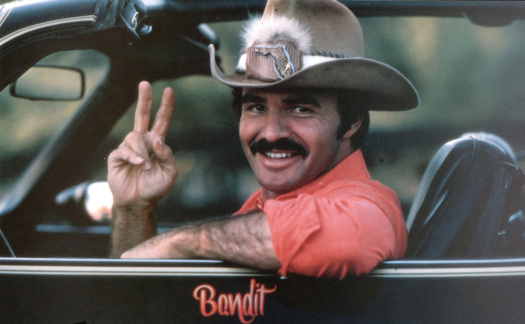
Smokey and the Bandit is a simple film. Burt Reynolds is the Bandit. He’s hired by two bored brothers to smuggle beer from Texas to Georgia. Working with the Snowman (Jerry Reed), Bandit is easily able to pick up the beer but it’s while driving back that the two of them run afoul Smokey, a.k.a. Sheriff Buford T. Justice (Jackie Gleason, who reportedly improvised most of his profane lines). Bandit also picks up a hitchhiker and runaway bride (Sally Field) who he calls Frog.
There’s not much to Smokey and the Bandit. The Bandit has an incredibly cool car and he drives really fast. Snowman is funny and has a dog. Smokey has a dumb son and is constantly threatening to hit people. It’s a dumb movie but it works. The cars are fast, the crashes are spectacular, and the entire film is the perfect daydream for when you’re sitting in your office at work and wondering whether there’s something more rewarding you could be doing with your life.
Who hasn’t wanted to the Bandit at some point in their life?
Who hasn’t wanted to get behind the wheel of black trans am and just take off, driving down country roads while giving the slip to old Smoky and joking with Snowman on your CB radio and maybe picking up a young Sally Field while smuggling beer and winning a bet?
(There’s been a lot of terrible moments on The Family Guy but, for me, one of the absolute worst was when Brian Griffin went into the past and asked 70s Burt Reynolds, “So, you’re going to go get some of that hot Sally Field action, huh?” Anyone who has seen Smokey and the Bandit knows that Sally Field was smoking hot back in 1977!)
Smokey and the Bandit comes to us from a different time. No one worries about what speeding halfway across the country in a little over 24 hours is doing to the environment. No one apologizes for who they are or where they’re from. The Bandit lives by a simple rule: Treat him with respect and he’ll treat you with respect. Talk down to him or try to tell him what to do and the Bandit’s just going to jump in his car and leave you standing in a cloud of dust.
During the latter part of his career, Burt Reynolds would often lament that appearing in financially successful but critically lambasted films like Smokey and the Bandit made him a huge star but also kept him from getting the type of roles that he felt he deserved. Reynolds was right but there are worse things than being known as The Bandit. For many, Burt Reynolds will always be the Bandit because he was so perfectly cast for the role. Not many actors could pull off the scene where, after fooling a cop, the Bandit looks straight at the camera and grins. Burt Reynolds could. Playing the Bandit may have never won Burt Reynolds an Academy Award but it did make him an American icon.
If you’re feeling down, watch Smokey and the Bandit. If you need an escape, watch Smokey and the Bandit. It demands so little and gives so much.
Welcome to Noirvember!
Yeah, yeah, I know. That sounds kinda silly, doesn’t it? However, November is traditionally the month that classic film bloggers tend to concentrate on writing about film noir. It provides a bit of grit and cynicism in between the horror fun of October and the holiday schmaltz of December.
I have to admit that I’m a little bit torn when it comes to taking part in Noirvember. On the one hand, I love a good film noir and there’s quite a few obscure and underrated ones available on YouTube right now. On the other hand, as a natural-born contrarian, I don’t like the idea of hopping on any bandwagons.
In the end, my love of film noir won out. So, welcome to my first entry in 30 Days of Noir.

The 1942 film, Lady Gangster, opens with Dot Burton (Faye Emerson) walking up to a bank. She’s carrying a small white dog with her. Though the bank isn’t due to open for another 30 minutes, she explains to the bank guard that she’s got a train to catch and she simply has to deposit a check. The guard unlocks the door and lets both her and her dog inside.
While filling out her deposit slip, Dot puts the dog down on the floor. The dogs runs off, distracting the guard just long enough for three men with guns to slip into the bank and rob the place. Though the police quickly arrive, the men manage to escape, taking $400,000 with them.
The police are immediately suspicious of Dot, especially when she struggles to keep her story straight as to why she’s at the bank. The lead detective thinks that Dot was in on it. Dot says that she was merely out for a stroll with her dog. Dot says that her dog is named Tiny. The dog, which looks exactly like one that was recently reported missing, is wearing a collar that reads “Boots.”
The district attorney announces that Dot will be prosecuted to the full extent of the law. However, a crusading radio broadcaster named Ken Phillips (Frank Wilcox) is convinced that Dot is being railroaded. Once he realizes that he went to high school with her, Ken is even more determined to help Dot. Using the power of the airwaves, he forces the district attorney to release Dot into his custody. Once free, Dot promptly confesses to Ken that she was a part of the robbery and that she’s hidden the money. An indignant Ken turns her into the police.
So now, Dot’s in prison and no one’s sure where the money is. One of the bank robbers even dresses up like a woman so that he can see Dot on visiting day but she refuses to tell him anything. Dot isn’t going to reveal where the money is unless it means she can also get parole. She needs to get released soon because she’s already got two psychotic snitches targeting her.
Fortunately, Ken has had a change of heart and is lobbying for her release. Unfortunately, Dot has been tricked into believing that Ken has once again betrayed her so, naturally enough, she sets him up to be murdered. When Dot discovers that she’s been fooled, can she find a way to warn Ken before it’s too late?
Believe it or not, all of this happens over the course of 62 minutes. With that many betrayals, twists, and crimes packed into that short of a running time, there’s never a dull moment in Lady Gangster. Though the film itself is full of huge plot holes and Frank Wilcox is a bit of a stiff as Ken, the film is totally worth seeing for Faye Emerson’s ferocious performance as Dot Burton. Dot is a force of nature. When the robbers try to steal her money, Dot instead steals from them. When Dot believes that Ken has betrayed her, she sets him up to be murdered with a moment of hesitation. When Dot discovers that Ken didn’t betray her, she immediately starts scheming to prevent the murder that she arranged. Even when Dot confesses to being a part of the robbery, she does it on her own terms. Nobody tells Dot what to do and, in that way, she represents the best of America. As Dot herself explains it, “I’ll play ball with anyone but Hitler.”
The film has a rather odd ending, one that makes you wonder just how forgiving people generally were back in 1942. But no matter! Lady Gangster is a quickly paced movie that’s just melodramatic enough to be enjoyable. It’s in the public domain and on YouTube. Watch it for Faye Emerson’s performance.
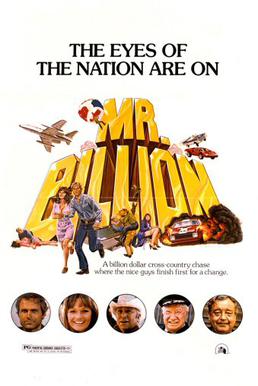
The 1977 film Mr. Billion tells the story of Gudio Falcone (played by Terence Hill, whose real name is Mario Girotti). Guido has got a pretty good life going in Italy. Everyone in his village loves him. He works as an auto mechanic. When we first see him, he speeding around in a red sportscar. When he returns to the garage, he smiles and says, in Italian, “Just like Steve McQueen.” Guido may not be rich but he’s happy.
But that’s all about change!
Well, not the happy part. Guido is pretty much always happy. But he’s about to get rich. It turns out that Guido is the last surviving relative of Antonio Falcone. Years ago, Antonio immigrated to America and founded Falcon Motors. The company eventually made Antonio one of the richest men in the world. Unfortunately, the big Falcon Motors sign eventually fell off the company’s headquarters and it landed right on top of Antonio.
Everyone’s upset about Antonio’s death. Well, everyone but the company’s vice president, John Cutler (Jackie Gleason). John was naturally expecting that he would be named Antonio’s successor and that he would also inherit all of Antonio’s money. Instead, Antonio’s will leaves everything to Guido!
Why?
Because, apparently, Guido never asked Antonio for anything more than a “pair of American cowboy boots.”
Cutler and his sleazy attorney (William Redfield) are soon on the next flight to Italy. When they find Guido, they make sure to compliment him on his cowboy boots. They explain to Guido that he has twenty days to go San Francisco and sign the proper papers. If he’s any later than 20 days he’ll lose the money. Of course, that shouldn’t be a problem since Guido can fly over anytime that he wants…
Except Guido refuses to fly! No, he says that if he’s going to go to America, he’s going to arrive there the same way that Antonio did. He is going to take a boat to New York City and then ride a train all the way to California.
Did you guess that the very next scene would be Guido standing on the dock of a cruise ship, staring at the Statue of Liberty? And did you also also guess that, upon disembarking, he would immediately find himself besieged by reporters, one of whom declares him to now be the world’s most eligible bachelor? If so, good work.
But here’s the big question. Did you also predict that John Cutler would attempt to sabotage Guido’s trip to California and that the sabotage would involve hiring a private detective (Valerie Perrine)? Even more importantly, did you predict that the detective would eventually end up falling in love with simple but honest Guido?
Because that’s totally what happens!
At the time that Mr. Billion was made, Terence Hill was a huge star in Europe but was barely known in the United States. He was best known for appearing in a series of comedic Spaghetti Westerns with Bud Spencer, the majority of which featured Hill as a lazy but likable ne’er do well. In Mr. Billion, Hill is cast as the exact opposite, as an earnest man-of-the-people who is so nice that it’s almost painful. Add to that some major tone problems (the film cannot make up its mind if it wants to be a comedy, an action film, or a romance) and you have a pretty forgettable movie.
And that’s kind of a shame because Terence Hill showed some legitimate charm in the lead role. The role may have been underwritten but all Hill had to do is flash that winning smile and it didn’t matter. It’s unfortunate that Hill didn’t get a more appropriate vehicle for his American debut.
 For my final Oscar-nominated film of the night, I watched the 1961 film The Hustler.
Filmed in harsh black-and-white and featuring characters who live on the fringes of conventional society, The Hustler is one of those films that’s so unremittingly bleak that it would probably be so depressing as to be unwatchable if not for the talented cast. Paul Newman plays “Fast Eddie” Felson, a pool hustler who is talented but cocky, a guy who has the talent of a winner and the self-centered, self-pitying personality of a loser. When we first meet Eddie, he and his manager, Charlie (Myron McCormick) have traveled all the way from Oakland to New York, all so Eddie can challenge and hopefully beat the legendary pool player Minnesota Fats (Jackie Gleason). Eddie does get his chance to challenge Minnesota (or perhaps I should call him Mr. Fats?) and comes close to winning. However, in the end, Eddie is too arrogant and impulsive and he ends up losing to Mr. Fats.
Defeated and humiliated, Eddie is hiding his meager possessions in a storage locker at the local bus station when he first meets Sarah Packard (Piper Laurie). Sarah is an alcoholic and an aspiring writer. She claims to be a part-time student but we never actually see her in class. She walks with a pronounced limp and she has a habit of declaring the world to be “perverted, twisted, and crippled.” Soon, she and Eddie are living together, two lost souls who support and destroy each other at the same time. When Sarah attempts to write a short story about Eddie, Eddie responds by destroying the page and ordering her to never write about him again. Charlie views Sarah as a destructive influence and decides that he doesn’t want to have anything else to do with Eddie.
However, Eddie soon finds a new manager. Bert Gordon (a demonic George C. Scott) is a gambler who says that if Eddie sticks with him, Eddie will not only get rich but he’ll defeat Minnesota Fats as well. At first, Eddie wants nothing to do with Bert but, when his own attempts at hustling lead to him getting his thumbs broken, Eddie has a change of heart. Under Bert’s guidance, Eddie find success but he does so at the expense of what little decency that he had to begin with…
Eddie is an interesting character, one who most viewers will probably have mixed feelings about. On the one hand, he’s a jerk. He’s an arrogant, cocky jerk who thinks that he’s the best and who either uses or allows himself to be used by almost everyone that he meets. Though he definitely ends up being exploited by Bert, Eddie knew what he was getting into when he made his deal with the devil. Though he loves Sarah and she loves him, Eddie still treats her poorly. There are just so many reasons to dislike Eddie Felson.
Except, of course, Eddie Felson is played by Paul Newman.
Seriously, it is possible to dislike a character played by Paul Newman? As an actor, Newman was so charismatic and projected an innate goodness that came through even when he was playing a character who didn’t always do nice things. As written, the character of Eddie spends the majority of the movie acting like a louse. But, as played by Newman, Eddie becomes a wounded anti-hero, the bad boy that every girl dreams of somehow redeeming.
Ultimately, there are many reasons to see The Hustler. Gleason and Laurie both give good performances. George C. Scott, meanwhile, is like a force of nature. Just listen to him as he shouts, “You owe me money!” Director Robert Rossen finds an odd beauty in some of the sleaziest parts of New York City. But, in the end, the main reason to see The Hustler is for Paul Newman’s amazing performance in the title role. It’s a great performance that elevates the entire film.
I have to admit that I don’t know much about pool. During my first college semester, I lived in a dorm that had a pool table in the front lobby. There was always a large group of people gathered around that table, playing pool and generally looking like a bunch of hipster douchebags. Sitting in the lobby meant having to listen to a constant soundtrack of balls clacking against each other, followed by people saying, “Such-and-such in the corner pocket” or whatever the Hell it is people say when they’re playing pool. (To be honest, though I could hear the voices, I rarely listened to what they were actually saying.) I don’t know if the people playing pool in the lobby were any good. But, after seeing The Hustler, I can say that Eddie Felson would have beaten all of them.
 Through the Shattered Lens