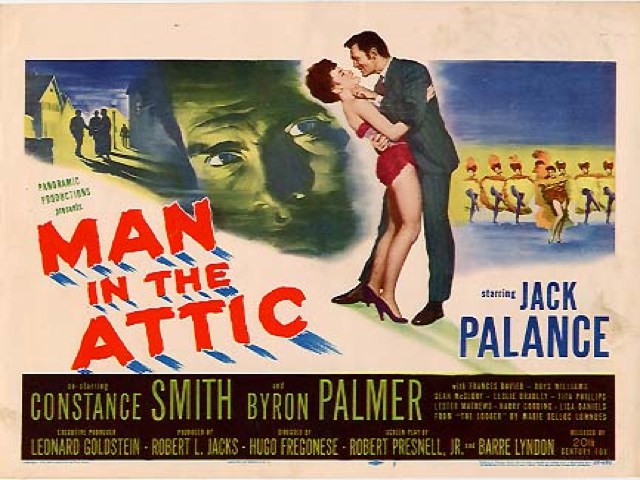
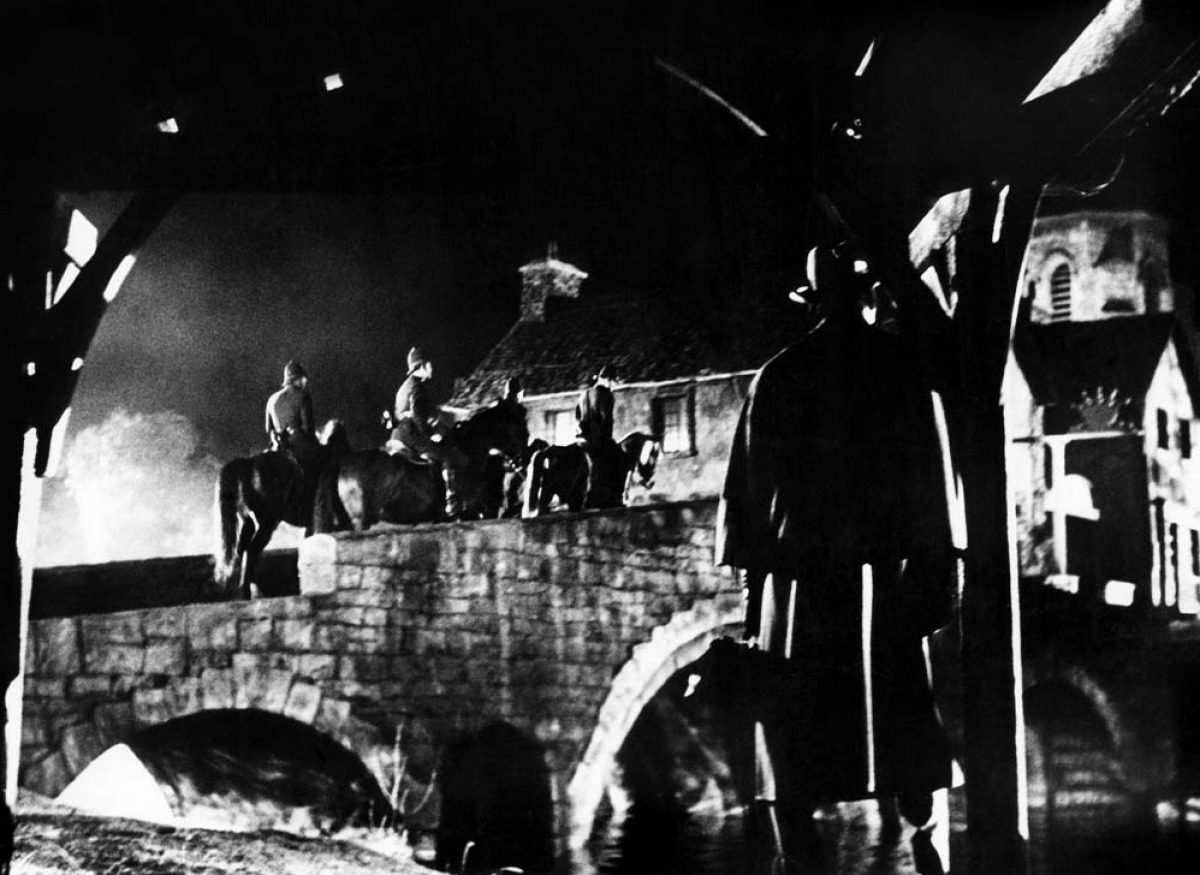
The story of notorious 19th Century serial killer Jack the Ripper has been told countless times on the screen. The case has never been officially solved, and there are probably more theories about Jack’s identity than there were victims. Author Marie Belloc Lowndes wrote “The Lodger”, a speculative fiction novel based on the Ripper murders, that was in turn made into a silent film by the Master of Suspense, Alfred Hitchcock in 1927. The film was remade in 1932 with the same star, Ivor Novello, then again in what’s probably the most famous version, 1944’s THE LODGER , starring Laird Cregar, Merle Oberon, and George Sanders. Almost a decade later, the tale was again remade, this time with Jack Palance as the mysterious MAN IN THE ATTIC.
Fog shrouded London’s Whitechapel District is being terrorized by a fiend known in the press as Jack the Ripper. Scotland Yard is baffled, police patrols have been…
Hi there! Well, as of my birthday yesterday, I am now officially an adult. What does that mean for this site? Well, for the most part, it means that I’m going to be even more aggressive about giving my opinion. After all, I’m an adult now. Whatever I say matters, no matter how weird or random it may be! In fact, I’m such an adult that I’m not even going to worry about proofreading these posts anymore. Adults don’t have to worry abut makin typos.
So, what is Lisa’s editorial corner? Well, it’s a new weekly feature where I talk about whatever caught my eye during the previous week. Basically, it’s a way for me to embrace my inner know-it-all. Fear not, I’m going to keep it entertainment-related. You don’t have to worry about me using this feature to try to convince you to vote for Gary Johnson in 2016. (At least not yet…)
For instance, I might use this feature to talk about Gunnar Hansen…
On Gunnar Hansen and Andrew Bryniarski
On November 7th, Gunnar Hansen passed away from pancreatic cancer. He was 68 years old. When I first heard the news, I was out with my friends in the SBS (and I’ll explain what that stands for at a more appropriate time) and we were celebrating my upcoming birthday. I spent the day after that with my family and then it was Monday and it actually was my birthday and … well, long story short: I’ve only now gotten a chance to write about his passing on this site. And I feel really guilty about that because Gunnar Hansen was an iconic figure in film history.
Who was Gunnar Hansen? Well, you probably already know. He was Leatherface in the original Texas Chainsaw Massacre. Beyond that, he was also a teacher, a writer, an acclaimed poet, and reportedly one of the nicest guys that you could ever hope to meet. I never met Gunnar but every story that I’ve ever heard about him — whether it was from someone who met him at a convention or someone who knew him outside of the world of horror fandom — has been a positive one. As well, I’ve read many interviews with Hansen about the making of Texas Chainsaw and he always came across as being a very intelligent and well-spoken individual.
And it’s often overlooked just how good a performance that Hansen gives in Texas Chainsaw Massacre. Hansen may have been cast because of his large frame and he may have had to perform underneath a mask but he still turned Leatherface into a genuine character. It’s often overlooked that, out of the entire cannibal family, Leatherface is the only one who has any real responsibilities. He’s just trying to prepare everyone’s dinner and he keeps getting interrupted! No wonder he eventually ends up sitting down and slumping in frustration.
Now, upon until a few hours ago, I had absolutely no idea who Andrew Bryniarski was. Do you know who he is? Here’s a picture of him, with Gunnar Hansen:
Gunnar is on the right.
Why are Andrew and Gunnar posing together? Because Andrew played Leatherface in 2003 remake of Texas Chainsaw and in 2006’s Texas Chainsaw Massacre: The Beginning.
And here is what Andrew said on Facebook after several people tagged him in posts about Gunnar’s death:
Seriously, Mr. Bryniarski? Now, before you think that he “misspoke” or any of that, he went on to double down on his comments. When someone pointed out that, if not for Gunnar, Bryniarski would have never played Leatherface, Bryniarski wrote back, “I played the role twice without him.” Bryniraski then told another FB user to “suck Gunnar’s dead nutz.”
Seriously — what the Hell!?
For what it’s worth, Bryniarski has an official response to everyone who is upset with him. You can check it out here. As far as I can tell, it appears that he feels that, while promoting Texas Chainsaw 3D, Gunnar criticized the way that he played Leatherface.
There’s probably more to it than that but … well, it really doesn’t matter. If you’re going to speak ill of the dead, you better have a hell of a better reason that professional jealousy. End of story. Bryniarski’s comments and the outrage that greeted them only serve to remind us that Gunnar Hansen was a class act.
Gunnar Hansen, R.I.P.
On Jack The Ripper
Over 4 years ago, when I reviewed Murder By Decree, I wrote about my fascination with the unsolved case of Jack the Ripper. Well, after all this time, I’m still fascinated. So, needless to say, when I read that an Australian professor named Richard Patterson was convinced that he had figured out the identity of Jack the Ripper, I was intrigued.
Then I found out that Patterson thought that poet Francis Thompson was the murderer and I promptly yawned.
Poor Francis Thompson.
Seriously, most evidence (as opposed to the speculation of people who have seen From Hell) indicates that Saucy Jack was probably some psycho who lived on the margins of society. He got away with his murders because he committed them in 1888, a time when just taking fingerprints was considered to be advanced forensic science. He was never caught, he died in obscurity, and no one knows his name.
However, that’s no fun! Why spend so much time researching Jack the Ripper if the final solution is just going to be some creep that nobody’s ever heard of!? That’s why it seems the almost every Victorian of any sort of renown has, at some point, been accused of being the Ripper. Oscar Wilde, Lewis Carroll, Francis Thompson, and the painter Walter Sickert — all of them have been accused and, amazingly, all of them have had their creative work cited as evidence of their guilt.
You have to wonder if, 100 years from now, amateur criminologists will insist that Stephen King was responsible for every unsolved murder in New England…
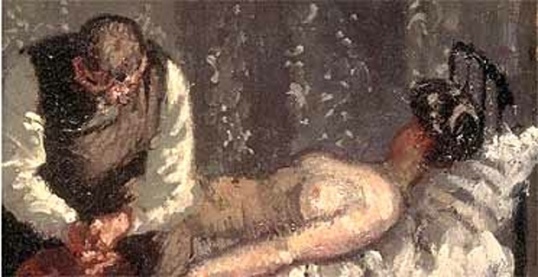
Speaking of Walter Sickert…
Here’s one of the infamous painting that’s always cited by people who are convinced that he was Jack The Ripper:
Why not listen to a little music before you leave?
Hey — did you know that I have a daily music blog? Check it out: Lisa Marie’s Song of the Day! This is the song that I shared on my birthday because a lot of people have told me that it might as well be about me:
You know what you should do now?
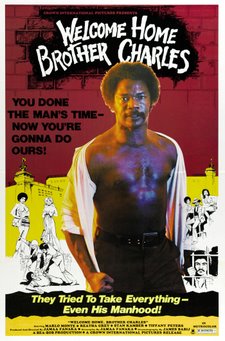
Since it’s the day after my birthday and all, why not go read the first review that I ever wrote for this site? Check out my thoughts on a strange little film called Welcome Home, Brother Charles.
Of all of the world’s real-life monsters, Jack the Ripper is one of the most iconic. Whether it’s because he was never actually caught or because he committed his savage crimes during an era that we associate with emotional and sexual repression or maybe just because he has a memorable name, Jack the RIpper continues to both fascinate artists of all genres and haunt the nightmares of viewers and readers like me.
Tonight’s episode of televised horror on the Lens deals with Jack the Ripper. This episode of Thriller was originally broadcast on April 11, 1961 and is based on a short story by Robert Bloch. It was directed by actor Ray Milland.
Without further ado, here is Yours Truly, Jack the RIpper…
Hi! Are y’all enjoying the Olympics? I’m not but I’m still occasionally watching them and asking myself questions like, “Why do male beach volleyball players actually get to wear clothes while competing?” and “Are there any countries other than America, Great Britain, and China competing this year?” Seriously, if you were just to judge from the coverage on NBC, it would appear that the USA is the only team competing in the majority of the events. It’s a bit unfair to those of us who, while American, are also proud of the fact that our ancestors came from Ireland, Italy, Spain, and Germany.
Therefore, this edition of Lisa Marie’s Favorite Grindhouse and Exploitation Film Trailers is dedicated to those countries that are being ignored by NBC (and probably the BBC as well). I’m talking about such worthy countries as Albania, San Marino, and especially the beautiful island republic of Chacal.
Here are 6 trailers for Team Chacal.
1) Gymkata (1985)
It’s not quite gymnastics and it’s not quite karate — instead, it’s Gymkata!
2) Jack the Ripper (1976)
From director Jess Franco comes a film that’s either about Jack the Ripper or the current Mayor of London, Boris Johnson.
3) Terrorgram (1988)
The name pretty much says it all.
4) Castle Freak (1995)
I can still remember this one on HBO when I was like 12 years old. It actually gave me nightmares, it was so scary!
5) Two Evil Eyes (1990)
I’ve been planning on seeing this movie for a while now. It was directed by both George Romero and Dario Argento!
6) Goldengirl (1979)
I’ve shared this one before but, with it being the Olympic season and all, I simply had to share this trailer again. Have you figured out her secret yet?
A week ago, I had a very odd dream, one that was more disturbing than frightening. I saw myself walking down a fog-covered street in London. Simply by the way I was dressed and the distant sounds of horses crossing cobblestone streets, I knew that this was towards the end of the 19th century. I walked down the street, aware that there were people near me who I could hear but couldn’t see because of the thick fog. Finally, I reached a shabby-looking boarding house. As I watched myself starting to open the front door, I realized that, in my dream, I was Mary Kelley, the final victim of Jack the Ripper. And, by stepping into that boarding house, I was heading towards my own death. That’s when I woke up.
Over on my twitter profile, I describe myself as being a “sweet little thing with morbid thoughts.” I guess my fascination with the mystery of Jack the Ripper is an example of those morbid thoughts. Out of all of the Ripper’s victims, Mary Kelley has always been the one that I’ve felt “closest” to. She was murdered on November 9th, 1888. I was born on November 9th, 1985. Like me, she was a fallen Irish Catholic. Like me, she had red hair. While the other Ripper victims were all in their 40s, Kelley was only 25 years old and, for the longest time, I believed I was destined to die between my 25th and 26th birthdays. (I’m 25 years old so hopefully, that was just my imagination working overtime.) I think what truly made Kelly’s murder stand out in my mind is that she was killed in her own room, probably attacked while she was either asleep or passed out. Being attacked while asleep has always been one of my phobias, one of the reasons why I’m often happier with insomnia than sleep.
Still, until my dream, I had given much thought to Jack the Ripper or any of his victims for quite some time. After the dream, I ordered a copy of The Jack The Ripper Encyclopedia from Amazon and then I rewatched my personal favorite of all the Jack the Ripper films, Bob Clark’s Murder By Decree.
Released in 1979, Murder by Decree mixes the facts of the Ripper case and the fictional characters of Sherlock Holmes and Dr. Watson with the same Royal Conspiracy theory that lies at the heart of the better known film From Hell. Unlike From Hell, Murder By Decree is an almost bloodless film. Instead of emphasizing the savagery of the Ripper murders, Clark chose to focus on creating an oppresively grim and paranoid atmosphere. Whether it’s the ominous image of the Ripper’s carriage slowly moving through the London fog or Holmes’ visit to a nightmarish insane asylum, Clark’s London is a grim and forbidding dreamscape that almost seems to have sprung from some lost example of German expressionism.
Into this dark and oppressive atmosphere, Murder By Decree drops the familiar and comforting characters of Holmes and Watson (played, respectively, by Christopher Plummer and James Mason). I have to admit that I’ve never actually been able to bring myself to read any of the Holmes stories (though I’ve tried) but the characters are both so iconic that I feel as if I had. Both Holmes and Jack the Ripper are characters that everyone feels they knew about even if they’re not sure when they first heard of them. Though this might sound rather gimmicky to have these two characters meet, a good deal of the film’s strength comes from the contrast between the nostalgic innocence of Holmes and Watson and the harsh reality of Jack the Ripper’s London. By the end of the film, when Holmes’ voice cracks as he describes the conspiracy behind the Ripper movies, he’s gone from being an icon to being a stand-in for everyone who has ever been disillusioned by what they previously believed in.
Plummer makes for a surprisingly physical Holmes but he does a good job with the role, bringing a surprising vulnerability to the detective. James Mason, meanwhile, makes for a perfect sidekick and he and Plummer both have the type of chemistry that Robert Downey, Jr. and Jude Law could only dream about. The rest of the cast is made up of familiar English and Canadian character actors and they all give memorable performances. Donald Sutherland is excellent as a haunted psychic but my favorite supporting performance probably comes from David Hemmings who plays a shadowy police inspector. This is because every time I see Hemmings on-screen, I’m reminded of Dario Argento’s Deep Red.
If I do have any issues with this film, it’s that it promotes the long discredited Royal/Masonic Conspiracy as a solution. (This theory will be familiar to anyone who has seen or read From Hell.) However, of all the various solutions that have been offered up in an attempt to explain and understand Jack the Ripper, the whole political conspiracy angle is undoubtedly the most cinematic and Clark makes good use of it here. This is a film in which a growing sense of paranoia and unease seems to pervasively fill every scene just as surely as the London fog. The viewer, in the end, is thankful to actually have the familiar characters of Holmes and Watson to identify with because otherwise, the worldview of Murder By Decree is almost unbearably dark.
By the way, the role of Mary Kelley in this film is played by a fellow redhead, the Canadian actress Susan Clark who tended to show up in a lot of low-budget, Canadian movies in the 70s. Though she doesn’t have many scenes, she is sympathetic presence and Plummer’s reaction to his inability to save her from Jack the Ripper is a scene that has haunted me since the first time I watched this movie and every time since.






 Through the Shattered Lens