October True Crime: The Ripper (dir by Christopher Lewis)


In the 1985’s The Ripper, a straight-to-video, regional production, Richard Hartwell (Tom Schreier) is a college professor who teaches a class on Jack the Ripper.  He discusses Jack the Ripper films, though he does at one point accidentally say that Murder By Decree starred Christopher Lee as Sherlock Holmes.  (Lee did play Mycroft Holmes in The Private Life of Sherlock Holmes).  He talks about some of the conspiracy theories that surround the Ripper.  He encourages his students to try to move beyond the version of Jack the Ripper that’s been sold to them by Hollywood.  Some of his fellow professors think that it’s a strange class and I kind of agree.  I mean, can you really do an entire semester on just Jack the Ripper?

One day, while shopping at an antique store with his girlfriend, Carol (Mona Van Pernis), Richard comes across an antique ring.  Even though the ring is way too big and kind of gauche, Carol loves it.  Richard decides to secretly buy it for her.  Unfortunately — and this is quite a coincidence considering Richard’s profession — the ring once belonged to Jack the Ripper.  And, by putting the ring on his finger, Richard is allowing Jack the Ripper to come back to life in 80s Oklahoma!

Soon, local women are being murdered in ways that duplicate the grisly crimes of Whitechapel.  The police suspect that it might be one of Richard’s students.  When Richard sleeps, he’s haunted by dreams about the crimes, with the Ripper always appearing in the shadows.  When the Ripper is finally revealed, it turns out that he’s …. TOM SAVINI!?

Well, kind of.  Tom Savini does appear as Jack the Ripper towards the end of the film.  Reportedly, he flew from Philadelphia to Oklahoma and shot his big scene in one day.  For the rest of the film, though, the Ripper was played by a stand-in who was always either seen from behind or seen standing in the darkness with his face usually obscured.  The few glimpses we do get of the stand-in’s face, it’s obvious that he looks very little like Tom Savini.  (He does have a mustache and a beard but they both look like they were pasted on.)  When Savini does actually play the Ripper, he seems slightly embarrassed by the whole thing.  Tom Savini has always been a pretty good actor but, in The Ripper, he’s not given much to do other than glower at the camera with an evil look on his face.  There’s little of the humor that Savini has brought to other roles and that’s a shame because Tom Savini can be a very charming actor when he’s allowed to poke fun at his image.

That said, I have to admit that I have a weakness for low-budget, regional films.  In this case, it helps that I’ve spent enough time in Oklahoma, as both a visitor and an occasional resident, that I felt like I could immediately recognize almost every location in the film.  There’s a DIY-charm to the film, one that is evident in both the stiff but likable performances and the gore effects, which are occasionally effective and occasionally rather cheesy.  (A decapitation scene manages to be both.)  Savini, I should mention, did not work on the special effects.  This is a silly, nonsensical horror film that runs about 20 minutes too long but it’s just such a product of its time and place (i.e., Oklahoma in the mid-80s) that it’s rather fascinating as a time capsule.  I mean, this may be the only Jack the Ripper film to feature an aerobics montage.  It doesn’t get more 80s than that!
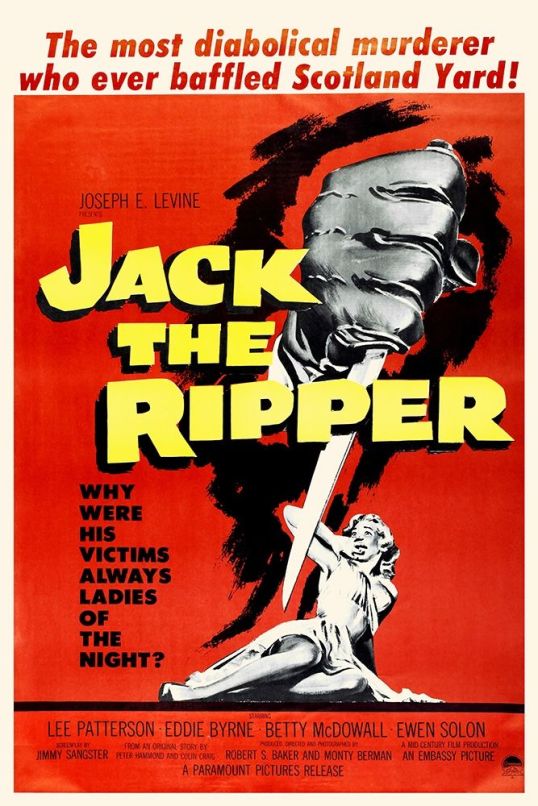
October True Crime: Jack The Ripper (dir by Monty Berman and Robert S. Baker)


The year is 1888 and London is a city in fear.

A mysterious, cloak-wearing serial killer know as Jack The Ripper is stalking the fog-strewn streets and killing prostitutes after asking them if they know the whereabouts of Mary Clark.  The newspapers are full of stories about the murders and editorials condemning the failure of Scotland Yard to capture the killer.  The citizens of London’s Whitechapel district are resorting to vigilante justice and any stranger is liable to be accused of being the Ripper.

When an American policeman named Sam Lowry (Lee Patterson) shows up in Whitechapel, he is accosted by a group of suspicious citizens.  Fortunately, before one of them can stab Sam, he’s saved by his old friend, Scotland Yard’s Inspector O’Neill (Eddie Byrne).  Sam explains that he’s come to London to not only help his old friend O’Neill catch the killer but to also study how the city of London has responded to the horror of the Ripper’s crimes.  O’Neill introduces Sam to both the world weary coroner, Sir David Rogers (Ewen Solon), and to Anne Ford (Betty MacDowell), the liberal-minded ward of Dr. Tranter (John Le Musurier).  As Anne shows Sam around London and speculates about why the Ripper has managed to avoid being caught by the police, O’Neill tries to discover the Ripper’s identity before he can strike again.

As you may have guessed from the plot description, this 1959 film doesn’t exactly stick to the historical fact when it comes to the murders of Jack the Ripper.  For instance, the names and the number of victims have been changed and, needless to say, the NYPD didn’t loan any of its detectives to Scotland Yard.  Then again, there’s very few films about Jack the Ripper that actually stick to the facts of the case.  (Murder By Decree came perhaps the closest, though it still insisted on pushing the ludicrous Royal Ripper theory.)  When one watches a Jack the Ripper film, it’s with the understanding that the story is probably going to be fictionalized.  Considering that there’s probably no chance of the Ripper’s identity ever being conclusively established, it’s to be expected.

As for the film itself, it actually has quite a few effective moments.  The heavy fog and the black-and-white cinematography creates the properly ominous atmosphere and the murders themselves are surprisingly brutal for a film from 1959, leaving no doubt that this film’s Ripper is a cruel sadist regardless of what other motives he may have.  The film itself ends with a properly macabre twist.  Patterson, Byrne, and MacDowell aren’t particularly interesting in the lead roles (and Patterson’s pompadour looks a bit ludicrous on a Victorian-era policeman) but the suspects, victims, and witnesses are all well-played by a cast of very British character actors.

There are apparently several versions of Jack the Ripper out there.  Though the film was a British production, it was filmed with an eye towards the international market and, as a result, there were several different edits depending on what the film could get away with in each country.  Apparently, one version actually switched from black-and-white to color whenever blood was spilled and certain European countries got a version that featured a few fleeting moments of nudity.  The version edited for American audiences, not surprisingly, doesn’t feature any of that but it’s still a watchable and entertaining Jack the Ripper film.

One final note: my personal opinion is that Jack the Ripper was some guy that no one has ever heard of.  He was probably not a doctor.  I doubt he was a Freemason.  He certainly was not a part of a Royal conspiracy or any of that other nonsense.  He may have been a butcher but it’s just as possible that he could have been a hatmaker or a carriage driver or a petty criminal who paid for his drinks through mugging.  He was probably never suspected at the time and I imagine he died without ever telling anyone what he had done.  People find comfort in conspiracies and elaborate cover-ups but often, the simplest solution is the correct one.

(That said, every time that Jeff and I go to London, we do the Jack the Ripper walking tour.  It’s always interesting to hear the weird theories that people come up with.)

International Horror Review: Jack The Ripper (dir by Jess Franco)


In this 1976 German film, Klaus Kinski plays Dr. Dennis Orlof.

He’s a doctor in what is supposed to be Victorian-era London.  (Some of the characters where Victorian-style clothes.  Some of them definitely do not.)  Dr. Orlof is known for being a kind and compassionate man.  He has dedicated his life to taking care of the poor and the sick.  He is one of the few doctors willing to take care of the men who fish on the Thames and the women who walk the foggy streets of Whitechapel.  Because his patients are not rich, Dr. Orlof makes very little money.  He is usually behind on paying the rent for his office but his lady doesn’t care.  Dr. Orlof is such a kind man.  Who could possibly even think of evicting a living saint?

Of course, what only he and his wife know is that Dr. Orlof is also a deviant who is haunted by hallucinations of a nearly naked woman taunting him and daring him to “come and get me.”  Dr. Orlof haunts the sleazy dance halls of London and he often offers to give the dancers a ride in his carriage.  Dr. Orlof is also the murderer who the press refers to as being Jack the Ripper.

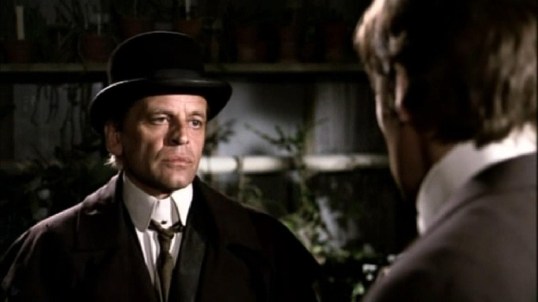
Klaus Kinski as Jack the Ripper?  That sounds like perfect casting, right?  Actually, it’s too perfect.  Klaus Kinski is so obviously unhinged from the first minute that he appears onscreen that it’s impossible to believe that he wouldn’t automatically be everyone’s number one suspect.  Kinski plays Orlof as being someone who is in a permanently bad mood.  Even when Orlof is doing his “good deeds,” he comes across as being so annoyed with the world that the viewer is left to wonder how anyone could have fallen for his act.  Kinski himself seems a bit bored with the role.  When Kinski was invested in a character (as he often was when he appeared in the films of Werner Herzog), he was a dangerously charismatic force of nature.  When he was bored, though, Kinski made little effort to keep anyone else from noticing.  Kinski moves lethargically through Jack the Ripper.

Trying to solve the Ripper case is Inspector Selby (Andreas Mannkopf).  The film spends a lot of time on Selby’s investigation but it’s never as interesting as one might hope.  Selby spends a lot of time in his office, looking concerned.  When he actually talks to the witnesses to the Ripper’s murders, the scene seem to drag out forever.  In one unfortunate scene, he gathers all the witnesses in one room and asks each one to describe what the Ripper looked like so a sketch can be made of him.  Again, what should have been a minute or two-minute scene is dragged out to an unbearable seven minutes.  Seven minutes is a lot of time when you’re bored.

Jack the Ripper was directed by Jess Franco.  On this site, I’ve defended some of Franco’s other films.  Franco was an idiosyncratic filmmaker whose films often felt rushed but who was also capable of creating a dream-like atmosphere and occasionally coming up with an insanely bizarre plot twist.  Jack the Ripper, with its tormented title character and its dance hall scenes, in unmistakably a Jess Franco film.  Unfortunately, it’s also often excruciatingly dull.  Kinski was obviously a big name in Europe in the 70s but I kind of wish that Franco had cast his frequent star, Howard Vernon, as Jack the Ripper.  Not only was Vernon the start of the original Awful Dr. Orlof but Vernon also specialized in playing self-loathing aristocrats.  If nothing else, Vernon would have been a bit less oblivious in his madness than Kinski.

Jack the Ripper is definitely a lesser Franco film.  It’s also a lesser Kinski film and a lesser Jack the Ripper film.  There is one good sequence in which Orlof and a victim ride through the London fog in a carriage.  Otherwise, this is a Franco film that you can get away with skipping.

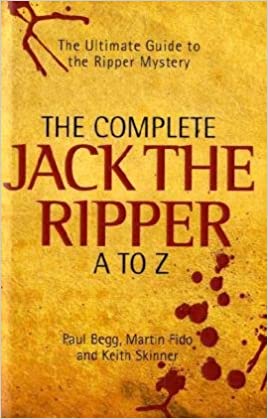
Book Review: The Complete Jack The Ripper: A to Z by Paul Begg, Martin Fido, and Keith Skinner


We will never actually know who Jack the Ripper actually was.

People will always be offering up theories, of course.  His crimes were so terrible and his nickname was so memorable and the fact that he was never caught is, to modern audiences spoiled by true crime shows and detective movies, so improbable that there’s a tendency to assume that Jack the Ripper must have been someone significant in his everyday life.  Everyone from Queen Victoria’s son to Lewis Carroll to Oscar Wilde has been accused over the years.

My personal theory is that Jack the Ripper was a nobody.  He didn’t have any medical training.  He wasn’t a part of a grand conspiracy.  He had no motive beyond his own hatred of women.  He stalked prostitutes because they were easy targets.  His murders were savage because he was a sadist who wanted to show off the power that he felt he had over his victims.  He got away with his crimes not because he was clever or protected but just because, in 1888, the police had no experience with a serial killer like Jack the Ripper.  In all probability, the killer was some anonymous loser, one of the many strange and angry men who could probably be spotted in Whitechapel on any foggy night.  

Unfortunately, after more than a 130 years of mystery, no one wants to admit that Jack the Ripper was probably some guy that no one’s ever heard of.  There’s a tendency to assume that he had to be someone important or, at the very least, someone who was at least mentioned in a handful of books about the Whitechapel murders.  Sadly, far too many people are under the impression that Patricia Cornwell solved the case in 2002.  In Portrait of a Killer, Cornwell accused the painter Walter Sickert of being the murderer.  Her main argument consisted of an inconclusive DNA test and an apparent inability to appreciate Victorian-era art.  Cornwell didn’t care much for Sickert’s paintings and therefore, Sickert had to be history’s most notorious murderer.  It’s a bit silly but a lot of people bought into it because it was Patricia Cornwell making the accusation.

To those people who insist that the murderer had to be a Victorian celebrity, I would point them to The Complete Jack the Ripper: A to Z.  Published in 2010, this book is the definitive guide to the Ripper murders.  It contains entries for every suspect, every victim, every policeman, every clue, and every theory.  There’s a lot of information to be found in this book.  In fact, there’s so much information that it’s easy to see how the actual killer could slip through the cracks and, unseen by the overwhelmed and underprepared legal authorities, disappear into the dark shadows of history.  Along with presenting a clear-eyed and nonbiased look at the suspects and the theories, the book is also to be commended for what it tells us about Jack the Ripper’s victims, who are too often forgotten when it comes to discussing the crimes.  So much time is spent on Jack’s identity that the women he murdered are often pushed to the side.  This book does not make that mistake.

This is the definitive book on Jack the Ripper, whoever he may have been.

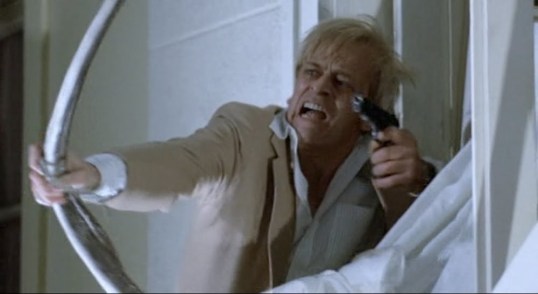
4 Shots From 4 Klaus Kinski Films


4 Shots From 4 Films is just what it says it is, 4 shots from 4 of our favorite films. As opposed to the reviews and recaps that we usually post, 4 Shots From 4 Films lets the visuals do the talking!

95 years ago today, Klaus Kinski was born in Poland.  Kinski was a brilliant actor who, by all accounts, was an absolute monster in his private life.  Werner Herzog worked with him on several films and reportedly considered murdering him on more than a few occasions.  Herzog, himself, wrote about the time that he had spent in a mental asylum and the time that was diagnosed as being a psychopath.  Because of his talent, he appeared in many great films.  Because of his reputation for being a literal madman, he also missed out on a lot of great roles and spent much of his career appearing in low-budget exploitation flicks.  Many of those films were in the horror genre.

Today, on the anniversary of Kinski’s birth, TSL presents….

4 Shots From 4 Klaus Kinski Films

Count Dracula (1970, dir by Jess Franco, DPs: Manuel Merino and Luciano Trasatti)

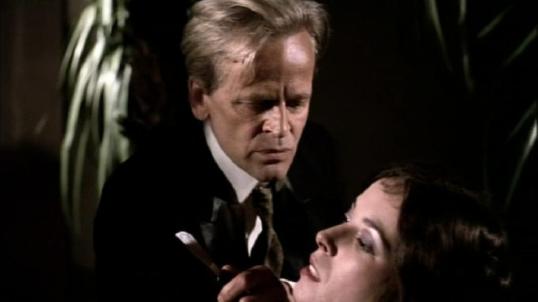
Jack the RIpper (1976, dir by Jess Franco, DPs: Peter Baumgartner and Peter Spoerri)

Nosferatu The Vampyre (1979, dir by Werner Herzog, DP: Jörg Schmidt-Reitwein)

Venom (1981, dir by Piers Haggard, DPs: Denys Coop and Gilbert Taylor)


Horror On TV: The Veil Episode 11 “Jack the Ripper” (dir by David MacDonald)


For our final episode of The Veil, we have a look at one of the most infamous real world monsters of all time, Jack the Ripper.

In this atmospheric episode, a London clairvoyant (Niall MacGinnis) is haunted by visions of the Whitechapel murders.  Unfortunately, his attempts to help the police only leads to them treating him like a suspect!  Each episode of The Veil was usually described as being “based on a true story.”  In this case, it’s actually true.  A medium named Robert Lees — renamed Walter in this episode — actually did go to the police with claims that he had seen the murders and could identify the killer.

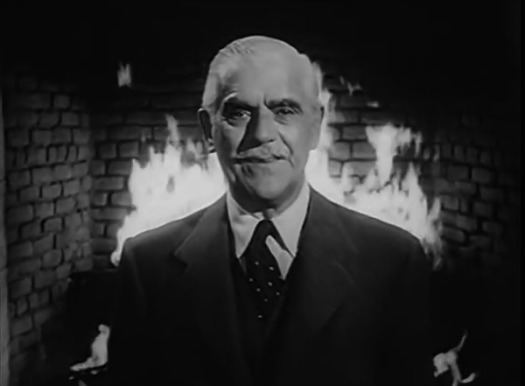
This is the only episode of The Veil in which Boris Karloff acts only as host.  That’s because this episode was not originally made for the series.  Instead, it was intended for an unrelated British anthology show.  The producers of the Veil later bought the episode and tacked on an introduction by Boris Karloff.  Of course, because The Veil itself never actually aired on television as a result of the production company running into financial problems, Jack the Ripper never aired in the U.S.  It was, however, later included in an anthology film that was put together using four episodes of The Veil.

Enjoy!  That’s it for The Veil.  Tomorrow, we start a whole new series!

Horror On TV: Thriller 1.28 — Yours Truly, Jack The Ripper (dir by Ray Milland)


Since I reviewed Robert Bloch’s novel, The Night of the Ripper, earlier today, it seems only appropriate that tonight’s excursion into televised horror should be based on another Robert Bloch story about Jack the Ripper!

Yours Truly, Jack The Ripper is a classic episode of the 60s anthology series, Thiller.  This episode aired on April 11th, 1961 and it was directed by the Oscar-winning actor, Ray Milland!

Enjoy!

http://www.youtube.com/watch?v=CtILSL5bDsY


Horror Scenes That I Love: The Jack The Ripper Scene From Pandora’s Box


Since I reviewed Robert Bloch’s Night of the Ripper earlier today, it only seems appropriate that Jack the Ripper should play a role in today’s horror scene that I love.

In the 1929 silent German film, Pandora’s Box, Louise Brooks plays Lulu who, through a series of misfortunes, goes from being the mistress of an upper middle class newspaper publisher to living in squalor in London.  Reduced to working as a prostitute, Lulu picks up her first client on Christmas Eve.  Little does she know that her client is actually the infamous murderer known as Jack the Ripper.  At first, Jack attempts to resist his urges by throwing away his knife but once they reach Lulu’s apartment, he discovers another.

This scene, which served as the film’s finale, was considered to be so controversial in 1929 that it was edited out of some prints, which had the effect of turning a tragic story about a woman forced into prostitution into a story about a woman who, following some bad luck, moves to London and is redeemed by volunteering for the Salvation Army.

Here is the original conclusion of Pandora’s Box:


Book Review: Night of the Ripper by Robert Bloch


As you might guess from the title, Night of the Ripper is set in London in 1888.  A shadowy figure is haunting the foggy alleyways of Whitechapel, savagely murdering prostitutes, terrifying the public, and leaving the police baffled.  In the taunting letters that he writes to the authorities, he says that his name is Jack.

Jack the Ripper, to be exact.

With both high and low society demanding an end to the murders, can the respected and determined Inspector Abberline discover the true identity of Jack the Ripper and bring his reign of terror to an end?  Helping him out will be an American doctor named Mark Robinson.  Robinson is an expert in a developing science called psychology but will that be enough?

*sigh*

This 1984 novel from Robert Bloch is an unfortunate misfire.  I say that as someone who has spent a countless amount of time reading about the murders and all of the identified suspects.  (Back in March, when Jeff and I were in London, we went on one of those Jack the Ripper walking tours.  It was wonderfully creepy!)  A century after his crimes, Jack the Ripper continues to fascinate us because, not only was he the first widely identified serial killer, but it also appears that he got away with it.  The police may have speculated that Jack was a disgraced lawyer who committed suicide after the murder of Mary Kelly but they never actually presented any evidence to back that up.  Over the last 130 years, countless people have been accused of being Jack the Ripper, everyone from an anonymous Russian doctor to Lewis Carroll to the son of Queen Victoria.  Solely based on the fact that she didn’t care much for his paintings, Patricia Cornwell wrote an entire book arguing that the artist Walter Sickert was the murderer.  In all probability, Jack the Ripper was an anonymous nobody but he’s become such a huge figure in the popular imagination that it’s difficult for many to accept that he was probably just a sexually dysfunctional loser who hated women.  Instead, elaborate conspiracy theories are pursued and films like Murder by Decree and From Hell are produced.

Bloch’s novel features plenty of prominent Victorians, though none of them are identified as suspects.  Oscar Wilde, Joseph Merrick, Conan Doyle, and Robert Lees all show up and then quickly disappear from the story.  When Bloch does eventually reveal the identity of Jack the Ripper, he turns out to be a minor character who was first introduced just a few chapters previously.  It’s a bit of a letdown.

Actually, the whole book is a letdown.  It comes across as if it was written in haste and Bloch’s attempt to give the story some gravitas by opening the final few chapters be describing ancient torture methods doesn’t really have the effect that I presume he was going for.  It’s a disappointment because, after all, this is Robert Bloch that we’re talking about.  Bloch not only wrote Psycho but he also wrote Yours Truly, Jack the Ripper, one of the best short stories ever written about Jack.

Read the short story but avoid the novel.  And if you ever get a chance to take a Jack the Ripper walking tour, do it!

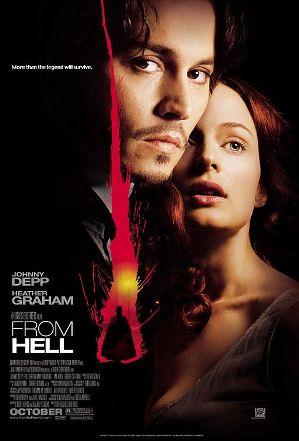
Horror Film Review: From Hell (dir by The Hughes Brothers)


Who was Jack the Ripper?

That’s a question that people have been asking for 129 years.  Arguably the world’s first famous serial killer, Jack the Ripper killed at least five prostitutes in the Whitechapel section of London.  Some claim that he killed as many as twenty.  He may have also written several taunting letters to the police.  Again, some say that the letters are authentic and some say that they were hoaxes.  Hell, there’s even some people who say that Jack the Ripper himself is a myth and the five murders attributed to him were actually five unconnected crimes.  It was speculated that Jack the Ripper was a butcher, a surgeon, or maybe a midwife.  Just as suddenly as the murders began, they ended.  The London police claimed that he had committed suicide by jumping into the Thames.  Few people believed them then and even less now.

The reason that there is so much uncertainty is because Jack the Ripper was never caught.  He was never identified.  There were stories of confessions, though many of them came from the mentally infirm or they were heard by someone who was a friend of someone who claimed to be the Butcher of Whitechapel.  At one point, there was even a claim that Jack’s diary had been found.

As a horror fan, a true crime fanatic, and a lover of history, I’ve read quite a few theories about who Jack the Ripper was.  Nearly every prominent (or, at the very least, remembered) Victorian has been accused of having been Jack the Ripper.  Oscar Wilde has been accused of hiding a confession in The Picture of Dorian Gray.  Various members of the Royal Family have been fingered as the culprit.  Even Lewis Carroll could not escape accusation.  The true crime author Patricia Cornwell wrote an entire book where she (wrongly) accused the painter Walter Sickert.  Cornwell’s case could basically be summed up as follows: “Walter Sicket’s paintings were weird.  Walter Sickert must be Jack the Ripper.”  Apparently, she managed to destroy one of Sickert’s paintings while looking for clues.

The truth of the matter is that Jack the Ripper was probably some guy who no one has ever heard of, most probably one of the unknown men who lived and worked in the shadows of Whitechapel.  For all the talk of Jack being a doctor, it can be argued that the surgical precision of his murders has been overstated.  He didn’t get away with murder because he was particularly clever.  Instead, he got away with it because, in 1888, even fingerprinting was considered to be a radical science.

But, honestly, that’s not very intriguing.  For those of us who have researched the case, it’s far more interesting to speculate that Jack the Ripper was either a famous person or that the murders were all the result of a huge conspiracy.

That’s certainly the appeal of From Hell, the 2001 film from The Hughes Brothers.  Making the same basic case as Bob Clark’s Murder By Decree, From Hell argues that the Jack the Ripper murders were the result of a royal conspiracy.  In reality, that theory has been discredited but it certainly is the most cinematic of all the possibilities.

And, speaking of cinematic, it must be said that From Hell is very stylish movie.  Though the title comes from one of Jack the Ripper’s letters, From Hell also could just as easily be used to describe the film’s vision of Whitechapel.  Whitechapel is full of shadows and secrets and the blood flows freely.  If Mary Kelly (Heather Graham) isn’t killed by Jack the Ripper, it’s just as likely she’ll be killed by one of her clients.  Even as the murders are committed, life and business in Whitechapel goes on.  What other choice is there?  It’s either risk being killed or starve.

It falls to Frederick Abberline (Johnny Depp) to solve the murders.  The real-life Abberline was an almost legendary detective who lived for decades after the final Jack the Ripper murder.  The movie’s Abberline is an opium addict who always seems to be on the verge of a breakdown.  When he and Mary Kelly fall in love, you’re not really sure if it’s something to be happy about.  Abberline seems just as likely to go crazy as everyone else.

From Hell is an uneven and somewhat overlong movie but I like it.  Heather Graham and Johnny Depp give somewhat odd performances but the oddness fits right in with the Hughes Brothers’s vision of a world that’s been turned permanently upside down.  It’s a movie that’s full of atmosphere and the story is intriguing even if it’s never exactly convincing.  For obvious reasons, I can’t reveal who plays Jack the Ripper but I will say that he gives a very good performance.  When he says that, “One day, men will look back and say that I gave birth to the 20th century,” you believe him.