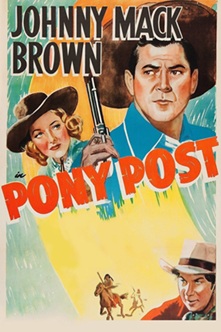
Pony Post (1940, directed by Ray Taylor)


In the days of the Old West, Griff Atkins (Stanley Blystone) manages a Pony Express station but, because of his gambling debts, he actually encourages the Indians and the outlaw Richard brothers (John Rockwell and Ray Teal) to attack the Pony Express riders and steal their horses.  Major Goodwin (Tom Chatterton) tries to put a stop to all this by firing Griff and putting Cal Sheridan (Johnny Mack Brown) in charge.  Griff and the Richard brothers continue their outlaw ways and eventually, the head of one of the relay stations is killed in one of their raids.  While the dead man’s daughter, Norma (Nell O’Day), investigates the murder, Cal works to bring peace the line and falls in love with Goodwin’s daughter, Alice (Dorothy Short).  Meanwhile, aspiring Pony Express rider Shorty (Fuzzy Knight) tries to invent a trampoline system that will help him to mount a horse.

No matter how bad things get in the west, you can always count on Johnny Mack Brown to bring some order and to get it done in less than an hour.  Johnny Mack Brown was always a good hero and that’s the case here.  Eventually this film has all of the horse riding and tough fighting that fans of the genre expect from these westerns but, for a short movie (it only runs for 59 minutes), it still seems to take a while for it to really get going.  The first half of the movie is more about Fuzzy Knight singing songs and trying to become a rider than it is about anything else.  I usually enjoy Fuzzy’s antics but, like the B-western themselves, they are definitely an acquired taste for most viewers.
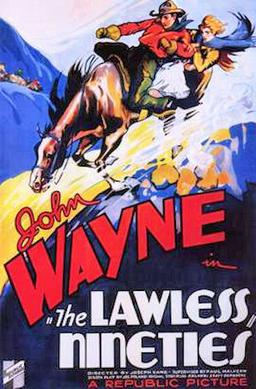
The Lawless Nineties (1936, directed by Joseph Kane)


The year is 1890 and Wyoming is on the verge of voting for statehood.  Newspaperman Major Carter (George “Gabby” Hayes) believes that it’s time for Wyoming to become a state and most of the locals agree with him.  Businessman Charles Plummer (Harry Woods) does not want Wyoming to become a state and he’s willing to send out his main henchman, Steele (Al Bridge), to intimidate the voters and to silence Carter.  Plummer has a profitable racket going and the last thing he wants is for the U.S. government to get involved in his activities.  It falls to two federal agents, John Tipton (John Wayne) and Bridger (Lane Chandler), to supervise the voting and protect the citizen.  When Major Carter is shot by a drunk anti-statehood activist, the mission to make Wyoming a part of the Union becomes personal.

The Lawless Nineties is typical of the B-movies that John Wayne made for Republic Pictures before John Ford resurrected his struggling career by casting him as The Ringo Kid in Stagecoach.  There are plenty of gunfights and horse chases and explosions as the bad guys try to keep the townspeople from voting and the federal agents set up their own sting operation to expose Plummer’s gang.  Wayne seems more relaxed here than he did in some of his other B-movies.  He was obviously getting more comfortable with being on camera and playing the hero.  Probably the most interesting thing about this film is that Gabby Hayes (credited as George Hayes, without his famous nickname) plays the renowned and intelligent Major Carter.  Hayes was just a year away from establishing himself as a perennial B-movie sidekick and supplier comedy relief.  He would soon be best-known for playing characters who had little in common with the intelligent and well-spoken Major Carter.  In The Lawless Nineties, Hayes gets a chance to play something other than the comedic relief and turns out to be petty good at it.

This is another one of those westerns that will be enjoyed by fans of the genre.  It’s nothing special but it does allow Wayne to show hints of his future stardom and it also gives Gabby Hayes a chance to show what he was actually capable of.

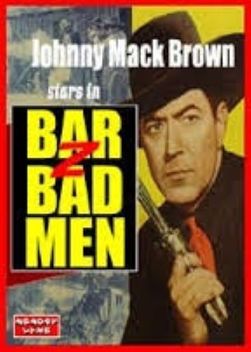
Bar-Z Bad Men (1937, directed by Sam Newfield)


After getting kicked out of town for shooting the place up during a night of friendly fun, cowboy Jim Waters (Johnny Mack Brown) drops in on his old friend, rancher Ed Parks (Jack Rothwell).  Ed has got a strange problem.  There are cattle rustlers about but instead of stealing Ed’s cattle, they’re adding cattle to Ed’s herd.  It’s an obvious scheme to try to create a feud between Ed and his neighbor, rancher Hamp Harvey (Frank LaRue).  Before Jim and Ed can solve the problem, Ed is gunned down.  Harvey is the number one suspect but Jim figures out the truth, that Harvey has been betrayed by one of his own employees and that all of this is a part of a scheme by Sig Bostell (Tom London) to take control of both ranches.

Bar-Z Bad Man is a B-western with a notably twisty plot as Bostell plays both sides against each other for his own benefit.  As usual, Johnny Mack Brown makes for a good and convincing western hero.  Whether he’s chasing someone on his horse or drawing his guns, Brown is always a convincing cowboy.  What makes this film interesting is that it opens with Johnny Mack Brown engaging in the type of behavior that most B-western heroes would never think of doing.  Shooting up the town and then getting exiled for his actions adds an element of redemption to Jim’s efforts to get to the bottom of Bostell’s schemes.  Or it would if Jim ever really seemed to feel bad about shooting the town up.  His excuse is that he was just having a good time.  Try to get away with that in the real old west, Jim!

Bar-Z Bad Men is a good B-western for those who like the genre.  The story is solid and Johnny Mack Brown is as convincing saving the west as he was shooting it up.


Roaring Rangers (1946, directed by Ray Nazarro)


Another frontier town is in trouble.

Sherriff Jeff Conner (Jack Rockwell) is having trouble ridding his town of outlaws so his son, Larry, (Mickey Kuhn) writes a letter to his hero to ask for help.  He addresses the letter to “Durango Kid, Texas.”  That’s all it takes for Steve Randall (Charles Starrett) and his sidekick, Smiley Burnette, to show up in town.

Steve and Smiley apply to be deputies but Sheriff Conner explains that someone is circulating a petition to get him fired.  Steve dresses up as the Durango Kid and pressures the citizens to give the Sheriff another chance.  Realizing that the Durango Kid is making them look bad, the outlaws decide to dress up one of their own as Durango and make the Kid look bad.  With the town turning on Durango, will Durango and Smiley be able to save Sheriff Conner from an assassination attempt?

This Durango Kid film is different from the rest of the series in that, for once, Steve is hired to be a deputy instead of a sheriff.  This really is Sheriff Conner’s story, as he tries to win the respect of the town and keep its citizens safe, even while his own brother (Ed Cassidy) is working with the outlaws.  There are all the usual horse chase and shootouts but this time, Durango and Smiley are mostly around to provide support to a man who is trying to do the right thing.  B-western fans will enjoy it.

Smiley sings a few songs, as always.  This time, musical accompaniment is provided by Merle Travis and his Bronco Busters.

Lawless Empire (1945, directed by Vernon Keays)


For years, outlaws have controlled the frontier town of Dusty Gulch but now their power is threatened by the homesteaders who are moving into the area.  Led by the crusading Rev. Tex Harding, the homesteaders are being progress and reform to the frontier.

Duke (Ethan Laidlaw) and his gang have launched a campaign of intimidation against the new arrivals.  Luckily, the Durango Kid (Charles Starrett) rides into town to protect the homesteaders.  Duke’s boss, businessman Blaze Howard (John Calvert), decides that the town needs a sheriff to go after the Kid.  Blaze offers the job to newcomer Steve Ranson, not realizing that Steve is not only the Durango Kid but also the brother of the former sheriff, who was murdered by Blaze’s men.

Lawless Empire is one of the few Durango Kid films not to feature Smiley Burnette as Durango’s sidekick.  Instead, Durango rides into town with Bob Wills and his Texas Playboys and, while Willis does perform a song or two, there’s still considerable less singing than in the films that featured Burnette.  The role of comic relief is provided by Dub Taylor in the role of Cannonball.  Cannonball gets a job sweeping up Blaze’s saloon and he feeds whatever information he learns back to Durango.  When Blaze figures out what’s going on, he deliberately supplies Cannonball with bad information but it doesn’t make any difference.  The Durango Kid is always one step ahead of the bad guys.

Lawless Empire is a little more serious than the other Durango Kid films.  Steve is not only trying to clean up the town but he’s also seeking to avenge his brother so there’s not as much room for as much comedy as usual.  Lawless Empire does have all of the usual gunfights and horse chases and the film gets off to an exciting start with Durango making his first appearance with his gun already drawn so that he can disarm Duke and his men.  Even without Smiley around to help him out, Durango brings law to a lawless empire.


Neath The Arizona Skies (1934, directed by Harry L. Fraser)


Chris Morrell (John Wayne) is an honest cowboy who keeps an eye on Nina (Shirley Jean Rickert), a little girl whose Indian mother died when Nina was just a baby.  When oil is discovered on land that belonged to Nina’s mother, Nina is offered $50,000 for the land.  Because Nina is only eight years old, her legal guardian will be responsible for taking care of the money.  Chris and Nina set out to find Nina’s father so that he can sign the guardianship papers and make Chris into Nina’s legal guardian.

When outlaw Sam Black (Yakima Canutt) decides that he would rather be Nina’s legal guardian, Chris sends Nina to a ranch owned by his old friend, Bud Moore, while he defeats Sam and his men.  At the ranch, it turns out that Bud Moore has died and the new ranch owner is another outlaw named Vic (Jack Rockwell) and Vic wants Nina’s oil claim for himself.  What Vic doesn’t know is that Nina’s father is one of his ranch hands.

For a 52 minute programmer, there’s a lot going on in ‘Neath The Arizona Skies.  There’s actually too much going on and, with that short of a run time, it feels as if more than a few important plot points were glossed over, like how Chris came to look after Nina in the first place.  John Wayne is stiff but likable as Chris while Yakima Canutt does his usual double duty as both an outlaw and a stuntman.  There are a few good action scenes, especially when Chris runs off Sam’s gang for the first time.  Sheila Terry plays Wayne’s love interest, who has to be first convinced that Chris isn’t actually an outlaw.  As Nina, Shirley Jean Rickert is energetic but you’ll quickly get tired of her yelling, “Daddy Chris!” whenever anything happens.  This isn’t one of the best of the 50 poverty row films that Wayne appeared in before Stagecoach made him a star but, even in this film, there are still hints of the screen presence that would later become Wayne’s trademark.