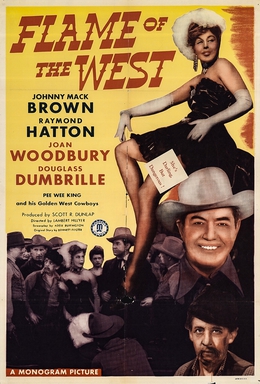
Flame of the West (1945, directed by Lambert Hillyer)


Marshal Tom Nightlander (Douglass Dumbrille) shows up in a lawless frontier town, tasked with bringing peace.  He could sure use the help of Dr. John Poole (Johnny Mack Brown), a former gunslinger who has set his weapons aside and now works as the town doctor.  Dr. Poole has sworn off guns but with corrupt businessman Wilson (Harry Woods) and his gang determined to keep their town lawless, Poole is soon forced to reconsider.

This B-western from Monogram is better than many of the other low-budget, poverty row westerns of the era.  While the plot is another example of a corrupt businessman and his gang making life difficult for peaceful settlers, the characters in Flame of the West are a little more complex than usual.  Brown stands out playing a character who, for once, doesn’t want to fight and believes that it’s better to talk than to shoot.  Of course, this being a B-western, he soon sees the error of his ways.  Dumbrille was usually cast as a villain so this film is a chance to see him in a likable and heroic role and he’s very convincing as a Wyatt Earp-style marshal.

Of course, even a serious B-western is still a B-western so songs and entertainment are provided by the gorgeous Joan Woodbury and Pee Wee King and his Golden West Cowboys.  (Don’t worry, I had never heard of them before, either.)  Joan Woodbury plays a saloon owner who wants to bring a higher class of entertainment to the frontier and she provides the film with enough sex appeal that 1945 audiences probably didn’t mind having to sit through the musical numbers before getting to the inevitable showdown between Johnny Mack Brown and Harry Woods.

Flame of the West is a good B-western that shows what dependable actors like Johnny Mack Brown and Douglass Dumbrille were capable of when given the opportunity.

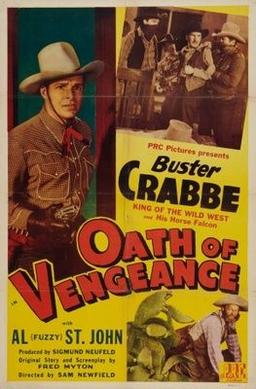
Oath of Vengeance (1944, directed by Sam Newfield)


In a small frontier town, the ranchers and the farmers are nearly at war with each other.  Cattle are being rustled.  The head of the farmers (Karl Hackett) is accused of killing a ranch hand.  Store owner Fuzzy Q. Jones (Al St. John) suspects that it’s all a set-up and he’s not going to stand for it.  If the farmers kill all the ranchers and the ranchers kill all the farmers, there won’t be anyone left to shop at his store.  Fuzzy calls in his friend, Billy Carson (Buster Crabbe).

Buster Crabbe may have gotten his start in the westerns by playing Billy the Kid but the producers of his films eventually realized that there was only so long that Buster could play a character known as “the Kid” and Billy the Kid’s reputation as an outlaw was actually not helpful at the box office because parents didn’t want to send their kids to a matinee that might teach them the wrong lessons.  After a handful of “Billy the Kid” films, Buster’s western hero suddenly had a new name.  Billy Carson was a standard western do-gooder, called in whenever a town needed to be cleaned up or his old sidekick Fuzzy needed some help around the store.  Crabbe was a convincing hero no matter what but the Billy Carson films lacked the thing that made the Billy the Kid films interesting.  Usually, no one was trying to arrest Billy Carson.

Oath of Vengeance isn’t bad, at least not by the standards of Poverty Row westerns.  There’s plenty of fights and Crabbe, being a former Olympian, looks convincing with he throws a punch.  The plot is a pretty standard B-western plot but Crabbe’s natural likability carries the day.  Fans of the genre will be happy to see Charles King and Kermit Maynard, playing bad guys.  Frank Ellis plays the ranch hand whose murder sets off the story.  It’s always good to see the old gang back together again.

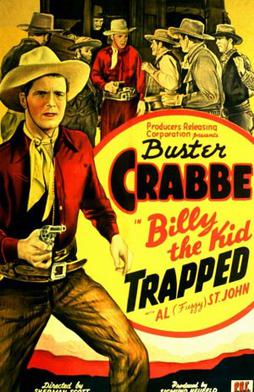
Billy The Kid Trapped (1942, directed by Sam Newfield)


Billy “The Kid” Bonney (Buster Crabbe) and his two buddies Fuzzy (Al St. John) and Jeff (Bud McTaggart) are just trying to mind their own business and make a living in the old west but they keep getting accused of every crime that happens.  This time, they’re sentenced to hang for a crime they didn’t commit.  Luckily, a group of strangers break Billy and his friends out of jail and send them on their way to the next town.  However, the men who broke them out of jail are soon committing crimes while disguised as Billy, Fuzzy, and Jeff!  Billy teams up with Sherriff Masters (Ted Adams) to stop the imposters, who are working for Boss Jim Stanton (Glenn Strange).

One of the joys of Poverty Row westers like this one is that they always featured the same stock company.  Al St. John was everyone’s sidekick.  Ted Adams was often a sheriff.  Glenn Strange was always the criminal mastermind pulling the strings.  Milton Kibbee was always a corrupt judge or ranch owner.  George Cheseboro, Horace B. Carpenter, Jack Curtis, and Budd Buster are amongst the very familiar faces in Billy The Kid Trapped.  It gives each film a homey feel that will be appreciated by fans of the genre.  The hero of the films often changed but the stock company always remained the same.

I like the idea behind Billy The Kid Trapped but the film still feels repetitive, even though it’s less than an hour long.  After Billy captures the men who are imitating him and his friends, a crooked judge sets the men free and the immediately go back to imitating Billy.  Billy has to capture them all over again.  No wonder Billy aged so quickly!  (Buster Crabbe was in his mid-thirties when he was playing The Kid.)  The movie does have all the usual gunfights and horse chases that people watch these movies for.  It’s comforting that, no matter what, the villain is always going to turn out to be Glenn Strange.

Streets of Ghost Town (1950, directed by Ray Nazarro)


Years ago, Bill Donner (George Cheseboro) double-crossed the other members of the Selby Gang and ran off with all of their stolen gold.  Now, Donner is blind and half-crazy.  When he says that he hid the gold in the ghost town of Shadeville, the Durango Kid (Charles Starrett), Smiley Burnette, and Sheriff Dodge (Stanley Andrews) ride off to find it.

Shadeville is long abandoned and, as the three men spend the night in a deserted saloon, Smiley is worried about ghosts.  The Durango Kid tells the story of the first time he met the Selby Gang.  The next morning, they discover that they are not the only ones who have come to Shadeville to look for the gold.

Like many of the later Durango Kid movies, Streets of Ghost Town is mostly made up of stock footage to Starrett’s earlier films.  This was a cost-cutting technique on the part of Columbia Pictures but it actually works because the flashbacks were always to the horse chases and the gunfights that the audience came to see in the first place.  In the days before home video and cable, those scenes were probably still new to many of the people sitting in the theater.

Starrett always made for a good hero and Smiley Burnett’s comic relief never took away from the films’s storylines.  This outing features a great scene where Durango shoots a skull in the dark just to let anyone watching him know that he’s a good shot.  I also enjoyed George Cheseboro’s manic performance as a man who really loves his gold.  Despite all of the stock footage, Streets of Ghost Town is still an above average Durango Kid film, predictable but entertaining if you’re a fan of the genre.

A Movie A Day #53: Ghost Town Renegades (1947, directed by Ray Taylor)


gtrWhen a federal surveyor disappears while checking out the ghost town of Waterhole, the U.S. Marshall sends Cheyenne Davis (Lash La Rue) and Fuzzy Jones (Al “Fuzzy” St. John) to investigate.  It turns out that gold has been discovered around Waterhole, on land owned by the Trent Family.  Bad guy Vance Sharpe (Jack Ingram) is trying to kill the last remaining Trents — Rodney (Steve Frost) and his daughter, Diane (Jennifer Holt) — so that he can claim the land as his own.  As Cheyenne and Fuzzy investigate, there are plenty of shootouts, fist fights, and an out of control stagecoach.  Since this is a Lash LaRue film, there is also a lot of exciting bullwhip action.

If you’re like me, the name Lash La Rue immediately makes you think of Pulp Fiction and Harvey Keitel asking John Travolta, “What about you, Lash La Rue, can you keep your spurs from jingling and jangling?”  But, long before Quentin Tarantino ever came up with that line of dialogue, Lash La Rue was a legitimate Western star, starring in several B-westerns in the 1940s and 50s.  What set Lash apart from other western stars was that he looked like he could have been Humphrey Bogart’s younger brother, he always wore black, and he often used a bullwhip instead of a gun.  In fact, when Harrison Ford needed someone to train him how to use a bullwhip for Raiders of the Lost Ark, 65 year-old Lash La Rue was the man that they called.

I have read that Ghost Town Renegades is considered to be the best of La Rue’s movies.  I haven’t seen enough of them to say whether it’s the best but Ghost Town Renegades is an entertaining and fast-paced B-western.  Lash La Rue is good with a whip, Jennifer Holt is beautiful, and not even the broad comedy of Fuzzy St. John detracts.

Interesting to note: Jennifer Holt, who co-starred in several of La Rue’s movies, was the daughter of Jack Holt and the sister of Tim Holt, both of whom were prominent western stars themselves.