Welcome to Retro Television Reviews, a feature where we review some of our favorite and least favorite shows of the past! On Tuesdays, I will be reviewing the original Fantasy Island, which ran on ABC from 1977 to 1986. The entire show is currently streaming on Tubi!
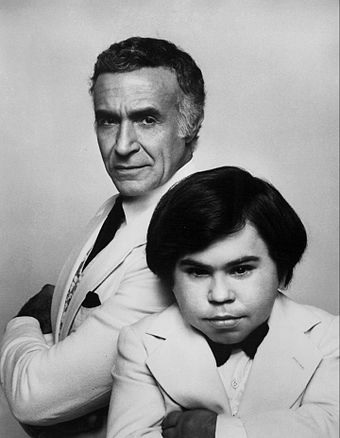
This week …. Tattoo gets a trumpet!
Episode 2.3 “The Beachcomber/The Last Whodunit”
(Dir by George McCowan, originally aired on September 30th, 1978)
Tattoo is learning how to play the trumpet and Mr. Roarke can barely hide his anger. That is this week’s Tattoo/Roarke storyline and it rasies a lot of questions about Roarke and Tattoo’s relationship. Is Roarke upset because Tattoo is a bad trumpet player or does he just dislike Tattoo in general? Does Tattoo really care about learning how to play the trumpet or is he just looking for an excuse to annoy Mr. Roarke? I think all of those possibilities may be true at the same time. If the previous two episodes hinted that Roarke and Tattoo no longer hated each other, this episode seems to confirm that they’re still the frenemies that they’ve always been. I sympathize with Roarke but it’s hard not to appreciate Tattoo’s determination to be an agent of chaos.
As for the fantasies, Charles Preston (John Astin) is a successful businessman who wants to throw it all ways so that he can spend the rest of his life as a beach bum. Roarke sets Preston up in a cabin on one of the shabbiest beaches on Fantasy Island. Seriously, the layout of Fantasy Island is just weird. A third of the island is a luxury resort. A third of the island is a magical jungle. And a third of the island is apparently just a collection of poverty-stricken fishing villages. Do the people who live on the island know that they could be having a fantasy if they only had the money? Let’s hope none of them ever pick up a copy of Marx or Piketty.
Anyway, Preston soon discovers that the life of a beach bum is not as easy as he thought it would be. For one thing, the chief of the island’s indigenous population demands that Preston marry his daughter. (The joke is that his daughter is overweight and …. well, it’s all pretty cringey by 2022 standards.) Meanwhile, a bounty hunter slaps some handcuffs on Preston and threatens to take him back to his family unless Preston pays him $70,000. “All of you beachcombers have a stash!” the bounty hunter hisses. Fortunately, Preston’s wife shows up and announces that she’s fine with him being a beach bum, as long as he’s a responsible beach bum who helps to pay the bills. And that’s the end of that. What an underwhelming fantasy.
Luckily, the episode’s other fantasy is a bit more entertaining. Mabel Jarvis (Celeste Holm) loves mystery stories and she wants to spend a weekend as her favorite fictional detective. Of course, Mabel soon finds herself investigating the real-life murder of Mabel’s favorite writer. Mr. Roarke explains that the writer was a friend of his and that he hoped Mabel could solve the case. That seems like a lot of responsibility to put on someone who is just looking for a vacation but, fortunately, Mabel proves to be up to the job. Anyway, this was a fun little fantasy and, as an avid reader of mysteries, it was one to which I could relate. Celeste Holm seemed to be having a lot of fun as Mabel and, even more importantly, her cat played a key role in solving the mystery.
This was not a bad episode. The beach stuff was forgettable but the episode was saved Celeste Holm and Tattoo’s trumpet.
 Lou Cherney (Robert Forster) was a top police detective until a perp with a shotgun shattered his leg. Now, Lou’s a private investigator with a limp, a girlfriend (Caren Kaye), and a learning disabled son named Joey (Philip Glasser). When Lou is hired to track down a missing girl, he discovers that she is now the lover of Nicole St. James (Lydie Denier), the head of a modeling agency. Nicole seduces Lou within minutes of meeting him but, when Lou attempts to return the missing girl to her family, Nicole reveals that she is actually an ancient demon and she possesses Joey. Soon, Joey is carrying an ice pick and throwing people out of windows.
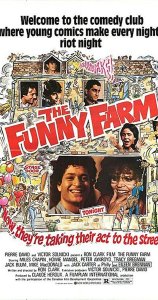 Mark Champlin (Miles Chapin) is a fresh-faced, aspiring comedian from Cleveland who drives across the country, listening to tapes of Steve Martin. He arrives in Los Angeles, hoping to become a star. Despite being too naive and trusting, Mark starts to find success in the cut-throat entertainment industry. Soon, he is performing at the Funny Farm, a comedy club owned by Gail Corbin (Eileen Brennan, giving the exact same performance that Melissa Leo gave in Showtime’s I’m Dying Up Here). Mark befriends the other comedians, finds love, and hopes for his big break.
 Through the Shattered Lens