I Watched A Winner Never Quits (1986, dir. by Mel Damski)


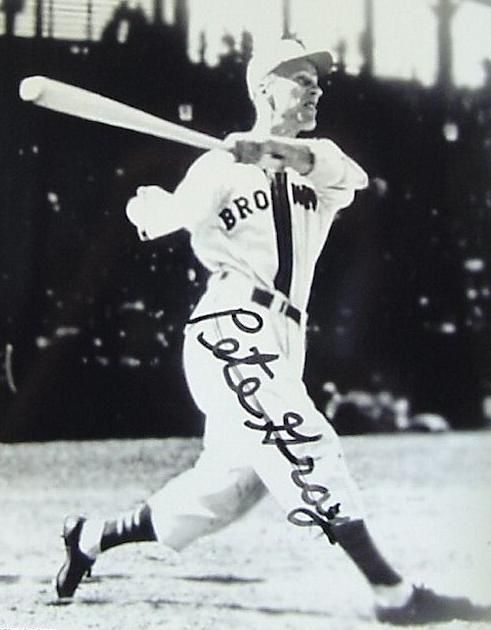
In 1945, Peter Gray made history when he became the first one-armed major league baseball player.  Gray grew up in poverty in Pennsylvania.  His father was a miner and Peter was one of five children.  He was only seven years old when he lost his right arm in a wagon accident but he loved baseball and he wasn’t going to let his disability keep him from playing.  He learned how to bat and catch and throw with his left hand.  He quit school when he was thirteen and worked for a while as waterboy while playing baseball in the local leagues.  Eventually, he made his way up to the minor leagues and, in 1945, he was called up to the majors.  He played one season for the St. Louis Browns.

The media loved the story of the one-armed baseball player but Peter always said that he resented feeling like he was being put on display whenever he took the field.  He was a competitive outfielder who could catch a ball, remove his glove, and then throw the ball to the infield just as quickly as anyone with two hands.  As a hitter, he struggled because pitchers figured out early on that he couldn’t hit the breaking ball.  After the 1945 season, Peter was sent to back to the minors, where he spent the rest of his career.  Though Peter was known for being an angry player who resented anyone pointing out his disability, he still made time to visit amputees in military hospitals to show them that they could still find success and to encourage them to chase after their dreams.

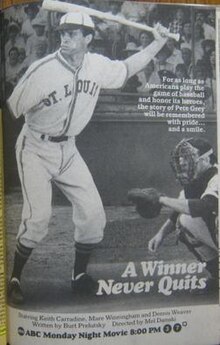
Peter’s story was the basis of A Winner Never Quits, which I watched on YouTube this weekend.  It was a good baseball movie, starring Keith Carradine as Peter.  What I liked is that the movie didn’t make him into a saint.  Carradine played Peter as being angry and with a definite chip on his shoulder.  Peter had every right to be angry and I’m glad the movie acknowledged that.  In both the movie and in real life, Peter was worried that he was just being treated as a sideshow.  In the movie, his attitude improves when he meets a young boy who recently lost his arm and who looks up to Peter.  Peter remained a friend to the boy and his family for the rest of his life.  A Winner Never Quits is about pursuing what you love and never giving up.  That’s what baseball is all about.  A Winner Never Quits is a good and inspiring baseball movie that’s not just for the fans.
Cinemax Friday: Stranger By Night (1994, directed by Gregory Brown a.k.a. Gregory Hippolyte a.k.a. Gregory Dark)


Detective Bobby Corcoran (Steven Bauer!) is a cop with an anger problem.  Whenever he and his parter, Troy Rooney (William Katt!!), catch a criminal, Bobby just loses control.  Since, for some reason, they seem to catch a lot of criminals on rooftops, this often leads to Bobby threatening to throw someone over the edge.  Even when his boss, Detective Larson (Michael Parks!!!) tells Bobby to stop trying to kill all of the suspects, Bobby still struggles to control his rage.  He’s seeing a Dr. Anne Richmond (Jennifer Rubin!!!!), a psychiatrist, about his anger issues but since their sessions usually get interrupted by bouts of soft-core, saxophone-scored sex, it is debatable how much time they actually spend digging into the roots of Bobby’s problems.

Bobby also suffers from frequent blackouts.  While he’s unconscious, he’s haunted by black-and-white memories of his abusive father (J.J. Johnston) beating up his mother.  When he wakes up, he’s often in a different room from where he blacked out.  Anne says that Bobby must be sleep-walking.  Bobby says that he’s not sleep walking because he’s stubborn and doesn’t feel safe letting anyone into his mind.  Lately, whenever Bobby passes out, a prostitute ends up dead.  An unknown killer is stalking them and chopping off their ears.  Bobby, with his anger issues and his dislike of prostitutes, is an obvious suspect.  Is Bobby the killer or is he being framed?

Stranger By Night‘s credited director is Gregory Brown, who is better known as Gregory Dark.  Dark is one of the best-known of the directors who specialized in erotic thrillers in the 90s.  Dark was responsible for some of the classics of the genre but, unfortunately, Stranger By Night is not one of his better efforts.  The action frequently drags and, with the exception of Bobby’s black-and-white flashbacks, Stranger By Night has none of Dark’s usual visual style.  The film looks and feels flat and the plot is never feels as involving as it should.  The discovery of the killer’s identity inspires not shock but an indifferent shrug.

On the positive side, it’s got a cast of skilled genre vets and all of them do what they can to elevate the material.  William Katt is jittery and frequently funny while Jennifer Rubin, who deserved to have a much bigger career, is as sultry as ever.  (Rubin brought both intelligence and sex appeal to almost every role that she played and it made her one of the best genre actresses around.)  Steven Bauer, another actor who probably deserves a bigger career than he’s had, does a good job in the lead role.  Bobby isn’t always a likable character and Bauer doesn’t try to make him one.  On the other hand, it’s frustrating that Michael Parks does not get to do much, other than frown.  There’s nothing more frustrating than watching a film that doesn’t take full advantage of the casting of Michael Parks.

Stranger By Night does seem to have a serious subtext.  It tries to deal seriously with how Bobby’s abusive childhood has scarred him and there’s a lengthy scene where Bobby finally talks to his aged father.  The scene is played straight and it’s not the sort of thing that you’d normally expect to see in a direct-to-video erotic thriller.  (It’s a good example of what set Gregory Dark apart from some of the other directors churning out these type of films in the 90s.)  For the most part, though, Stranger By Night is a forgettable trip to the world of late night Cinemax.

Embracing the Melodrama #36: Fatal Attraction (dir by Adrian Lyne)


fatal-attraction

(This review has spoilers because I felt like it and I’ll do whatever the Hell I want.)

Today, we continue embracing the melodrama by taking a look at the 1987 best picture nominee, Fatal Attraction.

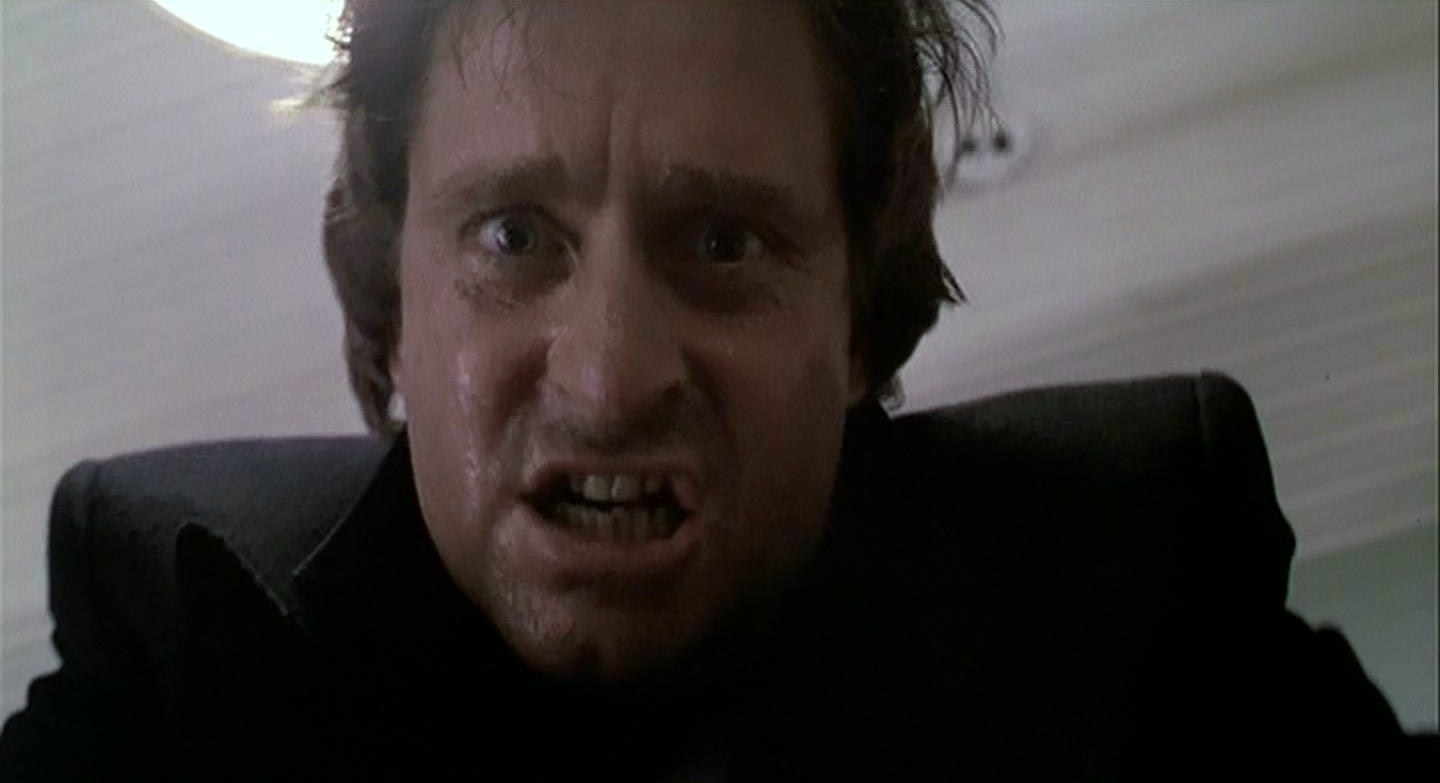
Fatal Attraction opens on a scene of domestic bliss, with lawyer Dan Gallagher (Michael Douglas) and his wife Beth (Anne Archer) in their luxurious Manhattan apartment, getting ready to go out for the night and waiting for the babysitter to arrive.  Dan would appear to have it all: a successful career, a fat best friend, and a beautiful wife.  However, when Beth and their daughter go out of town for the weekend, Dan ends up having an affair with Alex (Glenn Close).  Dan assumes that it was just a weekend thing but Alex is soon stalking Dan.  Trying to escape her, Dan moves his family out to the suburbs but Alex follows them.  Soon, pet rabbits are being killed, Alex is breaking into the house with a knife, and it’s up to Beth to step up and reclaim her man.

I have to admit that I have mixed feelings about Fatal Attraction.  On the one hand, it’s an undeniably well-made film.  It’s well-acted and director Adrian Lyne pushes all of the right emotional buttons and keeps the action moving quickly.  That the film is predictable doesn’t make it any the less effective.  As a lover of horror movies, I appreciated the skill with which Lyne crafted the film’s scare scenes.  Watching the movie, it was easy to see why Fatal Attraction was a huge box office success and why it continues to influence our culture to this very day.

fa05

And yet, at the same time, Fatal Attraction really annoys me.

The film is so well-made and so manipulative that it’s easy to miss the fact that Dan Gallagher is not only never punished for betraying his wife but he’s actually not held responsible for his actions in any way.  Instead, the only person who is truly punished for their transgression is Alex.  The film, after all, makes clear that Alex is the one pursuing Dan.  In fact, it could be argued that when it comes to Dan and Alex, the traditional gender roles have been reversed.  Alex (who, as opposed to the idealized Beth, has a name that is both masculine and feminine) is the aggressive one while Dan is the passive one who gives into temptation and, afterwards, feels guilty.  After admitting his transgression, Dan is allowed to reclaim his manhood and continue on with his perfect life.  However, Alex has no place in conventional society and therefore, she must be destroyed.

And so much the better if she’s destroyed by Beth, a woman who has no problem with accepting a traditionally domestic role.

Far too often, in the past, I know that my girl friends and I always assumed that men were simply incapable of resisting temptation.  Therefore, if your boyfriend cheated on you, it really was not his fault.  He was just being a guy.  Instead, it was the other woman’s fault because she was the one who tempted him.  (And, though we acknowledged this a lot less, it was also his girlfriend’s fault for allowing him to get into a position where he could be tempted in the first place.)  But it was never truly guy’s fault and, as long as you made him suffer for a bit, it was always expected that you would forgive him and take him back.

ff562f_50a74289f9f696cf59a7125eec69b111

That’s the same mentality that runs through Fatal Attraction (not to mention countless daytime talk shows where girlfriends and wives always beat up mistresses while their boyfriend or husband stands over to the side and watches, untouched).  Yes, Dan did cheat on his perfect wife and yes, he feels terrible about it.  But the real threat comes from the woman who pursued him despite knowing that he was married and then, afterwards, had the nerve to demand not to be ignored.  (If anything, the film seems to be suggesting that everything would have been okay if Dan had just fucked someone who works in his office, as opposed to someone who he can’t control through money or the threat of societal shaming.)  When, at the end of the film, Beth shoots Alex, it’s a crowd-pleasing moment but it’s also Beth’s way of reclaiming her man.  Since Dan — being male — can’t be expected to exercise any sort of self-control, it’s the responsibility of Beth to step up and destroy the temptation.

For not respecting the vows of marriage, Alex is a monster who must be destroyed.  Dan, on the other hand, is merely inconvenienced and ultimately, he ends up with a far stronger marriage as a result of having strayed.

In Fatal Attraction, the only thing more dangerous than sex with Alex is examining subtext.

Fatal Attraction-22