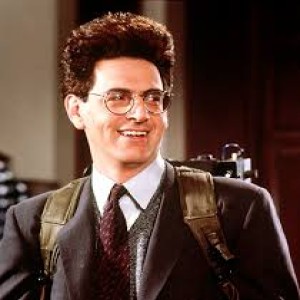
 I always wanted to be Egon Spengler.
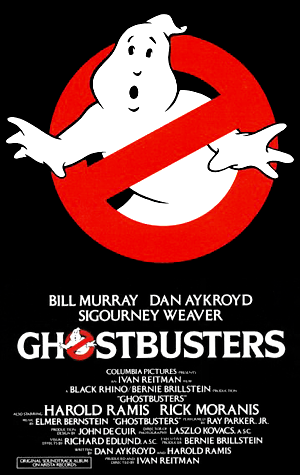
I can not remember how old I was when I first saw the original Ghostbusters but I know I was young enough that “Gatekeeper” and “Keymaster” went over my head. But I do remember that Ghostbusters was one of my favorite movies from the first time I saw it and that Egon Spengler (played by the much missed Harold Ramis) was always my favorite character.
I know that, for most people, Peter Venkmen (Bill Murray) is their favorite. It is true that Peter got the best lines and Sigourney Weaver. But I always wanted to be Egon. Egon was the one who knew everything. He knew how to track down and capture ghosts. He knew that the only way to defeat Gozer was to cross streams. No matter what happened, Egon was never surprised or scared. Egon always knew what to do. Egon did not get Sigourney Weaver but he did get Annie Potts.
Dan Aykroyd’s Ray Stantz never gets as much attention as either Peter or Egon, even though, without Aykroyd, there never would have been a Ghostbusters. Aykroyd originally envisioned Ghostbusters as being a sci-fi epic that would be a vehicle for him and John Belushi. After Belushi died, Aykroyd and Harold Ramis rewrote the script and scaled back the story. Bill Murray took the role that would have been played by Belushi and the famous ghost, Slimer, was created as a tribute to their fallen friend.
As for Ernie Hudson’s Winston Zeddemore, his role was much larger in the original script. But with each rewrite, Winston’s role got smaller and Peter’s role got larger. Winston’s role is still important because he is the ghostbuster who stands in for the audience. He is not a skeptic like Peter but he’s not a true believer like Ray and Egon. Winston just wants a steady paycheck.

I remember loving the original Ghostbusters when I was a kid but a new Ghostbusters is being released today and I have read that some people think that it is going to destroy my childhood. Since the lovely Lisa Marie Bowman and I are planning on seeing the new Ghostbusters tonight, we rewatched the original on Wednesday. In case my childhood was on the verge of being destroyed, I needed to enjoy it one final time.
32 years after it was first released, the original Ghostbusters holds up well. With the exception of Slimer and the Stay Puft Marshmallow Man, the special effects are no longer special but the script is still full of laugh out loud moments, from the opening with Bill Murray testing students for ESP to Rick Moranis asking random New Yorkers if they were the Gatekeeper to “It’s true … this man has no dick” to “when someone ask you if you are a god, you say yes!” Even the song is still catchy.
As I watched the original Ghostbusters, I realized that my childhood was not in danger of being destroyed. I hope the remake is good but even if it is terrible, the original Ghostbusters will always be there and it will always be too good to be forgotten. The original Ghostbusters was both smart and funny enough to survive a bad sequel, which Lisa and I made the mistake of watching after we finished the original and about which we swore to never speak again. Ghostbusters will survive a remake. If the remake is bad, it can be placed in storage with Ghostbusters 2, The Phantom Menace, X-Men: Apocalypse, Gus Van Sant’s Psycho, Batman and Robin, and every other ill-conceived remake, reboot, and sequel of the past 50 years. If the remake is good, it will be continuing a fine legacy of comedy. If a new audience enjoys the remake as much as we enjoyed the original, who are any of us to begrudge them that pleasure?
Whether the remake is good or bad, I’m not worried.
My childhood is going to be fine and so is everyone else’s.
Or, at least, it will be until dogs and cats start to live together…
 I think I was twelve when I first saw Heavy Metal. It came on HBO one night and I loved it. So did all of my friends. Can you blame us? It had everything that a twelve year-old boy (especially a 12 year-old boy who was more than a little on the nerdy side) could want out of a movie: boobs, loud music, and sci-fi violence. It was a tour of our secret fantasies. The fact that it was animated made it all the better. Animated films were not supposed to feature stuff like this. When my friends and I watched Heavy Metal, we felt like we were getting away with something.
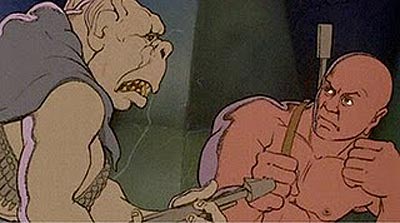 Den (directed by Jack Stokes, written by Richard Corben)
 On a space station orbiting the Earth, Captain Lincoln F. Sternn is on trail for a countless number of offenses. Though guilty, Captain Sternn expects to be acquitted because he has bribed the prosecution’s star witness, Hanover Fiste. However, Hanover is holding the Loc-Nar in his hand and it causes him to tell the truth about Captain Sternn and eventually turn into a bloodthirsty giant. Captain Sternn saves the day by tricking Hanover into getting sucked out of an air lock.
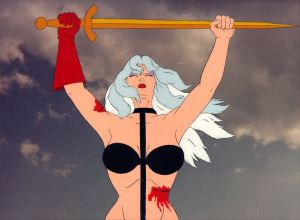 In the film’s final and most famous segment, Taarna, the blond warrior was featured on Heavy Metal‘s poster, rides a pterodactyl across a volcanic planet, killing barbarians, and finally confronting the Loc-Nar. She sacrifices herself to defeat the Loc-Nar but no worries! We return to Earth where, for some reason, the Loc-Nar explodes and the girl from the beginning of the film is revealed to be Taarna reborn. She even gets to fly away on her pterodactyl. Taarna was really great when I was twelve but today, it is impossible to watch it without flashing back to the Major Boobage episode of South Park.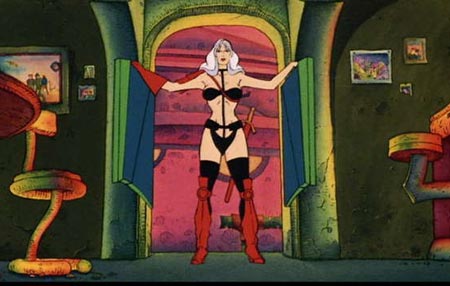


 Through the Shattered Lens