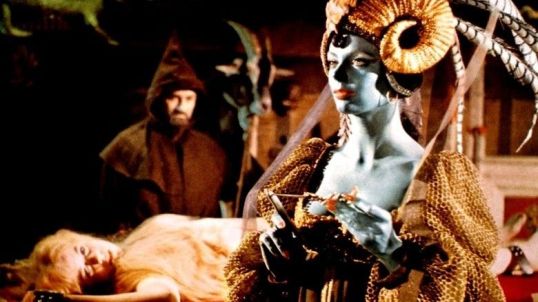
Italian Horror Showcase: The Long Hair of Death (dir by Antonio Margheriti)


http://www.youtube.com/watch?v=3lUV-TMeJ1I

This 1964 Italian horror film takes place in a feudal village in the 15th century.  It’s a time of fear, corruption, and ignorance, which is a dangerous combination.  The village is ruled over by the corrupt Count Humboldt (Giulliano Raffaelli).  With his villagers panicking about every day problems like poor crops, banditry, and disease, the Count understand that the best thing to do is just blame it all on a witch.  Of course, it doesn’t do much good to blame a witch unless you also burn her and that’s exactly what the count decides to do Adele Karnstein.  When Adele’s daughter, Helen (Barbara Steele), goes to the castle to make an appeal for her mother’s life, the Count responds by raping her and then tossing her over the edge of a cliff.

Adele’s other daughter, Lisabeth (Halina Zalewska), is adopted by the Count and grows up in his castle.  Eventually she is married off to the count’s evil and greedy nephew, Kurt (George Ardisson).  Knowing fully well what Kurt’s family did to her mother and her sister, Lisabeth is not all happy about the arrangement but what can she do?  She has absolutely no one to help her.

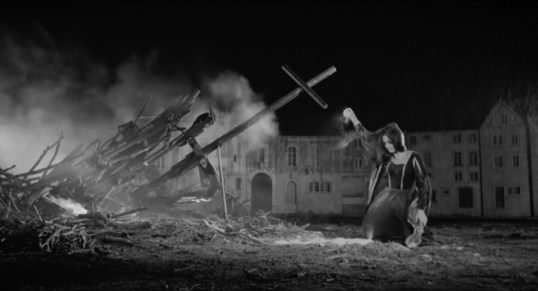
And then, one night, lightning strikes Helen’s grave.  Not only does the grave fly open but Helen is now suddenly walking around the village and heading for the castle.  Except, of course, she is now calling herself Mary.  When Mary arrives at the castle, Kurt is immediately taken with her, so much so that he starts to plot the murder of Lisabeth.  However, is it possible that this is all a part of Mary’s plan?

Meanwhile, the black plague has once again struck the village and again, the villagers are starting to demand a sacrifice….

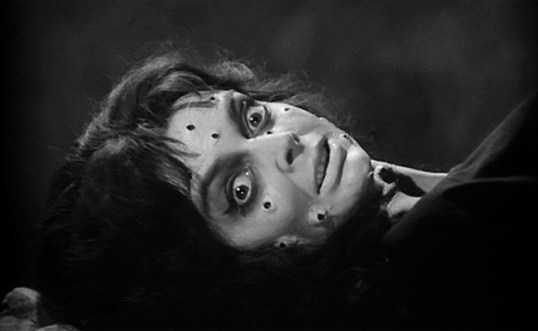
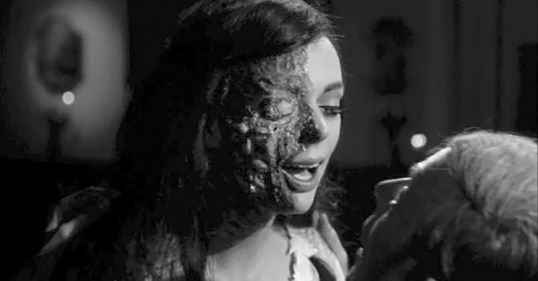
Obviously, the main reason to see The Long Hair of Death is for Barbara Steele’s performance in the dual roles of Helen and Mary.  In the early 60, Steele appeared in several Italian gothics and she almost inevitably always seemed to play a character who, after being unjustly killed by a member of the upper class, returned from the dead to get revenge.  (This was a template that was set down by her best-known Italian film, Mario Bava’s Black Sunday.)  While I’ve read that it’s a role that Steele got tired of playing, that doesn’t change the fact that she was very good at it.  Steele’s characters always returned to punish the men who had previously used and abused her, which is one reason why her performances remain popular to this day.

That’s certainly the case with The Long Hair of Death, in which the entire film is basically leading up to Kurt being punished for both his sins and the sins of his uncle.  George Ardisson gives a wonderful performance as Kurt, effortlessly going from arrogant and lecherous to terrified and helpless without missing a beat.  Director Antonio Margheriti plays up the story’s gothic atmosphere, giving the film an occasionally dream-like feel.  He emphasizes not just the villainy of the Humboldts but also the superstition of the villagers, making clear that evil cannot prosper without ignorance.

The Long Hair of Death is hardly perfect.  The middle part of the film drags and the low-budget is occasionally a hindrance.  (The village often looks like it’s made out of cardboard.)  But the film comes alive whenever Barbara Steele is on-screen and the ending is a brilliantly macabre.  Lovers of Italian gothic horror will find much to appreciate about The Long Hair of Death.

Italian Horror Showcase: Who Saw Her Die (dir by Aldo Lado)


Did you know that today is World James Bond Day?

It certainly is!  Today is the 55th anniversary of Dr. No and therefore, it’s the day when we celebrate all things Bond!

Now, it may seem strange to start a review of a classic giallo like 1972’s Who Saw Her Die? by talking about the James Bond franchise but the two do have something in common.

George Lazenby.

George Lazenby was the Australian model who was selected to replace Sean Connery in the role of 007.  It was Lazenby’s first big break and it also nearly destroyed his career.  Lazenby played the role only once, in On Her Majesty’s Secret Service.  Though many modern critics have come to recognize that film as one of the best installments in the franchise, contemporary critics were far less impressed.  After the disappointing reception of OHMSS, it was announced that Lazenby would be leaving the role and, in Diamonds Are Forever, Connery returned to the role.

What happened?  Why did George Lazenby exit one of the biggest film franchises in the world?  In my research, I’ve come across several different theories.  Some say that Lazenby voluntarily quit because he either wasn’t happy with the direction of the franchise or he didn’t get want to get typecast.  Others say that Lazenby was fired from the role because he was difficult to work with and was viewed as being a diva.  Others have said that Lazenby was viewed as being too stiff of an actor to continue in the role of James Bond.

Obviously, I can’t say whether Lazaneby was difficult to work with or not.  Nor can I even begin to speculate on what he thought of the franchise’s direction.  But, as far as this idea that Lazenby wasn’t a good actor goes … well, all I can say is have you even seen Who Saw Her Die?

As you can probably tell from the trailer, Who Saw Her Die? might as well take place on a totally different planet from the Bond films.  Who Saw Her Die? is an atmospheric and, at times, nightmarish giallo.  A murderer of children — complete with black gloves and a black veil, because this is a giallo film, after all — is stalking Venice.  When the daughter of architect Franco Serpieri (George Lazenby) is murdered, Franco and his ex-wife (Anita Strinberg) search for the murderer and discover a connection to a previous murder that occurred, years before, at a French ski resort.

It’s a dark and disturbing film, perhaps the most emotionally intense giallo film that I’ve ever seen.  A year before Nicolas Roeg did the same thing with Don’t Look Now, director Aldo Lado captures Venice as a city of both great beauty and great decay.  Every scene features the ominous shadow of death hanging over it and, after the murder of Roberta Serpieri (Nicolette Elmi), the viewer is painfully aware that everyone that we see is a potential child murderer.  Is it the artist?  Is it the priest?  Or is it some random passerby?  This film keeps you guessing.

And holding the entire film together is George Lazenby.  At the time, I’m sure that some said it was a step down to go from playing James Bond to appearing in a low-budget Italian thriller but Lazenby gives such an emotional and empathetic performance that it should silence anyone who has ever said that Lazenby was a stiff actor.  It’s not just that Franco wants justice for his daughter.  It’s also that he’s haunted by his own guilt.  Franco abandoned his daughter, leaving her on the streets of Venice, so that he could get laid.  If he had been with there, the killer never would have targeted her.  As played by Lazenby, Franco is motivated not just by rage but also by a need to redeem himself.  He is equally matched by Anita Strindberg, who perfectly captures the raw pain and rage of a mother who has lost her child.  Perhaps the film’s strongest moment features Franco and his ex-wife making love after their daughter’s funeral.  The scenes of their love-making  are intercut with scenes of them crying in bed afterwards, a technique that, a year later, Nicolas Roeg would also use for Don’t Look Now‘s famous sex scene.  Together, Stindberg and Lazenby make Who Saw Her Die? into the rare whodunit where you care as much about the future of the characters as you do the solution to the mystery.

Who Saw Her Die? is an excellent and powerful giallo and proof that George Lazenby was more than just someone who once played James Bond.

George Lazenby (center) in Who Saw Her Die?

Italian Horror Spotlight: Cannibal Apocalypse (dir by Antonio Margheriti)


The 1980 film Cannibal Apocalypse begins in Vietnam.

Sgt. Norman Hopper (John Saxon) leads his troops into a Vietnamese village.  A dog approaches.  One of the soldiers starts to pet it.

“Watch it, asshole!” Hopper shouts.

Too late.  The dog explodes and takes the soldier with him.  That’s just the first of many explosive events in the film.  Minutes after the dog blows up, Hopper discovers two American soldiers being held prisoner in an underground cage.  One of them is named Charles Bukowski (yes, I know) and he’s played by the great Italian actor, Giovanni Lombardo Radice.  The other one is named Tommy (Tony King).

“Hey,” Hopper says, “I know these guys!  They’re from my hometown!”  He reaches down to help them out of the cage.  Charlie and Tommy promptly take a bite out of his arm….

Suddenly, Norman Hopper wakes up in bed, next to his wife.  He’s been having another nightmare.  In the years since returning from Vietnam, Hopper has married, started a family, and bought a nice house in Atlanta.  He seems to have his life together but he’s still haunted by what happened that day in Vietnam.

Charlie and Tommy are also still haunted.  Unlike Hopper, they haven’t been able to get their lives together.  Charlie’s a drifter and, when he shows up in Atlanta and calls Hopper at his home, Hopper isn’t particularly happy to hear from him.  After talking to Hopper, Charlie goes to a movie where he watches a couple make out in front of him.  Soon, Charlie is trying to eat the couple while panicked movie lovers flee the theater.  (“What type of cinema is this!?” one man cries out.)

Forced to eat human flesh while being held prisoner, Charlie and Tommy are both cannibals today.  However, as the film makes clear, cannibalism travels like a virus.  Anyone who gets bitten by Charlie and Tommy becomes a cannibal themselves.  That includes Hopper.  For years, Hopper has managed to resist the craving but, as soon as he gets that call from Bukowski, he finds himself tempted to take a bite out of his flirtatious neighbor.

With the authorities determined to eradicate not only the cannibalism plague but also those infected, Hopper finds himself forced to go on the run with Charlie, Tommy, and an infected doctor (Elizabeth Turner).  Eventually, everyone ends up in the sewers of Atlanta where people are set on fire, one unfortunate is literally chopped in half by a shotgun blast, and the rats turn out to be just as hungry as the humans….

And here’s the thing.  You’re probably thinking that this sounds like a really bad movie but it’s actually kind of brilliant.  I may love Italian horror but, for the most part, I’m not a fan of cannibal movies.  But, thanks to the performances and the energetic direction of Antonio Margheriti, Cannibal Apocalypse transcends the limits of the cannibal genre.   Obviously, gorehounds will find what they’re looking for with this movie but far more interesting is Cannibal Apocalypse‘s suggestion that war (represented by the cannibalism that Hopper, Tommy, and Bukowski bring back from Vietnam) is an infectious virus.  Once someone gets bitten, it doesn’t matter who they are or what type of life that they’ve led.  The infection cannot be escaped.

In an interview that John Saxon gave for the film’s DVD release, Saxon said that making this film actually left him feeling suicidal.  It wasn’t just the fact that the film itself presents a rather dark view of humanity.  It’s because it upset him to know that there was an audience that was as rabid for violence as Norman Hopper is for human flesh.  Saxon said that he had never seen the film and, in the interview, he had to be reminded what happened to Norman Hopper at the end of the film.  It’s a bit of a shame because Saxon gives a brilliant performance as Norman Hopper.  Saxon plays Hopper as being a sad man, a man who knows that he can’t escape his fate as much as he wants to.  There’s a tragic dignity to Saxon’s performance, one that gives this cannibal film unexpected depth.

Also giving great performances are Giovanni Lombardo Radice and Tony King.  As played by Radice, Charlie is a living casualty of war, a man who served his country and came home to be forgotten.  You understand Charlie’s anger and his resentment.  (When Bukowski finds himself in a stand-off with the police, one the cops explains away Bukowski’s actions by dismissively saying, “He’s a Vietnam vet,” a line of dialogue that not only explains Charlie’s anger at America but also calls out America for not taking care of its veterans,)  Meanwhile, Tony King gets one of the best scenes in the film when, seeing Hopper for the first time in years, he grins at him and yells, “Remember these choppers!?”

As strange as it may seem to say about a film called Cannibal Apocalypse, this is a film that will bring tears to your eyes.  It’s one of the classics of Italian horror.

Italian Horror Spotlight: The Last Shark (dir by Enzo G. Castellari)


Chances are this is going to sound familiar to you.

The 1981 film, The Last Shark (a.k.a. Great White), takes place in a small seaside community.  A teenager goes out in the water, doesn’t pay enough attention to the surroundings, and ends up getting eaten.  Local civic leader named Peter Benton (James Franciscus) wants to shut down the beach.  A crusty old shark hunter named Ron Hammer (Vic Morrow) says that he can take care of the problem.  However, Mayor William Wells (Joshua Sinclair) refuses to even admit that there’s a shark in the water.  After all, sharks are not only bad for business but also could potentially keep him from being President someday!

However, the shark attacks continue.  After his son is nearly eaten by a shark — a great white, to be exact — even the mayor is forced to admit that something must be done….

If you think that the plot of The Last Shark sounds like it has a lot in common with Jaws …. well, you’re right.  And you’re not alone!  Universal Pictures though that The Last Shark borrowed a bit too much from Steven Spielberg’s seminal film as well.  In 1982, Universal filed a lawsuit to block the film’s distribution in the United States.  Though the film played for a month (and grossed 18 million dollars) while the case worked its way through the legal system, a federal judge eventually ruled that The Last Shark was too similar to Jaws and, as a result, The Last Shark was not only yanked from theaters but it also didn’t even get a proper video release until 2013!  Because of all this, The Last Shark has developed a cult following.  It’s literally the film that the major studios didn’t want people to see.  Of course, The Last Shark was neither the first nor the lat film to rip-off Jaws.  It was, however, one of the few to make a good deal of money and I imagine that was the main motivation behind Universal’s lawsuit.

Interestingly enough, The Last Shark actually has more in common with Jaws 2 than with Jaws.  Just as in Jaws 2, a bunch of stupid teenagers make the mistake of going after the shark themselves.  Also, much as in Jaws 2, the shark manages to bite down on a helicopter and pull it under the water.  A quality shark movie always features at least one helicopter getting destroyed.  That the original Jaws become a classic despite not featuring any helicopter destruction is a testament to Steven Spielberg’s ability as a director.

As for The Last Shark, it’s a thoroughly shameless and undeniably entertaining film.  Director Enzo G. Castellari (who directed several Franco Nero films and might be best-known to American audiences for directing the original Inglorious Bastards) keeps the action moving at steady pace and even manages to give us a few striking images of shark mayhem.  (The scene where a man gets bitten in half manages to be both shocking and ludicrous at the same time.)  James Franciscus appears to be taking himself far too seriously in the role of Peter Benton but Vic Morrow seems to be having a good time as the ill-tempered shark hunter.

A few other thoughts on The Last Shark:

Mayor Wells, who has presidential ambitions, also has a mustache and a haircut that makes him look like a 70s porn actor.  (In fact, with the exception of James Franciscus, nearly every adult male in this movie has a mustache.)  Whenever Mayor Wells walked through a scene, I found myself expecting to hear a lot of bass and plenty of wah wah on the soundtrack.

Secondly, it would appear that the best way to track down a shark is to drop a steak in the water.  At least, that’s the lesson I learned from watching The Last Shark.  There are actually a handful of scenes of shark hunters announcing that they’re about to go hunt for the shark and then holing up a steak.  Forget about using blood or noise to attract your prey!  Instead, just toss some spare ribs in the ocean and wait for the shark to show up!

Anyway, Italian filmmakers were always fairly shameless when it came to ripping off successful movies.  In fact, one reason why I love Italian cinema is because of that very lack of shame.  Whatever its flaws, The Last Shark is a film totally without shame and, for that reason, it’s more than worth viewing.

Italian Horror Spotlight: Hatchet for the Honeymoon (dir by Mario Bava)


“My name is John Harrington. I’m 30 years old. I am a paranoiac.”

So declares John Harrington (Stephen Forsyth) at the start of the 1969’s Hatchet for The Honeymoon.  Along with being a paranoiac, John Harrington is also handsome, charming, and apparently quite successful.  He owns a bridal dress factory in France, a business that he inherited from his mother after her untimely death.  On the outside, everything looks perfect but appearances can often be deceiving.

John’s wife, Mildred (Laura Betti), knows that John is hiding secrets.  She regularly taunts John, reminding him that he’s not only impotent but that he’s also has an unhealthy obsession with his memories of his mother.  John’s mother died when he was very young.  He witnessed her death but he’s repressed the memory of who actually killed her.  John is determined to recover those memories.

So, what does John do?

Does he go to a hypnotist?  Does he dig through old police files and search for clues?  Does he ask someone to analyze his dreams?  That’s what you or I might do but John, you must remember, is a paranoiac.  Somehow, John has realized that, whenever he commits a murder, he remembers just a little bit more about the night his mother died.  So, in order to learn the truth about his mother’s death, John is murdering the models who work at his bridal salon.  Apparently, it’s very important that his victims be wearing a wedding dress when they die….

Okay, now you’re probably already thinking that this sounds like a somewhat bizarre movie.  Well, believe it or not, things are about to get a lot stranger.

After John meets a new model named Helen (Dagmar Lassander), he decided that he doesn’t need Mildred yelling at him anymore.  So, he puts on a wedding veil and murders Mildred.  However, even in death, Mildred won’t leave John alone.  Mildred’s ghost shows up and announces that everyone will be able to see her but John.

So now, John is having to deal with everyone assuming that his wife is with him, even though he can’t see her.  As you might guess, this makes it a bit difficult for John to convince potential victims to come back to the salon with him.

And, from there, it just keeps getting stranger and stranger….

Hatchet For The Honeymoon was written and directed by one of the most important figures in the history of Italian cinema, Mario Bava.  A master technician with a wry and occasionally self-mocking sense of humor, Bava worked in every genre, from peplums to spaghetti westerns to poliziotteschis, but he’s best remembered for his work in the horror genre.  Bava is often credited with having directed the first giallo film and his often-violent thrillers are still influential to this day.

Hatchet For The Honeymoon is often described as being one of Bava’s lesser films but I don’t agree with that judgment.  If nothing else, Hatchet For The Honeymoon is probably one of Bava’s more playful movies.  From the increasingly bizarre twists and turns of the film’s plot to John Harrington’s wonderfully overwrought narration, the entire film has an almost improvisational feel to it.  One gets the feeling that Bava is poking fun at the conventions of the giallo genre.  The usual omnipresent, black glove-wearing killer has been replaced by an impotent wedding dress designer who can’t even escape the ghost of his dead wife.

(Reportedly, Mildred wasn’t originally in the script and was only added because Bava wanted to work with actress Laura Betti.  Perhaps that explains why Mildred often seems to be standing outside of the story, mocking not only John but also the mechanics of the thriller plot.)

As one would expect from a Bava film, Hatchet for the Honeymoon is frequently a visual marvel, a pop art-inspired mix of dark shadows and red blood.  The wedding dresses are to die for and so is the cinematography.  I especially liked the darkly ominous shots of John surrounded by the lifeless mannequins in his salon.  Early on, when we get a shot from John’s point of view, the image is slightly blurred and the angle seem just a bit off, a reminder of John’s twisted impression of the world around him.  When John walks up stairs to the kill his wife, the sound of his movement seems to echo through his ornate but sterile home.

If Stephen Forsyth sometimes seems to be a bit stiff in the role of John, it’s an appropriate reminder that John is an empty shell and all of his feelings and emotions are manufactured.  Laura Betti does a wonderful job nagging him in life and her palpable joy about getting revenge in death is one of the best things about the movie.

Hatchet For The Honeymoon is an exuberantly weird film and definitely one that needs to be seen by anyone seeking to fall in love with Italian horror.

Italian Horror Spotlight: Ratman (dir by Giuliano Carnimeo)


This October, along with with everything else, I want to highlight Italian horror!  Today, we start things off with a look at 1988’s Ratman!

Terry (Janet Agren) has come to a Caribbean island, not for a vacation but instead to collect the remains of her sister, Marlis (Eva Grimaldi).  Marlis was an up-and-coming model who came to the island with a photographer named Mark (Werner Pochath) and another model named Peggy (Luisa Menon).  Marlis had her entire life ahead of her but apparently, someone murdered her on the island and then left her body in an abandoned building where it was eaten by a rat.

Obviously, identifying a dead sibling would be a difficult task for anyone.  Fortunately, no sooner has Terry arrived on the island than she runs into Fred (David Warbeck).  Fred is a true crime writer, a man who knows the island and who is always ready with a quip or a joke.  For reasons that are never quite clear, Fred invites himself to accompany Terry down to the morgue.  Why does Terry allow a complete stranger to go with her to identify her sister’s body?  Who knows?  Maybe it’s because Fred is played by David Warbeck, who was one of the more likable actors to regularly appear in Italian horror films.

It turns out to be a good thing that Fred came along because, when they arrive at the morgue, it turns out that the police don’t actually have Marlis’s body!  Instead, they have Peggy’s body.  Peggy was murdered while wearing Marlis’s dress, which led to a case of mistaken identity.  But, if Marlis isn’t dead, where is she?

Could she and Mark have gone deeper into the jungles of the island, hoping to find the perfect place to take the pictures that will turn Marlis into a superstar?  Of course, they have!  Unfortunately, what they did not take into account is that the island is also the home of the Ratman!

Who is the Ratman?  Well, his name is actually Mousey (Nelson de la Rosa), despite the fact that he doesn’t really act like a mouse.  Mousey was created a mad scientist who wanted to see what would happen if he crossed the genes of a monkey and a rat.  The end result was a 2’4 sociopath with really sharp teeth and an insatiable urge to kill.  The scientist thinks that he’ll win the Nobel Prize for this creation but Mousey seems to be more concerned with killing people.  As soon as he gets out of his cage, he goes on a killing spree….

Mostly because of the presence of Nelson de la Rosa (who, until his death in 2016, was the world’s shortest man), Ratman has a cult following.  And it must be admitted that de la Rosa makes for a memorable ratman.  Unfortunately, he’s not really in the film that much.  The majority of the film is made up of filler.  For instance, we spend a lot of time watching Mark take pictures.  A lot of time is also devoted to Fred and Terry having to deal with the incompetent island police.  (The police are convinced that Marlis is dead and are apparently willing to force Terry to look at every dead body on the island to prove it.)

Fortunately, this film also features David Warbeck and, as any fan of Italian horror can tell you, Warbeck was one of those actors who improved any film in which he appeared.  Warbeck always approached his roles with a sense of humor and a likable joie de vivre and he’s probably as convincing as anyone could hope to be when appearing in a film like Ratman.  Warbeck delivers his lines with just enough of a smile to not only let you know that he’s in on the joke but to also invite you to play along with him.

Reportedly, Ratman was a troubled production and the film’s producer stepped in to take over from the credited director.  That perhaps explains why the film itself sometimes feels rather disjointed.  There is one undeniably effective sequence, in which a model is stalked by a knife-wielding maniac just to then be attacked by Mousey instead.  Otherwise, by the standards of most Italian horror films, it’s a visually bland movie.  I would have liked to have seen what someone like Lamberto Bava and Lucio Fulci could have done with Ratman.

Ratman exists in several different version.  The version I saw was dubbed into French and it was obvious that a good deal of gore had been cut from the film.  (The “official” Italian version has a running time of 82 minutes.  The version I saw only ran 76 minutes.)  Still, even in an edited form, this film has an undeniable “What did I just see” appeal to it and it’s always worth watching anything that features David Warbeck.

4 Shots From 4 Daria Nicolodi Films: Deep Red, Shock, Tenebre, Opera


4 Shots From 4 Films is just what it says it is, 4 shots from 4 of our favorite films.  As opposed to the reviews and recaps that we usually post, 4 Shots From 4 Films is all about letting the visuals do the talking.

Today is Daria Nicolodi’s birthday!

Daria Nicolodi has been called the “unsung hero of Italian horror” and it’s an apt description.  Along with starring in several of the films that Dario Argento directed during the first half of his legendary career, Nicolodi also was responsible for the story of and co-wrote the script for Suspiria.  (Nicolodi has always said that Suspiria was based on a true story involving one of her ancestors.)  Argento’s decision to give the lead role in Suspiria to Jessica Harper, instead of Nicolodi, is often cited as the beginning of the end of their relationship.

(It’s also a shame — actually, a more accurate description would be to say that it’s a goddamn crime — that Nicolodi apparently will not have even as much as a cameo in the upcoming Suspiria remake.)

Nicolodi also appeared in films directed by Mario Bava, Luigi Cozzi, Michele Soavi, and several other distinguished Italian directors.  In Scarlet Diva, she was directed by her daughter, Asia Argento.

This edition for 4 Shots From 4 Films is dedicated to Daria Nicolodi!

4 Shots From 4 Films

Deep Red (1975, dir by Dario Argento)

Shock (1977, dir by Mario Bava)

Tenebre (1982, dir by Dario Argento)

Opera (1987, dir by Dario Argento)

4 Shots From 4 Films: Happy 80th Birthday Barbara Steele


4 Shots From 4 Films is just what it says it is, 4 shots from 4 of our favorite films. As opposed to the reviews and recaps that we usually post, 4 Shots From 4 Films lets the visuals do the talking. British-born Barbara Steele, who shot to fame in a series of Italian lensed horror films during the 1960’s, celebrates her 80th birthday today. She’s the last of the iconic classic horror film stars, and in her honor here’s 4 shots from the career of Scream Queen Barbara Steele:

Black Sunday (1960, directed by Mario Bava)

The Long Hair of Death (1964, directed by Antonio Margheriti)

Nightmare Castle (1965, directed by Mario Caiano)

The Crimson Cult (1968, directed by Vernon Sewell)

Horror Scenes That I Love: The Finale of Dellamorte Dellamore


Today’s horror scene that I love comes from the 1994 Italian film, Dellamorte Dellamore.

Viewed out of context from the rest of the film, this is not an easy scene to explain.  My suggestion is enjoy it for the beauty of the images and Rupert Everett’s mournful performance.  And, if you haven’t seen it, watch Dellamorte Dellamore as soon as possible.