Horror Scenes That I Love: The Danse Macabre in Werner Herzog’s Nosferatu


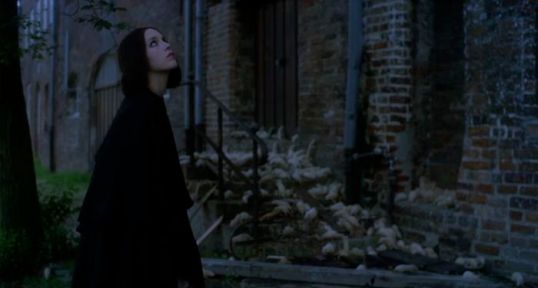
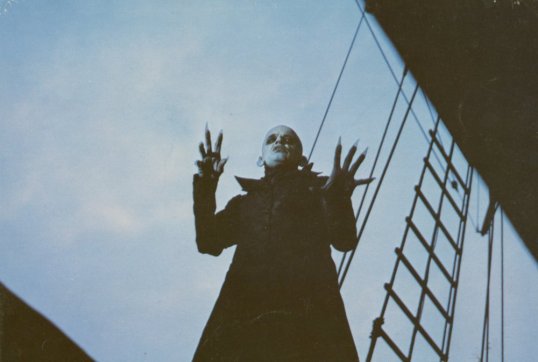
Since today’s horror on the lens was the original Nosferatu, it feels appropriate that today’s scene of the day should come from Werner Herzog’s 1979 remake.  In this scene, Lucy (Isabella Adjani) observes firsthand the madness that has come to the town of Wismar, along with the vampire and ship full of  plague-carrying rats.  While the people of the town have a last supper and celebrate their impending doom, Lucy tries to figure out a way to save them from Klaus Kinski’s Dracula.

This scene is a perfect example of how the director of a remake can both pay respectful homage to his source material while also bringing his own concerns to the story.

Horror Scenes That I Love: Klaus Kinski in Nosferatu


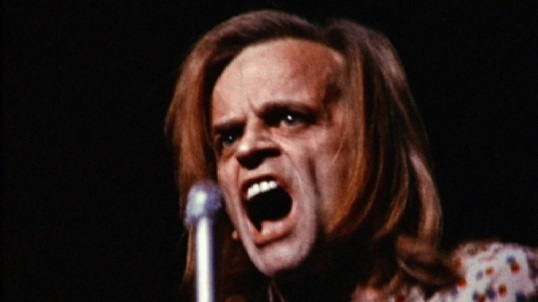
From the 1960s until his death in the early 90s, German actor Klaus Kinski was known for being the enfant terrible of world cinema.  Kinski was a volatile talent, an often angry and occasionally violent performer who specialized in playing extreme characters and who reportedly took pride in his ability to drive directors crazy.  Kinski appeared in good films and bad films and, in every one of them, he gave the type of unique performance that only he was cable of giving.

Kinski is best-remembered for his work with his frenemy, Werner Herzog.  When Herzog and Kinski weren’t making films together, they were often criticizing each other in the press and sending one another death threats.  In the documentary My Best Fiend, Herzog documented his partnership with Kinski.  Even while Herzog talked about the time that he went to Kinski’s home with the intent of killing him, Herzog’s affection for his frequent star was obvious.  Klaus Kinski was one of a kind.

In Werner Herzog’s 1980 film, Nosferatu, Kinski played the role of Dracula.  In this scene, she comes to visit Isabelle Adjani’s Lucy.

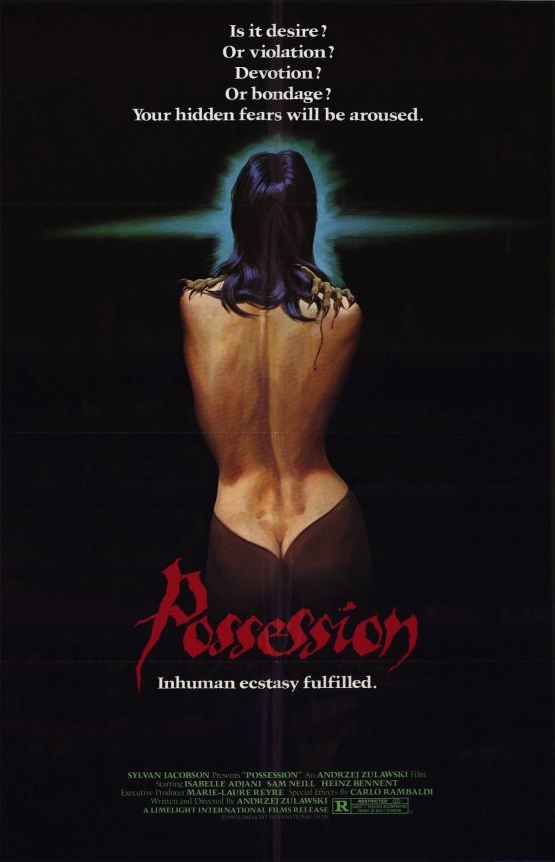
Possession (dir. by Andrzej Zulawski)


After finally watching Warner Herzog’s Nosferatu some years ago, I got into an Isabelle Adjani kick. I found out about Andrzej Zulawski’s Possession via Twitter, and considered picking it up. However, the only copy available at the time on Amazon was the Mondo Vision Special Edition, which clocked in at almost $175 dollars. I haven’t seen a movie priced so high since my Aunt purchased the VHS version of Conan the Barbarian when it was first released at around $80.

Thankfully, Metrograph has the film on rotation in part of their movies at home service since last year. I’ve watched it a few times since it was made available, and perhaps it’s why Titane didn’t bother me as much is it did others. I felt truly uncomfortable with Possession, and it’s not an easy recommendation. I’m not sure I’d refer to it a horror film. It’s more of a supernatural drama, but by the end of it, you may find yourself wanting to wash your eyes out. I guess maybe the closest films I could compare Possession to are Marriage Story and Blue Valentine, but with some darker elements.

I should a moment to warn you now. Possession contains elements of nudity, abuse, creature sex and even a miscarriage. The film was originally banned in the United Kingdom as part of a movement to corral more extreme content in cinema. Films like Faces of Death, Tenebrae, The Evil Dead, Mother’s Day (which my older brother owned), Shogun Assassin and even Suspiria were once on a watch list to be seized if their videos were owned by anyone. This was done under the notion that the content of the films were either offensive or could corrupt the minds of anyone (children, in particular) watching it.

Possession is the story of Anna (Adjani) and Mark (Sam Neill, Thor: Ragnarok). Having recently arrived home from working abroad as an Operative, Mark suspects that Anna is cheating on him. She has found someone else, and it proves to be a major rift in their already damaged relationship. Add to this their son, Bob, and it just grows more complicated. When Mark confronts Heinrich (Heinz Bennent), one of Anna’s lovers, it doesn’t go well for Mark. Try as he might to make amends with Anna, she simply doesn’t feel anything for him anymore or rather, her new relationship is too much to let go. Mark’s attempts to reconcile aren’t exactly working in his favor, as he moves from constant questioning to outright violence in some cases. Mark isn’t exactly innocent either, considering that he’s grown fond of Helen, Bob’s school teacher (also played by Adjani) and reluctantly spends some quiet time with his annoying neighbor, Margit (Margit Carstensen, Martha).

Eventually, Mark hires an investigator (Carl Duering) to follow Anna and track down her lover. The detective manages to find Anna living in a run down building. He discovers who (and more importantly, what) she’s been sleeping with, which prompts Anna to kill him. As curiosity grows over Anna’s new relationship, Heinrich checks in on Anna, only to be attacked. Heinrich returns to Mark for assistance, which leads to some strange events in the last half hour.

Although the film is about 2 hours and 4 minutes, it does takes a while to get to where it needs to go. I’ll admit to having moments of wondering just what was going on, as the film felt like it was looping in circles. Mark wants Anna, Anna hates Mark. Mark loves Bob, so does Anna. Once the detective comes into the picture, things pick up a bit. There’s also a miscarriage sequence that was hard to watch. If you can handle it, so be it, but for me, it was definitely a “What the hell?” moment.

Possession‘s special effects were created by Carlo Rambaldi, who also went on to work on E.T. The Extra-Terrestrial. The creature in the movie is somewhat menacing in its various forms, with tentacles slithering. I would have loved to see the audience reaction to it on screen. Possession was a hard film to make for both Sam Neill and Isabell Adjani. Supposedly, the movie caused Adjani so much stress that it was rumored she attempted suicide. Neill also had issues working in the film and according to Wikipedia, he considered it one of the “most extreme film” he ever made. It truly shows throughout the movie. Both actors push at each other like an angry married couple, and the interactions between the two are the real shocking elements of Possession. You have thrown chairs, tons of screaming and fighting.

Overall, Possession is a film that isn’t a required watch, but I was curious about the ban behind it. It has some strong and wild performances by both Sam Neill and Isabelle Adjani. Adjani’s performance would win her the Best Actress at Cannes, and was well deserved. It’s almost an out of body experience, for the most part.
International Horror Film Review: Nosferatu, the Vampyre (dir by Werner Herzog)


Agck!  The rats!

Nosferatu, Werner Herzog’s 1979 remake of the F.W. Murnau’s classic silent vampire film, may be best known for Klaus Kinski’s feral performance of Count Dracula but, for me, I’ll always remember the rats.

When Dracula first comes to the city of Wismar, he travels via a boat.  Spending the day in his coffin, he arises at night to kill the crew of the ship.  (Eventually, the captain’s dead body ends up tied to the wheel to ensure that the boat’s course is not altered.)  In order to keep the people of Wismar from realizing that they have a vampire in their midst, Dracula travels with thousands of rats and forges the ship’s log to make it seem as if the crew has fallen victim to the plague.  When the boat docks at Wismar, thousands of rats flood into the streets.  When Lucy (Isabelle Adjani) later walks through the streets of the Wismar, it becomes obvious that the rats have conquered the city.  The remaining people are too busy burying their dead and preparing for the end to do much about the rats.  One group cheerfully eats a lavish meal while thousands of rats wait behind them.  Later, the rodents have taken over the table.  The people are gone but the rats remain.

Werner Herzog has often cited the original Nosferatu as one of the films that most inspired him as a young filmmaker.  His remake is both a respectful homage to the original film and also a uniquely Herozgian work.  Much as the Spanish expedition at the center of Aguirre, The Wrath of God ended with the raft being conquered by monkeys, the city of Wismar is conquered by both rats and mythology.  Even towards the end of the film, when it becomes obvious that a vampire has come to town, the people refuse to believe it.  Some wait for God to save them.  Some just decide to celebrate the end.  But only Lucy, who we are told is pure of heart, is willing to sacrifice herself for the people of Wismar.  And yet, the film leaves us wondering if that sacrifice would really be worth it.  Are the people of Wismar worth saving?  This version of Nosferatu suggests that perhaps they’re not.


Lucy is the wife of estate agent Jonathan Harker (Bruno Ganz).  As with almost every version of Dracula, Nosferatu opens with Harker traveling to Dracula’s castle, dismissing the claims of local villagers are being mere superstition, and then eventually meeting the count himself.  Klaus Kinski may be made up to look like Max Schreck from the original film but he still turns Dracula into a uniquely Kinski-like creation.  Kinski’s Dracula has little of the old world charm of Bela Lugosi or even Christopher Lee.  Instead, he’s like a feral animal, hissing out his dialogue and almost always hiding in the shadows.  It’s been such a long time since this Dracula was human that he no longer knows how interact with them.  Instead, like an abused animal, he cringes when Harker attempts to speak to him.  There’s a loneliness to this Dracula and an unexpected sadness in his eyes.  Asking him to control his thirst for blood would be like asking a wild animal not to obey its natural instinct to kill.  The only time that this Dracula doesn’t seem to be full of self-loathing is when he’s actually hunting blood.  Then he moves like a calculating predator.

As one might expect from a Herzog film, Nosferatu moves at its somewhat odd but deliberate pace.  (Harker’s lengthy journey to reach Dracula’s remote castle will remind you of Klaus Kinski trying to conquer the Amazon in Aguirre and Fitzcarraldo.)  The imagery is surreal and dream-like.  I already mentioned the rats and the scene of Kinski stalking the captain of the boat feels like it was taken from a filmed nightmare.  It’s also impossible to forget the images of black-clad men, marching down the streets of Wismar and carrying coffins on their shoulders, all ignoring Lucy as she begs them to understand that there is something even deadlier than the plague at work in Wismar.

Both the original and the remake of Nosferatu are classic vampire films.  I suggest watching both.  Herzog shot two version of Nosferatu, one in German and one in English.  Though both versions are essentially the same, I recommend the German version just because, in the English version, it’s obvious the actors are occasionally having trouble performing in a foreign language.  The German version feels more authentic.  Since the film is basically a visual poem, it’s effective even if you’re watching it without subtitles.


Lisa Marie Does The Fouke Monster And Five Other Trailers


Isn’t he cute?  That happy little fellow is The Fouke Monster and he’s here because he’s the star of the very first trailer in this week’s edition of Lisa Marie’s Favorite Grindhouse and Exploitation Trailers.

1) The Legend of Boggy Creek (1972)

Before I talk about this trailer, allow me to share a few facts: my family used to live in Fouke, Arkansas!  I’ve been down to Boggy Creek!  I never saw the famous Fouke Monster but I went out looking for him a few times!  Anyway, this is the trailer for The Legend of Boggy Creek, which is a documentary about an apeman that supposedly lives in the area (though, according to Wikipedia, he hasn’t been spotted since ’98 so maybe he drowned or moved to Missouri).  This film is somewhat infamous because it features reenactments of various monster sightings, some of which star people who actually lived in Fouke at the time and who play themselves (and a few of them later sued once the film came out).  It was also the first film directed by Charles B. Pierce, who directed a lot of independent films in Arkansas and North Texas, including the classic The Town That Dreaded Sundown.  Sadly, Pierce passed away last year at the age of 71.

2)  Mean Mother (1974)

This is one of those trailers that I discovered while randomly searching Youtube and, I have to be honest, my first thought was that it was a parody trailer.  But no, after researching the manner, I can say that Mean Mother is a real movie.  It was apparently yet another one of the cinematic offerings of the late Al Adamson.

3) The Night Child (1976)

This Italian film is one of the countless Omen/Exorcist rip-offs that came out in the 70s.  Actually, The Night Child is an indirect rip-off of those two films as it’s actually a rip-off of a previous Italian version of the Exorcist, Beyond The Door.  What I especially love about this trailer is the “Keeping telling yourself, she’s only a child,” line which is obviously meant to recall the “Keep telling yourself, it’s only a movie…” tagline from Last House On The Left.

4) The Young Nurses (1973)

“Meet today’s women…beautiful, liberated, and ready for action!  They’re the young nurses and they’re growing up fast!”  I love the narrator of this trailer.  I’ve heard his voice in several exploitation trailers from the early 70s and he just has a way of delivering the sleaziest lines in the most cheerful, harmless way.  I’d love to know who he was and if he’s still with us.

5) Nosferatu The Vampyre (1980)

Oh.  My.  God.  Okay, I saw this movie a few years ago and I was watching it by myself at 3 in the morning with all the lights off while there was a thunderstorm going on outside and there was this howling wind that kept on making all the windows shake.  I got so scared, it’s not even funny.  This is a remake of the silent classic.  It stars Klaus Kinski, Bruno Ganz, and Isabelle Adjani and was directed by the one and only Werner Herzog.

6) Julia (1974)

“Why don’t you come along and see me this week?  And bring your girlfriend…”  This trailer was specifically designed to promote this film in Australia.  Needless to say, that’s not actually Sylvia Kristel providing the voice over.  

Banned in Vermont: 6 More Shocking Trailers


The latest installment of Lisa Marie’s Favorite Grindhouse and Exploitation Trailers features trailers that are too intense, too shocking, and too controversial for the new age hippies of Vermont.

1) Axe

This film was originally titled Lisa, Lisa.  Isn’t that just a great title?  Seriously, how can you go wrong with a title like Lisa, Lisa?  Just say it a few times.  Lisa, Lisa.  What a great name.

Anyway, this trailer is just pure exploitation and the narrator really loves saying “Axe” repeatedly.  Still, I think he would have been happier saying, “Lisa, Lisa…”

2) Snuff

“The film that could only be made in South America…where life is cheap!”  I’ve never actually seen Snuff though I’ve read a lot about it.  Apparently, this was originally a film called Slaughter.  It was made by pornographic pioneers Roberta and Mike Findlay.  Anyway, the film was bought by another distributor who tacked on some footage of one of the actresses supposedly being killed on camera.  Snuff was then advertised as being an actual snuff movie and, of course, a bunch of dumbfugs believed that it actually was.

3) Olga’s Girls

This is a movie I’ve been meaning on reviewing for a while.  Olga’s Girls is from 1964 and the trailer — like all good grindhouse trailers — makes the film seem a lot more sordid and explicit than it actually is.  The actual film is almost quaint.

4) The Syndicate: A Death In The Family

“The Underworld touches everyone…even you.”  I love the shameless melodrama of this trailer and the serious tone of the narrator.  I also love the swinging crime music.  This Italian film is apparently not available on DVD.

5) The Weird World of LSD

“To fly a giant bird!”  MK-Ultra much?  This is another film I haven’t actually seen and I’ve had next to no success in tracking down a copy.  Why is LSD always so much more fun in the movies than in real life?  Seriously.

6) Possession

As I said in an earlier post, Europe’s art films are often repackaged as America’s grindhouse and exploitation films.  1981’s Possession is a perfect example of that.  People either love or hate this film.  It gave me nightmares but I still think its one of the best (and most important) films ever made.  Everyday, when faced with adversity, I ask myself — “What would Isabelle Adjani do?”