Lisa Marie Review An Oscar Nominee: The Bishop’s Wife (dir by Henry Koster)


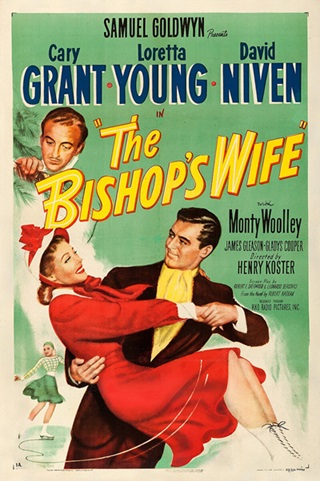
In 1947’s The Bishop’s Wife, Cary Grant stars as Dudley.

We first see Dudley walking down the snow-covered streets of a city that is preparing for Christmas.  He watches Julia Broughman (Loretta Young), the wife of the local Anglican bishop.  He stops to talk to Prof. Wutheridge (Monty Woolly), a secular humanist who is close to Julia and her husband, despite being irreligious himself.  Dudley seems to know all about the professor, even though the professor is not sure who he is.  The professor mentions that he was fired from a university because he was considered to be a “radical,” even though he has no interest in politics.  The professor says that the town’s church has seen better days, especially since the Bishop is more interested in raising money from the rich to build a grand new cathedral than actually meeting with the poor who need help.

The last person that Dudley visits is Bishop Henry Broughman (David Niven).  Dudley reveals to Henry that he’s angel and that he’s come in response to Henry’s prayers.  Henry has been frustrated in his attempts to raise money for a new cathedral.  Dudley has come to provide guidance.

With only the Bishop knowing the truth about Dudley, Dudley becomes a houseguest of the Broughmans.  The Bishop has become so obsessed with his new cathedral that he’s not only been neglecting his diocese but also his family.  While Dudley tries to show Henry what’s really important, he also helps Julia and her daughter Debby (Karolyn Grimes) to fit in with the neighborhood.  (Bobby Anderson, who played the young George Bailey in It’s A Wonderful Life, makes an appearance as a boy having a snowball fight who says that Debby can’t play because no one wants to risk hitting a bishop’s daughter with a snowball.)  The Bishop becomes jealous of Dudley and perhaps he should be as Dudley finds himself falling in love with Julia and considering not moving on to his next assignment.

(And now we know where Highway to Heaven got the inspiration for 75% of its episodes….)

The Bishop’s Wife is an enjoyable film, one that is full of not just Christmas imagery but also the Christmas spirit as well.  The Bishop finally realizes that his planned cathedral is more of a gift to his ego than to the men and women who look to him for guidance and comfort in difficult times.  David Niven is, as always, likable even when his character is acting like a jerk.  That said, this is pretty much Cary Grant’s show from the start.  Suave, charming, and gently humorous, Grant joins Claude Rains and Henry Travers in the ranks of great cinematic angels.  Never mind that Grant’s character is a bit pushy and has his own crisis of faith.  From the minute that Grant appears, we know that he’ll know exactly the right way to answer Henry’s prayers.

Cary Grant was not nominated for Best Actor for his performance here.  Undoubtedly, this was another case of Grant making it all look so easy that the Academy failed to realize just how good of a performance he gave.  Interestingly enough, The Bishop’s Wife was one of two Christmas films nominated for Best Picture that year, along with Miracle on 34th Street.  Both films lost to Gentleman’s Agreement.
The TSL Horror Grindhouse: Sweet Kill (dir by Curtis Hanson)


As the saying goes, everyone has to start somewhere and, for Curtis Hanson, that somewhere was with 1973’s Sweet Kill.

Curtis Hanson, of course, would go on to become one of Hollywood’s top genre directors, directing films like The River Wild, Bad Influence, Wonder Boys, The Hand That Rocks The Cradle, 8 Mile, and the Oscar-nominated L.A. Confidential.  But, in the early 70s, he was just one of the many recent film school grads who approached Roger Corman for a job.

Having previously worked on the script for the Corman-produced Dunwich Horror, Hanson approached Roger and told him that he had an idea for a Psycho-inspired movie about a female serial killer.  Corman replied that he would help finance the film if Hanson made the killer into a man.  Hanson did so but Corman still ended up only putting up a third of the film’s budget as opposed to the two/thirds that he had originally offered.  Hanson ended up convincing his parents to take out a mortgage on their home to help finance the movie.

Hanson shot the film in 1971.  Corman said that the film showed promise but that it needed more nudity and a better title if it was going to be successful.  Corman re-edited the film and additional nude scenes were shot and inserted into the film.  Despite this, Sweet Kill was a box office disappointment when it was originally released.  Corman re-titled the film Kisses For Eddie but it didn’t help at the box office.  Finally, the film was released under a third title, The Arousers.  Despite a lurid ad campaign built around “the arousers,” the film once again failed at the box office.  It wouldn’t be until years later, when Hanson started to achieve some mainstream success, that Sweet Kill would be rediscovered.

After all of the drama that went into post-production, it would be nice to be able to report that Sweet Kill was some sort of overlooked masterpiece but, to be honest, it’s pretty bad.  The film stars Tab Hunter as Eddie Collins.  When Eddie was a kid, he used to hide in the closet and watch as his mother lounged around her bedroom in lingerie.  Now that Eddie is a grown-up and working as a high school gym coach, he is still so haunted by his mother that he’s impotent.  As a result, Eddie spends his time breaking into apartments, stealing underwear, and having a prostitute dress up like his mother so that he can undress her while sobbing.  After a chance meeting with a hippie girl leads to Eddie once again failing to get it up, he shoves the girl hard enough to kill her.  The film implies that this act of violence leads to Eddie getting aroused for the first time and soon, Eddie is killing people and …. well, that’s pretty much the whole movie.  There’s not really a plot, beyond Eddie looking confused and trying to keep his sympathetic neighbor from finding out that he’s a serial killer.

Sweet Kill has gotten some attention because of the casting of former teen idol Tab Hunter in the role of psycho Eddie.  Tab Hunter has the right blonde look for Eddie, who is basically a homicidal beach bum, but otherwise, Hunter’s performance is fairly dull.  Watching the film, it’s obvious that he wasn’t particularly comfortable with the role of Eddie and, as such, he sleepwalks through the performance.  (Ironically, Eddie was based on Norman Bates, who was played by Hunter’s former partner, Anthony Perkins.)  There are a few creepy moments where Hunter stares off into the distance with a blank look on his face but otherwise, this isn’t a particularly memorable performance nor is Sweet Kill a particularly interesting film.

That said, Curtis Hanson went on to have quite a career so, on that level, Sweet Kill‘s bland badness is inspiring.  If the director of Sweet Kill could still go on to direct and produce some of the best films of the past 50 years, there’s hope for everyone looking to achieve their dreams.  Don’t let one failure get you down.

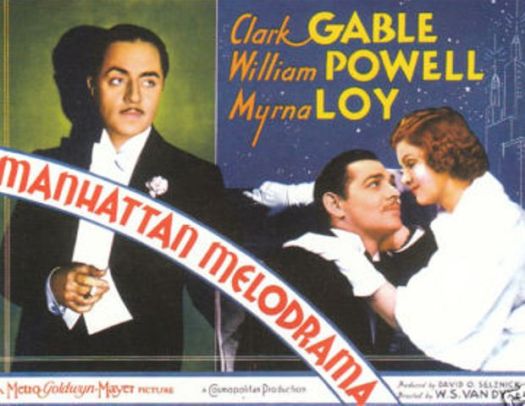
That Old, Familiar Song: MANHATTAN MELODRAMA (MGM 1934)


gary loggins's avatarcracked rear viewer

The plot of MANHATTAN MELODRAMA will certainly be familiar to movie lovers: there’s two kids, one rambunctious, the other studious. Rambunctious grows up to be on the shady side of the law, while Studious represents law’n’order. There’s Girl in the Middle, who loves Rambunctious but always winds up with Studious. Rambunctious perpetuates some evil deed, and Studious must now bring his old pal to justice. Girl in the Middle is torn between the two. In the end, justice prevails, and Rambunctious pays for his crimes, but not before making peace with Studious.

Sound familiar? Sure it does, having been rehashed umpteen times in countless westerns, gangster sagas, wartime dramas, and other genres. But MANHATTAN MELODRAMA was the first, even winning an Oscar for Arthur Caesar’s Best Original Story. Too bad Caesar didn’t copyright the idea; he’d have been a very rich man! The film also has that MGM shine going…

View original post 465 more words

Lisa Reviews An Oscar Nominee: Lost Horizon (dir by Frank Capra)


Long before there was Lost, there was Lost Horizon!

Much like the famous television show, the 1937 film Lost Horizon begins with a group of strangers on an airplane.  They’re people from all walks of life, all with their separate hopes and dreams.  When the plane crashes, they find themselves stranded in an uncharted land and, much like the Lost castaways, they are shocked to discover that they are not alone.  Instead, they’ve found a semi-legendary place that is ruled over by a man who has lived for centuries.  Much as in Lost, some want to return to civilization while others want to remain in their new home.  Both Lost and Lost Horizon even feature a terminally ill woman who starts to recover her health after becoming stranded.

Of course, in Lost, everyone was just flying from Australia to America.  In Lost Horizon, everyone is trying to escape the Chinese revolution.  Among the passengers on the plane: diplomat Robert Conway (Ronald Colman), his irresponsible brother, George (John Howard), a con artist named Henry (Thomas Mitchell), a paleontologist (Edward Everett Horton), and the very ill Gloria (Isabel Jewell).

While Lost featured a plane crash on a tropical island, Lost Horizon features a plane crash in the Himalayas.  In Lost, the sinister Others sent spies to infiltrate the survivors.  In Lost Horizon, the mysterious Chang (H.B. Warner) appears and leads the survivors to a place called Shangri-La.

Shangi-La is a lush and idyllic valley that has somehow flourished in one of the most inhospitable places on Earth.  The happy inhabitants inform the survivors that they never get sick and they never fight.  They’re led by the High Lama (Sam Jaffe), a philosopher who explains that he is several hundred years old.  The valley is full of magic and the Lama tells the survivors that Shangri-La is their new home.

Now, I’ve seen enough horror movies that I spent most of Lost Horizon waiting for the Lama to suddenly reveal that he was a vampire or an alien or something.  Whenever anyone in a movie seems to be too good to be true, that usually means that he’s going to end up killing someone about an hour into the story.  But that didn’t happen in Lost Horizon.  Instead, the Lama is just as wise and benevolent as he claims to be and Shangri-La is as much of a paradise as everyone assumes.  I guess we’re just naturally more cynical in 2018 than people were in 1937.

Of course, the Lama isn’t immortal.  Not even the magic of Shangri-La can prevent the inevitably of death.  The Lama is looking for a successor.  Could one of the survivors be that successor?  Perhaps.  For instance, Robert absolutely loves Shangri-La.  Of course, his brother George is determined to return to the real world.  He has fallen in love with one of the inhabitants of Shagri-La and plans to take her with him, despite the Lama’s warning about trying to leave…

Frank Capra was a huge fan of James Hilton’s book, Lost Horizon, and he spent three years trying to bring it to the big screen.  Based on Capra’s previous box office successes, Colombia’s Harry Cohn gave Capra a budget of $1.25 million to bring his vision of Shangri-La to life.  That may not sound like much today but, at the time, that made Lost Horizon the most expensive movie ever made.  The production was a notoriously difficult one.  (The original actor cast as the elderly Lama was so excited to learn he had been selected that he dropped dead of a heart attack.)  As a result of both its ornate sets and Capra’s perfectionism, the film soon went overbudget.  When Capra finally delivered a first cut, it was over 6 hours long.  Capra eventually managed to edit it down to 210 minutes, just to then have Harry Cohn order another hour taken out of the film.  When Lost Horizon was finally released, it had a running time of 132 minutes.

Seen today, Lost Horizon is definitely an uneven work.  With all the cutting and editing that went on, it’s hard to guess what Capra’s original vision may have been but, in the final version, much more time is devoted to the characters discussing the philosophy of Shangri-La than to the characters themselves.  (It’s always good to see Thomas Mitchell but he really doesn’t get much to do.)  Since you never really feel like you know what any of these characters were like outside of Shangi-La, it’s hard to see how being in Shagri-La has changed them.  You just have to take their word for it.  That said, it’s a visually stunning film.  Capra may have gone over budget creating the look of Shangri-La but it was money well-spent.  If I ever find myself in a magic village, I hope it looks half as nice as the one in Lost Horizon.

Despite all of the drama that went on behind the scenes and a rather anemic box office reception, Lost Horizon was nominated for best picture.  However, it lost to The Life of Emile Zola.

Embracing the Melodrama Part II #41: Ciao! Manhattan (dir by John Palmer and David Weisman)


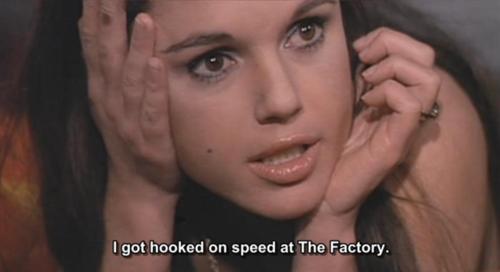
Ciao_posterI recently watched the 1972 film Ciao! Manhattan on TCM and it left me with incredibly mixed feelings.  The specific reason that I was watching Ciao! Manhattan was because it was the last film to feature the legendary model and actress Edie Sedgwick.  Tragically, at the age of 28, she died merely weeks after completing work on Ciao! Manhattan.  And while the film is dedicated to her memory and was apparently meant to be a tribute to her, it instead feels incredibly exploitive.  Watching the movie, I was aware that Edie was literally dying on screen and, as so often happened in her life, nobody was willing to step forward and help her.

In the late 60s, Edie Sedgwick was a model who was briefly the beautiful face of the underground.  Vogue called her a “youthquaker.”  She made films with Andy Warhol, she dated the rich and the famous and for a brief time, she was one of the most famous women in America.  But a childhood full of tragedy and abuse had left Edie fragile and unprepared to deal with the pressures of being famous.  She was fed drugs by those who claimed to care about her, she had numerous mental breakdowns, and, when she was at her most vulnerable, she was pushed away and rejected by the same people who had loved her when she was on top of the world.  Edie died because, when she asked for help, nobody was willing to listen.

Edie

I guess I should explain something.  I don’t believe in reincarnation but if I did, I would swear that I was Edie Sedwick in a past life.  Of all the great icons of the past, she, Clara Bow, and Victoria Woodhull are the ones to whom I feel the closest connection. (Edie is the reason why, for the longest time, I assumed I would die when I was 28.  But now I’m 29, so lucky me.)  When I watched Ciao! Manhattan, I felt as if I was watching myself (or, at the very least, a close relation) on-screen.

Ciao! Manhattan opens with Susan Superstar (Edie Sedgwick), standing topless on a street corner and hitchhiking.  She’s picked up by an aimless drifter named Wesley (played by Wesley Hayes).  Wesley gives Susan a ride back to the mansion that she shares with her mother (Isabell Jewell) and her servant, a rather disgusting guy named Geoff (Jeff Briggs).  Her mother hires Wesley to help take care of Susan.  It turns out that Susan used to be a world-famous model but now she spends her time sitting in an empty swimming pool, drinking and doing drugs.  While Wesley and Geoff listen, Susan talks about her past in New York.  While Susan talks, we see black-and-white footage of Susan (and Edie’s) past.

337224340_f1a0a57d44

Ciao! Manhattan began life in 1967 as an underground parody of a spy film.  When Edie had a nervous breakdown and was sent to rehab, filming was abandoned.  When she was finally released in 1970, filming began again.  The 1967 footage was now used for flashbacks to the wonderfully glamorous life that Susan (and Edie) had lost.

And, when viewed as a documentary of how Edie was exploited and then subsequently abandoned by everyone that she cared about, Ciao! Manhattan works.  The contrast between the happy and vibrant Edie of 1967 and the barely coherent and visibly unhealthy Edie of 1970 is heartbreaking.  Whereas the 1967 footage features an existence that is in constant motion, the 1970 footage shows us an existence that is slow and drenched in sadness.  The film makes no effort to pretend that Susan Superstar is anyone other than Edie Sedgwick and, when Edie talks about her past, no names are changed to protect the guilty.  And the film shows that, even after surviving a literal Hell, Edie Sedgwick was still a natural-born star.  Even when she’s slurring her words and staring at the world with poignantly sad eyes, Edie demands and gets the audience’s attention.

Edie2

When Ciao! Manhattan allows Edie to tell her own story, it works.  But, unfortunately, the film spends too much time with Wesley and Geoff, who are two of the most repulsive characters that I’ve ever seen.  Geoff is written to be offensive whereas the character of Wesley is done in by the very bad performance of the guy playing his role.  (Wesley Hayes was reportedly not a professional actor and it certainly shows.)

This is a film that provides evidence that, even in her last days, Edie Sedgwick was a talented and unique presence and, for that, I’m glad.  But, ultimately, it’s hard not to feel that Ciao! Manhattan was the final case of Edie and her tragic life being exploited for someone else’s profit.

Edie Sedgwick

Usually, I would end a review like this by including either a scene or the film’s trailer.  But, instead, I’m going to end this review with Edie Sedgwick’s silent Warhol screen test.  This is how I prefer to think of Edie Sedgwick — hopeful and curious with the promise of her entire life ahead of her.