The TSL Grindhouse: Exterminator 2 (dir by Mark Buntzman)


Four years after the end of the first Exterminator, the man they drove too far is driven too far again….

As you may remember, the first Exterminator ended with the CIA shooting vigilante John Eastland (Robert Ginty) because Eastland’s anti-crime activities were somehow making the President look bad.  The wounded Eastland fell into the Hudson River.  “Washington will be pleased,” the CIA agent said to the gunman.  However, the film’s final shot revealed that Eastland had survived his plunge.

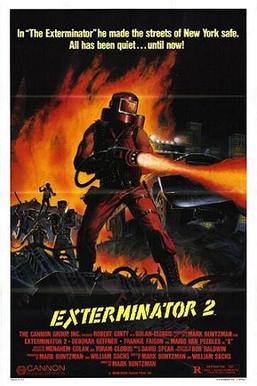
1984’s Exterminator 2 opens with Eastland returning to New York City.  He’s got a small apartment and a police scanner and when he hears a report that an elderly couple is being menaced by a group of thugs, he puts on a welding mask and uses his flame thrower to set the criminals on fire.  Of course, he doesn’t actually arrive in time to save the old couple from getting shot and killed.  Just because Eastland has decided to become a vigilante, that doesn’t mean that he’s particularly good at it.

The first Exterminator was a grim and gritty thriller that took itself very seriously.  In fact, one could argue that it took itself a bit too seriously.  Exterminator 2, which was produced by Cannon Films, takes a slightly different approach.  This is obvious as soon as Mario Van Peebles shows up as X, a cult leader who is looking to take over the New York drug trade.  Van Peebles, with his model good looks and his quick smile, is not exactly the most intimidating of villains.  And X is not exactly the most brilliant of bad guys.  For one thing, he drives a car with a big red X spray painted on one of the doors, which doesn’t seem to be the smartest thing to do when you have both the police and crazed vigilante hunting for you.
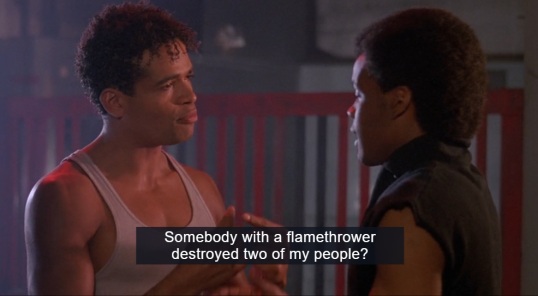
Fortunately, for X, John Eastland is easily distracted.  After he sets a few people on fire, he seems to lose interest in actually being a vigilante and instead, a large portion of the film is taken up with him getting a job collecting garbage with his friend, Be Gee (Frankie Fasion).  (Much like the previous film’s Michael Jefferson, Be Gree served with Eastland in Nam.)  Eastland also meets and falls in love with a dancer named Caroline (Deborah Geffner).  Unfortunately, a trip to Central Park leads to Caroline getting attacked by a bunch of X’s followers.  With Caroline in a wheelchair, Eastland has little choice but to pick up his flame thrower and transform his garbage truck into a tank of destruction….

Exterminator 2‘s production was a troubled one.  Director Mark Buntzman was one of the producers of the first Exterminator and apparently, Cannon disliked his first cut of Exterminator 2.  Director William Sachs (who was Cannon’s resident “film doctor”) was brought in to do extensive reshoots in Los Angeles.  Unfortunately, by the time Sachs was brought in, Robert Ginty had already moved on to another project and Sachs was forced to use his stunt double for any scenes involving Eastland.  (This is one reason why Eastland spends much of the film wearing a welder’s mask.)  Also because of Ginty’s absence, Sachs ended up adding a lot of scenes that focused on Van Peebles’s performance as X, with the end result being that the film often seems to be more about X and his gang than it is about Eastland and his hunt for revenge.  (Unfortunately, this also led to a lot of unresolved subplots, including one in which X orders one of his roller skating henchman to kidnap a woman off the street so she can be used to test a new batch of heroin.)  Many of the scenes featuring Ginty have a totally different feel to them from the scenes featuring Van Peebles and Ginty’s stunt double.

The end result is a film that really doesn’t have any sort of narrative momentum.  One is never really sure what either X or Eastland is hoping to accomplish.  Instead, they just kind of wander around until they have their final confrontation.  Along the way, there’s a few poorly edited fights but there’s also a lot of scenes that are just included to serve as filler.  As I already mentioned, Van Peebles is not a particularly menacing villain but Ginty also isn’t a particularly compelling hero.  Ginty’s goofy screen presence was nicely subverted by the grime and grit of the first Exterminator but, in the second film, he just comes across as being petulant and even a bit whiny.

The first Exterminator famously ended with the lines, “Washington will be pleased.”  I don’t think anyone would particularly be pleased with Exterminator 2.  As a final note, I will admit that I was so bored with this film that, when I watched it, I barely noticed when it ended and Tubi segued into showing a film called Executioner 2.  That pretty much sums up the entire Exterminator 2 experience.
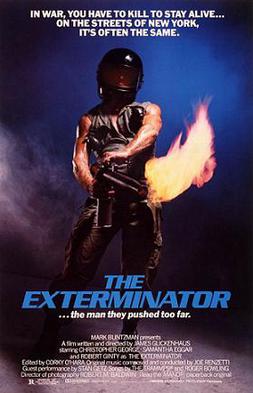
The TSL Grindhouse: The Exterminator (dir by James Glickenhaus)


First released in 1980, The Exterminator begins during the Vietnam War.

Two soldiers, John Eastland (Robert Ginty) and Michael Jefferson (future Cannon Film mainstay Steve James) have been captured by the Viet Cong and can only watch as a third soldier is beheaded by his captors.  (The graphic beheading, in which the camera lingers on the head slowly sliding off the neck, is an early warning of what this film has in store for its audience.)  Jefferson manages to free himself from his bonds and kills most of the enemy soldiers.  After Jefferson frees him, Eastland fires a bullet into the still twitching body of the VC commander.

The film jumps forward to 1980.  Living in New York City, Jefferson and Eastland are still best friends and co-workers at a warehouse.  For a second time, Jefferson saves Eastland’s life when the latter is attacked by a gang calling themselves the Ghetto Ghouls.  When the Ghouls get their revenge by tracking down Jefferson and piecing his spine with a meat hook, Eastland gets his revenge by killing …. well, just about everyone that he meets.

Though The Exterminator was obviously inspired by Death Wish, a big difference between the two films is that Eastland doesn’t waste any time before starting his anti-crime crusade.  In the original Death Wish, Paul Kersey (played by Charles Bronson) starts out as a self-described “bleeding heart” liberal who was a conscientious objector during the Korean War.  Even after his wife and daughter are attacked (and his wife killed) by Jeff Goldblum, Kersey doesn’t immediately pick up a gun and start shooting muggers.  Indeed, it’s not until the film is nearly halfway over that Kersey begins his mission and, in one of the film’s more memorable moments, he reacts to his first act of violence by throwing up afterwards.  While one could hardly call Death Wish an especially nuanced film, it does at least try to suggest that Kersey’s transformation into a vigiliante was a gradual process.

The Exterminator, on the other hand, goes straight from Eastland informing Jefferson’s wife about the attack to Eastland threatening a tied-up Ghetto Ghoul with a flame thrower.  When did Eastland kidnap the Ghetto Ghoul?  Why does Eastland have a flame thrower?  Where exactly has Eastland tied up the Ghetto Ghoul?  None of this is explained and the film’s abruptness gives it an almost dream-like feel.  The film plays out like the fantasy of everyone who has ever been mugged or otherwise harassed.  Magically, Eastland suddenly has the skills and the resources to outsmart not just the criminals but also the police who have been assigned to stop him.  Even the CIA is assigned to take down Eastland because his anti-crime crusade is inspiring people to wonder why the President hasn’t been able to reduce crime.  The film plays out like the type of daydreams that Travis Bickle had when he wasn’t driving his taxi.

Eastland is ruthless in his kills but fortunately, everyone he kills is really, really bad.  The Ghetto Ghouls clubhouse is decorated with a poster of Che Guevara but Che’s revolutionary rhetoric isn’t worth much when the Exterminator’s after you.  A mob boss makes the mistake of not telling Eastland about the Doberman that’s guarding his mansion so into the meat grinder he goes.  New Jersey loses a state senator when Eastland discovers him torturing an underage male prostitute.  The film was shot on location in New York City and the camera lingers over every grimy corner of the city.  A scene where Eastland walks through Times Square takes on a cinéma-vérité feel as people jump out at him and try to entice him to take part in everything the city has to offer.  If Death Wish suggested that Paul Kersey’s actions were saving New York, The Exterminator suggests that we should just let John Eastland burn the whole place down.

With his youthful face, Robert Ginty looks more like a mild-mannered seminarian than a hardened veteran of both Vietnam and the mean streets of New York but, ultimately, that works to the film’s advantage.  If anything, it explains why everyone who meets him trends to underestimate what he’s capable of doing.  B-movie vet Christopher George overacts in his usual amusing way as he plays the detective who has been assigned to catch The Exterminator.  Samantha Eggar plays a doctor who starts dating George for no discernible reason.  The scenes featuring George and Eggar often seems as if they belong in a different film but they do provide some relief from the rather grim and gruesome scenes of The Exterminator killing almost everyone who he meets.

The Exterminator was controversial when it was originally released and it still retains the power to shock.  It’s easy to laugh at some of the film’s more melodramatic moments but there were still more than a few scenes that I watched with my hands over my eyes.  The film’s hard edge grabs your attention from the start and the idea of the CIA sending assassins to take out a neighborhood vigilante is so over the top and ridiculous that it’s kind of hard not to appreciate it.  That the film totally buys into its paranoid worldview (“Washington will be pleased.”) makes the whole thing far more compelling than it should be.

As ludicrous as it all is, The Exterminator is a film that defies you to look away.

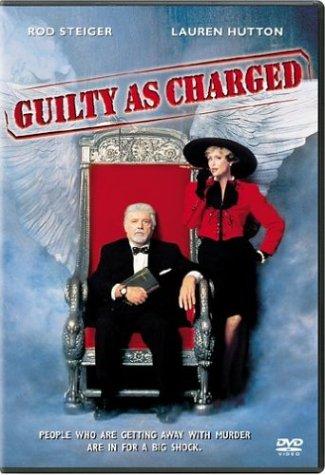
Guilty As Charged (1991, directed by Sam Irvin)


Stop me if you’ve heard this one before.

Kalin (Rod Steiger) is a crazy old religious fanatic who is rich enough to own a meatpacking plant and hire goons to work for him.  Underneath the meatpacking plant, he has a secret prison and an electric chair that he uses to electrocute people who he feels have escaped justice.  Helping out Kalin is a crazy preacher, played by Isaac Hayes (!), who waxes philosophically about how much he loves the smell of burning flesh.

While Kalin and the gang are executing people below ground, parole officer Kimberly (Heather Graham) is above ground and wondering why so many ex-cons are mysteriously vanishing.  Kimberly is worried that someone may be executing them but then she gets distracted by a politician named Stanford (Lyman Ward).  Stanford wants Kimberly to work on his campaign because she looks like Heather Graham and he’s a sleazy politico.

Meanwhile, a man named Hamilton (Michael Beach) has escaped from prison.  Hamilton claims that he was framed for a murder that he didn’t commit but no one is willing to believe him.  However, Hamilton is telling the truth and the murder was actually committed by Stanford!  The only people who know that Stanford is the murderer are Stanford, his wife (Lauren Hutton!!), and his maid (Zelda Rubinstein!!!).

It all leads to one question: How did all of these talented people all end up in this crappy film!?

The strange thing about Guilty As Charged is that, even though the film is centered around the death penalty, the film itself doesn’t seem to have any opinion on the issue.  Kalin and his followers are crazy religious fanatics who claim that they’re doing God’s work by executing people and Hamilton is an innocent man who has been marked for death so you would think that the movie is against the death penalty.  But then, in a twist that makes no sense, Kalin reveals that he knows that Hamilton is innocent and he’s only using him to get to Stanford and suddenly, the film is for the death penalty.  Kimberly is worried that someone is targeting ex-cons but, by the end of the movie, she’s targeting ex-cons herself even though nothing’s happened that should have made her change her mind.

Guilty as Charged is technically a comedy, though most of the jokes are too thuddingly obvious to provoke even the slightest of a smile.  Hayes wins some laughs, just because he seems like he’s having fun.  Rod Steiger bellows as if he’s getting paid by the decibel and doesn’t seem to be having any fun at all.  Guilty as Charged isn’t funny and it’s not thought-provoking but at least it’s got Isaac Hayes.

Pop Up Fly: SQUEEZE PLAY (Troma 1979)


gary loggins's avatarcracked rear viewer

squeez1

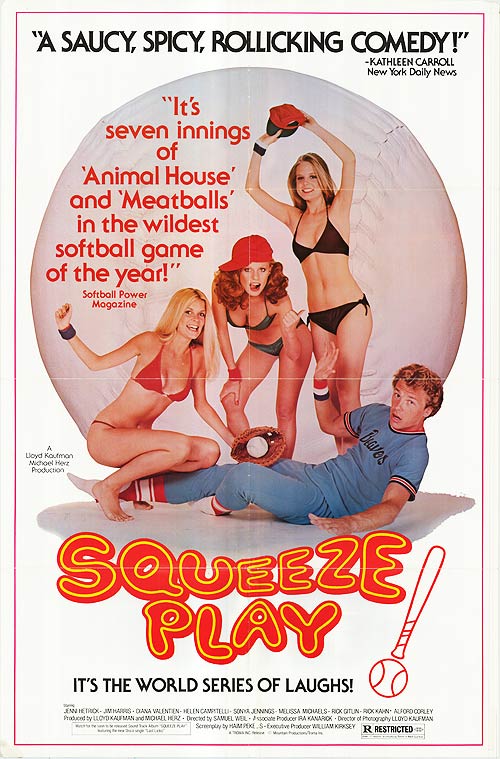
Welcome to the wacky, wonderful world of 70’s sexploitation comedies. Today we’ll be dealing with two Great American Obsessions: boobs and baseball! (Actually, it’s softball here, but why quibble).  SQUEEZE PLAY is brought to you by Lloyd Kaufman and his team at Troma Entertainment, the folks responsible for such cinematic gems as THE TOXIC AVENGER and CLASS OF NUKE EM HIGH. Let’s slide right into the plot of the movie, shall we?

SQUEEZE PLAY is your basic Battle of the Sexes romp. The Beavers are the champs of the Mattress Workers Softball League, and the guys on the team have been ignoring their women folk for softball. This is causing much friction between them (and not the pleasant kind!), especially our two leads, team captain Wes and his fiancée Samantha. Things change when Mary Lou, a pretty heiress on the run, comes to town and demonstrates a killer arm (seems…

View original post 453 more words