Lisa Reviews An Oscar Nominee: Foreign Correspondent (dir by Alfred Hitchcock)


ForeignCorrespondent

Before watching a film like 1940’s Foreign Correspondent, it helps to know a little something about history.

Nowadays, when we think about World War II, there’s a tendency to assume that, from the minute that Hitler came to power in Germany and started to invade the rest of Europe, the entire world united against the Nazis.  The truth is actually far more complex.  The world was still recovering from World War I and throughout the 1930s, even as the Axis powers were growing more and more aggressive, respected intellectual leaders and politicians continued to argue that peace must be maintained at all costs.  Pacifism was such a popular concept that otherwise intelligent people were perfectly willing to make excuses for Hitler and Mussolini.  For five years, the UK followed a policy of appeasement towards Nazi Germany.  Even after war broke out between Britain and Germany, the U.S. remained officially neutral.  In the 1940 presidential election, President Franklin D. Roosevelt — running on a platform of neutrality — was overwhelmingly reelected over internationalist Wendell Willkie.

Foreign Correspondent, an American film made by a British director, opens before the start of World War II.  An American newspaper editor, Mr. Powers (Harry Davenport), is frustrated because none of his foreign correspondents seem to be able to understand the truth of the situation in Europe.  They all claim that there is going to be no war in Europe but Mr. Powers feels differently.  He also feels that the newspaper’s most celebrated and respected foreign correspondents are just a bunch of out-of-touch elitists.  Instead of sending another upper class academic, Mr. Powers decides to send a hard-boiled crime reporter to cover the situation in Europe.  Johnny Jones (Joel McCrea) has never been to Europe and that’s exactly why Mr. Powers decides to send him.  In one of the film’s more clever moments, he does, however, insist that Johnny write under the more distinguished sounding name of “Huntley Haverstock.”

(Foreign Correspondent‘s pointed criticism of out-of-touch elitists repeating the establishment line remains just as relevant today as it was in 1940.)

From the minute the brash and tough Johnny arrives in Europe, he finds himself caught up in a huge conspiracy.  He’s been assigned to report on a group known as the Universal Peace Party and, since this film was directed by Alfred Hitchcock, we automatically know that any organization with the word “Peace” in its name has to be up to something shady.  The Universal Peace Party has been founded by Stephen Fisher (Herbert Marshall), who appears to sincere in his desire to avoid war.  Johnny meets and falls in love with Fisher’s daughter, Carol (Laraine Day).

From the minute that Johnny witnesses the assassination of distinguished Dutch diplomat Von Meer (Albert Bassermann), he suspects that things are not how they seem.  Working with Carol and a British journalist named Scott ffolliot* (delightfully played by the great George Sanders), Johnny discovers that Von Meer was not killed at all.  Instead, a double was assassinated and Von Meer was kidnapped by a group of spies.

But who are the spies?  After nearly getting killed by one of Fisher’s bodyguards, Johnny starts to suspect that Stephen Fisher might not be as into world peace as was originally assumed.  Complicating matters, however, is the fact that Johnny is now engaged to marry Carol…

Foreign Correspondent is a wonderfully witty thriller, one that has a very serious message.  While the film is distinguished by Hitchcock’s typically droll sense of humor (eccentric characters abound and the scene where Edmund Gwenn keeps getting interrupted before he can attempt to push Joel McCrea off of a tower is both funny and suspenseful), the film’s message was that America could not afford to stay neutral as war broke out across Europe.  As the all-American Johnny Jones says at the end of the film:

“All that noise you hear isn’t static – it’s death, coming to London. Yes, they’re coming here now. You can hear the bombs falling on the streets and the homes. Don’t tune me out, hang on a while – this is a big story, and you’re part of it. It’s too late to do anything here now except stand in the dark and let them come… as if the lights were all out everywhere, except in America. Keep those lights burning, cover them with steel, ring them with guns, build a canopy of battleships and bombing planes around them. Hello, America, hang on to your lights: they’re the only lights left in the world!”

Foreign Correspondent was nominated for best picture of 1940 but it lost to another far different Hitchcock-directed film, Rebecca.

http://www.youtube.com/watch?v=LMDJnTKotxo

——

* Yes, that is how he spells his last name.  As he explains, his family dropped the capital name in his surname after an ancestor was executed by Henry II.  Since it was George Sanders doing the explaining, it somehow made perfect sense.
Horror on the Lens: Diary of a Madman (dir by Reginald Le Borg)


For today’s horror on the lens, check out the 1963 film, Diary of a Madman!

It’s simply not October without at least one film featuring the great Vincent Price.  In Diary of a Madman, Price plays Simon Cordier, a French magistrate.  What is it that’s causing Simon’s personality to change?  What is making him suffer from greater and greater delusions?  Is he just going insane?  Or is he being haunted by a malevolent spirit known as a horla!?

Any film that features Vincent Price being sinister is worth watching and Diary of a Madman actually features one of his better performances.  Overall, Diary of a Madman is an enjoyable attempt at psychological horror.

Enjoy it below!

Lisa Watches an Oscar Nominee: Witness for the Prosecution (dir by Billy Wilder)


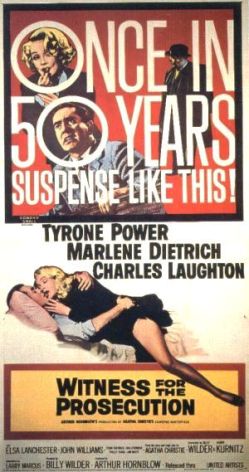
Movie_poster_for_-Witness_for_the_Prosecution-

Earlier today, I DVRed the 1957 best picture nominee, Witness for the Prosecution, off of TCM.  I watched the film as soon as I finished dinner and, having now seen Witness for the Prosecution, I am prepared to give you my professional and erudite review.

Okay, are you ready for it?  Here we go:

🙂 Oh my God, I freaking love this movie!!!!!!!!! 🙂

Witness for the Prosecution is many things.  It’s a courtroom drama.  It’s a domestic comedy.  It’s a twisty murder mystery.  It’s a showcase for three great performers.  It’s crowd pleaser that will make you think and, even if it does involve people killing each other, it will probably make you smile as well.  Don’t let that 1957 date fool you.  Witness For the Prosecution is a lot of fun.

Leonard Vole (Tyrone Power) is a somewhat sleazy man who has two claims to fame.  One is that he claims to be responsible for inventing the egg beater.  The other is that he’s been accused of murdering Mrs. French (Norma Varden), a wealthy widow who had recently named Leonard as the beneficiary of her will.  Everyone assumes that Leonard must have been having an affair with Mrs. French but Leonard claims that he’s innocent.

Suspecting that he is soon going to be arrested, Leonard hires Sir Wilfred Robarts (Charles Laughton) to serve as his attorney.  Though Sir Wilfred is recovering from a heart attack and has been ordered to not take on any more stressful criminal cases, he agrees to defend Leonard.  He proceeds to do just that, under the watchful eye of his nurse, the protective Mrs. Plimsoll (Elsa Lanchester).

(The testy relationship between Sir Wilfred and Mrs. Plimsoll provides the film with its comedic relief.  Laughton and Lanchester were married in real life and, watching the film, you can tell that they had a lot of fun acting opposite each other.)

Sir Wilfred is convinced that he can win acquittal for Leonard, especially since Leonard’s German wife, Christine (Marlene Dietrich), is willing to provide an alibi for him.  (In one of the film’s best moments, Sir Wilfred talks about how distraught Christine will be to discover that Leonard has been arrested just to then have the very calm and self-possessed Christine step into the room.)  However, to everyone’s shock, Christine is called as a witness for the prosecution.  She testifies that Leonard confessed the murder to her and that she only provided an alibi out of fear and love.

Things aren’t looking good for Leonard but then, a mysterious woman with a cockney accent contacts Sir Wilfred and reveals that Christine may have had reasons of her own for not giving Leonard an alibi…

Witness For The Prosecution ends with a voice over that says, “The management of this theater suggests that for the greater entertainment of your friends who have not yet seen the picture, you will not divulge, to anyone, the secret of the ending of Witness for the Prosecution.”  And I have to say that, when I heard that, it just made me love the film even more.  I had enjoyed the film so much and had so much fun following all the twists and the turns of the mystery that I found myself nodding in agreement.

“Sure, 58 year-old voice over,” I said, “I will not divulge the secret ending of Witness For The Prosecution.”

And I’m not going to!  Though, to be honest, you’ll probably guess the secret before it’s revealed.  It’s a plot twist that has been imitated by so many other courtroom dramas that it’s probably not as much of a mind-blower today as it may have been back in 1957.

But no matter!  Witness For The Prosecution is still a lot of fun.  Even if you figure out the mystery early, you can still watch the film and enjoy Laughton’s wonderfully theatrical performance.

Witness for the Prosecution was nominated for best picture and, interestingly enough, another theatrical courtroom drama — 12 Angry Men — was also nominated that year.  It’s interesting to compare the low-key drama of 12 Angry Men to the cheerful flamboyance of Witness For The Prosecution.  They are both great films about the law but each is told from a very different perspective.

Of course, in the end, both of these great films ended up losing to The Bridge On The River Kwai.

The Daily Grindhouse: Homebodies (dir by Larry Yust)


Can we just be honest about something?

Most of us are a little bit scared of the elderly.

Oh, we try to deny it.  We talk about how they’re “real characters” or we attempts to convince ourselves that their eccentricities are actually signs of an incurable zest of life.  We tell ourselves that old people remind us of the value of carpe diem but, ultimately, they creep most of us out because, when we look at them, we see our own future.  Regardless of what we do today or tomorrow, we’re all going to eventually become old.  Perhaps that’s why there’s a whole industry devoted to keeping old people out of sight and out of mind.

Today’s entry in the Daily Grindhouse, the obscure 1974 film Homebodies, is effective precisely because it understands that unpleasant truth.

Directed by Larry Yust, Homebodies tells the story of Mattie (Paula Trueman).  Mattie is one of seven elderly retirees who are the sole residents of a condemned apartment building.  All around them, buildings are being torn down and replaced with new apartments.  When an uncaring social worker (Linda Marsh) shows up and informs them that they’re going to be forcefully relocated to an assisted living facility, Mattie take matters into her own hands.  She realizes that every time there’s an accident on a construction site, work stops for a few days.  Hence, if there are enough accidents, work will be stopped indefinitely.  Mattie and her fellow residents (some reluctantly and some not) are soon murdering anyone they view as a threat.  While this is effective initially, things get complicated once Mattie starts to view some of her fellow residents with the same contempt that she previously reserved for construction workers.

Homebodies is one of those odd and dark films that could have only been made in the 70s.  When the film begins, one would be excused for expecting to see a heart-warming comedy about a bunch of plucky seniors outsmarting the forces of progress and real estate.  After all, the elderly residents of the condemned building are all appropriately quirky and, as played by Paula Trueman, Mattie doesn’t seem like she’d be out-of-place as one of the prankers on Betty White’s Off Their Rockers.  Linda Marsh’s social worker and Kenneth Tobey’s construction foreman both seem like the type of authority figures who one would expect to see humiliated in a mawkish 1970s comedy film.

Instead, Homebodies turns out to be an effectively creepy and dark little film.  When the elderly residents of the apartment building fight back, they do so with a surprising brutality that’s all the more effective because of the harmless exteriors of Mattie and her fellow residents.  Paula Trueman makes Mattie into a truly fascinating and frightening monster.  When a few of her fellow residents start to question Mattie’s methods, you truly do fear for them because Mattie has truly proven herself to be capable of just about anything.  While Trueman dominates the film, the entire cast is excellent.  As a classic film lover, I was happy to see that one of the residents was played by Ian Wolfe, a character actor who will be recognizable to anyone who has ever watched TCM.

(Remember the old man who gave the lecture at the observatory in Rebel Without A Cause?  Him.)

I first saw Homebodies on YouTube and I was going to share it below but, apparently, the video has been pulled from the site.  That’s a shame because it’s a film that definitely deserves to be seen, if for no other reason than to appreciate the performances from a cast of underrated character actors who, sadly, are no longer with us.   Unfortunately, the best I can offer is this Spanish-language trailer for the film.