In 1957, the citizens of the town of Moorheigh discovered that their local doctor was doing experiments on his patients, removing their hearts and using them to try to bring his dead wife back to life. The townspeople responded by executing Dr. Rendell and chanting a poem that goes, “This town has a doctor named Rendell/Stay away from his house because he’s the doctor from Hell.” They would have killed Dr. Rendell’s son too, except that Evan, Jr. escaped by sewing himself up in his mother’s corpse and then later using a scalpel to cut his way out.
Thirty-five years later, Evan, Jr. (Larry Drake) returns to Moorheigh, looking to get revenge on the town. Because of his evil laugh, he is now known as Dr. Giggles and he has a medical-related one liner for every occasion. When Dr. Giggles learns that Jennifer (Holly Marie Combs) needs a heart monitor, Dr. Giggles decides to stalk her while killing all of her interchangeable friends. Dr. Giggles says that he wants to give her a new heart, preferably one that he’s ripped out of someone else’s body. Jennifer is not very appreciative.
Dr. Giggles was meant to be a franchise started, in the fashion of the Nightmare on Elm Street and Friday the 13th films. It was a franchise that would never be because there wasn’t much that could be done with Dr. Giggles that wasn’t done during the first film. Larry Drake was a good actor but, other than the scene where he used a scalpel to cut himself out of a dead body, there was nothing about Dr. Giggles that distinguished from all the other horror movie slasher. He wasn’t a dream weaver like Freddy or indestructible like Jason. He was just a dude dressed like a doctor who giggled too much.
For a better film featuring Larry Drake as a villain, do yourself a favor and watch Sam Raimi’s Darkman.
Since today is October 13th, I figured that today’s horror scene of the day should be one of the best endings ever!
I’m talking, of course, about the ending of 1980’s Friday the 13th. You can say what you want about the rest of the film (though, personally, I think the film’s underrated) but the ending is brilliant. No, it doesn’t really make much sense, both in the context of the film and in the Jason-dominated sequels that followed. That’s probably because the ending was a last-minute addition. It wasn’t designed to make sense. It was designed to make audiences scream and hopefully set the groundwork for a sequel.
But no matter! I still love everything about this scene. I love how thing sopen with that serene lake. I love the calming music in the background. I love the feeling that everything’s going to be safe. And then suddenly …. AGCK! It may not be as effective today because we all know it’s going to happen but I bet this scared the Hell out of people back in 1980.
A few years ago, when I reviewed the entire Friday the 13th film franchise for this site, one of the main resources that I used in my research was the 2006 book, Crystal Lake Memories: The Complete History of Friday the 13th.
As you can probably guess from the title, the book is a nearly complete history of the Friday the 13th franchise. (I say nearly complete because the book was published to coincide with the release of Freddy vs. Jason so there’s no information about the later reboot. That’s okay, though, because the reboot sucks and deserves to be forgotten.) What sets this book apart is that it’s an oral history so you’re learning about the history of the Friday the 13th films from the people who were actually involved.
It makes for compelling and interesting reading, providing a portrait not just of the franchise but also of what it was like to be involved in the world of low-budget, genre film making. Friday the 13th may have started out as an independent American giallo just to then become a studio slasher franchise but the one thing that remained consistent was that, no matter how much money the films made, they weren’t ever given much respect. One of the recurring themes in the book is that the actors who were cast in the films were often happy for the work but it was rare that getting killed in a Friday the 13th film ever led to stardom. (Kevin Bacon, of course, is the exception to that rule. Though Bacon isn’t interviewed in the book, everyone who worked on the first film seems to agree that he was fun to work with.) Some of the actors interviewed are just happy to have been a part of an iconic franchise. Some of them display a commendable sense of humor while other seem rather annoyed to know that they’ll be forever associated with Friday the 13th. Some, like New Beginning‘s Jerry Pavlon, worry about the franchise’s subtext while actress Barbara Howard jokes that she calls her annual Final Chapter residual check her “blood money.”
Another recurring theme in Crystal Lake Memories is that of the bitter screenwriter. For the most part, the people assigned to write the scripts for these films come across as being a uniformly bitter lot. It’s actually understandable, as the majority of them attempted to add a new twist to the franchise just to be told that the studio just wanted more scenes of Jason killing camp counselors. That gets at a larger frustration shared by almost everyone interviewed. How do you add your own personal touch to a set of films that are specifically designed to be as impersonal as possible? That’s the question that everyone involved with the franchise had to answer for themselves and it makes for an interesting and relatable read.
Perhaps the most interesting part of the book deals with the lengthy development of the Freddy vs. Jason film. We’re told that one of the executives involved with the film believed that, if she added an environmental subtext to the story, Freddy vs. Jason would be the first slasher film to win an Academy Award. As for the films themselves, it sounds like Friday The 13th: A New Beginning had the most out-of-control set while Friday the 13th Part 2 was the fun set. The set I would have wanted to avoid would have been Friday the 13th 3D, where everyone was apparently too stressed out over the special effects to actually have any fun.
This book is a must not just for Friday the 13th fans but for movie lovers in general.
Like many Italian horror films, Mario Bava’s 1971 film, Bay of Blood, is known by many different names.
The original Italian title, or at least one of them, was Ecologia del delitto, which roughly translates to Ecology of Crime. That may sound a little dry to our English-speaking ears but it’s actually a totally appropriate title. The film is about a series of crimes, all inspired by greed and the desire to take control of a bayside mansion.
The film was also called Reazione a catena, which translates to Chain Reaction. Again, that may sound a bit bland but it’s a totally appropriate title. This film takes the concept of a chain reaction to its logical extreme. Everyone in the film wants control of the bay and everyone is willing to kill to do it. One person murders someone just to get murdered themselves. As dark as that may sound, this film actually finds Bava in a rather playful mood. Bava’s direction is wonderfully self-aware and totally cognizant of how absurd the film’s plot occasionally is. It all ends with a perfectly sardonic little twist, one that not only feels earned but which perfectly epitomizes the film’s darkly humorous worldview.
When the film was released in the UK and the United States it was given several different titles. (At one point, in the United States, it was actually sold as being a sequel to Wes Craven’s Last House On The Left, which it definitely was not.) One title was Carnage. Another was Blood Bath. Again, bland titles but totally appropriate to the film. Over the course of the film’s 84-minute running time, 14 people are murdered. With the exception of two innocent bystanders and four teenagers who made the mistake of trying to party in the murder mansion, they were all bad. Still, fourteen is a lot of carnage.
In fact, Bava’s film would later be cited as one of the first slasher films. That’s true, though this film has considerably going on beneath the surface than the average slasher film. If the average slasher often can be defined by sex=death, Bava’s film can be defined as greed=death. That said, several of this film’s murders were “borrowed’ by the early installments of the Friday the 13th franchise. Remember that double impalement from Friday the 13th Part 2? It was taken, almost shot-for-shot, from Bava’s film.
My favorite title for Bava’s film was Twitch of the Death Nerve, which is just so wonderfully over-the-top and melodramatic. It’s the title that most captures the film’s combination of blood and satire. If I was solely in charge of picking the film’s official title, I would have selected Twitch of the Death Nerve.
However, the official title of Bava’s film appears to be Bay of Blood and I guess that’s an okay title. I mean, it’s appropriate. A lot of blood is spilled in that bay, starting with Countess Federica (Isa Miranda) and then going on to include the majority of her family members and business associates. The film opens with Federica’s murder and then doesn’t waste any time in revealing that Federica was murdered by her husband, Filippo (Giovanni Nuvoletti). Filippo murdered his wife on behalf of her estate agent, Frank (Chris Avram) and now, Frank just needs Filippo to sign the property over to him. Of course, what Frank doesn’t realize is that Filippo was murdered just minutes after he murdered Federica….
And that’s just the start.
Bay of Blood is one of Mario Bava’s best films, featuring a cast of wonderfully sordid characters and grisly murders. The film itself becomes a bit of a black comedy, as one murder leads to another. Bava directs with his usual bravura sense of style, making the bay both beautiful and menacing at the same time. If you want to know why almost every horror film made since 1970 owes a debt of gratitude to Bava, Bay of Blood is a good place to start.
4 Shots From 4 Films is just what it says it is, 4 shots from 4 of our favorite films. As opposed to the reviews and recaps that we usually post, 4 Shots From 4 Films lets the visuals do the talking.
Since I reviewed A Nightmare on Elm Street earlier today, it just feels right to do….
4 Shots From 4 Nightmarish Films
A Nightmare on Elm Street (1984, dir by Wes Craven)
A Nightmare on Elm Street Part 3: Dream Warriors (1987, dir by Chuck Russell)
A Nightmare on Elm Street 4: The Dream Master (1988, dir by Renny Harlin)
Freddy’s Dead: The Final Nightmare (1991, dir by Rachel Talalay)
That may seem like an obvious point to make when talking about the original A Nightmare On Elm Street but it’s still one that needs to be made. I always seem to forget just how scary the original is. I mean, there’s been so many sequels. And there was that kind of silly movie where Freddy Krueger fought Jason Vooerhees. And then there was the fairly forgettable reboot. Freddy Krueger is something of a cultural icon. Even people who have never watched any of the movies knows who Freddy Krueger is. Freddy has become so well-known for his quips and his puns and his bad jokes that it’s easy to forget that the reason he put razors on his gloves was so he could kill children.
Despite the fact that Jackie Earle Haley took over the role in the reboot, Freddy Krueger will always be associated with the actor who first played him, Robert Englund. What’s interesting is that, whenever you watch or read an interview with Englund, he comes across as being literally the nicest guy in the world. (His autobiography is one of the most cheerful Hollywood memoirs that I’ve ever read.) Before he was cast as Freddy, Englund was a fairly busy character actor. It’s always a little odd when he pops up in some old movie on TCM because, inevitably, he’s always seems to be playing a nice and often kinda shy guy. Supposedly, when Englund auditioned for the role of Freddy, he darkened his lower eyelids with cigarette ash and he purposefully said very little while meeting with director Wes Craven. Craven, who based Freddy Krueger on a childhood bully, was impressed enough to cast this very likable actor as one of the most evil killers in the history of horror cinema.
And make no mistake about it. In the first film, Freddy Krueger is terrifying. He’s not the joker that he would become in later installments of the franchise. When he does laugh, it’s because he’s taunting his latest victim. This Freddy isn’t quite as quick-witted as the Freddy who showed up in Dream Warriors and other films. This Freddy keeps things simple, popping up in your nightmares, chasing you, and, once he catches you, killing you. It’s not just his glove and his burned faced that makes Freddy terrifying in this film. It’s how determined and relentless he is. He’s not going to stop until he catches you and, seeing as how he’s already dead, there’s really not much you can do to slow him down. Englund plays Freddy as being the ultimate bully. The only joy he gets is from tormenting the rest of us. It’s a testament to the strength of Englund’s performance that memories of Freddy dominate our thoughts when it comes to A Nightmare of Elm Street, despite the fact that Freddy is only onscreen for seven minutes.
It’s an effective film, not just because of the nightmare scenes but also because of the scenes that take place in the waking world. The majority of the film follows Nancy (Heather Langenkamp), Glen (Johnny Depp), Tina (Amanda Wyss), and Rod (Jsu Garcia, who is credited as Nick Corri in this film) as they try not to die. And let’s be honest. None of these characters are particularly deep. Rod’s the bad boy. Tina’s the rebellious Catholic. Glen’s the nice guy. Nancy’s the good girl. They’re archetypes that should be familiar to anyone who has ever seen a slasher film. And yet, you really do care about them, especially Nancy and Glen. (Admittedly, everyone that I’ve ever talked to about this film seems to care about Rod the least.) Langenkamp, Depp, and Wyss all give such likable performances that you really do find yourself worrying about what will happen to them when and if they fall asleep.
I rewatched A Nightmare on Elm Street last night and I was shocked to discover that, even though I knew what was coming, the movie still scared me. The sight of Freddy straining against the wall over Nancy’s head was still unbelievably creepy. The gory scene where Freddy attacks Tina still frightened me, as did the famous geyser of blood scene. Even the much-parodied scene where Freddy’s glove rises up between Nancy’s legs while she sleeps in the bathtub still made me shudder.
It’s easy to take for granted just how good and scary the original Nightmare on Elm Street actually is. For horror fans, it’s a film that deserves to be watched this October season. Just don’t fall asleep afterwards.
Chicago gangsters are turning up dead! Is it a mob war or is it something else? Kolchak suspects the latter and, as you can guess from this episode’s title, he’s right. This episode features gangsters, numbers runners, and voodoo!
The 1958 film I Married A Monster From Outer Space tells the story of Marge (Gloria Talbott) and Bill Farrell (Tom Tryon).
Just one year ago, they seemed like the perfect couple. They were newlyweds, looking forward to starting a family and living in a nice house in the suburbs. Bill seemed like the perfect guy, warm, friendly, humorous, and loving.
However, things have changed. On their one-year anniversary, Bill is cold and distant. He certainly seems to have little interest in romance or anything like that. When Marge gives Bill a new dog as his anniversary present, he doesn’t seem to be sure how to react to it. When the dog later ends up dead, Bill gives her an implausible excuse.
Bill has changed but he’s not the only one. Marge notices that all of her friend’s husbands are acting strange as well. It’s as if something has magically turned every man into the neighborhood into a stiff, humorless jerk.
(Either that or it’s the 50s!)
One night, Marge decides to follow Bill into the forest and she sees something that challenges everything that she previously thought she knew about her husband. What does she discover? Well, it’s right there in the title. Marge has married a monster from outer space!
I imagine that most people’s natural instinct with a film like this is to make fun of the title and just go on from there but actually, I Married A Monster From Outer Space is an intelligent and well-done sci-fi film. Gloria Talbott does a great job in the lead role and Tom Tryon’s rather stiff screen presence is perfectly suited for the role of Alien-Bill. Gene Fowler, Jr. directs the film as if it were a film noir where the usual gangsters and bank robbers have been replaced by humanoid aliens who don’t like dogs.
Since this movie is from 1958, there’s all sorts of subtext creeping around. The most obvious, of course, is that America is being invaded from within. You don’t think your husband could be an alien? Well, Alger Hiss’s mother probably didn’t think her son was a communist spy! You think it’s a silly idea that normal seeming humans would be working to conquer the world? Have you not heard of Julius and Ethel Rosenberg? When Bill and the other men turn cold and impersonal, it’s easy to see that they’ve embraced an ideology opposed to individual freedom and we all know what that means.
However, for me, this film works because it strikes at a very primal fear. How well do you really know the people who you love? Is he always going to be as perfect as he seems when you first start going out or is he going to totally change once he’s sure that you’re not going to leave him? Like many women who have tried to escape from abusive boyfriends and spouses, Marge discovers that no one believes her. She lives in a world controlled by men and all of the men have been taken over by the same thing that’s taken over Bill. Even if you’ve never married a monster from outer space, you know what Marge is going through.
So, don’t dismiss this film because of the melodramatic title. I Married A Monster From Outer Space is an intelligent sci-fi horror film, one that’s still relevant today.
Michael (William Bumiller) owns the hottest health club in Los Angeles but that may not stay true if he can’t do something about all the guests dying. Members get baked alive in the sauna. Another is killed when a malfunctioning workout machine pulls back his arms and causes a rib to burst out of one side of his body. Shower tiles fly off the wall and panic a bunch of naked women. A woman loses her arm in a blender and a man is somehow killed by a frozen fish. Strangely, all of the deaths don’t seem to hurt business as people still keep coming to the gym. Surely, there are other, safer health clubs in Los Angeles.
Michael suspects that his brother-in-law, David (Merritt Butrick), might be to blame for all of the trouble. David is good with computers and since this movie is from 1989, that means that he can do anything. (David is described as being a “hacker,” which may be the first time that overused term was used in a film.) Michael feels that David has never forgiven him for the suicide of his sister. Two useless cops show up to investigate the murders while the spa gets ready for Mardi Gras night.
This incredibly cheesy horror movie used to be a mainstay on HBO, where young viewers like me appreciated all of the gore and slightly older viewers appreciated all of the nudity. Viewed today, Death Spa is a real nostalgia trip. From the leg warmers to the bulky computers to the choreographed workout routines, this is a movie that could only have been made in the 80s. The plot is beyond stupid but some of the gore effects were well-executed and that scene where the frozen fish comes to life continues to amaze. Sadly, this was Merritt Butrick’s last film. The actor, who was best known for playing Captain’s Kirk’s son in The Wrath of Khan and The Search for Spock, died the same year that Death Spa was released.
Today’s scene that I love comes from the 1922 silent film, Haxan!
Haxan is a documentary, one that recreates the history of witchcraft throughout the ages. In this scene, the film examines the belief that the devil is everywhere. Apparently, the Devil has a lot of free time on his hands.
Directed by Benjamin Christensen, Haxan was a Swedish film that was released in its native country in 1922 but which took 7 years to make it over the United States. Though contemporary audiences were a bit confused by it, it was popular with the surrealists and it quickly became one of the first true cult movies. It was even re-released in 1967 with a narration provided by Beat writer William S. Burroughs.
Haxan, like many silent films, exists in many different forms. Needless to say, the censors were not kind when this film originally made its way over to the United States. It wasn’t until 2001 that Haxan was fully restored and released as a part of the Criterion Collection.
 In 1957, the citizens of the town of Moorheigh discovered that their local doctor was doing experiments on his patients, removing their hearts and using them to try to bring his dead wife back to life. The townspeople responded by executing Dr. Rendell and chanting a poem that goes, “This town has a doctor named Rendell/Stay away from his house because he’s the doctor from Hell.” They would have killed Dr. Rendell’s son too, except that Evan, Jr. escaped by sewing himself up in his mother’s corpse and then later using a scalpel to cut his way out.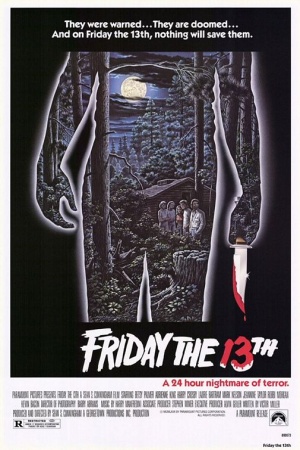


 Michael (William Bumiller) owns the hottest health club in Los Angeles but that may not stay true if he can’t do something about all the guests dying. Members get baked alive in the sauna. Another is killed when a malfunctioning workout machine pulls back his arms and causes a rib to burst out of one side of his body. Shower tiles fly off the wall and panic a bunch of naked women. A woman loses her arm in a blender and a man is somehow killed by a frozen fish. Strangely, all of the deaths don’t seem to hurt business as people still keep coming to the gym. Surely, there are other, safer health clubs in Los Angeles.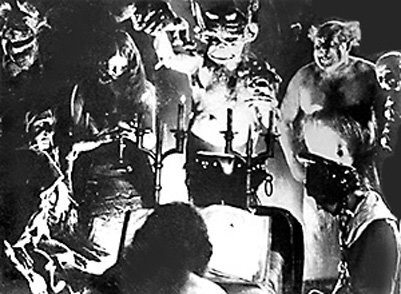
 Through the Shattered Lens