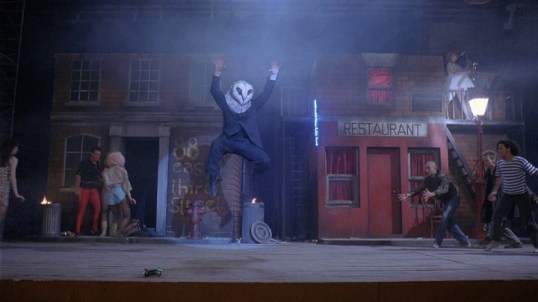
The opening on Michele Soavi’s 1987 masterpiece, StageFright, is one of the most brilliant ever filmed. Not only does it send up the conventions of the slasher genre but is also sends up musical theater. Seriously, how can you not love a horror film that features Marilyn Monroe playing the saxophone?
Of course, the opening of the film only begins to hint at the violence that’s going to follow. When a real killer manages to get into the theater, fantasy and reality blend together.
Interestingly enough, I think a real-life Broadway adaptation of StageFright would be a hit.
Ventriloquist dummies are creeping as Hell and no one sane should own one. Seriously, I’ve seen enough movies and TV shows about living dummies that there’s no way I would ever allow myself to be near one. They’re always talking about their wild sex lives (which, considering the state of the lower half of their body, I kind of suspect that they’re lying about) and complaining about someone having their clammy hand inside of them and, apparently, if you don’t keep them happy, they’ll try to kill you and everyone that you love. Stay away from the dummies!
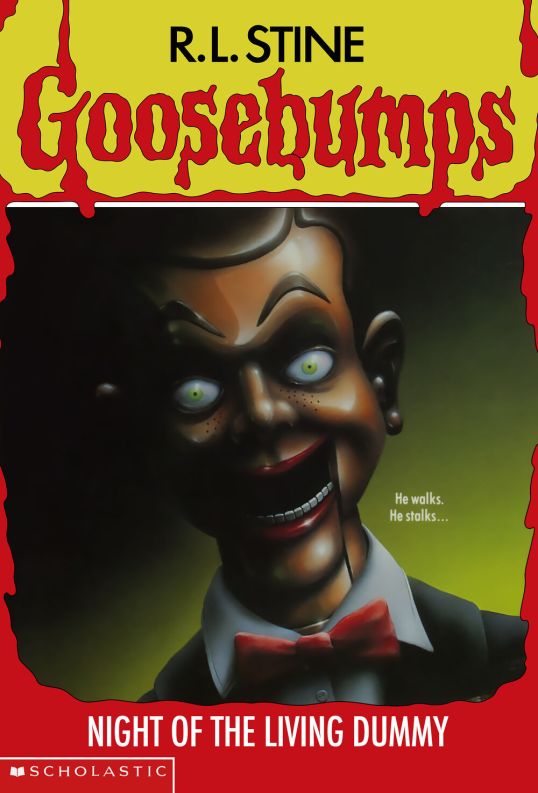
R.L. Stine obviously understands the inherent creepiness of the ventriloquist dummy as well. The 1993 YA horror novel, Night of the Living Dummy, is about two sisters who get into a dummy-inspired rivalry. When Lindy finds a ventriloquist dummy in the garbage, she names it Slappy and soon, she’s the most popular kid around, which …. seems kind of strange. But who knows? Maybe in 1993, ventriloquism was really cool instead of being ultra creepy. Lindy’s sister, Kris, gets a dummy of her very own. She names him Mr. Wood. Now, there’s two ventriloquist dummies in the house!
And …. they appear to hate each other….
Once you get passed the idea of a young ventriloquist being popular as opposed to shunned by society, Night of the Living Dummy is a fun little book, featuring both a realistic portrait of sisterhood and a memorably nasty dummy. Mr. Wood is a real instigator, insulting everyone he meets and mocking a teacher for being overweight. And yet, is Mr. Wood doing this himself or is he just an extension of Kris’s anger and jealousy towards her sister? It’s an interesting idea, though Stine is smart enough not to get bogged down in subtext. He understands that his readers are reading the book because they want some demonic dummy action and he delivers a lot of that.
I can’t end this review with pointing out that today is R.L. Stine’s 77th birthday! Happy birthday and thank you for the chills!
Sitting in the middle of the forest, there’s a camp ground. Rumor has it that the camp was built on the site of an ancient Native American burial ground and that’s why grouchy Robert Ritchie (David Hess) and his wife Julia (Mismy Farmer) were able to afford it as such as reasonable price. I guess that could be true and maybe the part about the curse is true, too…. Well, no matter! People love to camp and the forest is lovely and there’s no way that this camp ground won’t be a success!
In fact, the only thing that could stop it from being a popular vacation location would be if two teenagers were mysteriously murdered one night….
Which, of course, is exactly what happens! The daughter of a local doctor (played by John Steiner, of all people) goes off with her boyfriend and both of them are murdered! (Though we’re told that the two of them are high school students and, when we first see them, they’re at basketball practice, both victims appear to be in their early 30s. When the actress playing the doctor’s daughter first approached him, I immediately assumed that she was playing his wife. I was actually a little bit stunned when she said, “Bye, Daddy.”)
Anyway, the unsolved murder pretty much ruins any hope of the camp ground being successful. 15 years later, Robert is paranoid and convinced that a Native shaman is sneaking around the forest and looking for campers to kill. Meanwhile, Julia is so frustrated with her increasingly unstable husband that she’s having an affair with the sheriff (Charles Napier). The sheriff is so busy shtupping Julia that it often falls upon Deputy Ted (Ivan Rassimov, who had the best hair of all the Italian horror actors) to actually enforce the law. Meanwhile, the doctor is still mourning the death of his daughter and wandering around the forest.
Eventually, a bunch of obnoxious 30-something teenagers arrive, looking for a place to park their camper and ride their dirt bikes. Despite the history of murder and the general grouchiness of Robert Ritchie, they decide to say at the campground. Soon, a masked killer is carving people up. Is it the spirit of the Native shaman or is it something else? Who will survive and what will be left of them?
This 1986 Italian film was directed by none other than Ruggero Deodato, the man behind films like Cannibal Holocaust and The House On The Edge of the Park (which starred Body Count’s David Hess). As one might expect from a Deodato film, the emphasis is on blood and atmosphere. Deodato, who always had a good eye for properly ominous locations, gets a lot of mileage out of that spooky forest, which really does look like exactly the place where a masked killer would chose to hang out. While the kills are tame by Deodato standards, they’re still icky enough to make you cringe. I’m sorry but if the scene involving the body hanging from the hook doesn’t freak you out, then you’ve obviously become dangerously desensitized and you probably should probably take a break from watching movies like this.
Of course, the main appeal of Body Count is to see a cast of Italian horror and exploitation veterans going through the motions of starring in an American-style slasher film. David Hess, Ivan Rassimov, John Steiner, Charles Napier, and Mimsy Farmer are all such wonderfully eccentric performers that they’re worth watching even when they’re stuck in one-dimensional roles. David Hess, especially, does a good job as the unhinged Robert Ritchie and the film makes good use of Hess’s image. The film understand that we’re so used to watching David Hess kill people on screen that our natural instinct is to suspect the worst when we see him in Body Count. I also liked the performance of John Steiner, largely because Steiner always came across like he couldn’t believe that, after a distinguished theatrical education, he somehow ended up an Italian horror mainstay. And, of course, Ivan Rassimov had the best hair in the Italian horror genre.
Body Count is on Prime. The story’s not great but it’s worth watching just for the horror vets in attendance.
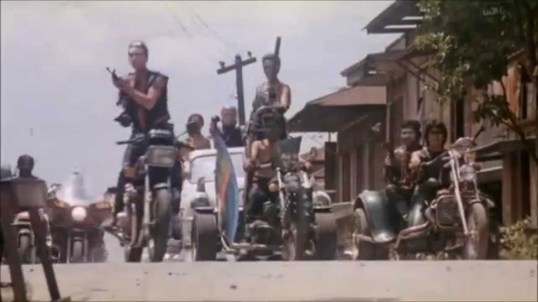
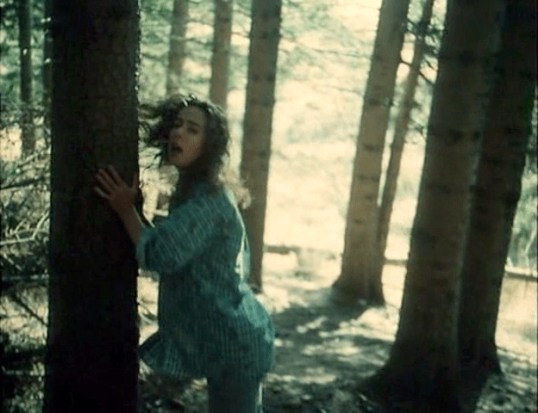
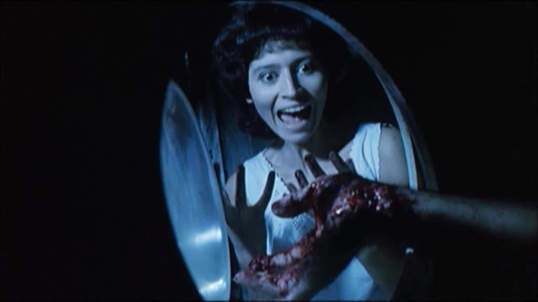
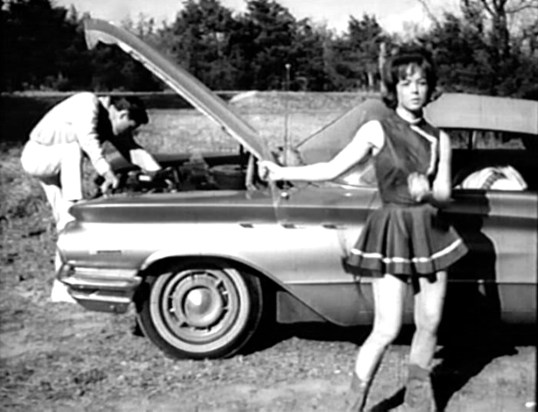
4 Shots From 4 Films is just what it says it is, 4 shots from 4 of our favorite films. As opposed to the reviews and recaps that we usually post, 4 Shots From 4 Films lets the visuals do the talking!
This October, we’ve been using 4 Shots From 4 Films to pay tribute to some of our favorite horror directors! Today, we recognize one of the most controversial directors of all time, the master of Italian horror, Ruggero Deodato!
4 Shots From 4 Films
The House on the Edge of the Park (1980, dir by Ruggero Deodato)
The Raiders of Atlantis (1983, dir by Ruggero Deodato)
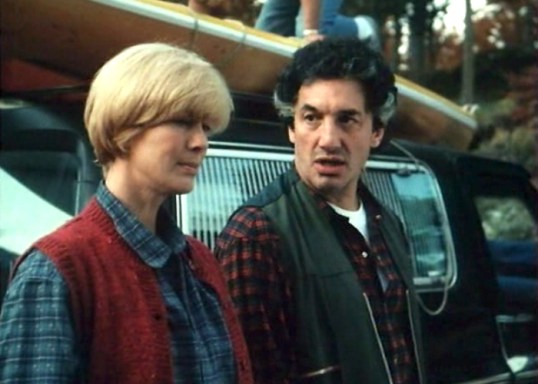
Body Count (1986, dir by Ruggero Deodato)
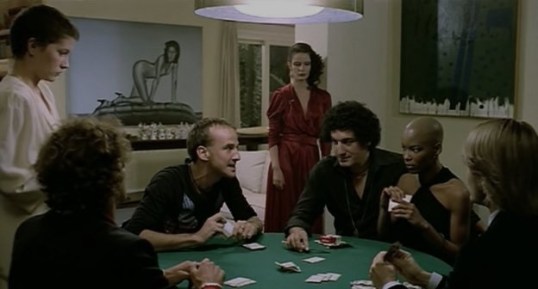
The Washing Machine (1993, dir by Ruggero Deodato)
Yesterday, I didn’t get to watch or review any horror films because the air conditioner at the house stopped working. While I know that a lot of people up north think that AC is a luxury that’s going to destroy the world, I live in Texas and an air conditioner is a necessity down here. So, if that leads to glaciers melting and me getting a lecture from some obnoxious little brat …. well, fine.
Anyway, we were able to get the air conditioner fixed. It took a while but it’s now working again. Once the AC was again blowing cool air into the house, I started to think about how it could be worse. I mean, the house could be haunted. We always tend to assume that ghosts are going to be nice but really, there are some nasty ghosts out there.
Take the 1986 film, House, for instance. House stars William Katt as Roger Cobb, a horror author who needs a best seller. Cobb is dealing with a lot. He’s wife (Kay Lenz) has left him. His son has vanished. His aunt has recently committed suicide, leaving behind her house. On top of all that, Cobb is still haunted by his experiences during the Vietnam War, when he was forced to leave behind a gravely wounded soldier named Big Ben (Richard Moll). Cobb wants to write about his Vietnam experiences but his agent is aghast. No one wants to talk about the war!
So, Roger moves into his aunt’s old house. He was originally planning on selling it but, for whatever reason, he thinks living in an abandoned house that drove its last owner to suicide will be a good idea. Roger thinks that living in the house will help him finish his book. The House has different ideas.
Soon, Roger finds himself dealing with a series of incidents that feel as if they were lifted from other, more cohesive horror movies. In a scene that feels like it was inspired by the Evil Dead, his wife turns into an otherworldly creature and tries to attack him. Weird gremlin creatures, which could have come from Troll or Ghoulies, keep showing up and trying to kidnap an obnoxious neighbor child. Roger’s neighbor (George Wendt) thinks that it’s possible that Roger is a murderer and that he’s buying his victims out in the backyard. Even worse, a decaying and pissed off Big Ben starts to show up.
House is an occasionally likable attempt to mix horror and comedy. Most of the comedy comes from Roger’s attempts to keep anyone else from noticing just how crazy things have gotten in the house. (Disposing of a demon’s body turns out to be not as easy as one might imagine.) William Katt does a good job with selling the comedy, though he never quite convinces you that he’s a best-selling horror author. That said, the horror aspect is far more interesting, if just as a metaphor for Roger’s PTSD. At its best, the film suggests that the house is feeding off of the lingering trauma of Roger’s war experiences. It’s an interesting idea but not one that’s really explored as much as you might like. Unfortunately, the film struggles to balance the horror and the comedy. Just when it really starts to scare you, it remembers that it’s supposed to be a comedy. Sam Raimi would have been the ideal director for House.
That said, House is entertaining, if a little bland. If nothing else, watching it made me feel better about my own house. My air conditioner may have gone down for a few hours yesterday but at least it didn’t open a portal to Hell.
For today’s horror on the lens, how about 1963’s The Yesterday Machine? This film opens with some impressive baton twirling and then segues into telling a story about time travel, mad scientists, and …. well, that’s about it. Still, what else do you need? Have you ever wondered what would happen if a sane scientist discovered time travel? For some reason, it’s always the insane ones who figure it out.
This film was shot in North Texas! That’s right, this is one of those low-budget regional productions, the one’s where the film might not be great but you kind of have to admire the determination of the filmmakers to try to make a real movie. Even if you didn’t recognize the landscape, the accents of the actors would have given it away immediately. Russ Marker was an independent filmmaker, based in Texas. The Yesterday Machine is one of two films that Marker directed. He also had an uncredited role as a bank guard in 1967’s Bonnie and Clyde.
Finally, the film stars Tim Holt who also appeared in The Magnificent Ambersons and Treasure of the Sierra Madre. How Does The Yesterday Machine rank when compared to those two films? Watch and find out! (And, after you watch it, read my review from last year.)
I guess this music video isn’t literally about a ghost in the middle of the street but it could be and that’s the important thing. It’s October, after all. The ghost have to be somewhere.
Jenny Lee was only seventeen years old when she was brutally murdered, beaten to death with her own saxophone. Now, seventeen years later, you have been sent into the past to investigate her murder. A disembodied voice follows you everywhere you go, sometimes offering up hints but sometimes reprimanding you if you find clues to a solution that the voice doesn’t want to hear. The voice makes it clear that you have a limited amount of time to solve the murder and when that time expires, so will you. When you’re not investigating, you’re in limbo, where you can move in every direction but you can never escape. Or can you?
This work of Interactive Fiction is actually two mysteries in one. The first is the mystery of who murdered Jenny Lee. The other is the mystery of who you are and why you’ve been sent to the past. Neither is an easy mystery to solve and, fortunately, the game does have a walk-through for those who just want to find out what’s going on in the most straight-forward way possible. However, it’s best to play this game without using the walk-through so that you can fully immerse yourself in the world that it creates. Not everything you see in the game is going to be relevant to solving the mystery. Like all good detective stories, there are red herrings.
The best advice I can give you for what to do while playing The Brutal Murder of Jenny Lee is to write things down. A lot of the game’s clues involve remembering either directions or passcodes. Making the right or wrong decision when going either north, south, east, or west be can be the difference between a good ending and a bad ending.
From 1958’s Attack of the 50 Foot Woman, Harry discovers that cheaters never get away with it. Especially when they’re cheating on someone who is 50 feet tell….



 Through the Shattered Lens