Suspense is a ten-minute blast from the past that comes to us all the way from 1913.
In this film, the Woman (played by Lois Weber) and her baby are menaced by the Tramp (Sam Kaufman), a sinister figure who cuts her phone lines and breaks into her home. While the Woman tries to protect herself, the Husband (Val Paul) rushes home to save his wife.
Suspense was one of the first thrillers and it introduced many elements that are still used to today, including the cut phone lines and the isolated location. This was also one of the first films to use the split screen as a narrative technique. There are many modern horror films that owe a debt to Suspense, whether the filmmakers realize it or not.
Suspense was written and directed by Lois Weber, who is widely acknowledged as being America’s first female filmmaker.
Tonight, we have the final episode of Hammer House of Horror and it is a macabre one indeed! A morgue attendant (Peter McEnery) becomes obsessed with both the number nine and a recently deceased neurosurgeon who died after trying to drill a hole in his own head in an attempt to let out all of his evil thoughts. McEnery finds himself becoming consumed by disturbing thoughts as well. Is he going mad or is he somehow seeing what no one else can see? This episode is effectively creepy and not for the squeamish.
First released in the groovy and psychedelic year of 1970, The Dunwich Horror stars Sandra Dee as Nancy, an somewhat innocent grad student at Massachusetts’s Miskatonic University. When the mysterious Wilbur Wheatley (Dean Stockwell) comes to the university and asks to take a look at a very rare book called The Necronomicon, Nancy agrees. She does so even though there’s only one edition of The Necronomicon in existence and it’s supposed to be protected at all costs. Maybe it’s Wilbur’s hypnotic eyes that convince Nancy to allow him to see and manhandle the book. Prof. Henry Armitage (Ed Begley) is not happy to see Wilbur reading the book and he warns Nancy that the Wheatleys are no good.
Nancy still agrees to give Wilbur a ride back to his hometown of Dunwich. She finds herself enchanted by the mysterious Wilbur and she’s intrigued as to why so many people in the town seem to hate Wilbur and his father (Sam Jaffe). Soon, she is staying at Wilbur’s mansion and has apparently forgotten about actually returning to Miskatonic. She has fallen under Wilbur’s spell and it soon becomes clear that Wilbur has sinister plans of his own. It’s time to start chanting about the Old Ones and the eldritch powers while naked cultists run along the beach and Nancy writhes on an altar. We are in Lovecraft county!
Actually, it’s tempting to wonder just how exactly H.P. Lovecraft would have felt about this adaptation of his short story. On the one hand, it captures the chilly New England atmosphere of Lovecraft’s work and it features references to such Lovecraft mainstays as Miskatonic University, the Necronomicon, and the Old Ones. As was often the case with Lovecraft’s stories, the main characters are students and academics. At the same time, this is very much a film of the late 60s/early 70s. That means that there are random naked hippies, odd camera angles, and frequent use of the zoom lens. The film makes frequent use of solarization and other psychedelic effects that were all the rage in 1970. Lovecraft may have been an unconventional thinker but I’m still not sure he would have appreciated seeing his fearsome cult transformed into a bunch of body-painting hippies.
Really, the true pleasure of The Dunwich Horror is watching a very earnest Sandra Dee act opposite a very stoned Dean Stockwell. Stockwell was a charter member of the Hollywood counterculture, a friend of Dennis Hopper’s who had gone from being a top Hollywood child actor to playing hippie gurus in numerous AIP films. As for Sandra Dee, one gets the feeling that this film was an attempt to change her square image. When Wilbur tells Nancy that her nightmares sound like they’re sexual in origin and then explores her feelings about sex, Nancy replies, “I like sex,” and it’s obviously meant to be a moment that will make the audience say, “Hey, she’s one of us!” But Sandra Dee delivers the line so hesitantly that it actually has the opposite effect. Stockwell rather smoothely slips into the role of the eccentric Wilbur. Wilbur is meant to be an outsider and one gets the feeling that’s how Stockwell viewed himself in 1970. Sandra Dee, meanwhile, seems to be trying really hard to convince the viewer that she’s not the same actress who played Gidget and starred in A Summer Place, even though she clearly is. It creates an oddly fascinating chemistry between the two of them. Evil Wilbur actually comes across as being more honest than virtuous Nancy.
Executive produced by Roger Corman, The Dunwich Horror is an undeniably campy film but, if you’re a fan of the early 70s grindhouse and drive-in scene, it’s just silly enough to be entertaining. Even when the film itself descends into nonsense, Stockwell’s bizarre charisma keeps things watchable and there are a few memorable supporting performances. (Talia Shire has a small but memorable roll as a nurse.) It’s a film that stays true to the spirit of Lovecraft, despite all of the hippies.
1988’s The Unnamable takes place in the type of small, superstitious town that H.P. Lovecraft made famous in his stories. (The Unnamable is loosely based on Lovecraft’s work.)
The students at Miskatonic University are fascinated by the stories that surround the old Winthrop place, a mansion where, 100 years ago, Joshua Winthrop’s wife supposedly gave birth to a hideous monster that proceeded to kill Joshua and all of his servants. It is said that the mansion is still haunted, perhaps by the ghost of Joshua or maybe by the monster itself! The students regularly dare each other to stay at the old Winthrop Place. Joel (Mark Parra) accepts the dare and vanishes, worrying his friends Howard Damon (Charles Klausmeyer) and Randolph Carter (Mark Kinsey Stephenson). While Howard is a skeptic about the supernatural, Carter is a dedicated student and he’s obsessed with what might be found within the Winthrop house.
Meanwhile, two frat boys (Eben Ham and Blane Wheatley) convince Wendy (Laura Albert) and Tanya (Alexandra Durrell) to come hang out with them for the night in the Winthrop House. The frat boys claim that it’s an annual initiation that all new students go through. For the most part, the frat boys just want to get laid. One of them even drapes a sweater over his shoulders. Since when has anyone wearing a sweater that way turned out to be a good guy?
Of course, it turns out that Winthrop House is haunted and soon, heads are rolling (literally) and blood is being spilled. While the frat boys and the girls fight for their lives, Howard and Carter break into the mansion to see if they can find their missing friend Joel. Of course, Carter is immediately distracted by the mansion’s collection of ancient texts and hidden tunnels. Howard, on the other hand, just wants to save Wendy’s life and prove that he’s as good as any sweater-draping frat boy.
The Unnamable is fairly low-budget affair, one that mixes the slasher genre with Lovecraft’s chilly horror. It works surprisingly well. The house is a wonderfully atmospheric location. The monster, when it finally makes its appearance, is frightening and very Lovecraftian. In fact, the monster feels as if could have wandered over from Stuart Gordon’s Castle Freak. (The Unnamable probably would never have been made if not for the success of Gordon’s Re-Animator.) The gore is plentiful and, at times, disturbingly convincing. The main thing that makes The Unnamable work as well as it does is that the cast is surprisingly game and they attack their stereotypical roles with a likable enthusiasm. Nobody coasts on the fact that the film is just a “horror movie” or just as “slasher flick.” The characters may not have much depth but the cast still does a good job of bringing them to life (and death). I especially liked the performance of Mark Kinsey Stephenson as Randolph Carter. Randolph Carter, of course, is a name that should be familiar to most Lovecraft readers and Stephenson is a delight as he ignore the chaos around him so that he can check out the mansion’s library. While the film definitely takes some liberties with Lovecraft, Stephenson is still the ideal Carter.
Having had a vison of the President of the Time Lords being assassinated, the Doctor returns to his home planet to prevent it from happening. Instead, he ends up framed for the crime. The Doctor insists that he is innocent and then announces that he will be a candidate for the presidency. Under Time Lord law, a candidate for president cannot be prosecuted for any crimes in the run up to the election.
The Doctor’s investigation leads him into the Matrix, a virtual reality world that is the collection of all the Time Lords’s consciousnesses. He discovers that the assassination was actually masterminded by The Master (Peter Pratt, replacing the late Roger Delgado). Having used up all of his previous regenerations, The Master is now a decaying skeletal figure who can barely speaks and wears a black hood. 12 lifetimes of evil appear to have caught up with him. The Master’s plan is steal the black hole nucleus that was captured by the first Time Lod, Rassilon (sorry, Omega!), and use it to give himself a new set of generations. Doing so will also destroy Gallifrey.
This was an important serial for many reasons. It was the first serial to feature The Doctor on his own, with no other companions. Having a companion usually gave the Doctor a chance to explain things that might seem strange or alien to the audience at home. For The Deadly Assassin, we learn that Gallifrey has a BBC-like television service that provides coverage of political events and helpfully explains what is happening even though the audience of Time Lords would presumably already know. The Doctor also spends a good deal of time talking to himself. Normally, that could have been awkward but Tom Baker was a great talker and very good at handling solo conversations. This serial also fully introduced us to Time Lord politics and featured the first appearance of the Doctor’s former teacher, Borusa (Angus MacKay). Finally, and most importantly, it featured the return of the show’s greatest villain, The Master. The Master hadn’t been seen since Roger Delgado’s tragic death in 1973.
The Deadly Assassin was one of the more violent of the Doctor Who stories. The President was assassinated. Time Lord anchorman Runcible (Hugh Walters) ended up with a dagger in his back. The Master’s ally, Chancellor Goth (Bernard Horsfall), attempted to drown the Doctor in The Matrix. After receiving outraged letters from parents, the BBC actually edited out the scene of Goth holding the Doctor’s head underwater from rebroadcasts. The Deadly Assassin was also one of the scarier serials of the classic era. The Master was truly a frightening figure with his raspy voice and his burned-out, skeletal appearance.
I’ve always liked The Deadly Assassin. It features a genuinely interesting story and Tom Baker gives one of his best performances. (Baker had specifically asked to do one serial without a companion.) The serial’s cynical view of politics almost made it ahead of its time. The Deadly Assassin ends with The Doctor being told that he’s won the election and that he is now President of the Time Lords. He’s also told that it’s far too early for him to even think of resigning. Of course, the Doctor makes a run for his TARDIS.
The TARDIS materializes in a quarry and, for once, it’s an actual Earth quarry and not just an alien plant that looks like a quarry. An explosion both knocks Sarah Jane Smith out and also exposes a fossilized hand that has been hidden away under the rocks for centuries. The hand belongs to an executed alien was criminal named Kastrian Eldrad (Stephen Thorne, playing yet another Doctor Who baddie). When the hand is found, it starts to search for sources of radiation so that it can fully regenerate back into its original form and then seek revenge on its home planet.
The Hand of Fear would have been a standard Doctor Who adventure, except that it ended with Sarah Jane (Elisabeth Sladen) announcing that she can no longer handle the death, violence, and occasional mind control that goes along with being the Doctor’s companion. She asks the Doctor (Tom Baker) to return her to South Croydon. The Doctor reluctantly agrees. While Sarah is packing her things, The Doctor suddenly gets a telepathic message telling him to come to his home planet of Gallifrey and he realizes that, even if Sarah wasn’t leaving, he would not be able to take her with him. When The Doctor tells Sarah this, it upsets Sarah. Even though she impulsively decided to go home, it’s obvious that it’s not really what she wants. When The Doctor drops her off on Earth, she tells him not to forget her and we know that he never will. As the Doctor dematerializes, Sarah looks around and sees that she’s on Earth and probably in England but nowhere close to South Croydon.Plenty of companions had come and gone before this episode but none of them had quite the impact of Sarah Janes Smith. Sarah was one of the few companions to actually be viewed as being an equal of the Doctor. Even though she spent a lot of time doing typical companion things like being menaced by aliens and asking the Doctor to explain things, Sarah Jane still always projected a determination and inner strength that made her more than worthy to be traveling through time and space. Even dressing like Andy Pandy during her final appearance couldn’t diminish Sarah Janes Smith as a character.
Elisabeth Sladen had the perfect rapport with both Jon Pertwee and Tom Baker. Sladen and Baker were apparently close enough that they improvised their final goodbye and the emotions in that scene feel very real. For viewers like me, who were introduced to Doctor Who by PBS airing the Fourth Doctor’s adventures, Sarah Jane was the first companion that we met and her suddenly leaving came as a shock. She just seemed as if she was meant to be a part of the TARDIS crew forever.
Sarah Jane Smith would return, of course. There was K-9 and Company in 1981. There were the Sarah Jane Adventures, which ran from 2007 to 2011. Sadly, the wonderful Elisabeth Sladen passed away in 2011. For many of us, it felt like losing a valued a childhood friend.
I guess it was inevitable that a movie would be made with that title.
Carter Wilcox (David Phillip Carollo) is a virgin artist who draws pictures of ancient symbols for the one-eyed Professor Edna Curwen (Helenmary Ball) and who meets and falls in love with a call girl/stripper named Riley (Melissa LaMartina). Because Riley has got an octopus-shaped birthmark on her ass, she gets kidnapped by a cult who tries to turn her into the bride of Cthulhu.
You pretty much know what you’re going to get when it comes to this movie and it pretty much delivers. There’s plenty of nudity, blood, juvenile humor, and references to the work of H.P. Lovecraft. The pacing is abysmal and the acting is terrible but surprisingly, the gore was disgustingly realistic and the special effects were not awful. The tentacled monster was probably about as convincing as it could be in a film like this. You can tell where the most of the money in the budget went.
The actors playing Carter and Riley are forgettable and chemistry-free. The one good performance came from Dave Gamble as the smug cult leader. Never allow yourself to get too smug when dealing with the Great Old Ones.
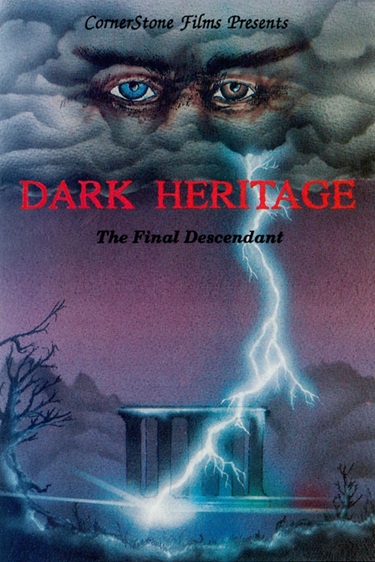
1989’s DarkHeritage deals with the aftermath of a violent thunderstorm in Louisiana.
After the thunder has rumbled and the lightning has flashed and all of the rain has fallen, several dead bodies are discovered in the wilderness near a mansion. Why are the bodies out there? How did they end up dead? Are they connected to the reclusive Dansen clan, a once notorious family that may not even exist any more? Bearded reporter Clint Harrison (Mark LaCour) is sent to find out!
DarkHeritage is an example of one of my favorite genres, the low-budget regional horror film. DarkHeritage not only takes place in Louisiana but it was also filmed in Louisiana with a cast that spoke in genuine Louisiana accents. It wouldn’t surprise me to learn that the majority of the crew was from the state as well. This is not one of those films where the South is represented by the mountains of California. That brings a certain amount of authenticity to the production and that authenticity can make up for a lot. This film captures the true atmosphere of Louisiana at its most humid and gothic and there aren’t any yankees around to ruin everything. That’s always nice.
At the same time, DarkHeritage also wears its low-budget on its sleeve. Sometimes, it’s effective. A sepia-clad vision of a ghostly member of the Dansen clan entering the mansion and motioning for the reporter to follow him is far more effective than it has any right to be. The horror genre is one of the few genres that actually benefits from grainy cinematography and dark lighting. There are other times when the amateurishness of the production is definitely a distraction. A scene towards the end where a man threatens Clint with a gun is so overacted by everyone involved that it actually becomes rather humorous to watch. If the most intense scene of your horror film inspires laughter instead of a racing heart, it’s definitely a problem.
The film itself is loosely based on H.P. Lovecraft’s The Lurking Fear. Just as with the original story, we get an extended sequence of an underground chamber that is full of some genuinely creepy monsters. That said, the film’s plot is often not that easy to follow, both because of the illogical actions of the characters and also some genuinely poor sound recording that makes it difficult to follow the conversations. This is a film where Clint first goes to the mansion with two companions. When those companions disappear, Clint is told that he is now a murder suspect. Clint’s reaction is to go find someone else to return to the house with him. Surely he knows that if that person also dies while visiting the house, he’ll look even more guilty. I mean, that would only make sense, right? Why not just stay away from the house?
DarkHeritage has a lot of atmosphere and it even manages to give us a few memorable and creepy visuals. That said, it’s ultimately done in by its low-budget and its often incoherent plot.
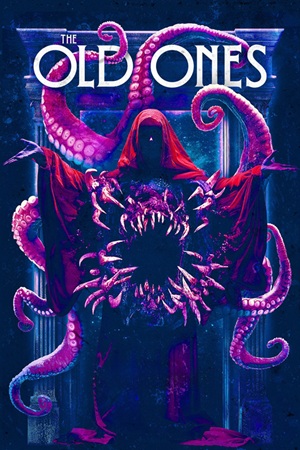
2024’s The Old Ones opens with an animated sequence of an old sea captain being tossed into a light, an apparent sacrifice. On the one hand, it’s properly macabre, featuring as it does a cult sacrifice. On the other hand, it’s also kind of cute because it’s animated. That juxtaposition between the horrific and the cute pretty much defines the entire film.
The sea captain is Russell Marsh (Robert Miano). He eventually washes up, 95 years after he left his home on a sea voyage. Russell is discovered by Dan (Scott Vogel) and his son, Gideon (Brandon Philip), who are camping and having some father-and-son bonding time. Russell tells them that he was born in 1865 and that he last set sail in 1930. Dan and Gideon point that’s not possible because it’s 2025 and Russell doesn’t appear to be a day over 65. Russell says that he’s spent the last 95 year being possessed and controlled by the Old Ones, the cosmic beings who control the universe. Dan is skeptical but then Dan is promptly killed by a monster who materializes out of nowhere. Russell and Gideon go on the run, trying to avoid cultists and others who have been possessed by the Old Ones. Russell says that, if he can find the mysterious Nylarlahotep, he may be able to travel through time and stop himself from going to sea in 1930. Russell would never be possessed by the Old Ones and, in theory, Gideon’s father would never had died.
The Old Ones is “based on the writings of H.P. Lovecraft” and it should be noted that the film does contain references to a lot of Lovecraft’s stories. Nylarlahotep (played here by Rico E. Anderson) is a character straight out of Lovecraft and his behavior here — menacing and enigmatic, if slightly bemused by the foolishness of humanity — very much conforms to Lovecraft’s portrayal of him. The Old Ones will be familiar to anyone with even a passing knowledge of the Cthulhu Mythos. That said, the film itself doesn’t always feel particularly Lovecraftian, if just because of the amount of humor that is found during Russell and Gideon’s quest. Gideon is often in a state of shock while Russell is the one who has seen it all and faces every horror with a studied nonchalance.
(One of the film’s best moments is when Russell pragmatically suggests that Gideon should sacrifice himself since Russell is just going to reverse time anyways.)
Considering that the budget was obviously low and that the writings of H.P. Lovecraft are notoriously difficult to adapt, The Old Ones works far better than I certainly expected it to. The story moves quickly and even the humor adds to the overall feel of the chaotic energy of the Old Ones invading human existence. The strongest thing about the film is the performance as Robert Miano as Russell Marsh. As played by Miano, Russell is the perfect hero for this type of story, compassionate but also pragmatic enough not to shed any tears if someone happens to die on Russell’s way to reversing time. Even if the humor may not reflect the source material, the film still ends on a very Lovecraftian note. One person’s happy ending is another’s nightmare.


 Through the Shattered Lens