Horror Film Review: Night of Terror (dir by Benjamin Stoloff)


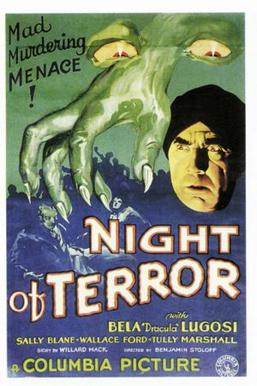
1933’s Night of Terror opens with a character known simple as The Maniac (Edwin Maxwell) attacking random people with a knife.  The Maniac is on a murder spree.  He leaves taunting newspaper articles on the bodies.  (Don’t look at me, I didn’t write the script,)  Wisecracking newspaper reporter Tom Hartley (Wallace Ford ) would love to track the Maniac down.

Meanwhile, the richest man in town has been murdered.  Was he killed by the Maniac?  No one is sure.  What is known is that he divided his large fortune amongst not only his heirs but also his servants.  Of course, if an heir or a servant should die, that just means more money for everyone else!  Meanwhile, the man’s nephew — scientist Arthur Hornsby (George Meeker) — is busy trying to talk his family into burying him alive so that he can test his new suspended animation serum.  Arthur swears that he’s figured out a way for people to live without oxygen for a period of time!

Okay, Arthur, that’s great.  Anyway….

This sixty-one minute horror film features Bela Lugosi as Degar, the butler.  Degar and his wife, Sika (Mary Frey), are regularly referred to as being “heathens” by some of the other members of the family.  And yet, when the family needs someone to hold a seance so that they can figure out who is trying to kill all of them, who do they ask to conduct it?  Degar’s not happy about it but Sika agrees to do so.  Needless to say, things don’t go well.

It’s a bit of silly film and the final twist doesn’t make much sense.  One gets the feeling that the script was written over the course of one night and no one really spent that much time worrying about whether or not it all came together to tell a coherent story.  Moments of humor are mixed in with moments of would-be terror.  The family chauffeur is easily scared.  The members of the family all toss out insults at each other.  When the police show up, they speak in the rat-a-tat fashion of 1930s police officers.  No one in the film yells, “Scram!” and yet it seems like they should have.  It’s that type of movie.  My favorite scene featured a handcuffed Lugosi offering a police officer a cigarette from “Asia.”  Needless to say, the cigarette caused the cop to pass out.  Its 1930s stoner humor.

Bela Lugosi got top-billing but his role is actually pretty small.  Still, Lugosi gives a good performance and delivers his lines with a straight face.  He gets the honor of explaining the mystery to all of the police officers and family members.  That said, the film is stolen by Edwin Maxwell as the Maniac.  Maxwell gets to break the fourth wall at the end of the film and he probably sent many young audience members home with nightmares.  The Maniac tells the audience not to reveal how the film ended, lest they want to be haunted by him.  Hitchcock would have been proud.

Horror Film Review: The Ape Man (dir by William Beaudine)


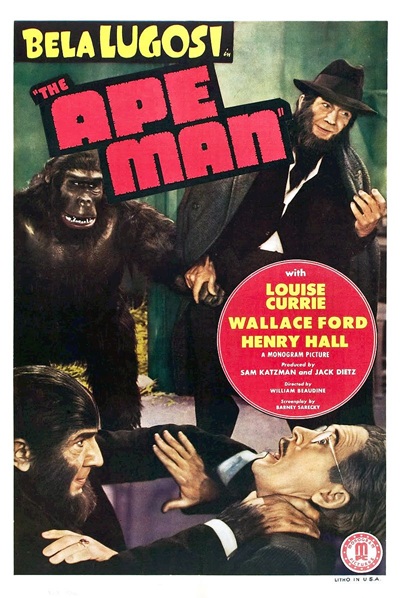
In this 1943 film, a mysterious man suggests to reporter Jeff Carter (Wallace Ford) that he should go out to the mansion of Dr. James Brewster (Bela Lugosi) and look into the recent disappearance of the doctor.  Dr. Brewster’s sister (Minerva Urecal) is a well-known ghost hunter and Carter’s editors likes the idea of Carter and photographer Billie Mason (Louise Currie) heading out to the mansion and getting a picture of a ghost.

Carter is upset because he’s having work with a — gasp! — woman.  Bliie is not impressed by the fact that Carter is still in America while all the other men his age are fighting overseas.  Carter explains that he’ll be enlisting in the Navy in a week.  Billie realizes that Carter is not an unpatriotic coward and we, the viewers, are reminded that this film was made during World War II.  I like the fact that America was so unified during World War II that even fictional characters were expected to explain what they were doing for war effort.

For the record, Dr. Brewster’s mansion is not haunted by ghosts.  Instead, the problem is that Dr. Brewster’s experiments have turned him into a man-ape hybrid.  He has a beard, he walks like a monkey, and he fears that he’s turning more into an ape everyday.  He spends almost all of his time locked up in a cage with a gorilla.  Dr. Brewster has (somehow) discovered that the only way to reverse the process is to get regular injections of spinal fluid.  However, it’s impossible to extract the spinal fluid without also killing the donor.  Dr. Brewster’s colleague, Dr. Randall (Henry Hall), refuses to be a party to murder but he still wants to help Brewster.  Unfortunately, Brewster is beyond saving and he’s also losing his mind as he finds himself slowly becoming more and more of an ape.

The Ape Man was directed by William Beaudine, a filmmaker who directed 179 movies over the course of his long career.  Beaudine worked in all genres, starting off as a major director during the silent era before then becoming a prolific B-movie maker during the sound era.  As a B-movie director, Beaudine was famous for rarely doing second take.  If someone flubbed a line or a piece of scenery nearly fell over, that was too bad.  Of course, it should be noted that Beaudine was working for various Poverty Row production companies and he probably didn’t have the budget to do multiple takes.  His job was to get the film shot quickly and for as little money as possible.

That certainly seems to be the philosophy between The Ape Man, which is only a little over an hour long and which features all of the usual plot holes and continuity eras that one might expect to find in a film that was tossed together in just a few days.  That said, The Ape Man is kind of a fun movie.  Bela Lugosi does his best, even when he’s wearing a totally ludicrous beard.  Wallace Ford and Louise Currie deliver their lines in the rat-a-tat fashion that seemed to be popular with journalists in the films of the 30s and 40s.  The plot’s cheeful lack of coherence actually becomes rather charming and the story ends with a nice moment of 4th wall breaking, as the film itself is saying, “Hey, we had fun, didn’t we?”

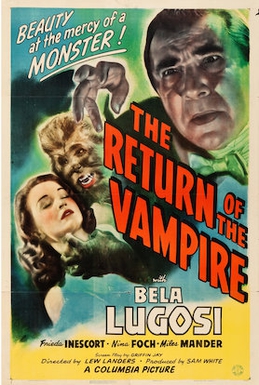
Horror Film Review: The Return of the Vampire (dir by Lew Landers)


1943’s The Return of the Vampire opens in 1918.

Lady Jane Ainsley (Frieda Inescort) and her colleague, Dr. Walter Saunders (Gilbert Emery), suspect that there might be a vampire active in London.  After reading a book on vampirism that was written by Dr. Armand Tesla, they manage to find the vampire’s coffin.  As the vampire’s servant — a werewolf named Andreas (Matt Willis) — watches, Lady Jane and Dr. Saunders drove a metal stake through the vampire’s heart.  It turns out that the vampire was none other than Armand Tesla himself!  Andreas turns back into a normal person and becomes Lady Jane’s assistant.

Jump forward to the 1940s.  During an attack by the Germans, a bomb explodes over Tesla’s grave and exposes not just his coffin but also the metal pole in the middle of his skeleton.  Two workmen assume that the pole is just bomb debris and they remove it.  Tesla (Bela Lugosi) promptly comes back to life and Andreas turn back into a werewolf.  Tesla sets out to get revenge on Lady Jane and the daughter of Dr. Saunders, Nicki (Nina Foch).

The Return of the Vampire is an interesting film.  Since the film was not made by Universal Pictures, it could not use the name “Dracula” for its vampire but it’s obvious from the start that Armand Tesla is meant to be Dracula.  Tesla wears his Dracula costume, speaks in his Dracula voice, and gives his Dracula performance.  To his credit, Lugosi actually gives a very strong performance in The Return of the Vampire.  His anger towards the people who staked him feels very real and there’s nothing of the intentional campiness that marred some of Lugosi’s later performances.  Lugosi leaves little doubt that Tesla is not only evil but he’s someone who truly enjoys being evil.  He can’t leave England until he gets his revenge on the people who previously defeated him.  For all the talk of stakes, sunlight, and crosses, the vampire’s true weakness is its own vanity and its inability to let go of a grudge.

As a history nerd, I found myself fascinated with how the film worked the then-current Blitz into its story.  The main villain may have been played by Bela Lugosi but the Germans definitely played their role as well, launching the bombing raids that distracted the authorities from the vampire in their midst.  Indeed, it’s probably not coincidence that it was a German pilot who brought Tesla back to life in the first place.  The German pilot is shot down but not before he drops a bomb on Tesla’s crypt.  The film says to be aware of the outside threat but to also be aware that threats can come from the inside as well.  While the Germany terrify the citizens of London, the vampire coolly moves through the night.

Clocking in at a fast-paced 69 minutes, The Return of the Vampire also features a stiff upper lip Scotland Yard inspector (Miles Mander) who, of course, is skeptical of the existence of vampires.  At the end of the film, he asks his subordinates if they believe in vampires.  They reply that they do.  He then looks at the camera and asks us, “And do you, people?”

Well, do you?

Bonus Horror On The Lens: The Devil Bat (dir by Jean Yarborough)


Because today would have been Bela Lugosi’s birthday, it seems appropriate to showcase him in a bonus horror on the lens!

In the 1940 film, The Devil Bat, the owners of a company in the small town of Heathville are super-excited because they’re going to be given their head chemist, Dr. Paul Carruthers (Bela Lugosi), a bonus check of $5,000.  However, since Carruthers’s inventions have made millions for the company, he is offended by the small check and decides that the best way to handle this would be to sue in court and demand fair compensation …. just kidding!  Instead, Dr. Carruthers sends his army of giant bats to kill the families of his employers.

The Devil Bat was produced by Production Releasing Corporation, a poverty row studio that specialized in shooting quickly and cheaply.  Going from Universal to PRC was technically a step down for Lugosi but The Devil Bat is actually an excellent showcase for Lugosi and he gives one of his better non-Dracula performances as the embittered Dr. Carruthers.  Indeed, one can imagine that Lugosi, who played such a big role in putting Universal on the map, could relate to Carruthers and his bitterness over not being fairly rewarded for the work he did to make others wealthy.

Enjoy The Devil Bat, starring the great Bela Lugosi!

Horror On The Lens: Monster From Green Hell (dir by Kenneth G. Crane)


I hate wasps!

A lot of that is because I’ve never been stung by a wasp so I have no idea whether or not I’m allergic.  Considering that I’m allergic to almost everything else, it just seems likely that I would be allergic to wasps as well.

Another reason why I dislike wasps is that, opposed to hard-working honey bees, wasps just look evil.  They fly straight at you.  They get tangled in your hair.  They try to build their nests right next to your air conditioning unit.  They’re the worst!

1957’s Monster From Green Hell is all about evil wasps.  A group of scientists, working with the space program, come up with the brilliant idea of sending wasps into space.  When the wasp rocket crashes back to Africa, it leads to giant wasps and paralyzed victims.  Can the scientists who created the problem fix things?  Or will nature have to take care of itself?

Watch and find out!  This film is one of many “giant monster’ films to come out of the 50s but it’s perhaps more interesting as an examination of the fears of what would happen when mankind finally went into space.  Today, we take space exploration for granted.  In 1957, it was very exotic and, I imagine to some, very frightening.

One final note: Barbara Turner, the female lead in this film, is also the mother of actress Jennifer Jason Leigh.


Monday Live Tweet Alert: Join Us for Killdozer!


As some of our regular readers undoubtedly know, I am involved in hosting a few weekly live tweets on twitter and occasion ally Mastodon.  I host #FridayNightFlix every Friday, I co-host #ScarySocial on Saturday, and I am one of the five hosts of Mastodon’s #MondayActionMovie!  Every week, we get together.  We watch a movie.  We snark our way through it.

Tonight, for #MondayActionMovie, the film will be 1974’s Killdozer!

It should make for a night of fun viewing and I invite all of you to join in.  If you want to join the live tweets, just hop onto Mastodon, pull up Killdozer on YouTube, start the movie at 8 pm et, and use the #MondayActionMovie hashtag!

Enjoy!


Horror On TV: The Great Bear Scare (dir by Hal Mason)


I came across this old cartoon on YouTube.  Apparently, it aired in October of 1983.

It’s about bears living in Bearbank.  Halloween is approaching and they’re worried about getting invaded by the monsters who live on Monster Mountain.  Well, that makes sense.  My question is why would you buy a house near a location called Monster Mountain?  And really, shouldn’t the monsters be in the houses and the bears in the mountains?  This cartoon is weird.

Anyway, the bears are getting ready to feel the city but little Ted E. Bear sets out to confront his fears!  Woo hoo!

I don’t know.  It’s from 1983.  That was a strange year, I guess.

Enjoy!

Doctor Who — The Talons Of Weng-Chiang (1977, directed by David Maloney)


The TARDIS materializes in Victorian-era London.  Accompanying the Fourth Doctor (Tom Baker) is his new companion, Leela (Louise Jameson).  After returning Sarah Jane Smith to her own time (more or less) and saving the Time Lords from being destroyed by the Master, the Doctor meet Leela on an unnamed planet in the far future.  Though Leela, with her short animal-skin outfit and her very large knife, seemed like a savage, she was actually the descendant of a group of Earth astronauts who had crashed on the planet centuries before.  Leela insisted on traveling with the Doctor and the Doctor reluctantly decided to try to civilize Leela or, at the very least, get her to stop carrying that big knife around with her.

Hence, the trip to London.  The Doctor wants her to see where her ancestors came from.  The Doctor’s plan is to take her to the Palace Theater, owned by Henry Gordon Jago (Christopher Benjamin), so that they can see a performance by the magician Li Hi’sen Chang (John Bennett).  Instead, they end up getting caught up in a series of murders that involving Chang, a giant rat in the London sewers, a miniature killer named Mr. Sin (Deep Roy) who snorts like a pig, and a 51st century war criminal named Magnus Greel (Michael Spice).

The Talons of Weng-Chiang is not only one of the best of the Fourth Doctor’s adventures but it’s also one of the best Doctor Who serials ever.  Victoria London, with its foggy streets and its collection of eccentric rogues, proves to be a perfect fit for Tom Baker’s Doctor, allowing Baker to try out the Sherlock Holmes persona that he would later use when he played the great detective himself in a BBC production of Hound of the Baskervilles.  Louise Jameson is also a delight in this story, with Leela’s naturally independent nature befuddling all of the very proper Victorians that she comes into contact with.  Louise Jameson had the unenviable task of trying to follow in the footsteps of the beloved Elisabeth Sladen.  (The show’s writers helped out by making Leela the opposite of Sarah Jane is almost every way.)  Supposedly, Tom Baker had not wanted a new companion and initially treated Louise Jameson very coldly, though he eventually warmed up to her.  With her performance in this serial, Louise Jameson proved that she definitely deserved to be a part of the Doctor’s adventures.

Of course, for many, the real highlight of this serial is the chemistry between Henry Gordon Jago and Professor Lightfoot (Trevor Baxter), the coroner who has been investigating a number of strange murders in London.  The blustery Jago and the reserved Lightfoot are almost as important to defeating Magnus Greel than the Doctor and Leela and the scenes in which they become an unlikely detective team are so enjoyable that it’s not a surprise that the BBC considered giving them a series of their own.  (From 2010 to 2017, the pair did star in an audio drama, one that imagined them investigating other mysteries and even teaming up with other Doctors.)  Of course, when I first saw The Talons of Weng-Chiang, I was just happy that Jago and Lightfoot managed to survive all six chapters.  After you watch enough Doctor Who, you learn not to get to attached to any of the supporting characters.  That Jago and Lightfoot did not fall victim to Mr. Sin was cause for celebration.

The Talons of Weng-Chiang actually has a pretty interesting story, one that justified its 6-episode length.  Magnus Greel is one of the great Doctor Who villains, a time traveling war criminal who pretended to be a God.  For the most part, Michael Spice was convincing as Greel, though his over-the-top delivery of a threat to “rip your flesh,” is one of the serial’s few unintentionally funny moments.  Another false step was the “giant rat,” which was clearly a normal-sized rat shot on a miniature set.  The rat looked bored.  When the rat has to interact with the Doctor and Leela, it becomes a giant rat dummy that looks very little like the normal rat.  And finally, a stuntman had to do a few scenes inside a rat costume.  All of the rat stuff doesn’t do much other than leave you wondering whether the story really needed a giant rat at all.   Of course, it’s really not Doctor Who if there isn’t at least one notable case of special effects failure.

The rat aside, there is another thing that has to be discussed when it comes to The Talons of Weng-Chiang.  When I was a kid, I didn’t really notice it because I was too busy enjoying the action set pieces, Tom Baker’s tongue-in-check performance, the Jago/Lightfoot team-up, and everything about Louise Jameson.  Rewatching The Talons of Weng-Chiang as an adult, the thing I immediately noticed was that, for an episode that featured a lot of Chinese characters (the majority of whom were not presented in a particularly positive light), there weren’t many Chinese actors in the cast.  The most prominent Chinese character was played by John Bennett, in full yellowface.  Reading about the production of the serial, I was not surprised to see that one of the inspirations was Sax Rohmer’s notoriously racist Fu Manchu novels.  While The Talons of Weng-Chiang may not be as flat-out racist as Rohmer’s novels, it still has its share of negative racial stereotypes.  (Of course, the story’s main villain is not Chinese.  Magnus Greel is described as being “the butcher of Brisbane,” make of that what you will.)  The Talons of Weng-Chiang is well-acted, well-directed, and well-written and there’s no way it would be made today, at least not in the same way that it was made in the 70s.  I’m not saying that’s a bad thing or a good thing.  It just a reminder of how much things have changed since 1977.

The final serial of the 14th season, The Talons of Weng-Chiang was a triumph and also proof that the Doctor could still have worthwhile adventures, even if he was no longer traveling with Sarah Jane.