Novel Review: Night Games by R.L. Stine


“What the Hell was that!?” I said, as I read the final line of Night Games.

First published in 1996, Night Games is another one of those R.L. Stine books in which a group of otherwise law-abiding, wholesome American teenagers decide to live every teenager’s fantasy and have some fun by harassing one of their teachers.  (No, Lisa Marie, I loved all of my teachers!  Yeah, I hear you but I don’t believe you.)  Mr. Crowell seems like a nice enough guy but he’s constantly giving Lenny a hard time so all of Lenny’s friends decide that it’s time to play some “night games” with Mr. Crowell.  At first, this is limited to breaking into Mr. Crowell’s house at night and moving stuff around and stealing an item or two.  But then Mr, Crowell dies and our narrator, Diane, has to figure out if he was murdered by her ex-boyfriend or her current boyfriend.  At no point does it ever seem to occur to Diane that, in an ideal world, she wouldn’t have a history of dating boys who are capable of murder.

Anyway, the only special thing about this book is the final twist and I’m going to reveal it because, otherwise, this is going to be a short review.  So, consider this to be your SPOILER ALERT.  (I have to admit that every time I type the words “spoiler alert,” I lose a little respect for myself and even more respect for the people who demand that such warnings be used even for a book that is 26 years old.)  Anyway, it turns out that Lenny, despite his temper, is not the murderer.  Instead, the murderer is Spencer and Spencer …. well, Spencer’s a ghost.  He’s come back from the dead just to make Diane’s life difficult.  He starts to strangle Diane but Diane hugs him and apologizes to him for not being a better friend.  Spencer is conquered by love and his spirit is set free.  Yay!  All of Diane’s friends are happy but what they don’t realize is that Diane is now a ghost and now she’s plotting to get  revenge on all of them!

That’s actually not a bad ending.  Diane’s friends were really annoying so they deserve what’s coming to them.  Still, it’s interesting that Diane automatically became an evil ghost as opposed to a mournful ghost or a philosophical ghost or a confused ghost.  She died and she immediately embraced the dark side.  Agck!

Now, that’s scary!

Book Review: The Scandalous History of the Roman Emperors by Anthony Blond and Laura Blond


Who were the scariest people in the Roman Empire?

According to this book, which was first published in 1994, it was the Emperors.  The Scandalous History of the Roman Emperors takes an enjoyably gossipy and occasionally disturbing look at the first six emperors of the Roman Empire, from Julius Caesar to Nero.  By analyzing the words of Roman historians and occasionally reading between the lines, Anthony Blond makes a good argument that the most powerful men in the ancient world were, for the most part, an incredibly petty group of neurotic people.  Julius Caesar emerges as a pompous blowhard who probably owed most of his reputation to the circumstances of his death.  Augustus is motivated less by strategic genius and more by his fear of never escaping his uncle’s shadow.  Tiberius starts out strong, just to end up a paranoid mess on the Isle of Capri.  Caligula is a spoiled brat.  Claudius emerges as a casually cruel man who used his infirmities as a way to keep his enemies off guard.  And finally, Nero is portrayed as a frustrated artist whose subsequent reputation for cruelty may have been overstated by biased historians.  The emperors are portrayed as being flawed humans who all, even Caligula, had potential to do good but who were ultimately corrupted by a society that treated them like Gods while also constantly plotting their downfall.

Laura Blond contributes chapters about life in ancient Rome. A chapter which examines a day in the life of a Roman citizen reveals not only the grandeur of Rome but also all the details that would have made me frightened to walk barefoot through the city.  If you think the erratic emperors were frightening, just try to get through the chapter about Roman eating habits!  Agck!

It makes for compulsive and occasionally gossipy reading.  I’m a history nerd and I’m fascinated by the Roman Empire so I loved it.

International Horror Review: Jack The Ripper (dir by Jess Franco)


In this 1976 German film, Klaus Kinski plays Dr. Dennis Orlof.

He’s a doctor in what is supposed to be Victorian-era London.  (Some of the characters where Victorian-style clothes.  Some of them definitely do not.)  Dr. Orlof is known for being a kind and compassionate man.  He has dedicated his life to taking care of the poor and the sick.  He is one of the few doctors willing to take care of the men who fish on the Thames and the women who walk the foggy streets of Whitechapel.  Because his patients are not rich, Dr. Orlof makes very little money.  He is usually behind on paying the rent for his office but his lady doesn’t care.  Dr. Orlof is such a kind man.  Who could possibly even think of evicting a living saint?

Of course, what only he and his wife know is that Dr. Orlof is also a deviant who is haunted by hallucinations of a nearly naked woman taunting him and daring him to “come and get me.”  Dr. Orlof haunts the sleazy dance halls of London and he often offers to give the dancers a ride in his carriage.  Dr. Orlof is also the murderer who the press refers to as being Jack the Ripper.

Klaus Kinski as Jack the Ripper?  That sounds like perfect casting, right?  Actually, it’s too perfect.  Klaus Kinski is so obviously unhinged from the first minute that he appears onscreen that it’s impossible to believe that he wouldn’t automatically be everyone’s number one suspect.  Kinski plays Orlof as being someone who is in a permanently bad mood.  Even when Orlof is doing his “good deeds,” he comes across as being so annoyed with the world that the viewer is left to wonder how anyone could have fallen for his act.  Kinski himself seems a bit bored with the role.  When Kinski was invested in a character (as he often was when he appeared in the films of Werner Herzog), he was a dangerously charismatic force of nature.  When he was bored, though, Kinski made little effort to keep anyone else from noticing.  Kinski moves lethargically through Jack the Ripper.

Trying to solve the Ripper case is Inspector Selby (Andreas Mannkopf).  The film spends a lot of time on Selby’s investigation but it’s never as interesting as one might hope.  Selby spends a lot of time in his office, looking concerned.  When he actually talks to the witnesses to the Ripper’s murders, the scene seem to drag out forever.  In one unfortunate scene, he gathers all the witnesses in one room and asks each one to describe what the Ripper looked like so a sketch can be made of him.  Again, what should have been a minute or two-minute scene is dragged out to an unbearable seven minutes.  Seven minutes is a lot of time when you’re bored.

Jack the Ripper was directed by Jess Franco.  On this site, I’ve defended some of Franco’s other films.  Franco was an idiosyncratic filmmaker whose films often felt rushed but who was also capable of creating a dream-like atmosphere and occasionally coming up with an insanely bizarre plot twist.  Jack the Ripper, with its tormented title character and its dance hall scenes, in unmistakably a Jess Franco film.  Unfortunately, it’s also often excruciatingly dull.  Kinski was obviously a big name in Europe in the 70s but I kind of wish that Franco had cast his frequent star, Howard Vernon, as Jack the Ripper.  Not only was Vernon the start of the original Awful Dr. Orlof but Vernon also specialized in playing self-loathing aristocrats.  If nothing else, Vernon would have been a bit less oblivious in his madness than Kinski.

Jack the Ripper is definitely a lesser Franco film.  It’s also a lesser Kinski film and a lesser Jack the Ripper film.  There is one good sequence in which Orlof and a victim ride through the London fog in a carriage.  Otherwise, this is a Franco film that you can get away with skipping.

4 Shots From 4 Horror Films: 2017


4 Or More Shots From 4 Or More Films is just what it says it is, 4 shots from 4 of our favorite films. As opposed to the reviews and recaps that we usually post, 4 Shots From 4 Films lets the visuals do the talking!

This October, I’m going to be doing something a little bit different with my contribution to 4 (or more) Shots From 4 (or more) Films.  I’m going to be taking a little chronological tour of the history of horror cinema, moving from decade to decade.

Today, we take a look at 2017!

4 Shots From 4 Horror Films: 2017

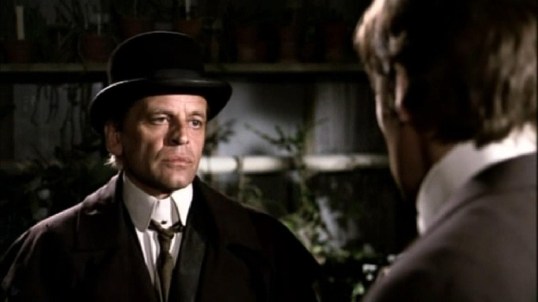
Get Out (2017, dir by Jordan Peele, DP: Toby Oliver)

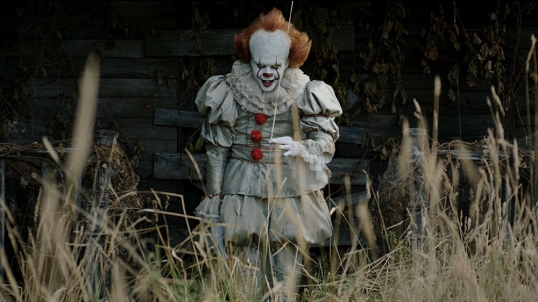
It (2017, dir by Andy Muschietti, DP: Chung-hoon Chung)

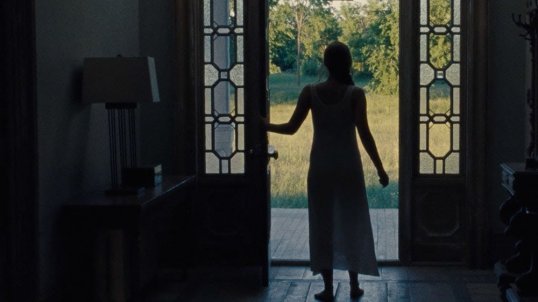
mother! (2017, dir by Darren Aronofsky, DP: Matthew Libatique)

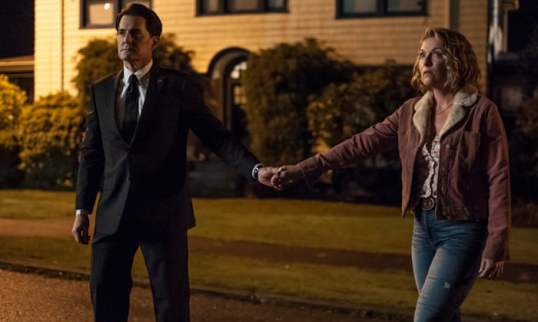
Twin Peaks: The Return Part 18 (2017, dir by David Lynch, DP: Peter Deming)

Horror Film Review: Night of Dark Shadows (dir by Dan Curtis)


Since I just reviewed House of Dark Shadows, it only makes sense to now take a look at 1971’s Night of Dark Shadows today!

While Night of Dark Shadows is not a direct sequel to the first film, it is still definitely a part of the same cinematic universe.  There may not be any vampires in this film but it does take place in the same house and it features two members of the family that was decimated over the course of the previous film.  At one point, it’s mentioned that Joan Bennett’s character from House of Dark Shadows died after the first film but no one goes into any details.  I guess a vampire in the family is something that’s simply not discussed amongst polite company.

Night of Dark Shadows deals with Quentin (David Selby) and Tracy Collins (Kate Jackson).  Quentin is an artist who confesses that he wasn’t particularly nice before he married Tracy.  When they move into the Collins mansion, they bring two friends with them, Alex (John Karlen) and Claire (Nancy Barrett.)  Interestingly enough, Karlen and Barrett both played different characters in House of Dark Shadows.  Grayson Hall, who played Dr. Hoffman in House of Dark Shadows, also returns for Night of Dark Shadows.  This time Hall is playing Carlotta Drake, the creepy housekeeper.  (Needless to say, all mansions comes with a creepy housekeeper.)

Soon after everyone moves in, Quentin starts acting strangely.  He becomes obsessed with the painting of a beautiful woman who was named Angelique (Lara Parker) and with the story that Angelique was hanged when it was discovered that she was having an affair with Quentin’s ancestor, Charles.  (For his part, Charles was apparently walled up in the mansion.  That sounds a bit extreme to me but I guess that’s the way they did things in the 19th century.)  Quentin starts to have visions and nightmares involving his ancestor who, it turns out, looked exactly like him!  Meanwhile, Carlotta and the groundskeeper, Gerard (Jim Storm), seem to be determined to make sure that Tracy doesn’t feel welcome in her new home.  It’s almost as if they’re trying to drive everyone but Quentin away from the house.

Night of Dark Shadows is a much more polished film than House of Dark Shadows but it also unfolds at a far more leisurely pace.  It lacks the relentless energy that distinguished House of Dark Shadows.  This wouldn’t be as much of a problem if the plot itself wasn’t so totally predictable.  From the minute that Quentin first sees that portrait of Angelique, you know that he’s going to get possessed and start acting strangely.  There are a few atmospheric scenes but, for the most part, the film just doesn’t grab the viewer’s attention the way that House of Dark Shadows did.

On the plus side, David Selby is properly intense and brooding in the dual roles of Quentin and Charles Collins while Lara Parker does an equally good job as the wonderfully evil Angelique.  Grayson Hall, who tended to go overboard in House of Dark Shadows, gives a much better and far more menacing performance here.  Night of Dark Shadows isn’t a bad film.  It’s just not a particularly memorable one.

Horror Film Review: House of Dark Shadows (dir by Dan Curtis)


There’s a lot that you can say about this vampire film from 1970 but I think it can all be summed up with one word: relentless.

A lot of this is because House of Dark Shadows is a film adaptation of a daytime drama.  Over the course of six sesons, Dark Shadows ran for a total of 1,220 episodes.  That’s a lot of story to cram into a 97-minute film but director Dan Curtis does just that.  The end result is an incredibly busy film and I mean that in the best way possible.

Seriously, there are so many twists and turns in this film’s plot that it’s difficult to even know where to begin.  This is one of the most incident-filled horror films that I’ve ever seen.  No sooner does one plotline resolve itself than another begins.  Meanwhile, a surprisingly large cast wanders through the shadows and tries not to get transformed into a vampire.  Most of them do not succeed.

See if you can keep all of this straight:

In Maine, a lowlife handyman named Willie (John Karlen, giving the film’s best performance) breaks into a mausoleum and approaches a coffin that’s covered with chains.  Willie thinks that there’s a treasure hidden in the coffin but, after he removes the chains, he instead discovers that he’s stumbled across the home of a vampire!  Barnabas Collin (Jonathan Frid, who perfectly combines old world manners with thinly veiled menace) has spent 175 years trapped in that coffin and now that he’s been released, he’s not in a very good mood.

Soon, Barnabas has introduced himself to his descendants (including Joan Bennett, as Elizabeth, the family matriarch) as a cousin from England.  Everyone is impressed with Barnabas’s charm and courtly style.  Of course, some people are a little bit skeptical.  Prof. Stokes (Thayer David) notices that Barnabas doesn’t seem to know much about London while Dr. Hoffman (Grayson Hall) flat out accuses Barnabas of being a vampire.  Barnabas admits that this is true but fear not!  Dr. Hoffman’s fallen in love with him and wants to help cure him.

Meanwhile, everyone in town is growing concerned about all of the bloodless bodies that are showing up.  They especially get worried after Elizabeth’s daughter, Carolyn (Nancy Barrett), dies and then promptly comes back to life, complete with her own set of fangs….

While the town concerns itself with what to do about Carolyn, Barnabas has fallen in love with a nanny named Maggie (Kathryn Leigh Scott), who he thinks is the reincarnation of his former lover.  Unfortunately, Maggie already has a boyfriend named Jeff (Roger Davis) but when has the ever been a problem for a vampire?  Far more of a problem than Jeff is the fact that Willie is also in love with Maggie and Dr. Hoffman is so jealous of Barnabas’s love for Maggie that she’s willing to inject him with a formula that causes him to transform into an elderly man….

And all that’s just in the first hour!

Needless to say, it all leads to one final, gore-filled confrontation.  When I say that this film is gory, I mean just that.  Blood isn’t just spilled in House of Dark Shadows.  Instead, it flows like water busting out of a cracked dam.  When Barnabas bites a victim, he doesn’t just leave two neat little puncture marks.  Instead, he literally rips their neck to shreds.  Just how savage Barnabas and Carolyn get in this film is one of the things that sets House of Dark Shadows apart from other vampire films.  As opposed to the type of tragic figure who shows up in so many vampire films, Barnabas is ruthless, cruel, and unforgiving.  He’s a genuinely frightening creation.

House of Dark Shadows is a chaotic movie but it’s also a lot of fun.  This is one of those films that you watch in amazement as it just keeps going and going, piling on one incident after another.  Does the film always make sense?  No, but it doesn’t have to.  Quickly paced and featuring nonstop gore and fog, the film has a dream-like feel to it.  Curtis and the cast attack the material with such unbridled enthusiasm that it doesn’t matter if the plot occasionally doesn’t always add up or if the dialogue is occasionally a bit clumsy.  It’s impossible not to get swept along with the film’s insanity.

Probably because of its television roots, House of Dark Shadows is often dismissed by critics.  (I’ve never seen any old episodes of the show so I can’t say how the movie compares to it.)  Well, those dismissive critics are wrong.  House of Dark Shadows is one of my favorite vampire films and it’s definitely one that deserves to be rediscovered.

(And yes, it’s a helluva lot better than that movie that Tim Burton made with Johnny Depp….)

Live Tweet Alert: Join #FridayThrillerClub, #FridayNightFlix, and #FridayHeretics For An Epic Live Tweet


As some of our regular readers undoubtedly know, I am involved in a few weekly live tweets on twitter.  I host #FridayNightFlix every Friday, I co-host #ScarySocial on Saturday, and I am one of the five hosts of #MondayActionMovie!  Every week, we get together.  We watch a movie.  We tweet our way through it.

Tonight, I will filling in for Matthew Titus and hosting #FridayThrillerClub and #FridayHeretics as well!  So, that’s going to be three live tweets in a row.  What are we going to be watching?  I’m glad you asked.

#FridayThillerClub starts at 7:30 pm et with 1987’s Angel Heart!  Mickey Rourke is a detective.  Robert De Niro is a very special client.  This atmospheric and controversial mix of noir and horror was directed by Alan Parker!

#FridayNightFlix follows at 10 pm et, with 1981’s Full Moon High!  In this comedy, a teen becomes a werewolf!  You might even say that he’s a …. teen wolf!

Then, at 12:30 am et, it’s time for #FridayHeretics!  This week’s film will be 1976’s Burnt Offerings, starring Oliver Reed, Karen Black, Bette Davis, and a house that just want stop killing.

All three of these films are on Prime and everyone is invited to join us on twitter for tonight’s epic three-part live tweet!

See you there!

Horror on the Lens: The Last Man on Earth (dir. by Ubaldo Ragona and Sidney Salkow)


Hi there and Happy October 28th!  For today’s treat from the ranks of horror films that have fallen into the public domain, I present to you one of the most important films in horror history.  Though it wasn’t appreciated when it was first  released back in 1964, The Last Man On Earth was not only the 1st Italian horror film but George Romero has also acknowledged it as an influence on his own Night of the Living Dead.

It’s easy to be a little bit dismissive of The Last Man On Earth.  After all, the low-budget is obvious in every scene, the dubbing is off even by the standards of Italian horror, and just the name “Vincent Price” in the credits leads one to suspect that this will be another campy, B-movie.  Perhaps that’s why I’m always surprised to rediscover that, taking all things into consideration, this is actually a pretty effective film.  Price does have a few over-the-top moments but, for the most part, he gives one of his better performances here and the black-and-white images have an isolated, desolate starkness to them that go a long way towards making this film’s apocalypse a convincing one.  The mass cremation scene always leaves me feeling rather uneasy.

The film is based on Richard Matheson’s I Am Legend and no, it’s nowhere as good as the book.  However, it’s a lot better than the Will Smith version.

If you have 87 minutes to kill, please enjoy The Last Man On The Earth.