In this work of Interactive Fiction, you take on the role of someone who has just lost their fiancé. You are in mourning and trying to figure out how you can go on with your life even though you’ve lost your reason for living. Staying at home doesn’t help. Going to work doesn’t help. Seeing a therapist doesn’t help. Religion has failed. Group therapy provides only momentary relief.
Then, you find an envelope, addressed to you and in her handwriting. You find the envelope under a park bench that the two of you used to frequent. Unable to open it, you leave it on the mantle next to the wedding invites that you’ll never get to send. (Come on, that’s a powerful image.) Sometimes, the ink on the envelope seems to move, as if the envelope itself is alive. Will you find the courage to open the envelope and see what is inside?
Ink is an enigmatic but intriguing work of Interactive Fiction. I would hesitate to call it a game. It’s a short story that comes with a few options. You can try to make different choices each time that you play but it seems like the story is fated to always reach the same conclusion, no matter how many detours you try to take. The letter, much like mourning, cannot be escaped no matter how much you try. The story is well-written and captures the feeling of being in deep mourning. The inescapable ending carries enough of a kick to stick with you afterwards.
Today’s horror scene that I love comes from one of my favorite films, 1953’s Creature From The Black Lagoon. In this scene, Julia Adams goes for a swim. Little does she realize that, under the water, the Creature is following her every move. Wonderfully directed by Jack Arnold, this creepy yet oddly lovely scene is one of the best of the 50s.
The notorious Dr. Orloff is dying. Orloff was the lead character in director Jess Franco’s The Awful Dr. Orlof. (The spelling of Orlof’s last name changes from film to film.) In the first film, Orlof (played with maniacal relish by Howard Vernon) was a father driven mad by his daughter’s disfigurement. With the help of his mute servant, he murdered women so that he could perform skin transplants in order to give his daughter back her beauty. In Dr. Orloff’s Monster, Dr. Orloff is a more of a generic mad scientist and he is now played Javier de Rivera. Knowing that his time is running out, Orloff passes along his secrets to one of his disciples, Dr. Conrad Jekyll (Marcelo Arroita-Jáuregui).
(In the dubbed American version of the film, Dr. Jekyll’s name is changed to Dr. Conrad Fisherman.)
Dr. Jekyll returns to his own remote Austrian castle. He’s soon joined by his innocent niece Melissa (Agnes Spaak). Melissa is searching for her father, Andros (played by Hugo Blanco). What she doesn’t know is that Dr. Jekyll earlier caught Andros in bed with Jekyll’s wife, Inglud (Luisa Sala). Jekyll murdered Andros. This led to Inglud becoming an alcoholic.
However, thanks to the teachings of Dr. Orloff, Jekyll knows how to bring Andros back to life. Unfortunately, the reanimated Andros is a hulking monster who Conrad uses to kill all of his former mistresses. It turns out that Inglud wasn’t the only one who had trouble sticking to marriage vows. Soon, Inspector Klein (Pastor Serrado) is investigating a growing number of nightclub-related murders. Inspector Klein is also falling in love with Melissa, which has the potential to make things more than a bit awkward.
Dr. Orloff’s Monster (which is also known as The Mistresses of Dr. Jekyll) was Franco’s first sequel to The Awful Dr. Orlof and it was also the tenth film that was he was credited with directing. (As Franco was a prolific filmmaker who used a huge amount of pseudonyms and whose films were often released under several different titles, we will probably never have a definite answer on how many films he actually directed over the course of his long career.) Particularly when compared to Franco’s later films, Dr. Orloff’s Monster seems rather restrained. As always with Franco, there’s a bit of nudity and an emphasis on murder but the violence is rather bloodless and the usual Franco perversions are hinted at without being explicitly shown. Instead, with this film, Franco emphasizes atmosphere over shock. The black-and-white cinematography creates the feel of a perfect noir, with Andros emerging from the shadows to attack his victims and then retreating back into the darkness. This, along with a deliberate pace and Franco’s frequent use of close-ups, gives Dr. Orloff’s Monster the feeling of a languid but menacing dream. With this film, Franco fills the screen with nightmarish ennui.
Unfortunately, the film suffers due to the absence of Franco’s usual villain, the great Howard Vernon. Vernon always brought a hint of old world decadence to his performances and the rather bland Marcelo Arroita-Jáuregui is simply not as interesting as Dr. Jekyll. Despite his death at the start of the film, Dr. Orloff would appear in other Franco films and, fortunately, Howard Vernon would return to play him.
With the arrival of both October and our annual horrorthon, today’s Blast From The Past is here to help us get in the mood with some head action.
In this short film, director Georges Milies plays a magician who can remove his head. Fear not! When he removes his head, another head quickly appears on his shoulder. Pretty soon, our magician has one head on his shoulders and three other heads chatting away on a table. Everything’s fine until it’s discovered that, apparently, the heads aren’t very talented when it comes to singing.
Obviously, today, we know how camera tricks like this are done. We tend to take them for granted. But consider this, when watching The Four Troublesome Heads: this film was made in 1898. At a time when the movies themselves seemed like an act of magic, Georges Melies was removing his head and then trying to perform a song.
Yes, this the same Georges Melies who was played by Ben Kingsley in Martin Scorsese’s Hugo. That’s a great film, by the way. It marks the only time that Christopher Lee appeared in a Scorsese film. Go watch it, if you haven’t already.
4 Or More Shots From 4 Or More Films is just what it says it is, 4 shots from 4 of our favorite films. As opposed to the reviews and recaps that we usually post, 4 Shots From 4 Films lets the visuals do the talking!
This October, I’m going to be doing something a little bit different with my contribution to 4 (or more) Shots From 4 (or more) Films. I’m going to be taking a little chronological tour of the history of horror cinema, moving from decade to decade.
Today, we take a look at the mid-50s!
4 Shots From 4 Horror Films: The Mid 50s
Creature From The Black Lagoon (1954, dir by Jack Arnold, DP: William E. Snyder)
Tarantula (1955, dir by Jack Arnold, DP: George Robinson)
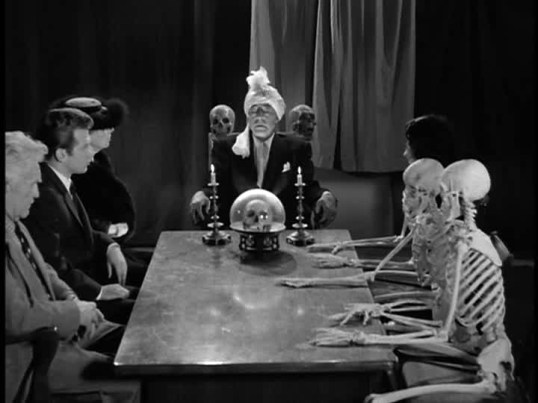
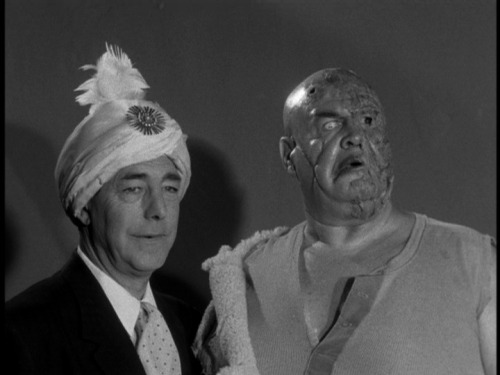
Bride of the Monster (1955, dir by Ed Wood, DP: Ted Allan and William C. Thompson)
It Conquered The World (1956, dir by Roger Corman, DP: Fred E. West)
A few months ago, I rewatched the original 1988 Child’s Play.
I have to say that I was surprised by just how well the film held up. Today, of course, everyone knows about Chucky. Everyone know that Chucky was originally Charles Lee Ray (Brad Dourif), a serial killer who was chased into a toy store by police detective Mike Norris (Chris Sarandon). Knowing that he had little chance of escaping and not wanting to go to back to prison or face the electric chair, Charles Lee Ray performed a quick occult ceremony. While lighting crashed all around the store, Charles transported his soul into a “Good Guy” doll.
That doll was later purchased by a hard-working, single mom named Karen Barclay (Catherine Hicks). She gave the doll to her six year-old son, Andy (Alex Vincent). There was nothing that Andy wanted more for his birthday than a talking Good Guy doll. Unfortunately, Good Guy dolls were also very expensive and Karen wasn’t sure if she’d ever be able to afford to buy one. But, when she ran into a homeless guy who happened to be selling stolen merchandise out of his shopping cart, Karen was able to make Andy’s birthday a happy one! Andy unwrapped the doll and smiled as the doll introduced himself as being “Chucky” and asked if he wanted to play.
Unfortunately, it soon turned out that Charles Lee Ray wasn’t going to stop killing people just because he was now trapped inside the doll. If anything, being trapped in the doll made Ray even more homicidal. It makes sense if you think about it. I’m sure that Charles Lee Ray didn’t realize that performing that voodoo curse would cause him to wake up as a plastic toy wearing overalls and being expected to be a 6 year-old’s best friend.
Anyway, Chucky went on a rampage, killed several people, and everyone blamed Andy. Not even Karen believed Andy when Andy explained that Chucky was the one killing people with toy hammers and blowing up houses. Or, at least, Karen didn’t believe Andy until she herself was attacked by Chucky. With Chucky freaking out about the prospect of being stuck in the doll’s body for the rest of his existence and wanting to possess his new owner instead, Karen and Mike teamed up to protect Andy from the world’s worst birthday present.
To be honest, Child’s Play shouldn’t work as well as it does. The story is ludicrous, even by the standards of late 80s horror. There’s no way that a doll should be able to do things like throw a hammer with enough force to send someone flying out of a window. (Making the scene even stranger is the fact that it’s not even a real hammer but instead a little plastic Good Guy hammer.) And yet, the film does work and not just as an example of nostalgic camp. This is a scary and emotionally effective story, even if you already know the truth about Chucky. It helps that Alex Vincent gives a totally natural, uncutesy performance as Andy. Your heart really breaks for him as he begs the adults in his life to understand that it’s Chucky who is doing all of the bad things and not him. As well, Catherine Hicks deserves a lot of credit for taking her role seriously. And finally, the great Brad Dourif does wonders with just his voice. At first, it’s undeniably funny to hear his angry voice coming out of Chucky but Dourif delivers his lines with such unhinged conviction that it’s actually rather frightening when he suddenly drops the act and starts cursing out Karen. After all of the sequels and the subsequent television shows, Chucky himself has become a bit of a pop cultural icon. He’s almost as lovable as Freddy and Jason combined. But in the first Child’s Play, that doll is seriously scary. He may be small but he has the energy and ruthlessness of a feral beast. When he attacks, you have no doubt that he’s not going to stop until he’s gotten what he wants and what he wants is usually for someone to die.
The first Child’s Play earns its status as a horror classic by being surprisingly scary and also surprisingly emotional. You really do end up caring about Karen and Andy. When Karen finally went after that smug, murderous doll, I definitely cheered a little. Take that, Chucky!
For today’s Horror on the Lens, we have a made-for-TV movie from 1973. As you can tell from the video below, it originally aired as a part of ABC’s Tuesday Night At The Movies so it’s only appropriate that we are also sharing it on Tuesday.
A Cold Night’s Death tells the story of two scientists (Eli Wallach and Robert Culp) who are sent to a remote research station to investigate the apparent disappearance of another scientist. They soon come to suspect that they may not be alone and soon, paranoia rears its ugly head. With its frozen landscape and its ominous atmosphere, this movie feels like a distant cousin to John Carpenter’s The Thing.
Grim Reaper was so hardcore that they ever had Satan himself watching over their concerts!
See You In Hell is probably best remembered for Beavis and Butt-Head’s epic takedown of both the video and the singer.
Unlike certain other musicians — Oh hai, Winger — Grim Reaper was actually a good sport about Beavis and Butt-Head’s mockery. Mike Judge once told David Letterman that one of the scariest moments of his life was when he ran into Grim Reaper’s lead guitarist while backstage at a concert. Judge was expecting the guitarist to be angry with him but instead, he said that the band enjoyed and agreed with Beavis and Butt-Head’s critique. He also sent Judge copies of the band’s other two videos so that the boys could take a crack at them.
On tonight’s episode of Ghost Story, James Franciscus plays a father who discovers that trying to change the future isn’t as cut-and-dried as it seems. When Paul (Franciscus) dreams that his daughter is going to be murdered 20 years in the future, he moves to the town from his dream to try to prevent it. He ends up falling in love with Julie (Meg Foster), who happens to be engaged to man named Ed (Karl Swenson) who looks just like the man who Paul dreamt was going to murder his daughter!
This episode originally aired on September 29th, 1972.